Delight Springs

Showing posts sorted by relevance for query skeptics. Sort by date Show all posts

Monday, September 30, 2019

Nothing matters? I'm skeptical

LISTEN. As late as about 3 pm yesterday I was prepared to declare, on the last day of the 162-game regular major league baseball season, that it didn't matter to me who won the National League Central Division pennant. Then, my team ran the score against the Chicago Cubs up to 9-0. Suddenly I was nine years old again and nothing mattered more. That's how you stay forever young, and reconnect with Trump-loving family members. Is it a cure for overdoing democracy? I believe it just might be.

Pyrrho and the ancient skeptics didn't want us to have beliefs, but also somehow wanted us to believe (or entertain the notion?) that "nothing matters" -- or so we're told in our CoPhi chapter on them. But would it matter, if nothing matters? This is no deep paradox, just a shallow confusion. But it makes for good animated satire.

Philosophy Matters (@PhilosophyMttrs)
Nothing Matters Part 2: Rick and Morty and Nietzsche ... buff.ly/2yavB9d

In any event, much matters. The late Christopher Hitchens' statement about nihilism and meaning matters to me:
A life that partakes even a little of friendship, love, irony, humor, parenthood, literature, and music, and the chance to take part in battles for the liberation of others cannot be called 'meaningless' except if the person living it is also an existentialist and elects to call it so. It could be that all existence is a pointless joke, but it is not in fact possible to live one's everyday life as if this were so. Hitch-22 [10.4.18... More old "skeptics" posts]
==
But enough of skeptics and nihilists, I want to think instead of Josiah Royce and his 1892 Spirit of Modern Philosophy. It so earnestly affirmed that life and ideas matter, and that philosophy is the discipline most directly devoted to their articulation, that it would never have occurred to me back in 1978, when I first picked it up as a green undergrad (when green still just meant naive and uninstructed), to give either nihilism or extreme Pyrrhonic skepticism a moment's consideration. It helped me, back then, to imagine I had a clue of what the German pre-Heglian metaphysical idealists Fichte and Schelling were up to, with their mystifying talk of the autonomous noumenal self, objective transcendental consciousness, etc. I'm scheduled to share that reconstructed imagination with a gathering of Royce scholars at Vanderbilt in a little over two weeks.  I begin with this text:
No, the philosopher's work is not lost when, in one sense, his system seems to have been refuted by death, and when time seems to have scattered to scorn the words of his dust-filled mouth. His immediate end may have been unattained; but thousands of years may not be long enough to develop for humanity the full significance of his reflective thought.
This early (for undergrad me) statement of the long view, always the best philosophers' reflexive purview, anticipated (I see now in retrospect, looking back) the radically mind-expanding shift of perspective I'd find in The Long Now - the raised-consciousness commitment to deep time as ours, in our present, and the eponymous Stewart Brand-led foundation that's been raising consciousness and ethical acuity with projects like the Clock of the Long Now The concept of a 10,000 year clock, meant to symbolize and motivate the long-term thinking we need to break our cycle of addiction to unsustainable short-sighted consumerism, was Danny Hillis's idea. Announcing it in Wired in the millennial year 01995, in the spirit of Royce's Spirit of Modern Philosophy, he professed:
I cannot imagine the future, but I care about it. I know I am a part of a story that starts long before I can remember and continues long beyond when anyone will remember me. I sense that I am alive at a time of important change, and I feel a responsibility to make sure that the change comes out well. I plant my acorns knowing that I will never live to harvest the oaks.
I have hope for the future. 
Of course, as Greta Thunberg has reminded us, you can't just hope. You have to earn it. You have to do something.


Thursday, January 26, 2023

Skeptics

An old post...


Good citizens are skeptics of the moderate, non-Pyrrhonic sort. They think critically, they call out false beliefs rooted in pseudoscience and superstition. They seek truth, facts, and reality. And they do it with humility, kindness, and compassion.

Carl Sagan was a good citizen.
I worry that, especially as the Millennium edges nearer, pseudoscience and superstition will seem year by year more tempting, the siren song of unreason more sonorous and attractive... The candle flame gutters. Its little pool of light trembles. Darkness gathers. The demons begin to stir. Carl Sagan, 1996
==
Today in CoPhi it’s skeptics. Or sceptics, if you prefer the British spelling. Or you can follow their lead and refuse to commit. “Don’t commit, and you won’t be disappointed.”

I haven’t generally found that to be a reliable guidepost in life, instead taking my cue from the lesson James’s “first act of free will” (noted last time) seems to me to teach: don’t just sit there, stand and select a destination. And get going. As my old pal the [now-retired] Carolina prof says, do something – even if it’s wrong. And as James also said, “our errors surely are not such awfully solemn things.” Lighten up. Pick a path. Move.

But that’s my therapy, it may not be yours. Some of us really do prefer sitting on a fence, avoiding firm opinions, keeping all accounts open. And there’s no doubt, a healthy dose of skepticism is good for you. But how much is too much?

My answer is implied by the bumper sticker message on my bulletin board: “even fatalists look both ways before crossing the street.” If you stop looking, you’re either too skeptical or not skeptical enough. Probably a lunatic, too. Or the ruler of the universe. “I say what it occurs to me to say when I think I hear people say things. More I cannot say.”

Point is, we need beliefs to motivate action lest we sit and starve like Buridan‘s ass, or cross paths with a cart and get flattened. Prudence demands commitment. Commitment is no guarantee against error and disappointment, but indifference and non-commitment typically leave us stuck in the middle of the road or drop us off the cliff.

That wasn’t Pyrrho‘s perspective, jay- and cliff-walker though he was. Fortunately for him, he seems always to have had friends steering him from the edge. His prescription – but is a skeptic allowed to prescribe? – was to free yourself from desires, don’t care how things will turn out, persuade yourself that nothing ultimately matters, and you’ll eventually shuck all worry. Or not. If we all were Pyrrho “there wouldn’t be anyone left to protect the Pyrrhonic Sceptics from themselves.” Prudence wins again.

Prudence and moderation. “The point of moderate philosophical scepticism is to get closer to the truth,” or further at least from falsehood and bullshit. Easier said than done, in these alt-fact days of doublespeak. “All the great philosophers have been [moderate] sceptics,” have sought truth and spurned lies, have deployed their baloney detectors and upheld the bar of objective evidence. Sincerity alone won’t cut it.

The contemporary proliferation of bullshit also has deeper sources, in various forms of skepticism which deny that we can have any reliable access to an objective reality and which therefore reject the possibility of knowing how things truly are. These anti-realist doctrines undermine confidence in the value of disinterested efforts to determine what is true and what is false, and even in the intelligibility of the notion of objective inquiry… Facts about ourselves are not peculiarly solid and resistant to skeptical dissolution. Our natures are, indeed, elusively insubstantial-notoriously less stable and less inherent than the natures of other things. And insofar as this is the case, sincerity itself is bullshit.
So, be a skeptic. But to paraphrase David Hume and Jon Batiste, stay human. (“Be a philosopher, but amidst your philosophy be still a man.”)

Read Skeptic magazine, which in the latest issue doubts the possibility of eternal youth and features the parodic perspective of Mr. Deity. [The latest issue is actually about nationalism.] Skeptic’s editor Michael Shermer says “Smart people believe weird things because they are skilled at defending beliefs they arrived at for non-smart reasons.” And, “I’m a skeptic not because I do not want to believe, but because I want to know.”

Pyrrho must not have been that crazy, to have lived to nearly ninety. “He did not act carelessly in the details of everyday life,” said a defender, he just suspended judgment as to their ultimate import in the larger truths of things. Or maybe he just wanted to protect his batting average, so to speak. If you never swing, you’ll never miss. But you’ll still strike out if you take too many.

David Hume, again. He was a skeptic but he didn’t let that interfere with living. He ventured opinions but couched them in philosophic humility. He knew we couldn’t all be Pyrrho, for “all action would immediately cease” and “the necessities of nature” would “put an end to [our] miserable existence.” Miserable? He must have been having a bad day. Generally he was of great cheer and humane disposition.

So let’s not throw in the sponge on humanity just yet. What a strange expression, “throwing in the sponge”-it comes from the Roman Skeptic Sextus Empiricus, who told a story about a painter who stopped trying so hard to paint the perfect representation of a horse’s mouth and discovered that sometimes it’s best to just let fly. Fling your sponge, let it land where it may. Okay, if you’re just painting. If you’re living a life, though, maybe just a bit less skepticism is prudent.

Is it possible to go through life questioning and doubting everything, committing always to nothing, and holding no firm opinions? Is it desirable or useful to try doing so? And do you know anyone who doesn’t look both ways before crossing the street?

10.11.17

Tuesday, August 27, 2019

Opening Day part 2

Get to meet another section of CoPhi today, followed by Happiness. LISTEN

In Philosophy of Happiness we'll commence our inquiry into the ancient "Graceful-life" philosophies, especially my favorite: Epicureanism.

But we'll also consider Stoicism, Cynicism, and Skepticism.

As Jennifer Michael Hecht says in The Happiness Myth,
Ancient ideas of knowing yourself were about coming to be a better person. The process was psychological, but more in the realm of conditioning one's mind than in finding out why the mind does what it does. Marcus Aurelius said, "Cast away opinion and you are saved. Who then hinders you from casting it away?" Can we really control our emotions by decision? The best of the ancient writers, including Aurelius, acknowledged that we could not do it, and with a smile and a shrug provided exercises for teaching ourselves to improve what self-control we have. That's what religion and graceful-life philosophies are doing with their rituals and their meditations: teaching us to wake up to ourselves, for the sake of happiness. Not all philosophy overtly calls for ritual meditation. For instance, epistemology, the study of how we know things, and eschatology, the study of how things end, involve conceptual investigation. But some philosophies, throughout history, have been about how we should live. Much life advice comes as part of a particular religion or politics. To indicate a philosophy primarily concerned with advice for living, I use the term "graceful-life philosophy." The important ancient ones were Epicureanism, Stoicism, Cynicism, and Skepticism, and the term is also useful for referring to the work of the Renaissance thinker Montaigne, and of any modern thinker who offers secular, philosophical arguments for how individuals should best live their lives. . . LISTEN
My own view is that  happiness is best pursued somewhere on the road between the stoics and epicureans, with an edge going to the latter. "The Stoics cared about virtuous behavior and living according to nature, while the Epicureans were all about avoiding pain and seeking natural and necessary pleasure." (Daily Stoic)

They were both right. But I think Epicureans have more fun, and are less likely to disengage from life's more pitted challenges-like the battle against mortality. Of course that's one we'll all lose in the end, but who knows when that will be? The brevity of life is no matter of indifference to me.

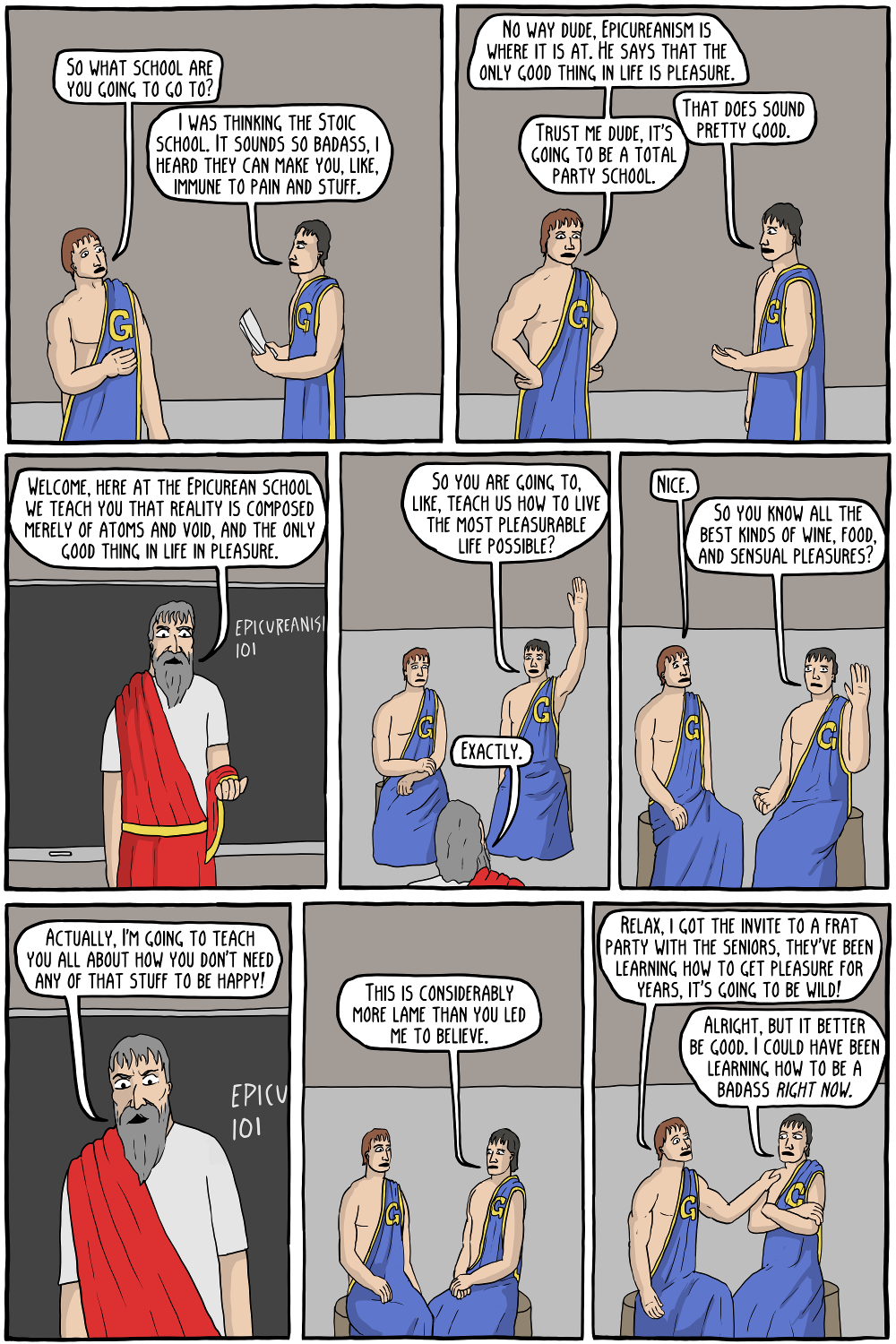
Image result for stoic epicurean cartoon

Epicureanism: the original party school

Also, we know Thomas Jefferson was no Saint. But he was an Epicurean... and sort of a Stoic too. He pursued happiness and (says Maira Kalman) everything.
"Before he attained domestic happiness he had probably worked out his enduring philosophy of life; it was marked by cheerfulness not gloom, and he afterwards described it as Epicurean, though he hastened to say that the term was much misunderstood. He came to believe that happiness was the end of life, but, as has been said, he was engaged by the "peculiar conjunction of duty with happiness"; and his working philosophy was a sort of blend of Epicureanism and Stoicism, in which the goal of happiness was attained by self-discipline." Dumas Malone, Jefferson the Virginian
And as for cynics and skeptics:

Most philosophers are moderate (not extreme) skeptics: their default mindset is to doubt and question what "everybody knows," so that truth, facts, and reality may emerge. George Santayana said skepticism is the chastity of the intellect, and you should guard it. But don't get stuck in doubt, like this guy (who very much resembles my dog Pita) on my desk at home. (Did you know, btw, that "cynic" means doglike?)


Also, don't get stuck in epicurean hedonism, stoic resignation (Stoic Pragmatists understand this), or cynical impropriety. You'll be happy not to live in a barrel or under a cloud.


Thursday, August 29, 2019

More Epicurean (etc.) happiness

LISTEN. Following up on our first Happiness class discussion of Epicureans, Stoics, Skeptics, & Cynics Tuesday, here's an old post on Jennifer Michael Hecht's discussion of graceful-life philosophies...

Hecht @home


Jennifer Hecht contributes a weekly post to “The Best American Poetry” blog, ranging over all kinds of topics including happiness and atheism. Take a look.

She noted recently, at the passing of People’s Historian Howard Zinn (who inspired both impassioned admiration and criticism), that he blurbed Doubt.
And check out her musings on “poetic atheism“: How strange to find our little thinking and blinking faces amid a universe that is for the most part not alive at all. Believers say,  “If this weirdness is true, why not believe angels,” but adding nonsense is not helpful.

Hecht is one of the breed of kinder, gentler atheists, like Rebecca Goldstein (of whom a reviewer writes: “Whether or not God exists, in moments of transcendent happiness we all feel a love beyond ourselves, beyond anything. [She] doesn’t want to shake your faith or confirm it”).
Neither shaking nor confirming? Sounds agnostic, though it may simply be “doubtful” and pluralistic. In any case, she has a rich and largely-neglected story to tell. The New Atheists stand on the shoulders of giants. Atheism is not new.

About those Greeks…
Hecht really sheds fresh light, in Doubt: a historyon the naturalizing impulse of the pre-Socratic and Hellenic thinkers. For instance, Democritus (the beautiful regularity of the universe was neither created nor maintained by the guiding intelligence of a god), the Cynics (Diogenes‘ advice is that we stop distracting ourselves with accomplishments, accept the meaninglessness of the universe, lie down on a park bench and get some sun while we have the chance)and Stoics (feeling a part of the community of the universe) and Epicureans (there are no ghostly grownups watching our lives and waiting to punish us… we might as well make an art of appreciating pleasure… in this beautiful moment one is alive) and Skeptics (I do not lay it down that honey is sweet but I admit that it appears to be so), with fresh slants on Socrates (among those great minds who actually cultivated doubt in the name of truth) and Plato (whose form of the Good has been illicitly conflated with God for two millennia).
What I like most in her section on Greek doubt (or as I prefer, Greek spirit): the forest metaphor, which offers the most timeless but (in an age of restless spiritual “cherry [*berry?]-picking”) also timely wisdom: The experience of doubt in a heterogeneous, cosmopolitan world is a bit like being lost in a forest… we could stop being lost if we were to just stop trying to get out of the forest. Instead, we could pick some *blueberries, sit beneath a  tree, and start describing how the sun-dappled forest floor shimmers in the breeze. The initial horror of being lost utterly disappears when you come to believe fully that there is no town out there, beyond the forest… Hang a sign that says HOME on a tree and you’re done; just try to have a good time.

As Epicurus realized, it is accepting the finality of death that makes it possible to enjoy the pleasures of the garden. This is a very different garden than the one we got kicked out of in the Eden story. This time you have to eat from the tree of knowledge to get in.

That’s James and Sagan redux: at home in the universe, at ease with the human condition.
==
And, another old post that may be worth pondering today...

Back to Pyrrho and Epicurus... but first a quick follow-up on Plato and Aristotle. Check out this version of School of Athens.

As for Aristotle’s eudaimonia, in some ways it anticipated Epicurus’s garden and what Jennifer Michael Hecht calls “graceful-life philosophies” that proclaim in all simplicity: “we don’t need answers and don’t need much stuff, we just need to figure out the best way to live.” Then, and only then, will we be happy.

As for Pyrrho: If you’d asked him Who rules the Universe?, he might have replied: Lord knows. Cats, again. And pigs.
pig 

Reminding us of Pyrrho’s famous pig, who impressed Montaigne by riding out a storm at sea with much greater equanimity (and, crucially, much less comprehension) than his human shipmates, and of J.S. Mill’s declaration that it’s “better to be a human dissatisfied than a pig satisfied,” Hecht comments: “This whole pig-versus-philosopher debate is pretty hilarious, yes?”

Yes. But I agree with Spinoza and Hecht. “The happiness of a drunkard is not the happiness of the wise,” though of course there are happy occasions when it has its place too. Bottom line: “Knowledge and wisdom are worth it,” it can be everything to have found true love and meaningful work, and both– all-- can end in a flash, without warning. Stay on your toes, but don’t fret too much about the storm.
piranha
One more little animal image for Pyrrho, whose name I prefer to pronounce compatibly with this mnemonic trick: just remember that a pyrrhonic skeptic is like a piranha fish, toothily devouring every proposed candidate for belief. Cats and pigs too, probably.

And as for Epicurus, Jennifer Hecht‘s got his number. It’s listed.
For an Epicurean, somewhere there are beings that are truly at peace, are happy… The mere idea of this gentle bliss is, itself, a kind of uplifting dream. After all, we human beings know a strange thing: happiness responds to circumstances, but, basically, it is internal. We can experience it when it happens to come upon us; we can induce it with practices or drugs; but we cannot just be happy.

No, we must work to “solve the schism” between how we feel and how we want to feel. Happiness is a choice and a lifetime endeavor, and though it comes easier for some than for others there are tips and tricks we can use to trip our internal happy meters and achieve ataraxia, peace of mind, simple contentment, “tranquillity, or the freedom from disturbance and pain that characterizes a balanced mind and constitutes its first step toward the achievement of pleasure.”

Stop fearing the harmless and remote gods, Epicurus said. Stop fearing your own death, it’s not (as Wittgenstein would echo, millennia later) an event you’ll ever experience. “Life is full of sweetness. We might as well enjoy it.”

*Sissela Bok calls Epicurus a hedonist, but that's only technically correct. Yes, he said pleasure's at the heart of happiness. But what kind of pleasure?

A happy life is tranquil, simple, loving, and above all free from pain, fear, and suffering, available to all regardless of social status, nationality, or gender. Such a life of pleasure, Epicurus held, would of necessity have to be a virtuous one; ...


That’s Alain de Botton, author of a text I used to use in this course, and controversial proponent of religion for atheists. (Don’t confuse him with Boethius.) His interview with Krista Tippett was instructive. Like Jennifer Hecht, he wants us to use philosophy to enhance our bliss and sweeten our dreams.

Pyrrhonian deep skepticism and moral/cultural relativism share a common root. Simon Blackburn voices the right reply to those who say we can function without beliefs, or without discriminating between better and worse beliefs, when he points out that this is simply impractical and socially dysfunctional. Not only might you get run over by a racing chariot or step off a cliff, you also scatter seeds of discord within your community and perhaps even your family.

So I too “would defend the practical importance of thinking about ethics on pragmatic grounds.” To pretend  with “Rosy the Relativist” that we can all simply have and act on our own truths, our own facts, without confronting and negotiating our differences and critically evaluating our respective statements of (dis)belief, really is “farcical.” Lord knows.

I’ve been thinking some more, btw, about a student’s question whether Oprah is a philosopher. I’d say she has philosophical moments, sometimes asks the hard questions, and is indeed seeking to have and share a “graceful” (if opulent) life. So, sure. Same for the poets (like Whitman) who let us off the hook for contradicting ourselves (“I contain multitudes.”) I don’t think the Philosophy Club should be exclusive or restrictive. Many of my colleagues would disagree, amongst themselves, at their annual association meetings and in their ivory towers. They’ll never give me a car, either.

Anyway: we won’t suffer a meaning deficit, though, if we live simply and naturally in the company of friends who’ll help us conquer our fears and address our many questions about life, the universe, and everything. That’s the Epicurean way, when we decide nature’s already provided enough for our peace of mind and our contentment. That’s ataraxia.

So finally there are these dots, connecting Epicurus and Pyrrho:
Epicurus, though no friend to skepticism, admired Pyrrho because he recommended and practiced the kind of self-control that fostered tranquillity; this, for Epicurus, was the end of all physical and moral science. Pyrrho was so highly valued by his countrymen that they honored him with the office of chief priest and, out of respect for him, passed a decree by which all philosophers were made immune from taxation.

Tranquility and a free ride: now that would make me happy. A free ride to the APA, not so much.
==
More oldies on this theme: Happily home... Safe at home... The triumph of experience... "Brave thinking about truth is the secret to happiness"

Monday, October 1, 2018

Skeptics

LISTEN: Skeptics

That's the topic today in CoPhi...

It's October! I'm never skeptical about the MLB postseason, which gets a jumpstart with a pair of one-off pre-playoff tiebreakers today. No doubt about it. Go Cubs & Rockies.

Nor am I ever skeptical about Younger Daughter's visits, which usually include fine dining. Pie season's here! And the food truck dining was good at Good Neighbors Day on Saturday in Richland Park. Pulled pork makes a strong nonethical case against veganism, I'm afraid.

As for skepticism, I'm increasingly drawn to the Ruler of the Universe's version. "I say what it occurs to me to say when I think I hear people say things. More I cannot say."

Say no more? Doubtful.

Thursday, September 23, 2021

More than happiness

LISTEN. Who could ask for anything more? Cards have now won eleven in a row. I want twelve. 

Stoics and Buddhists, according to our new author in Happiness today, want more. But more what? More life? More time? More equanimity? More acceptance? Just more, says Thor. "I just think that’s what being a New Yorker is all about, being hungry for more," says the star hurler with the high school education who is also "a  multidimensional human being with feelings and problems and goals outside of sports."

 More Than Happiness: Buddhist and Stoic Wisdom for a Sceptical Age is Antonina Macaro's contribution to the growing body of literature commending "mindfulness" and (in the blurbed words of secular Buddhist Stephen Batchelor) "the pragmatic and therapeutic dimensions of philosophy." 

Owen Flanagan is another secularist who finds natural wisdom in Buddhism. Robert Wright (Why Buddhism is True) too. “Ultimately, happiness comes down to choosing between the discomfort of becoming aware of your mental afflictions and the discomfort of being ruled by them.” Wright and Stoic resurrector Massimo Pigliucci agree that Buddhists and Stoics like Marcus Aurelius come to similar conclusions "from a different metaphysical starting point."

“Think, remind yourself every time do you have a problem, every time you have an issue with other people, remind yourself of the big picture. You think about the extent of time, think about the extent of space, and the part that you are within it, and you will see that, (a) your particular concerns are actually not that important, but also, (b) that you are connected to everything else and that therefore the rational thing to do for you as a human being is to try to do your best to improve society at large."
“The Four Noble Truths are pragmatic rather than dogmatic. They suggest a course of action to be followed rather than a set of dogmas to be believed. The four truths are prescriptions for behavior rather than descriptions of reality. The Buddha compares himself to a doctor who offers a course of therapeutic treatment to heal one’s ills. To embark on such a therapy is not designed to bring one any closer to ‘the Truth’ but to enable one’s life to flourish here and now, hopefully leaving a legacy that will continue to have beneficial repercussions after one’s death.” ― Stephen Batchelor, Confession of a Buddhist Atheist

Macaro declares herself neither Buddhist nor Stoic, favoring Aristotle and noting that Epicurus has yet to enjoy a resurgence of interest and attention akin to that lately visited on the Stoics. She notes as well the Stoic connection to Cognitive Behavioral Therapy.

Therapy is of coure the keyword, and the binding thread of most ancient philosophies. Relieving distress and improving the experienced quality of lives was pretty much the entire point. But that's not to say that happiness is the entire point. "Happiness is not everything." But it may be the thing most indicative of whether our therapeutics are working. 

Stoics are not Skeptics, but if there's a significant connection between Stoics and Buddhists it's natural to wonder about the connection between Buddhists and Skeptics too. Was Pyrrho influenced by Buddhists? Committing to firm beliefs about the nature of reality, for instance, seems to have been anathema to both traditions. Not to commit to beliefs, even provisionally and experimentally, is to travel without a map (or gps). It doesn't seem smart. It doesn't seem likely to work, if one of the points of a journey is to arrive at a destination. Or at least approach it. So: is happiness a destination, or a journey?

Well it's both, isn't it? So shouldn't we want more reliable maps, more accurate satellite positioning, more stable infrastructure of all kinds, smooth roads and clear skies and plenty of pleasant diversions along the way? And more charging stations for our more efficient and eco-friendly vehicular conveyances?

Lots of metaphors to unpack, then, on the road to less suffering and more happiness.  Will metaphysics help or hinder? Will god-talk? James said his religious act was to defend experience against "philosophy," and that in general the religious impulse for most of us is driven not by a yearning for that sort of transcendence. What do Buddhists and Stoics think about that?

And what do they think about Nabokov's "common sense" view of our predicament, our "cradle above the abyss," our "brief crack of light between two eternities of darkness"?  What do we?

I think Humbert-squared's creator was on to something uncommonly acknowledged, with those stark images. As was the Venerable Bede, which is why this was our wedding scroll:

“The truest vision of life I know is that bird in the Venerable Bede that flutters from the dark into a lighted hall, and after a while flutters out again into the dark...It is something--it can be everything--to have found a fellow bird with whom you can sit among the rafters while the drinking and boasting and reciting and fighting go on below; a fellow bird whom you can look after and find bugs and seeds for; one who will patch your bruises and straighten your ruffled feathers and mourn over your hurts when you accidentally fly into something you can't handle." --Wallace Stegner, The Spectator Bird

Contrary to the popular notion of cold dispassionate Stoics and monkish meditating Buddhists, then, we'll treasure human connection above all, if we truly seek a life of more happiness. We'll value community, we'll work on relationships, we'll want to leave a legacy. We'll care about what life is going to be like here, after we're gone.

And in the words of the late psycho-novelist Irvin Yalom, we'll learn to "temper the anguish of our finitude" in the face of life's brevity, fragility, and beauty. We'll realize the rainbow wisdom that "we are going to die, and that makes us the lucky ones..."

We'll ride our winning streaks. Life brings suffering, of course, lots of it. But it also brings pleasure and joy. Happy people get this. And they want more.

Saturday, May 14, 2016

Grit in the glass

The Stoics and Skeptics are glass-half-empty people, a lack-centered disposition and temperament not to my taste. But they're also be calm and  carry on people of perseverance and grit. That deserves a lot of credit.

“Begin each day," advises Aurelius, "by telling yourself: Today I shall be meeting with interference, ingratitude, insolence, disloyalty, ill-will, and selfishness – all of them due to the offenders’ ignorance of what is good or evil.”  I don't endorse that - we've all had many better days, better meetings - but I do admire the proactivity, the advance work, and the charity of the assumption that even the most obnoxious people are doing the best they know how to do.

“The happiness of your life depends upon the quality of your thoughts.” True, and on the quality of the thoughts of others whose deeds flow from those thoughts. Stoics don't like to talk about that, and the vulnerable mutual dependency it implies, but it's true too. That's why we can't be content to work only on ourselves, and why I can't accept the Stoic proposition that only our respective interiors can be landscaped. We must ameliorate external conditions too, or die trying.

For Schopenhauer, external conditions and inner life alike are wholly controlled by the impersonal, implacable, voracious Will. We can't starve it to death but we can learn to feed it on our schedule, and feed it less.

“It is difficult to find happiness within oneself, but it is impossible to find it anywhere else.” Yes, but the best skeptics know it's imperative to seek it together and in public, and to share our finds. That's why they write books, live with dogs (Schopenhauer's were all called "Atman"), and stay on Earth as long as they can. We must imagine them (the best of them) happy. Glass half empty? I'll have another.

6 am/5:43, 59/63/43, 7:43

Monday, May 16, 2016

The cynical solution

You don't realize how much stuff a college dorm can hold until you have to empty it. Took about four hours of schlepping between dorm room and two packed-to-the-gillls vehicles yesterday... a nice break in the monotony of the drive up and back.

And the happy result: family all home and reunited, until Older Daughter's next move in about three weeks, destination Hollywood via Chavez Ravine. (I'm looking forward to catching a glimpse of the great Vin Scully, she's looking forward to a glimpse of her professional future.)

Another happy weekend event: the neighbors down the street hosted a block party, with bourbon, beer, barbeque, and bluegrass  I'd just been complaining about how we don't make enough of an effort, most of the time, to know the people in our neighborhood. As with so many inertial complaints, the solution was simple. Somebody just had to step up and issue the invitations. Thanks for your generosity and initiative, neighbors.

Today's lifelong learning philosophers thought happiness pretty easy to solve: the Stoics and Skeptics both say it involves a therapeutic recognition and acceptance of our limitations. We can only do and know so much. As the overworked sports cliche has it, they tell us we can be happy if we just learn to "stay within ourselves" and don't overreach.

The original Hellenistic Stoics and Skeptics were cousins of the Epicureans and Cynics. What they all had in common was a sense that humans could indeed take the initiative and create the conditions of their own well-being by living in accord with nature. They "hoped to move philosophy beyond the bounds of formal discussion" established in the groves of Plato's and Aristotle's academes, writes Arthur Herman in The Cave and the Light, and to impress everyday people with the value of reflective thinking that informs deliberate and ameliorative living. They "would have been at home on Facebook or Twitter as any contemporary blogger."

Image result for diogenes the cynic

Diogenes the Cynic was a dog philosopher, finding canines more reliable than humans. Homeless, fearless, and deconstructive, he famously told Alexander to "stand out of my sunlight." He had no use for social status or convention, or for intellectual conundrums that fail to recognize a practical solution even when staring it in the face. [Diogenes @dawn]

Solvitur ambulando! He'd have been fun at a block party. Probably not so much help on moving day, though: we'd have had to step around the "School of Athens" lounger while he complained about the light.
==
Happy birthday, Studs Terkel! Studs was no cynic, but Diogenes would have loved him anyway. "Why are we born? We're born eventually to die, of course. But what happens between the time we're born and we die? We're born to live. One is a realist if one hopes."

5:30/5:41, 51/70, 7:45

Thursday, August 1, 2013

Substance and focus

One of my old mentors is supportive but skeptical of our prospective British summer sojourn, which we fully intend will be merely the first in a series of  perennial pilgrimages across the pond. There are so many pragmatic roots and branches to ponder, beneath and amongst the English ivy, we can't possibly plumb them all at once.

Yet he writes:  "just came back from 5 weeks in England—visited Oxford and Cambridge as well as Wales, Lake District etc.  Loved it but about all I got philosophically was to visit a castle where Hobbes was the tutor."

Challenge accepted. The substance and focus of our course, so evident to us in the early stages of planning and development, may need a little framing and "selling" if we're to win over the skeptics. 

Our pedagogic challenge as I see it is to walk ourselves and our charges along the path from empiricism to its "radical" American successor, in the process laying bare the spirit and mutual influence of each on the other. We also intend to resuscitate a peripatetic style of teaching and learning usually only associated nowadays, to our hurried so-called civilization's detriment, with long-dead ancients in togas.

My colleague adds,
 as we work out the themes, and tie them to both readings and locations, i think we'll have plenty of "substance" on offer.  Among the possibilities we've discussed already, I'm thinking maybe we could work up either: (a) something that fits under an overarching question, like: How did Darwin's theories of evolution (common descent, evolution per se, gradualism, etc.) transform the problems of American philosophy (giving rise to James' radical empiricism, pragmatism per se, theory consciousness, and speculations about the varieties of religious experience)?  or (b) something that lines up the likes of, say, Hobbes (materialism) Hume (empiricism), Darwin (evolution), Schiller (pragmatism), as James' intellectual progenitors.  

That said, I do think your point about the value of "resuscitating a peripatetic style of teaching and learning we usually only associate with long-dead ancients in togas" is good enough to stand on its own--that is to say, another way we might structure the class could be around the question: How to philosophize in our times.  See, that would fit the idea of each student beginning the day with a question of their own, based on their readings of texts we select, then walking, ruminating, and conversing through the day, and then writing up the fruits of those labors at day's end.

I gather X's reservations over "substance" amount to the same sort of concern one has to address when seeking a Fulbright: why is it vital actually to visit foreign countries to carry out the project?  My first thought in response is something like: actually to walk the earth where Hume thought, or Hobbes tutored is more likely to stimulate thinking about roots and branches than sitting in a library in Nashville.  One's sense of history is enormously enriched when one is actually on the ground where the events and lives in view occurred and were lived.
Yes, that's it exactly. My colleague has spoken of his Roman epiphany.
 There's something special about just being in place where big ideas were hatched (I recall with minute precision looking out of Dante's windows in Florence and seeing the same sky, the same rooftops, and hearing the same din of pedestrian traffic that filled his senses, what, seven-hundred years ago ... not soon to be forgotten!).  
And I've had my Jamesian mystical moments in New Hampshire and MA.
 That's the frisson I got at James's places in Chocorua & Cambridge. Standing in the very space where he lived and died, sitting on the stone wall where he wagged his finger in Royce's face and damned the Absolute, climbing his little mountain... I have no problem pitching such moments as pedagogically valuable.
That's what we'll tell the skeptics. And as I told my old friend, in the spirit of full disclosure:  

"And then of course there's the unique British "focus" one finds only with a pint in a pub (or two)... let's be frank, that's no small part of the draw (pun unintended) for my colleague and me. I'll bet you sampled that form of focus yourself a bit, on your recent trip. Hope you did, anyway!"

Knowing him, I knew that last expression of hope was purely gratuitous. I had him at pint.

"I think it is great, and that it provides a focus of interest for students who are phil majors or thinking about become majors etc.  It is something fun to do if you are in philosophy and we need plenty of that and if it focuses students on some ideas that is great too."

Not sure if "it" means our course, or English pub culture, or both. But we're taking it as a provisional endorsement. Cheers!