Our friendly regional Peace Corps rep visited my classes yesterday, seeking possible future recruits for one of the better options available to young people in transition, in uncertain times. (Aren't they always?) We recently noted Voltaire's counsel to "cultivate our garden," a call to service the Corps answers better than anyone. They've come in from the Cold War, and applications are spiking since they streamlined the process. Oh to be twenty again, with a world to save!
Immanuel Kant, who I bashed a bit yesterday for his deontological cold-hearted refusal to admit our universal worthiness to be happy, deserves kudos for his "perpetual peace" campaign. "To pay men to kill or to be killed seems to entail using them as mere machines and tools in the hand of the state, and this is hardly compatible with the rights of mankind." He'd support the Corps, to pay for peace and pay it forward. Its success is one great measure of our worthiness. War and the perpetual threat of war have been our species' norm, at least as far back as the hypothetical state of nature. We have to initiate and establish a state of peace, and continually work to sustain it. If we're unwilling to do that, maybe we don't deserve happiness.
That "debate" in Boulder last night was anything but peaceful. Or worthy, or real, or generous.
Still thinking about Camus, whose Nietzschean roots I now finally grasp. In Richard Powers' Generosity: An Enhancement, Russell Stone (get it?) is Sisyphus, striving to overcome his own inertia. As noted in Happiness last time, we're not very good at assessing the extent of our own flourishing. But if we've faced down the absurd, and the threat of self-annihilation, maybe it's true: we must imagine ourselves happy, or at least push ourselves in that direction. “Maybe happiness is like a virus," Stone thinks. "Maybe it's one of those bugs that sits for a long time, so we don't even know that we are infected.” It would be nice to know.
5:39/7:08, 53/66
Thursday, October 29, 2015

Wednesday, October 28, 2015
Brave new world
In Happiness yesterday we belayed Sisyphus and caught up with Nietzsche, considering his "gifts" of adversity, hardship, and total recurrence - thanks, but no - the formula of his happiness ("a yes, a no, a straight line, a goal"), and his dream of a stark new "dawn of day" for
Yes, it's a wonderful life. But no, I can't write a blank check to the demon for every "this," when he asks: "Do you desire this once more and innumerable times more?" I'm not that well disposed to suffering, which does not always offer a saving grace. I refuse to reduce it all to a single thumbs up or down. On this this, I'm with the meliorists, the utilitarians, and the Buddhists.
the mountain climber, who, although he sees his goal far above him, nevertheless falls asleep on the way from utter exhaustion, and dreams of the happiness of the contrast this effortless rolling down hill.
So we did sort of get to Sisyphus, with that image of strenuous ascent relieved by a revery of hope for the other side of the mountain. It looks like a deluded revery, for the condemned man. But Nietzsche's point is also Camus's: in just such moments we may seek our happiness. We must. Or we imagine we must.
Or as Daniel Haybron puts it in The Pursuit of Unhappiness, reported by Crystal, Jesse, and Dilyse, “Even when things don't go very well, even when life is hard, it still tends to be a pretty wonderful thing to be alive.”
Still, we need our contrarians. Haybron concludes with Aldous Huxley's Brave New World "Savage":
“But I don’t want comfort. I want God, I want poetry, I want real danger, I want freedom, I want goodness. I want sin.” “In fact,” said Mustapha Mond, “you’re claiming the right to be unhappy.” “All right then,” said the Savage defiantly, “I’m claiming the nght to be unhappy.” “Not to mention the right to grow old and ugly and impotent; the right to have syphilis and cancer; the right to have too little to eat; the right to be lousy; the right to live in constant apprehension of what may happen to- morrow; the right to catch typhoid; the right to be tortured by unspeakable pains of every kind.” There was a long silence. “I claim them all,” said the Savage at last. Mustapha Mond shrugged his shoulders. “You’re welcome,” he said.
The Savage is welcome to have it all, all over again, eternally, in a world without end and with few comforts (no soma, no beer), with pain, suffering, "real danger," and self-overcoming - the right to engineer one's own nonconformity. It's not what most of us mean by happiness, but it's a perspective that needs representing in a course on happiness. It takes all kinds.
Podcast
5:55/7:07, 63/67
Podcast
5:55/7:07, 63/67
Tuesday, October 27, 2015
Sisyphus
"One must imagine Sisyphus happy." Really? Why?
5:30/7:06, 61/61
Those are our Happiness questions today. But first I have to say: Happy Birthday, Older Daughter! The day of your birth back in the halcyon '90s was the least Sisyphean, the least routine or repetitive, the most inimitably joyous, I'd ever experienced.
Did Sisyphus have kids?
If all the days of your life, save one or two, were filled with unpleasant drudgery, but those one or two were as ecstatic as the birth of a child, would you call yourself happy? I think I would. Fortunately I've had many more than one or two great days, and relatively few days of dread. Thanks to my walking habit, even most of those were salvaged by a happy hour away from the rock of pointless routine. And because I find my teaching vocation mostly gratifying, most of my routine feels purposive, not pointless (except when pushing paper and filling out forms for our administrative overlords).
If Sisyphus had no children, no down-time to himself, and no hope for early retirement, I really can't imagine him happy. (Maybe he was a secret Buddhist, meditating on the transience of existence and willing the good of all sentient beings, behind his rock.) Nor can I really imagine Samuel Beckett's "Unnamable" happiness: "I can't go on, I'll go on." But apparently, happily, some can.
5:30/7:06, 61/61
Monday, October 26, 2015
Supremely happy
It's been a Humean autumn: we did David Hume on happiness a couple of weeks ago, in Happiness, I've been enjoying our independent readings course on Hume, and today it's Hume in CoPhi. “Reading and sauntering and lounging and dosing, which I call thinking, is my supreme Happiness... Tendency to joy and hope is true happiness; tendency to fear and melancholy is a real unhappiness."
After a few youthful bumps in the road, Hume seems to arrived and stayed in a lifelong condition of supreme happiness. He learned both to practice and to sporadically suspend "abstruse" scholarship, in order that he might "be still a man" amidst his philosophizing.
Hume is commonly misunderstood as a firebrand atheist. He was an atheist, in the strictest sense: he did not affirm the existence of a supernatural creator god, and found much fault with the standard reasons people give for doing so. But Simon Blackburn points out that his practical bent focused his main interest on the natural implications and consequences of belief. So, for instance,
James Boswell, who we've already consulted for a first-hand account of Dr. Johnson's rocky refutation of Berkeleyan idealism, was also present to refute the legend of Hume's unmanly demise.
Podcast
5:45/7:05, 57/65
After a few youthful bumps in the road, Hume seems to arrived and stayed in a lifelong condition of supreme happiness. He learned both to practice and to sporadically suspend "abstruse" scholarship, in order that he might "be still a man" amidst his philosophizing.
Hume is commonly misunderstood as a firebrand atheist. He was an atheist, in the strictest sense: he did not affirm the existence of a supernatural creator god, and found much fault with the standard reasons people give for doing so. But Simon Blackburn points out that his practical bent focused his main interest on the natural implications and consequences of belief. So, for instance,
if you find a religious text telling you that homosexuality is a bad thing, well that text is written by someone and he brought to it his ethics, and he takes out of it his ethics. So, in a nutshell, as I like to put it, Hume’s position is you can’t check out of Hotel Supernatural with any more baggage than you took into it. That’s a very important discovery. It means that arguing about the existence of God becomes kind of pointless. What you should argue about is the implications people think they can draw from it.Whether there is a god or not, in other words, Hume's point was that nobody can ever prove He/She/It shares, sanctions, or will reward our prejudices. We have to work it out for ourselves.
James Boswell, who we've already consulted for a first-hand account of Dr. Johnson's rocky refutation of Berkeleyan idealism, was also present to refute the legend of Hume's unmanly demise.
On Sunday forenoon the 7 of July 1776, being too late for church, I went to see Mr David Hume, who was returned from London and Bath, just adying. I found him alone, in a reclining posture in his drawing-room. He was lean, ghastly, and quite of an earthy appearance. He was dressed in a suit of grey cloth with white metal buttons, and a kind of scratch wig. He was quite different from the plump figure which he used to present. He had before him Dr. Campbell's Philosophy of Rhetoric. He seemed to be placid and even cheerful. He said he was just approaching to his end. I think these were his words. I know not how I contrived to get the subject of immortality introduced. He said he never had entertained any belief in religion since he began to read Locke... He then said flatly that the morality of every religion was bad, and, I really thought, was not jocular when he said that when he heard a man was religious, he concluded he was a rascal, though he had known some instances of very good men being religious. This was just an extravagant reverse of the common remark as to infidels.
I had a strong curiosity to be satisfied if he persisted in disbelieving a future state even when he had death before his eyes. I was persuaded from what he now said, and from his manner of saying it, that he did persist. I asked him if it was not possible that there might be a future state. He answered it was possible that a piece of coal put upon the fire would not burn; and he added that it was a most unreasonable fancy that we should exist for ever...
I asked him if the thought of annihilation never gave him any uneasiness. He said not the least; no more than the thought that he had not been, as Lucretius observes...
He had once said to me, on a forenoon while the sun was shining bright, that he did not wish to be immortal. This was a most wonderful thought. The reason he gave was that he was very well in this state of being, and that the chances were very much against his being so well in another state...
...Mr. Hume's pleasantry was such that there was no solemnity in the scene; and death for the time did not seem dismal. It surprised me to find him talking of different matters with a tranquility of mind and a clearness of head which few men possess at any time...Le Bon David had, by this account, as good a death as he had a life. Thus he refuted his critics, no craven foxhole conversion, no rocks needing to be kicked. He'd smile to know we'll next be talking Sisyphus.
Podcast
5:45/7:05, 57/65
Friday, October 23, 2015
A conversation with Nietzsche
We never even got to Nietzschean happiness yesterday - did he? - when, at a reporter's request, we flipped our usual process and did reports first. And that was the ballgame, so positively provocative were our reporters' questions. But it's ok, Nietzsche recurs.
I wonder: what would Nietzsche say, in reply to the questions that pre-empted him?
I suspect he'd evade the first question, with talk of masks, perspectives, and rhetorical shots at the very concept of "real" happiness as a pleasure-seeking convention of weakness .
To the second, he'd disingenuously boast of his own icy and superior state of flourishing amidst the warm-hearted herd.
To the third, he'd insist - perhaps rightly - that to truly enjoy and appreciate one's ascent and arrival at the peak, one must have endured the arduous climb. So, no to Happy designer-genes.
And what would Fritz have said about one of the more heated peripheral topics to arise in our free-flowing response to #3, on GMOs? "What doesn't kill me makes me stronger," maybe?
5:40/7:03, 54/82
I wonder: what would Nietzsche say, in reply to the questions that pre-empted him?
- Are you interested in illusory happiness?
- Can you be happy in an unhappy environment?
- Would you allow or regulate genetic engineering intended to make people happier?
I suspect he'd evade the first question, with talk of masks, perspectives, and rhetorical shots at the very concept of "real" happiness as a pleasure-seeking convention of weakness .
To the second, he'd disingenuously boast of his own icy and superior state of flourishing amidst the warm-hearted herd.
To the third, he'd insist - perhaps rightly - that to truly enjoy and appreciate one's ascent and arrival at the peak, one must have endured the arduous climb. So, no to Happy designer-genes.
And what would Fritz have said about one of the more heated peripheral topics to arise in our free-flowing response to #3, on GMOs? "What doesn't kill me makes me stronger," maybe?
5:40/7:03, 54/82
Wednesday, October 21, 2015
Cultivating our classroom garden
Voltaire and Leibniz are up, today in CoPhi.
Yesterday in Happiness we had a constructive, positive conversation about J.S. Mill's recovery after a pressure-cooker childhood of experimental education, thanks to his belated discovery of the indispensable importance of cultivating an inner life. Identifying one's own peculiar sources of joy, one's wellsprings of personal delight, is crucial. Saving the world while sacrificing yourself may sound noble, but it's literally self-defeating. Fortunately young JSM rallied in time.
And then, a report purportedly on happiness ("the happiest people we know" was the original proposal) that instead featured a YouTube video of Christian apologist William Lane Craig bashing evolution and an attack on Richard Dawkins for not debating him. It didn't make me happy, having just read Dawkins' rationale in Brief Candle in the Dark. (He views Craig as a scripted science-denier and defender of genocidal scripture, not an honest debater.)
But it did remind me of my resolve to do the Atheism course next semester in a different spirit, to foster a climate of mutual affirmation, to make sure we all spend our classtime articulating views positively, not engaging in paltry polemics. Our theme will be Atheism & the Afterlife, exploring the reasons why godless people happily affirm mortality.
Today will be good practice. Voltaire was a master of parodic satire, which can be executed in a positive way but is more often construed by its targets as hostility. If I were a Leibnizian, I'd have a hard time not responding defensively to Dr. Pangloss. But I might find it easier to engage a discussion of what Voltaire meant when he urged us all to "cultivate our garden." We'll focus on that, on Voltaire's garden and on ours. The classroom will be our garden, our crop will be civility. The best of possible worlds surely must be, as J.S. Mill also discovered, a world of happy, productive cultivators.
Podcast
5:30/7:01, 48/78
Monday, October 19, 2015
Bridging identity
My weekend was highlighted by a ceremonial event on Saturday for a man who never stood on ceremony, and who probably wouldn't have approved all the pomp and fuss of the occasion. My late father-in-law, Freddie William Roth, was honored with the dedication of a bridge named in his memory.
 It was, in fact, the last of more than a thousand such bridges he built in middle Tennessee over the span of a decades-long career. Several of his old coworkers commented on his intelligence and memory, his uncanny ability quickly to calculate the complex mathematics involved in supporting weight and defying gravity, and his absolute refusal to cheat or cut corners. "When you crossed one of Freddie's bridges you knew you were safe." "If you wanted a job done right, you called Freddie."
He had a year of college, but mostly taught himself his craft and code of honor. "School of life," indeed. And he knew exactly who he was.
He's who I think of first, whenever my philosophy classes address topics like today's - personal identity. How do you know you're the same person you were yesterday, or last year, or last decade? I think Freddie would just shake his head and chuckle, and remember why he became impatient with school back in the day. If you built a thousand bridges, you'd know. You wouldn't have to ask.
In fairness to my discipline, I think most of us have little use for extreme versions of the identity question. We realize that if we ever really don't know who we are, we probably need to consult psychiatric specialists. Urgently. Most of us accept the continuity of life as we encounter it in our own individuated experience, and in our accreted memory, as bedrock common sense.
And yet, it's worth wondering how the experience of memory secures that sense of self, worth pondering how tenuous our identities are when memories fade, are forgotten, or are falsely resurrected. Thomas Reid, of the Scottish "common sense" school, said we just need enough overlapping memories to hang our stories on, to know we're who we think we are. That does make sense, more at least than the unrealistic Lockean demand for total recall; but it doesn't eliminate the worry that at least some of our overlaps may be more fabricated or reconstructed than accurately recollected.
So, the practical common sense solution is to take good notes and archive them. Notch experience on your stick, as you go. Build a lifetime of solid recorded memories, and they'll be a bridge to the past you won't fear to cross, a legacy to attach your name to.
Podcast
5:25/6:59, 35/70
Friday, October 16, 2015
Too cool for school?
A review of a new book on Hume makes an important point, but slightly misleads.
We were considering some of those in our reports yesterday, when debating the value of "mind-wandering" versus "presence," the "trapped" feeling some of us associate with our insatiable and never-fulfilled consumer culture, and the sad sense of happiness postponed by the hoops and rigors of formal education. My plea to young people, borrowed from Le Bon David: don't wait another moment, enjoy your education and your life now. It won't make you uncool. And, so what if it does?
Podcast
6:00/6:56, 62/67
Hume wanted to restore to the philosophy of his own day something of the equable temper of ancient philosophy. Of course, this wish was in part encoded disparagement of the dogmatic, intemperate spirit with which Christianity had infected the realm of thought ever since the momentous church councils of the fourth century.
What it did not mean was that Hume wanted to reintroduce the ancient idea of philosophy as intellectual medicine. Concerning the ends of philosophy Hume was unswervingly modern. For him philosophy was a mode of investigation and a style of thought. It could never be a therapy.Actually, as we noted in Happiness yesterday, Hume distinguishes "abstruse" scholarship from the sort of popular philosophy he himself perpetrated in Essays Moral, Political, and Literary, and does indicate and endorse the practical therapeutics the latter at its best can deliver. That's a crucial qualification, of course, "at its best"-bad pop philosophy is just BAD, but philosophy that frees itself from the academic cloister and speaks directly to the specific natures, needs, and yearnings of real men and women can indeed be an antidote to the worst maladies of melancholy-especially those of the self-induced variety.
We were considering some of those in our reports yesterday, when debating the value of "mind-wandering" versus "presence," the "trapped" feeling some of us associate with our insatiable and never-fulfilled consumer culture, and the sad sense of happiness postponed by the hoops and rigors of formal education. My plea to young people, borrowed from Le Bon David: don't wait another moment, enjoy your education and your life now. It won't make you uncool. And, so what if it does?
Podcast
6:00/6:56, 62/67
Wednesday, October 14, 2015
It is happening
That was a nice Fall Break, with plenty of sunshine and quality time out in it. A memorable Southern Festival of Books with Older Daughter. A merciless series of serenades from Younger Daughter: "Go Cubs Go..."
Her sister says "gross," of that Cubs' victory song, but it's actually kinda sweet. And thanks to my partisan gloating after the first and only Cards win in Game 1, I deserved it. Anyway, it seems to be the Cards' destiny to break everybody's curses.
So, it's a good day to think in CoPhi about a philosopher who found his bliss in contemplating the rational necessity of all that is. Was that Cubbies fan with the "IT IS HAPPENING" sign a Spinozist?
Not anymore, probably. The whole point of passionate crowd fandom is somehow to defy what William Carlos Williams called its delightful "spirit of uselessness" and try to help the team. The point of Spinozism, to the contrary, is to reconcile oneself to the inevitable and happily accept it.

Today, mourning the Cards - the team of my youthful indoctrination - I'm a Spinozist. Tomorrow, though, in rank defiance of Younger Daughter's insistence that I'm not allowed to, and of Einstein's own Spinozism, I'll add my slim support to the Cubs' cause. I'll do what little I can to disrupt the orderly harmony of what exists and boost the fates and actions of those talented young human beings from the North Side. It ultimately, cosmically doesn't really matter who wins a game. It does matter that we can care.
There's no crying in baseball, and there's no acceptance of metaphysical necessity either. It is happening.
Podcast
5:40/6:55, 48/78
Her sister says "gross," of that Cubs' victory song, but it's actually kinda sweet. And thanks to my partisan gloating after the first and only Cards win in Game 1, I deserved it. Anyway, it seems to be the Cards' destiny to break everybody's curses.
So, it's a good day to think in CoPhi about a philosopher who found his bliss in contemplating the rational necessity of all that is. Was that Cubbies fan with the "IT IS HAPPENING" sign a Spinozist?
Not anymore, probably. The whole point of passionate crowd fandom is somehow to defy what William Carlos Williams called its delightful "spirit of uselessness" and try to help the team. The point of Spinozism, to the contrary, is to reconcile oneself to the inevitable and happily accept it.
Today, mourning the Cards - the team of my youthful indoctrination - I'm a Spinozist. Tomorrow, though, in rank defiance of Younger Daughter's insistence that I'm not allowed to, and of Einstein's own Spinozism, I'll add my slim support to the Cubs' cause. I'll do what little I can to disrupt the orderly harmony of what exists and boost the fates and actions of those talented young human beings from the North Side. It ultimately, cosmically doesn't really matter who wins a game. It does matter that we can care.
There's no crying in baseball, and there's no acceptance of metaphysical necessity either. It is happening.
Podcast
5:40/6:55, 48/78
Friday, October 9, 2015
Stay happy
Fall Break begins today, soon as I get out of my Education Abroad meeting this afternoon and tune in the Cubbies trying to break their goat curse against the Cards. "Hey Chicago, whatta ya say...?" The great thing about being a Cubs fan, apparently, is that - win or lose - you stay happy. Miserably happy, or happily miserable, maybe, but you don't forget to enjoy the game no matter what. Growing up in St. Louis, in the halcyon '60s and let-down '70s, that wasn't always my experience. Don't tell Younger Daughter, but I kinda envy the Chicago way.
Thursday, October 8, 2015
Spinoza
We finish Lenoir's Philosopher's Guide in Happiness today. He's given us a Gallic perspective on our subject, and a refreshingly happier one than we're accustomed to getting from the likes of Sartre and Camus. We must imagine Sisyphus happy, with his rock? But the Algerian was onto something crucial when he said "real generosity towards the future lies in giving all to the present." The cultural stereotype says French people don't want to be happy, not in the American way at least, but Lenoir delightfully defies it.
Lenoir exits the page with Spinoza, who breathed his last request... for beer. Something about that strikes me as deeply reverential for life (if you like beer). I intend to follow suit.
But I still can't embrace a "Spinozism of freedom," or agree that free will is a cruel illusion. It may be a happy one, or none at all. If he's right, though, we can't actually choose either to renounce or affirm it - can we? Or reconstruct our conative wills, at will? "We can do what we want, but cannot want what we want," if we take this line. Or so Schopenhauer, another determined fatalist, supposed.
And: a truly pantheistic universe, perfectly and integrally stitched by rational necessity, really ought to yield universals and absolutes. But Spinoza rejects this. Why?
Why do Spinozists allow themselves to entertain and applaud even delusional sources of bliss? Einstein's endorsement of "Spinoza's God" seems the better model, admitting our relative ignorance of all the cosmic laws but still wonder-struck by their consistency and compelled by intellectual curiosity (aka "love of god") to seek their accurate articulation.
Lenoir cites a Bengali Swami, Anandamayi, as having expressed the core of Spinoza's bliss in these terms: "There isn't an inch of earth where God is not." The world in its totality (as distinct from its parts, in all their unreconciled plurality) would be a lot easier to accept, if you believed this.
Lenoir cites a Bengali Swami, Anandamayi, as having expressed the core of Spinoza's bliss in these terms: "There isn't an inch of earth where God is not." The world in its totality (as distinct from its parts, in all their unreconciled plurality) would be a lot easier to accept, if you believed this.
But, seriously: how can you?
5:30/6:49, 60/87
5:30/6:49, 60/87
Wednesday, October 7, 2015
Matthieu Ricard
Took advantage of Indian Summer yesterday with a long lunch-hour walkabout at the old civil war fortress. How do other academics, granted the glorious freedom to get away from their desks at mid-day, allow themselves not to, on days like these?
And, how do they allow themselves and their classes not to spill out into any of our many seductive campus courtyards? We did that in my classes yesterday again, in the morning for a CoPhi report on The Simpsons & Philosophy (Sophia was right, it's much easier to think out there) and then late in the day in Happiness to learn why Matthieu Ricard is such a happy guy. Damon, Caroline, and Jessica assumed appropriate meditative postures on the ground and gave us a great introduction to the "happiest man in the world."
Ricard repeatedly writes that happiness takes work, but promises that it's work we're all fitted for if we're willing. We don't have to toss our western careers and lifestyles and move to Tibet, we can detach from the toxins of our culture, from our habitual acquisitiveness and busy-ness, at will.
Ricard repeatedly writes that happiness takes work, but promises that it's work we're all fitted for if we're willing. We don't have to toss our western careers and lifestyles and move to Tibet, we can detach from the toxins of our culture, from our habitual acquisitiveness and busy-ness, at will.
This is an eastern message whose "astonishing" western echo Frederic Lenoir finds finds in Stoicism and Montaigne's skepticism.
This wisdom can be summed up in a few words: nothing is more precious than life, and in order to be happy we just need to learn to love life and enjoy it in the proper, adaptable way, in accordance with our own natures.And also like Chuang Tzu, and the current Dalai Lama, Montaigne has a happy sense of humor. He laughs at himself and invites us all to lighten up in a spirit of gentle self-mockery: On the highest thrones we're still seated on our asses, etc. What fun he would have had with TV's viagra and cialis spots.
But, just learn to love life really seems more promissory than practical - kind of like the Pythons' "How to Do It."
Here's Jackie to tell you how to rid the world of all known diseases... Well, first of all become a doctor and discover a marvelous cure for something, and then, when the medical world really starts to take notice of you, you can jolly well tell them what to do and make sure they get everything right so there'll never be diseases any more.Tune in next time, sure, but don't expect anyone to teach you how to love life. That's the self-help each of us has to manage for ourselves if we can. The happy example of a radiant French-Tibetan scientist/monk, and a TED Talk or two (or two dozen) is more than encouraging, but ultimately the pursuit of happiness is personal.
Podcast
6:49/6:49, 59/86
Tuesday, October 6, 2015
Tupac, Donald, and the Prince on means and ends
OK, I get it now. Machiavelli is better-known to my students than Hobbes because Tupac Shakur made him "gangsta" ("Makavelli"), having discovered his hero in prison; and youth loves to epater le bourgeois. Go Rimbaud.
Yesterday was Machiavelli & Hobbes Day in CoPhi, and at last I understand. First a student in section 12 asked if I was familiar with Tupac and whether his Machiavelli was the same.
Then, an older student in section 11 explained to the younger cohort that Tupac was probably more familiar to their parents' generation. Then she proceeded to endorse the Florentine's ruthless "whatever it takes, end justifies means" murderous modus operandi. "It makes a lot of sense."
Maybe it does, in The Donald's America. ("Trump is also a student of Machiavelli.") Is that what we've come to? Hail to the Gangsta in Chief? No, Machiavelli and Tupac both lost in the end, and Trump will be a loser too. Already is, in his own sense of the word.
Our relation to means and ends, and the reciprocal relation between them, is much more complicated than any of those losers can apparently appreciate. "The point of inquiring into means, and into ends considered as means or causes of further consequences, is not merely to determine how to achieve an end, but to appraise the value of the end itself." As Calvin learned the hard way from Hobbes.

Podcast
5:30/6:48, 65/85
Yesterday was Machiavelli & Hobbes Day in CoPhi, and at last I understand. First a student in section 12 asked if I was familiar with Tupac and whether his Machiavelli was the same.
Then, an older student in section 11 explained to the younger cohort that Tupac was probably more familiar to their parents' generation. Then she proceeded to endorse the Florentine's ruthless "whatever it takes, end justifies means" murderous modus operandi. "It makes a lot of sense."
Maybe it does, in The Donald's America. ("Trump is also a student of Machiavelli.") Is that what we've come to? Hail to the Gangsta in Chief? No, Machiavelli and Tupac both lost in the end, and Trump will be a loser too. Already is, in his own sense of the word.
Our relation to means and ends, and the reciprocal relation between them, is much more complicated than any of those losers can apparently appreciate. "The point of inquiring into means, and into ends considered as means or causes of further consequences, is not merely to determine how to achieve an end, but to appraise the value of the end itself." As Calvin learned the hard way from Hobbes.
Podcast
5:30/6:48, 65/85
Monday, October 5, 2015
Hobbes "walked much and contemplated"
Machiavelli and Hobbes are on tap in CoPhi today. Students often come to them already intrigued with the former but unaware of the latter, though both their names have become adjectival terms of notoriety. Beware Machiavellian politicos and their ends-justify-the-means mentality, we all seem to have been forewarned, and beware Machiaveliian schemers generally. But while the last century spawned chilling examples of totalitarianism and its murderous toll, fewer of us have been alerted to the dangers of the Hobbesian superstate.
The explanation could have something to do with the evident sweetness of temper of "Tommy" Hobbes (as my old poli-sci prof at UMSL called him), who envisioned Leviathan but exemplified something more like the lamb in his personal conduct and bearing. Simon Critchley's Book of Dead Philosophers offers an endearing glimpse of a true English eccentric. He "avoided excess 'as to wine and women' and stopped drinking at age sixty," he "walked vigorously every day to work up a sweat... and expel any excessive moisture," he sang "prick-songs" late at night to stimulate his lungs and lengthen his life.
My favorite thing about Hobbes remains, naturally, his peripatetic nature. He walked to work up a sweat but also to stimulate ideas, which he'd interrupt himself long enough to record by disengaging the quill from his walking stick. "He walked much and contemplated," says Aubrey's Life, "and he had in the head of his cane a pen and ink-horn, carried always a note-book in his pocket, and as soon as a thought darted, he presently entered it into his book, or otherwise he might perhaps have lost it."
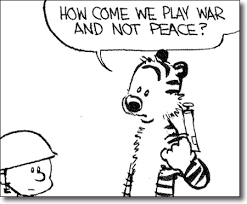
Another explanation of the failure of "Hobbesian" to convey the menace it might is, of course, a certain sweet-natured cartoonish tiger-cat who resisted his namesake's "war of all against all."
Podcast
6:30/6:47, 58/82
The explanation could have something to do with the evident sweetness of temper of "Tommy" Hobbes (as my old poli-sci prof at UMSL called him), who envisioned Leviathan but exemplified something more like the lamb in his personal conduct and bearing. Simon Critchley's Book of Dead Philosophers offers an endearing glimpse of a true English eccentric. He "avoided excess 'as to wine and women' and stopped drinking at age sixty," he "walked vigorously every day to work up a sweat... and expel any excessive moisture," he sang "prick-songs" late at night to stimulate his lungs and lengthen his life.
My favorite thing about Hobbes remains, naturally, his peripatetic nature. He walked to work up a sweat but also to stimulate ideas, which he'd interrupt himself long enough to record by disengaging the quill from his walking stick. "He walked much and contemplated," says Aubrey's Life, "and he had in the head of his cane a pen and ink-horn, carried always a note-book in his pocket, and as soon as a thought darted, he presently entered it into his book, or otherwise he might perhaps have lost it."
Another explanation of the failure of "Hobbesian" to convey the menace it might is, of course, a certain sweet-natured cartoonish tiger-cat who resisted his namesake's "war of all against all."
Podcast
6:30/6:47, 58/82
Friday, October 2, 2015
Magic music
Fine report yesterday from Alex, Kodi, & Blake in Happiness, on music: on how its engagement with the brain's neurochemistry delivers such pleasing doses of dopamine and makes learning fun, how musical improvisation flows like a good conversation and vice versa, how the discordant strains of a Stravinsky can shock, how the enthusiastic energy of "Na Nach Nachma" can heal, how the frenzy of "Crash Worship" can induce a trance of awakening. We agreed that people who deliberately resist exposure to all kinds of music are missing the point. Our closing note was to supplement the "ten happiest songs according to Science":
In CoPhi Blake and Axle did a nice Harry Potter report, though they didn't mention my favorite Dumbledore quote: "Happiness can always be found, if we just remember to turn on the light." And maybe they'd agree with this one too: “Ah, music. A magic beyond all we do here!”
Podcast
5:45/6:44, 57/60
--Don't Stop Me Now- QueenMy top ten has to include some Beatles & Stones ("In My Life," "Happy"), just about any Steely Dan (Donald Fagen's "New Frontier," about early-60s bomb shelter vigor and optimism, is my go-to song whenever I need a quick hit of happy), John Prine ("Spanish Pipedream")... Bottom line: all brains may be more-or-less the same, when it comes to the neurophysiology of music, but minds differ. And that's good!
--Dancing Queen- ABBA
--Good Vibrations- Beach Boys
--Uptown Girl- Billy Joel
--Eye of the Tiger- Survivor
--I'm a Believer- The Monkees
--Girls Just Wanna Have Fun- Cyndi Lauper
--Livin' on a Prayer- Bon Jovi
--I Will Survive- Gloria Gaynor
--walking on Sunshine- Katrina and The Waves
In CoPhi Blake and Axle did a nice Harry Potter report, though they didn't mention my favorite Dumbledore quote: "Happiness can always be found, if we just remember to turn on the light." And maybe they'd agree with this one too: “Ah, music. A magic beyond all we do here!”
Podcast
5:45/6:44, 57/60
Thursday, October 1, 2015
Big Bangs, First Causes, Bullshit, Pythagoras
Yesterday's CoPhi discussionsof Anselm's Ontology and Aquinas's First Cause were bracketed by a report on Bullshit (and Philosophy) in section 12, and on Pythagoras in 11. So, when a student in 11 (not having encountered the bullshit in 12) said his theory opposed "that Big Bang bullshit," he wasn't trying to be funny. What created our universe, then, if not a singular primordial blow-up? "The creator created it!" Duh!!
And that was his theory, an unvarnished version of Aquinas's... not quite so involved as Ann Elk's theory of the brontosaurus. But what's to insure the godliness, the omni-qualities of power, knowledge, and goodness, of the seminal creation? He didn't have a theory on that yet, he'll get back to us. Also, on how an unexplained and incomprehensible divinity is an explanatory improvement on the as-yet unexplained and incomprehensible universe as such.
The bullshit session in 12 was good. Someone asked if I'd ever bullshitted. My bullshit answer: I got through grad school, didn't I? And prelims? Everybody does it to an extent, but Harry Frankfurt's opening line - "One of the most salient features of our culture is that there is so much bullshit" - has never wrung truer than at this very moment in what can only ironically be called our cultural and political evolution. The presidential campaign has only just begun, it's gonna get thick.
Then Pythagoras, who was such a strange combination of superstitious mystic and ordered rationalist. Beyond the numbers astrology and the music of the spheres, though, he's credited with saying as many sensible things as Socrates and the rest of his successors.
- “As long as Man continues to be the ruthless destroyer of lower living beings, he will never know health or peace. For as long as men massacre animals, they will kill each other. Indeed, he who sows the seed of murder and pain cannot reap joy and love.” [A pre-Singer animal liberationist]
- “In anger we should refrain both from speech and action.” [A conciliator]
- “Educate the children and it won't be necessary to punish the men.” [A prison reformer]
- “A man is never as big as when he is on his knees to help a child.” [A nurturer]
- “All is Number.” [An over-quantifier]
- “Do not say a little in many words, but a great deal in few!” [A born tweeter]
- “Silence is better than unmeaning words.” [A Wittgensteinian]
- “Declining from the public ways, walk in unfrequented paths.” [A road-less-traveled nonconformist]
Just before class I was pleased to note that my little motivational message, aimed at certain squabblers who know who they are, was picked up and amplified ("favorited") by one of my favorite Plato scholars, @mmmccabe1.
Enjoy: To all who've been stressing about exams or reports: please stop. Enjoy your education. http://bit.ly/1KRsDTS
 Phil Oliver
It's another exam day today. Should be fun.
5:30/6:44, 63/65
Wednesday, September 30, 2015
Stay human
Sherry Turkle's Reclaiming Conversation found its way into the conversation yesterday, both in CoPhi and Happiness. What's special about face-to-face encounters? Why didn't Boethius just write up his Consolation as a soliloquy? Isn't texting and tweeting a lot more like talking to yourself than to another, even another you've invented or hallucinated? Is all this screen-time really making us happier?
Jonathan Franzen (whose Purity I can already recommend, four chapters in) features lots of conversation. He reviews Turkle:
Turkle:
And the threat to happiness is bigger still. Those Alan Watts tweets about washing this dish, taking this step, are on target. (Ironically, yes.) "Unitasking," Turkle calls it. It might just be the medicine we need.
Podcast
5:45/6:43, 69/69
Jonathan Franzen (whose Purity I can already recommend, four chapters in) features lots of conversation. He reviews Turkle:
When you speak to people in person, you’re forced to recognize their full human reality, which is where empathy begins... And conversation carries the risk of boredom, the condition that smartphones have taught us most to fear, which is also the condition in which patience and imagination are developed... children develop better, students learn better and employees perform better when their mentors set good examples and carve out spaces for face-to-face interactions.I knew that. We've been carving away all semester, and I've begun calling out students when I notice them checking out of our conversations in class. It makes us all uncomfortable. Good.
Turkle:
We’ve gotten used to being connected all the time, but we have found ways around conversation — at least from conversation that is open-ended and spontaneous, in which we play with ideas and allow ourselves to be fully present and vulnerable. But it is in this type of conversation — where we learn to make eye contact, to become aware of another person’s posture and tone, to comfort one another and respectfully challenge one another — that empathy and intimacy flourish. In these conversations, we learn who we are.That's the nub of it. Empathy, fellow-feeling, openness, spontaneity, depth seem threatened by our newfound excess of mediated distraction. It's a big price to pay for an end to boredom.
And the threat to happiness is bigger still. Those Alan Watts tweets about washing this dish, taking this step, are on target. (Ironically, yes.) "Unitasking," Turkle calls it. It might just be the medicine we need.
One start toward reclaiming conversation is to reclaim solitude. Some of the most crucial conversations you will ever have will be with yourself. Slow down sufficiently to make this possible. And make a practice of doing one thing at a time. Think of unitasking as the next big thing. In every domain of life, it will increase performance and decrease stress.
But doing one thing at a time is hard, because it means asserting ourselves over what technology makes easy and what feels productive in the short term. Multitasking comes with its own high, but when we chase after this feeling, we pursue an illusion. Conversation is a human way to practice unitasking.A human way. As Colbert keeps saying: stay human.
Podcast
5:45/6:43, 69/69
Tuesday, September 29, 2015
If you're happy and you know it
In Happiness today we'll note Frederic Lenoir's sensible concession, countering an earlier invitation to be "happy every moment," that that no one is happy all the time. That's more reasonable. But, maybe a zen form of the broader ambition can be salvaged with just a bit of attentive adjustment. Alan Watts, who lives timelessly on in cyberspace as insinuated by the film Her, puts it smartly:
 And is that happiness?
It might be interesting to funnel all of our discussion questions today through the "one dish" filter, and ask what would Alan say?
5:30/6:42, 72/75
Dispelling dread isn’t a matter of trying to forget about washing dishes.
Alan Watts @AlanWattsDaily It is realizing that in actual fact you only have one dish to wash, ever: this one; only one step to take, ever: this one. And that is Zen.
It might be interesting to funnel all of our discussion questions today through the "one dish" filter, and ask what would Alan say?
- Can you confirm the claim that we always recur to our happiness set-point? Have you experienced unsustained highs or lows? Do you think you've raised your personal set-point, over the course of your life? Are you working to do so?
- Do you anticipate a "mellow" future? Do you dread the prospect of senescence?
- Are we really "visceral egoists"? And isn't it an error to include Adam Smith (as opposed to some free-marketeers who think they're following him) as one of these? ("There is nothing is Adam Smith to support a 'greed is good' mentality,"write Solomon & Higgins.) Are you an altruist?
- Have you personally experienced the phenomenon of (un-)happy contagion?
- If schaudenfreude can be explained in evolutionary terms, can cooperation and the spirit of mutual support be similarly explained?
5:30/6:42, 72/75
Monday, September 28, 2015
Boethius
The most interesting thing to me about today's CoPhi subject, Boethius, is that he could find any "consolation" at all in "Philosophy's" theodicy. His Comfort Woman convinced him of the divine necessity of his own brutal sacrifice, for the greater good - or Good, in the Platonic perfectionist sense. He had to accept the notion that some must give all, in an unjust and irreparable cause, and moreover that this is part of a perfect plan. I don't think I could do that, though it surely would make those last hours pass more peaceably. (Of course there's also the objection that it probably isn't true.)
It's difficult not to take Boethius more as a late Stoic (his anti-Stoical protestations notwithstanding) than an early Christian. He doesn't brandish the latter identity at all in his final testament, as might have been expected of one whose time on earth is nearly up. If he anticipated waking, post-torture, in a personal heaven, he didn't let on. "Consolation of Philosophy makes references solely to ancient Greeks and Romans - not a single Christian author or figure appears in it, not even Jesus." (The Cave and the Light)
Bertrand Russell could not "think of any European man of learning so free from superstition and fanaticism... He would have been remarkable in any age; in the age in which he lived, he is utterly amazing."
The other thing especially noteworthy about Boethius is his focus, right to the end, on human happiness as the point of existence, a form of divinity in which all may participate. As Russell notes, that almost sounds pantheistic. Lots of things had to be glozed over, about Boethius, to turn him into a Christian martyr.
But he's still an admirable figure, more admirable even than his big fan Ignatius J. Reilly realized.
5:30/6:41, 69/80
Friday, September 25, 2015
"My first act"
Yesterday's CoPhi topic, free will, blended pretty seamlessly into the "molecules of emotion" in Happiness. I posed a question as to whether our ease and familiarity with the language of chemical contentment - dopamine, serotonin, oxytociun, re-uptake inhibitors and the like - didn't signal some sort of surrender to a model of mind that wouldn't sustain belief in free will.
Turning to a less abstract approach, I solicited practical advice for how to trip those happy-making molecules at will, as it were. We must believe that, at least, to be a reasonable aspiration. Why else study the conditions of happiness, if not to learn their application in everyday life? What other "inner work" could we be talking about, when we talk about choosing happiness?
No one really came up with anything much beyond pharmacology, which again reinforces the model of mind I find problematically reductive. So we moved on to discuss "rumination" and how it differs from healthy reflection. We chewed on that, most of us, while ambling about campus in the rays of late afternoon: always the best medicine.
The key, it seems to me, remains the old concept of attention. When William James "just about touched bottom," then pulled himself up by his and Charles Renouvier's bootstraps, he was at full attention.
Podcast
6:30/6:39, 67/74
Does it bother you to think of your happiness being governed by the "molecules of emotion"? Is this an objectionably reductive way of understanding subjectivity and the mind, or merely a strategically useful handle on one's state of well-being? Does it over-objectify experience, or imply a deterministic worldview at odds with your notion of free will?I couldn't find anyone who admitted to any unease of this sort, or who really even understood the question. That might indicate excessive and misplaced concern on my part. Or, it might just be a feather in the cap of neuroscience, and more evidence of its success in planting a paradigm of inhospitality to indeterminism.
Turning to a less abstract approach, I solicited practical advice for how to trip those happy-making molecules at will, as it were. We must believe that, at least, to be a reasonable aspiration. Why else study the conditions of happiness, if not to learn their application in everyday life? What other "inner work" could we be talking about, when we talk about choosing happiness?
No one really came up with anything much beyond pharmacology, which again reinforces the model of mind I find problematically reductive. So we moved on to discuss "rumination" and how it differs from healthy reflection. We chewed on that, most of us, while ambling about campus in the rays of late afternoon: always the best medicine.
The key, it seems to me, remains the old concept of attention. When William James "just about touched bottom," then pulled himself up by his and Charles Renouvier's bootstraps, he was at full attention.
"I think that yesterday was a crisis in my life. I finished the first part of Renouvier's second Essais and see no reason why his definition of free will — 'the sustaining of a thought because I choose to when I might have other thoughts' — need be the definition of an illusion. At any rate, I will assume for the present — until next year — that it is no illusion. My first act of free will shall be to believe in free will."Is free will an illusion? I too assume it need not be. But let's assume the choice is yours.
Podcast
6:30/6:39, 67/74
Thursday, September 24, 2015
Choosing free will
More in class today on free will. Augustine's theological commitment to the concept is one hook, neuroscience is another. "Our brains take decisions before our minds are aware of them," reports the BBC podcast I've asked students to consider.
"But there's evidence that whether or not we have free will, believing in it is good for us." Some experiments support the claim that those who believe in free will, and act on that belief, are by various measures happier, healthier, more conscientious and ethically responsible, less liable to cheat, steal, and lie.
The "happier" claim is most arresting, or it will be for us in Happiness class this afternoon. William James, in his books but more impressively in the totality of his post-free will crisis lifetime, supports it too. One day he "just about touched bottom," the next he resolved that "my first act of free will shall be to believe in free will," and in subsequent decades he certainly seemed to find pragmatic vindication for the concept. In his own terms, he found it better for him to believe in free will. Far better. That's not proof, but neither is it irrelevant or illusory.
But is it an adequate answer to Gregg Caruso's contention (and Sam Harris's) that as a society we would be better off giving it up, even if some individuals like James would not be? Caruso:
5:30/6:38, 61/88
"But there's evidence that whether or not we have free will, believing in it is good for us." Some experiments support the claim that those who believe in free will, and act on that belief, are by various measures happier, healthier, more conscientious and ethically responsible, less liable to cheat, steal, and lie.
The "happier" claim is most arresting, or it will be for us in Happiness class this afternoon. William James, in his books but more impressively in the totality of his post-free will crisis lifetime, supports it too. One day he "just about touched bottom," the next he resolved that "my first act of free will shall be to believe in free will," and in subsequent decades he certainly seemed to find pragmatic vindication for the concept. In his own terms, he found it better for him to believe in free will. Far better. That's not proof, but neither is it irrelevant or illusory.
But is it an adequate answer to Gregg Caruso's contention (and Sam Harris's) that as a society we would be better off giving it up, even if some individuals like James would not be? Caruso:
I maintain that life without free will may actually be good for our well being, and our relationships with others, since it could tend to eradicate an often destructive form of moral anger, a kind of moral anger that's corrosive to our relationships and to our social policies...
We need to acknowledge the role that luck plays in our lives, who we are, and how we turn out... Let's give up the belief in free will, and with it, the pernicious belief in just-deserts, that people justly deserve what they get. Let's leave this adequate notion behind, lose our moral anger and stop blaming the victim. Instead, let's turn our attention to the difficult task of addressing the causes that lead to criminality, to wealth inequity, and educational inequity. Once we relinquish the belief in free will, this will allow us to look more clearly at the causes and more deeply at the systems that shape individuals and their behavior, and this will allow us to adopt more humane and more effective policies in education, criminal justice, and social policies.Sounds great. It might be the right choice, if we have one. But I don't think it would have got William James up off the floor, when he touched bottom. I'm not sure it would have got me up out of bed this morning at 5 am. I choose to suspend final judgment on this issue. Or think I do.
5:30/6:38, 61/88
Wednesday, September 23, 2015
A passion for truth
That last Discussion Question is the one that really got us going in Happiness class yesterday, the one about whether religion or spirituality add years to one's life - seven years, specifically, according to the cited study... presumably seven quality years, my quip about the mitigating effects of all those hours lost in Sunday School notwithstanding.
I said I was prepared to believe it, so long as we understand "spirituality" inclusively and naturalistically. There is such a thing as humanist, secular, and atheistic spirituality, and if the point is to believe in something larger than oneself (not necessarily a god, possibly just people, the planet, or the starry heavens above) then godless spirituality should qualify for the Life-Extension dividend too. As Andre Comte-Sponville says, experience and a universe should suffice if anything does.
Not surprisingly, in the ensuing discussion the name of Professor Dawkins quickly came up. He was alleged to have denied, in The God Delusion, that there is any objective truth or goodness in the universe. I didn't recall him saying that, but if he did (I said) he misspoke.
But on further reflection, I can't imagine him writing that. Or even implying it. Say what you will about RD's polemically provocative style and tendency to shoot from the hip, expressing ill-formed judgments about women (recall his many dust-ups over others' feminist sensibilities), boys (the young clock-maker in Texas), "faithheads," etc., it must be acknowledged that the man is passionate for truth. In fact, he has apologized (sorta) for precisely that: "Sorry if I go a bit over the top in my passion for truth."
In God Delusion he wrote,
Yes, I know, I'm a dreamer. But I'm not the only one.
==
NOTE: If you're reading this at Wordpress, you might be missing something. Check out version 2.0 at Blogger...
Podcast
5:30/6:37, 56/87
I said I was prepared to believe it, so long as we understand "spirituality" inclusively and naturalistically. There is such a thing as humanist, secular, and atheistic spirituality, and if the point is to believe in something larger than oneself (not necessarily a god, possibly just people, the planet, or the starry heavens above) then godless spirituality should qualify for the Life-Extension dividend too. As Andre Comte-Sponville says, experience and a universe should suffice if anything does.
Not surprisingly, in the ensuing discussion the name of Professor Dawkins quickly came up. He was alleged to have denied, in The God Delusion, that there is any objective truth or goodness in the universe. I didn't recall him saying that, but if he did (I said) he misspoke.
But on further reflection, I can't imagine him writing that. Or even implying it. Say what you will about RD's polemically provocative style and tendency to shoot from the hip, expressing ill-formed judgments about women (recall his many dust-ups over others' feminist sensibilities), boys (the young clock-maker in Texas), "faithheads," etc., it must be acknowledged that the man is passionate for truth. In fact, he has apologized (sorta) for precisely that: "Sorry if I go a bit over the top in my passion for truth."
In God Delusion he wrote,
when two opposite points of view are expressed with equal force, the truth does not necessarily lie midway between them. It is possible for one side to be simply wrong. And that justifies passion on the other side.A passion for truth is nothing to apologize for. Intemperance, incivility, and insult in its name may be. That's why I'm toying with the idea of trying out an improvised version of John Rawls' "Original Position" thought experiment in next semester's Atheism & Philosophy course. I'd ask everyone to don the "veil of ignorance" as to their own (ir-)religious attitudes and beliefs, and just join a civil conversation about atheism and concepts of an afterlife without so much demonstrative personal investment in their own preconceptions. At the end we'd raise the veil and evaluate our performance not in the light of who we are individually, but how much kinder and gentler we might be as a collaborative community in passionate pursuit of truth.
Yes, I know, I'm a dreamer. But I'm not the only one.
==
NOTE: If you're reading this at Wordpress, you might be missing something. Check out version 2.0 at Blogger...
Podcast
5:30/6:37, 56/87
Tuesday, September 22, 2015
Stoic spirituality
Seneca's "On the Shortness of Life" is so full of practical wisdom and, for those in my line of work, positive reinforcement:
Before class yesterday my wife texted that a friend and her family had been involved in a serious automobile accident in Florda, with the little girls suffering serious injury. "I'm very upset." What would a Stoic say? Popular caricature suggests a cold and inhumane response like "Don't be upset. An emotional reaction changes nothing..." etc.
But the more time I spend reading and reflecting on the old Stoic texts, the less I think that's what Seneca and his school would say. Theirs would be a more measured judgment: "Your upset is understandable, and natural for our kind. Our humanity is a hybrid of reasoned reflection and feeling, we must allow both their due. Acknowledge your emotions, register their practical instruction, and move forward." Something like that.
Similar issues arise in Happiness this afternoon, when we'll wonder about the extent to which it may be possible for persons to do the "internal work" of Stoic adjustment required for hybrid happiness. And, an aside in our reading today has caught my attention, the claim that religious/spiritual people add years to their lives. I'm prepared to believe that, if "spiritual" is construed in its full and natural signification. Andre Comte-Sponville:
5:30/6:36, 53/84
Of all men they alone are at leisure who take time for philosophy, they alone really live; for they are not content to be good guardians of their own lifetime only... We may argue with Socrates, we may doubt with Carneades, find peace with Epicurus, overcome human nature with the Stoics, exceed it with the Cynics. Since Nature allows us to enter into fellowship with every age, why should we not turn from this paltry and fleeting span of time and surrender ourselves with all our soul to the past, which is boundless, which is eternal, which we share with our betters?I wouldn't put it in terms of "surrender" to the past, though. We study the old dead philosophers because the best that's been thought, said, and written better prepares us to meet present and future with equanimity and intention. For instance...
Before class yesterday my wife texted that a friend and her family had been involved in a serious automobile accident in Florda, with the little girls suffering serious injury. "I'm very upset." What would a Stoic say? Popular caricature suggests a cold and inhumane response like "Don't be upset. An emotional reaction changes nothing..." etc.
But the more time I spend reading and reflecting on the old Stoic texts, the less I think that's what Seneca and his school would say. Theirs would be a more measured judgment: "Your upset is understandable, and natural for our kind. Our humanity is a hybrid of reasoned reflection and feeling, we must allow both their due. Acknowledge your emotions, register their practical instruction, and move forward." Something like that.
Similar issues arise in Happiness this afternoon, when we'll wonder about the extent to which it may be possible for persons to do the "internal work" of Stoic adjustment required for hybrid happiness. And, an aside in our reading today has caught my attention, the claim that religious/spiritual people add years to their lives. I'm prepared to believe that, if "spiritual" is construed in its full and natural signification. Andre Comte-Sponville:
The universe is our home; the celestial vault is our horizon; eternity is here and now. This moves me far more than the Bible or the Koran. It astonishes me far more than miracles (if I believed in them). Compared to the universe, walking on water is a cinch!
Why would you need a God? The universe suffices. Why would you need a church? The world suffices. Why would you need faith? Experience suffices. The Little Book of Atheist SpiritualityThe Stoics entertained a range of religious views, but "experience suffices" pretty much captures what they had to tell us of our hybrid nature. Sufficit.
5:30/6:36, 53/84
Monday, September 21, 2015
Seize the weekend
Great outdoorsy weekend, highlighted by our discovery of a long new leg of Greenway connecting Warner Parks to Bellevue. How long's it been open, and why hadn't anyone told me!? Younger Daughter proposed that outing, her first voluntary recreational bikeride in recent memory but, she promises, not her last. What an easy escape, pedaling past baled fields and ball fields and rivers and woods, and an exorbitantly expensive private school, right up to the Horse Farm where she once had riding lessons. Simple pleasures are best, especially when seized spontaneously. Carpe diem isn't always grandly heroic, sometimes it's just a Saturday in the park.
Or the beer garden. I was so inspired, I went and joined the Tailgate mug club. They have a sundown beer garden site (they call it a "barn") well worth the price. Carpe cervisia.
And then yesterday, so mildly autumnal I never had to set foot in the house all afternoon. Did set foot in the pool, with slightly less enthusiasm than Saturday. Approaching each submersion now as potentially the last.
When I was a younger person myself, I was very little attuned to the elements and the seasons. How many beautiful Fall days of yore did I squander indoors, watching televised games I really could care less about, thinking I had all the time in the world before me? How many quality hammock hours did I miss? Too many. "As if you could kill time without injuring eternity." Doing my best to compensate now.
We turn to the Stoics in CoPhi today. Old Seneca had it right, our problem is not a paucity of time but a failure to make the most of the time we do have. "The life we receive is not short but we make it so; we are not ill provided but use what we have wastefully.” Life is short, but the days can still be long if we know how to use them.
5:30/6:36, 60/81
Friday, September 18, 2015
Lucidity
Interesting Happiness discussions yesterday, addressing our text's assertion that "illusory happiness does not interest us." Frederic Lenoir's point is that philosophers are truth-seekers, unwilling to swap "lucidity" for happiness, uninterested in becoming Voltaire's "happy idiots."
Yes, we agreed, but... what do you mean, "we"? We are knee-deep in the age of virtual reality, entertainment/ "reality" programming, sports fanaticism, and just generally the fuzzing-up of any boldly-drawn line between what's real and what's fabricated.
For that matter, ever since our "idiot" ancestors started scratching images on cave walls we've been telling stories. That's virtual reality too.
I found myself invoking old Captain Pike (didn't even have to mention the Next Generation's holodeck): "You have reality, he has his illusion. We'll see who has the better fate." (That's how I'm remembering it, it's been awhile. I'll see if I can fact-check that one.) [UPDATE: "Captain Pike has an illusion and you have reality. May you find your way as pleasant."]
Then there's the Matrix, the Experience Machine... and as one of us pointed out, you don't even have to invoke sci-fi to see how rapidly we're running up on non-fictional forms of VR. Ocular something-or-other (What exactly did you call it, Damon?) has already arrived in the brave new world of illusion-for-sale.
[UPDATE: "Oculus Rift," "next-gen VR," "the magic of presence"...

"There's no evidence that this is causing damage to your health." But what might it do to your "lucidity," let alone your curb appeal?]
I'll look into details. There are more than a couple of happy illusions I'd pay for right now. For one thing, I'd like to awaken from the nightmare of the GOP political campaign. Or sleep it off.
Podcast
5:30/6:33, 61/89
Yes, we agreed, but... what do you mean, "we"? We are knee-deep in the age of virtual reality, entertainment/ "reality" programming, sports fanaticism, and just generally the fuzzing-up of any boldly-drawn line between what's real and what's fabricated.
For that matter, ever since our "idiot" ancestors started scratching images on cave walls we've been telling stories. That's virtual reality too.
I found myself invoking old Captain Pike (didn't even have to mention the Next Generation's holodeck): "You have reality, he has his illusion. We'll see who has the better fate." (That's how I'm remembering it, it's been awhile. I'll see if I can fact-check that one.) [UPDATE: "Captain Pike has an illusion and you have reality. May you find your way as pleasant."]
Then there's the Matrix, the Experience Machine... and as one of us pointed out, you don't even have to invoke sci-fi to see how rapidly we're running up on non-fictional forms of VR. Ocular something-or-other (What exactly did you call it, Damon?) has already arrived in the brave new world of illusion-for-sale.
[UPDATE: "Oculus Rift," "next-gen VR," "the magic of presence"...
"There's no evidence that this is causing damage to your health." But what might it do to your "lucidity," let alone your curb appeal?]
I'll look into details. There are more than a couple of happy illusions I'd pay for right now. For one thing, I'd like to awaken from the nightmare of the GOP political campaign. Or sleep it off.
Podcast
5:30/6:33, 61/89
Thursday, September 17, 2015
Time out
It was a different kind of day at school, yesterday.
Arriving on campus I headed not to the office but instead straight to a colleague's speaking appearance at the Student Union. He was speaking on a bioethical theme, wondering about the future of intelligent machines and how we'll relate to them. Fascinating to think we may one day have to parse the autonomy and ethical standing of our own creations.
En route to the talk I was intercepted by my favorite student Research Assistant, who says I'm the only teacher she knows who takes classes outdoors on these beautiful Fall days. That's one good reason to continue pushing the peripatetic approach. We've become sedentary strangers to the sky. We need to look up and take our bearings, chart our path by the clouds and the stars, place our small indoor lives in proper perspective.
And we did, again, in CoPhi. But our time was shorter yesterday because we convened at the library, for a tutorial on research. Good information from my friend David on how to make the most of the Philosophers Index, Google Scholar, and the like, before my crash course on Pyrrho and Epicurus.
When discussion time finally came, we spilled out into the late afternoon sunshine and took a couple slow laps around the Science courtyard pondering the ultimate Epicurean question: is death anything to fear?
As always, interesting and unexpected things were said. And conventional, boring things. Wheat and chaff are separable, but it takes time.
That's the big Epicurean message, isn't it? Time is of the essence. The good life takes time. Take time for happiness. No time like the present. The time to live is now. Our ground-time here is brief. Time's a'wastin'. We're almost out of time, it'll soon be time to go.
So, take a breath, relax, enjoy the time you've got. It was in that mood and spirit that I decided to stop at the Mayday Brewery on my way home last night, and was pleasantly rewarded to encounter two former students with kind things to say about those old classes. One said Happiness class had a major impact on her life.
That's what we all want, isn't it, to have an impact before time's up?
5:30/6:33, 61/87
Wednesday, September 16, 2015
Back to the garden
Good classes again yesterday, continuing to explore what's good about the good life of eudaimon in CoPhi, and in Happiness wondering if it's as easy to dispel our instinctive fear of oblivion or a punitive post-existence in a supernatural afterlife as Epicurus said it is.
I'm not the only one, it emerged, who as a small and trusting child was taught and inadvertently terrorized by a bedtime prayer before the age of reason:
I don't blame my parents, who with the best of intentions simply transmitted an old religious meme that's been kicking around unchallenged for eons (or since 1711, allegedly). They didn't talk much about Hell or eternal divine retribution in our home (leaving that unpleasantness to the preacher and Sunday School teachers), nor do I think they thought about it much themselves. And therein lies a huge but non-malicious cultural error of omission that philosophy must rectify.
It was in the name of philosophy that I thus responded as I did to the student who yesterday insisted the error is not that of those who instill fear in their young, but rather of those like Epicurus and me, who would slough it off. It's not unreasonable or irrational, he suggested, to fear a god who just might be crazy enough to commit the innocent children he loves (as George Carlin reminded us) to the flames.
So I testified to my own Epicurean moment, as a youngster, when the whole frightening fable just no longer felt real. The student said a belief that makes you uncomfortable (bit of an understatement, that) might still be true. Yes, I said, but discomfort might be reason enough to explore other worldviews. And, I added, "if there's a retributive god out there, may he strike me down. No, wait: may he strike you down."
It got a laugh, but there's a serious point here. So many believers (and non-believers) are so frequently devastated by life's various natural calamities and moral calumnies, that faith loses all credibility as a shield against punitive bolts from heaven. Heaven loses all credibility as a saving alternative to hell.
And that's why Epicurus and his Garden friends would applaud Professor Dawkins' bus billboard campaign. (Unlike him, though, I think they'd prefer to leave "probably" on the bus.)
I was asked if I agree with Dawkins' rhetorical extremity, in calling religious indoctrination "child abuse." I don't use that language myself, as there seems a crucial distinction between the unwitting harm of much indoctrination and the exceptionless malevolent harm of assault and torture. My parents were no torturers. Most religious fundamentalists are not torturers. But they do inflict harm, in the form of an unfounded fear. I forgive them, they know not what they do.
And I say, with Epicurus: Relax, and enjoy. We are stardust, and we've got to get ourselves back to the garden. Park that bus right here.

podcast
5:30/6:32, 60/85
I'm not the only one, it emerged, who as a small and trusting child was taught and inadvertently terrorized by a bedtime prayer before the age of reason:
"Now I lay me down to sleep, I pray the Lord my soul to keep, if I should die before I wake, I pray the Lord my soul to take."Another "aging professor [who] laments his shrinking brain" has recently noted the abusive aspects of that little rhyme.
I don't blame my parents, who with the best of intentions simply transmitted an old religious meme that's been kicking around unchallenged for eons (or since 1711, allegedly). They didn't talk much about Hell or eternal divine retribution in our home (leaving that unpleasantness to the preacher and Sunday School teachers), nor do I think they thought about it much themselves. And therein lies a huge but non-malicious cultural error of omission that philosophy must rectify.
It was in the name of philosophy that I thus responded as I did to the student who yesterday insisted the error is not that of those who instill fear in their young, but rather of those like Epicurus and me, who would slough it off. It's not unreasonable or irrational, he suggested, to fear a god who just might be crazy enough to commit the innocent children he loves (as George Carlin reminded us) to the flames.
So I testified to my own Epicurean moment, as a youngster, when the whole frightening fable just no longer felt real. The student said a belief that makes you uncomfortable (bit of an understatement, that) might still be true. Yes, I said, but discomfort might be reason enough to explore other worldviews. And, I added, "if there's a retributive god out there, may he strike me down. No, wait: may he strike you down."
It got a laugh, but there's a serious point here. So many believers (and non-believers) are so frequently devastated by life's various natural calamities and moral calumnies, that faith loses all credibility as a shield against punitive bolts from heaven. Heaven loses all credibility as a saving alternative to hell.
And that's why Epicurus and his Garden friends would applaud Professor Dawkins' bus billboard campaign. (Unlike him, though, I think they'd prefer to leave "probably" on the bus.)
I was asked if I agree with Dawkins' rhetorical extremity, in calling religious indoctrination "child abuse." I don't use that language myself, as there seems a crucial distinction between the unwitting harm of much indoctrination and the exceptionless malevolent harm of assault and torture. My parents were no torturers. Most religious fundamentalists are not torturers. But they do inflict harm, in the form of an unfounded fear. I forgive them, they know not what they do.
And I say, with Epicurus: Relax, and enjoy. We are stardust, and we've got to get ourselves back to the garden. Park that bus right here.
podcast
5:30/6:32, 60/85
Tuesday, September 15, 2015
The good life
What does it take to live the good life? That was our wander-topic yesterday in CoPhi. Many of us agreed with Aristotle, that a good life revolves around the cultivation and habitual exercise of virtue, character, and one's personal potential. And we must be "sufficiently equipped with external goods" to be happy (eudaimon), but how much is sufficient? How "fashionable" must we be?
Many also indicated a preference for "nice things" and name brands, regretting the expense of clothes and other shiny signals of status in this society but unsure how to disengage from the consumer chase. "Beware all enterprises that require new clothes," said Thoreau. Simplify, simplify.
Epicurus is on deck for next time, not a moment too soon. The mania for things can seem inescapable, until you see how others have escaped. You don't have to join a Garden commune to begin the process of simplification, you just have to form a habit of closer scrutiny: is the appeal of this apparel real, or is it socially constructed and hence de-constructible? How much of my valuable time, how much irretrievable life, is this bauble really worth? Do the people I care about really care about the brand I wear? When was the last time one of my consumer purchases made my life really flourish?
But, we must be sensible about simplicity. There's some truth too in Mark Twain's observation: "Clothes do make the man. Naked people have very little influence in society."
5:30/6:31, 55/83
Monday, September 14, 2015
Aristotle
We meet Aristotle today in CoPhi. Finally, a guide who can really help us begin to make our way out of Plato's cave. Plato won't do it from his rationalist prototype armchair. Nor, despite his Republic/Book VII homage to the great gadfly, will Plato's Socrates. Dreaming of transcendent perfection doesn't make it so, and as much as I love asking questions, there comes a time for provisional hypotheses.
What we most need, and get, from Aristotle is a different metaphor. Pace Plato's metaphysics, we don't know ourselves to be benighted cave-dwellers, blinded by the very material that composes not only our habitat but also our perceptual selves.
We do know we're standing on a planet full of facts and relations, in a realm of process and change, in (cosmic-calendrically speaking) the pre-dawn of intelligent human inquiry. We do know we need more light.
Aristotle's the guy who first thought to bring a candle, in the form of an intense practical curiosity about everything before us, and an indefatigable interest in analyzing, cataloging, comparing, and reflecting on all we see. It's not that we've got to climb out of a terrestrial hole, into the empyrean light. We've just got to clarify the immediate environment, carefully noting how things are, admitting our finite fallibility, anticipating our empirical errors, correcting them as we go.
So I will again encourage ambitious students to consider the ongoing epic of our western heritage, and will confess my partiality to the candle-bearing empiricists as against those rationalist denizens of darkness who say we'll never have our eyes opened so long as we're still staring at the cave wall they consider this earth to be. I side with those who say there's plenty of truth to discover and tell about life here on the ground. Light will be cast, by those who light a candle.
Another sturdy candle was lit when Arthur Herman published The Cave and the Light a couple of years ago and wrote in the preface,
It's finally just a question of emphasis and attitude: how do we frame our condition, where do we think shining a light might take us? To Plato's (or anyone else's) Formal heaven? Or to a deeper appreciation of the meaning and possibilities of life on earth? It's a great question.
podcast
5:30/6:30, 51/80
What we most need, and get, from Aristotle is a different metaphor. Pace Plato's metaphysics, we don't know ourselves to be benighted cave-dwellers, blinded by the very material that composes not only our habitat but also our perceptual selves.
We do know we're standing on a planet full of facts and relations, in a realm of process and change, in (cosmic-calendrically speaking) the pre-dawn of intelligent human inquiry. We do know we need more light.
Aristotle's the guy who first thought to bring a candle, in the form of an intense practical curiosity about everything before us, and an indefatigable interest in analyzing, cataloging, comparing, and reflecting on all we see. It's not that we've got to climb out of a terrestrial hole, into the empyrean light. We've just got to clarify the immediate environment, carefully noting how things are, admitting our finite fallibility, anticipating our empirical errors, correcting them as we go.
So I will again encourage ambitious students to consider the ongoing epic of our western heritage, and will confess my partiality to the candle-bearing empiricists as against those rationalist denizens of darkness who say we'll never have our eyes opened so long as we're still staring at the cave wall they consider this earth to be. I side with those who say there's plenty of truth to discover and tell about life here on the ground. Light will be cast, by those who light a candle.
Another sturdy candle was lit when Arthur Herman published The Cave and the Light a couple of years ago and wrote in the preface,
Instead of trying to rise above mundane reality, Aristotle believed the philosopher's job was to explain how the world works, and how as human beings we can find our proper place in it. There is no cave; only a world made of things and facts. "The fact is our starting point..."As it should be, on my view. But I hesitate to endorse the rigid-sounding dichotomy Herman then pins on the classic schism between empiricists and rationalists, sorting them into the camps of science, logic, and technology on Team Aristotle, and theology, mysticism, poetry, and art on Team Plato. That's too neat, too black-and-white. Good empiricists are open to the experience of wonder, mystery, poetry, and art. Good rationalists like facts and gadgets too (see Rebecca Goldstein's Plato at the Googleplex).
It's finally just a question of emphasis and attitude: how do we frame our condition, where do we think shining a light might take us? To Plato's (or anyone else's) Formal heaven? Or to a deeper appreciation of the meaning and possibilities of life on earth? It's a great question.
podcast
5:30/6:30, 51/80
Subscribe to:
Posts (Atom)