Then tonight, as noted yesterday, it's the first of my two classes in the MALA course on Human Migration. I'm calling my block contribution "The Human Journey to Cosmopolitanism," first retracing the genetic trail of Y-chromosome crumbs that prove we have indeed walked far, then wondering if we'll ever complete the mission summarized by that ambitious (if premature) plaque on the moon.
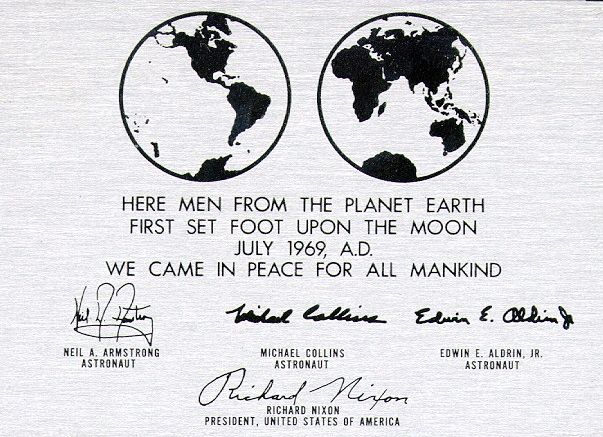
"Premature," I say, as evidenced by that other marker we left in the lunar dust.

Also premature perhaps in its implication that humans at this stage of their evolutionary development have in fact become a peaceable, or even reliably civil, species. I ventured out to the airport last night and was met with several instances of gratuitous incivility. Lots of us seem like powder kegs waiting to blow, these days. Oh well. At least I didn't get beat up or kicked off a plane. I'd rather walk than fly any day.
We might check in tonight with Frederic Gros's Philosophy of Walking, and Christopher Orlet's Gymnasiums of the Mind, and "Walking to the stars": Some of us fervently believe, with Nietzsche, Rousseau, and so many others, that the best ideas first come while walking. Some of us also believe we should expand our range to include more distant turf, over the Terran horizon. I'm a believer.
But first, those 19th century stars.
But first, those 19th century stars.
Mill, we've noted, disagree with Bentham about pleasure. He had nothing against "pushpin," just impatience with humans who wouldn't bother to explore more. His great passion was of course for liberty, so his insistence on qualitative pleasure-standards sets up a taut challenge: how to prescribe but not impose those standards, and still respect the rights of all to seek their own good in their own ways without (as John Lachs puts it) meddling. Open discussion in a free society, especially about our differences, forces invaluable self-critique. "If you don't have your views challenged by people with opposing views, then you will probably end up holding them as 'dead dogmas'..." But of course we rarely call out our own dogmas, it's other people's prejudices we detest. So we need to hear out other people.
The great Huxley-Wilberforce debate has probably grown in legend beyond its moment, but what wouldn't I give to have been there! I think Dan Dennett is probably right, evolution by natural selection is probably the single best idea anyone ever had. Huxley was probably right too, when he upbraided himself for not having thought of it first. The best ideas are often right under our noses, out of sight.
Since Darwin's day genetics, tonight's topic, "has given a detailed explanation of how inheritance works." It's not just a theory, it's a hypothesis with "a very substantial weight of evidence in support."
The Danish Socrates said evidence/schmevidence, what's that to me if my "subjective truth" says I should take a flying leap into the darkness. Some of us think Kierkegaard committed intellectual suicide, but we're glad somebody stepped up to defend the irrationalist position. It gives us more to talk about. And it's clear enough why some Existentialists (though not the atheists like Sartre) look back to the Melancholy Dane as their early prototype. Kierkegaard was all about "choosing how to live and the difficulty of knowing that your decision is the right one." My view is that you only make that more difficult, when you renounce reason. And, you do contradict yourself in the broadest sense of reason when you write tracts attempting to vindicate your irrationalism. Nigel's unvarnished judgment: "Faith involves risk. But it is also irrational: not based on reason."
But, give Kierkegaard credit for defending "the subjective point of view" against the pure objectifiers in philosophy who leave themselves no place to stand, pretending to occupy Professor Nagel's "view from nowhere." That really is a Nowhere Land, Nowhere Man.
Karl Marx always looks angry. The "grim conditions" of industrial capitalism and its assault on the poor and powerless dispossessed sent him to the British Library and into collaboration with Engels to crank out their Manifesto. The political struggle of class demanded and predicted revolution, they said. They took Hegel's history and said it's all coming to a head much sooner than his intellectualistic analysis allowed, given its manifest material contradictions. Theye didn't predict the Soviet Union, though.
"From each according to ability, to each according to need": a beautiful vision, which American students seem conditioned to reject as impossible. Seems to work pretty well in places like Denmark and Switzerland, though.
Finally, Marx famously called religion "the opium of the people." He didn't think that was an insult, but a sympathetic explanation. "In the new world after the revolution human beings would achieve their humanity." Sounds so naive, from the perspective of 2017. But humanity is an achievement, not just a genetic fact. We've got to reclaim it constantly.
Lotsa questions: Name two or three of your favorite pleasures. Are any of them higher or better than the others? In what way? Are any of yours higher or better than those of a friend whose list includes none of yours? Why or why not? Is state paternalism ever warranted? Why don't we ever talk about state maternalism? What are the appropriate legal limits on speech and expression in a free society, if any?
How would you reply to Wilberforce's debate question? What do you think was the best idea ever?
Do you want a map of your own genome? Why or why not? Do you agree with Darwin that the subject of God is "too profound for human intellect"? Does it mean we should all be agnostic? What would you have done, in Abraham's position? Would you have doubted the "message" or challenged the messenger? Does it damage the parent-child relationship if Mom or Dad make it clear to the child that they'll always defer to the perceived instructions of a "heavenly father," even including murderous instructions? Does anything "trump the duty to be a good [parent]"? Would you ever do something you considered morally wrong, in the name of faith? Does taking a "leap of faith" make you irrational? How do you balance your subjective point of view with objectivity, and with the subjectivity of others? What role should inter-subjectivity play, in forming that balance? If you ever own a business will you pay your workers as little as possible and extract as much "surplus value" from them as you can? Is anything in history "inevitable"? Does religion make people more reconciled to oppression and exploitation, and less likely to revolt?
==
In Human Migration: The Human Journey to Cosmopolitanism, we lead off with Spencer Wells' Journey of Man: A Genetic Odyssey. [Slides]
The great Huxley-Wilberforce debate has probably grown in legend beyond its moment, but what wouldn't I give to have been there! I think Dan Dennett is probably right, evolution by natural selection is probably the single best idea anyone ever had. Huxley was probably right too, when he upbraided himself for not having thought of it first. The best ideas are often right under our noses, out of sight.
Since Darwin's day genetics, tonight's topic, "has given a detailed explanation of how inheritance works." It's not just a theory, it's a hypothesis with "a very substantial weight of evidence in support."
The Danish Socrates said evidence/schmevidence, what's that to me if my "subjective truth" says I should take a flying leap into the darkness. Some of us think Kierkegaard committed intellectual suicide, but we're glad somebody stepped up to defend the irrationalist position. It gives us more to talk about. And it's clear enough why some Existentialists (though not the atheists like Sartre) look back to the Melancholy Dane as their early prototype. Kierkegaard was all about "choosing how to live and the difficulty of knowing that your decision is the right one." My view is that you only make that more difficult, when you renounce reason. And, you do contradict yourself in the broadest sense of reason when you write tracts attempting to vindicate your irrationalism. Nigel's unvarnished judgment: "Faith involves risk. But it is also irrational: not based on reason."
But, give Kierkegaard credit for defending "the subjective point of view" against the pure objectifiers in philosophy who leave themselves no place to stand, pretending to occupy Professor Nagel's "view from nowhere." That really is a Nowhere Land, Nowhere Man.
Karl Marx always looks angry. The "grim conditions" of industrial capitalism and its assault on the poor and powerless dispossessed sent him to the British Library and into collaboration with Engels to crank out their Manifesto. The political struggle of class demanded and predicted revolution, they said. They took Hegel's history and said it's all coming to a head much sooner than his intellectualistic analysis allowed, given its manifest material contradictions. Theye didn't predict the Soviet Union, though.
"From each according to ability, to each according to need": a beautiful vision, which American students seem conditioned to reject as impossible. Seems to work pretty well in places like Denmark and Switzerland, though.
Finally, Marx famously called religion "the opium of the people." He didn't think that was an insult, but a sympathetic explanation. "In the new world after the revolution human beings would achieve their humanity." Sounds so naive, from the perspective of 2017. But humanity is an achievement, not just a genetic fact. We've got to reclaim it constantly.
Lotsa questions: Name two or three of your favorite pleasures. Are any of them higher or better than the others? In what way? Are any of yours higher or better than those of a friend whose list includes none of yours? Why or why not? Is state paternalism ever warranted? Why don't we ever talk about state maternalism? What are the appropriate legal limits on speech and expression in a free society, if any?
How would you reply to Wilberforce's debate question? What do you think was the best idea ever?
Do you want a map of your own genome? Why or why not? Do you agree with Darwin that the subject of God is "too profound for human intellect"? Does it mean we should all be agnostic? What would you have done, in Abraham's position? Would you have doubted the "message" or challenged the messenger? Does it damage the parent-child relationship if Mom or Dad make it clear to the child that they'll always defer to the perceived instructions of a "heavenly father," even including murderous instructions? Does anything "trump the duty to be a good [parent]"? Would you ever do something you considered morally wrong, in the name of faith? Does taking a "leap of faith" make you irrational? How do you balance your subjective point of view with objectivity, and with the subjectivity of others? What role should inter-subjectivity play, in forming that balance? If you ever own a business will you pay your workers as little as possible and extract as much "surplus value" from them as you can? Is anything in history "inevitable"? Does religion make people more reconciled to oppression and exploitation, and less likely to revolt?
==
In Human Migration: The Human Journey to Cosmopolitanism, we lead off with Spencer Wells' Journey of Man: A Genetic Odyssey. [Slides]
Wells is quick to disclaim any sexist intent with his genetically-informed title, to which some sensitive souls might object on the grounds of cultural insensitivity. "The journey we trace is one primarily made by men, because it is the Y-chromosome, inherited from Adam down the male line, which gives us our keenest tool for deciphering the journey." We might rather wish he'd left Adam out of it, since that story of Edenic seduction is inescapably freighted with sexist baggage. But you catch his point, or will if you follow him as he follows the DNA-Y Trail through the ages and across the continents.
Two questions mark our start:
- How do we decide if the concept of human 'race' has any validity? Are we indeed all one species, or are there discrete divisions among human groups?
- How did we come to occupy every corner of the globe?
We're looking for answers in those ubiquitous, peripatetic Y-chromosomes. They carry us all over the globe and back through time. Indeed, Wells thinks of his genetic odyssey as a form of time travel "capable of resurrecting the stories of the past from people living in the present." And it reminds him of the Australian Aborigines "songlines" memorialized by Bruce Chatwin, evoking "actual journey taken by their ancestors during the Dreamtime, a period in the distant past, before collective memory."
Chatwin in turn reminds us of what the author of Remembrance of Things Past reminds us of. “Proust, more perspicaciously than any other writer, reminds us that the 'walks' of childhood form the raw material of our intelligence.” The walks of our species' childhood must have been similarly formative.
And, Chatwin writes,
The ancient Greek historian Herodotus is credited by Wells as the pioneering ethnographer who first introduced us to ethnic and cultural diversity, which has of course diversified considerably since his time. Only in the past decade or so have we been in a position to grasp the source and significance of all that human difference, to understand the sameness in difference that is its signal salience.Chatwin in turn reminds us of what the author of Remembrance of Things Past reminds us of. “Proust, more perspicaciously than any other writer, reminds us that the 'walks' of childhood form the raw material of our intelligence.” The walks of our species' childhood must have been similarly formative.
And, Chatwin writes,
“As a general rule of biology, migratory species are less 'aggressive' than sedentary ones.So we're all descended from anarchists. Good to know.
There is one obvious reason why this should be so. The migration itself, like the pilgrimage, is the hard journey: a 'leveller' on which the 'fit' survive and stragglers fall by the wayside.
The journey thus pre-empts the need for hierarchies and shows of dominance. The 'dictators' of the animal kingdom are those who live in an ambience of plenty. The anarchists, as always, are the 'gentlemen of the road'.”
The aforementioned T.H. Huxley, reflecting on what he considered his own extreme stupidity not to have tumbled to natural selection himself, before Darwin, might also have reflected on its inexorable contribution to diversity. Pardon the indulgence of an old Trek geek who recalls in this connection the ancient Vulcan philosophy of IDIC: "infinite diversity from infinite combinations."
The uniformitarian geologist Charles Lyell and the catastrophist/naturalist Louis Agassiz debated whether "occasionally all hell would break loose." Theirs was no Wilberforce-Huxley standoff, but it gave young Darwin a frame for his questions as he boarded the Beagle in 1831. His ultimate unnamed subject, by the time he got around to penning his provisional conclusions in 1859, was "the diverse array of humanity... Why were people around the world so different from each other?" It must have been their nurture, not something deep and ineradicable in their nature. Their manners and practices may have appalled a Victorian gentleman, but then again so did those of Darwin's shipmates.
He also asked himself about the corresponding "commonality" that marked slavery as such a horrid abomination and led to his own call for abolition. You mustn't overrate outward appearances, in classifying humanity. "Our long habit of observing ourselves" sets us up to invest too much confidence in mere surface appearances. Go deeper. Look to the genes and their common branchpoints.
Polygenists postulate "many origins" rather than multiple branchings from a single family tree. That again is the problem with mentioning Adam, it revives the Genesis account that is contradicted by subsequent science and biologists' findings of "extensive hybridization among human races."
Anthropology in the early 20th century was overtly political, aiming "to serve humanity as well as study it" - not an objectionable aspiration as such, but susceptible to racist abuse when coupled with dreams of eugenic purity and immigration austerity. Ironically it was Darwin's own cousin Galton who pushed for the former. Philosopher Herbert Spencer sowed confusion we're still saddled with, in his advocacy of Social Darwinism. Darwin himself was no Social Darwinist, no "survivalist" willing to sacrifice the gen-poor for the gen-rich. In the long run of Darwinian natural selection it may well turn out that the fittest are also the kindest, the most solicitous of the weak, the most cooperative, the most progressive.
Culture is important. That's the message in Wells' chapter 8, which begins with an ancient Sumerian creation myth that says the gods drank too much beer before they got busy creating our mad mad world. I guess that would explain a lot.
And the "selfish gene" hypothesis? “Let us try to teach generosity and altruism, because we are born selfish. Let us understand what our own selfish genes are up to, because we may then at least have the chance to upset their designs, something that no other species has ever aspired to do.” Thus spake Richard Dawkins in the first edition of The Selfish Gene. He was encouraged by people "learned in philosophy" (to borrow his derisively-dipped phrase) to reformulate for the second edition. Are we born selfish? Or, would our genes be selfish if they had a choice?
Either way, culture (and specifically education) is the arena in which we must "try to teach generosity and altruism." If we succeed, we may also claim some degree of independence from our "selfish genes," some freedom from strict genetic determinism. If we fail, we will still at least have declared the human journey ours as much as theirs. But we have to try. What would we be if we didn't? (If you, like me, are a Lyle Lovett fan, you know what comes next. "Please, if it's not too late..." (Extra credit to the first student who can complete the sentence.)
"The Polynesian seafarers who colonized Hawaii were accomplished sailors," to the consternation of Captain Cook and his company of British colonizers. Time and again we tend to mistake cultural difference for inferiority. "It is easy to forget that only a few hundred generations ago we were all hunter-gatherers." Easy, and self-serving for those who want to "discover" and conquer "new" lands. It's not enough for them "to boldly go," to come and go in peace for all mankind. Not yet. When? Perhaps in the next few hundred generations, if we can learn to think like the Long Now Foundation wants us to. 10,000 years is really just the blink of an eye, in genetic terms.
Speaking of genetic terms, I'll bet I'm not the only non-biologist who could use a handy-refresher glossary... Human Genetics: The Basics... Evolution: The Basics... Pandora's Seed: The Unforeseen Cost of Civilization (and Why the Hunter-Gatherer Holds the Key to Our Survival)
Neolithic humans left us an impressive legacy when they took up farming, beginning with the concept of choice and free will. They chose "not to wander for miles each day to gather their food." That was a big breakthrough for civilization, of course, but it came at a cost for those who forgot the benefits of wandering. All who wander are not lost.
That's a quick fly-over of about half of what we want to discuss this evening. Can't wait.
==
A new book asks: "Is our common humanity a discovery or an invention?" It's both.
Still thinking about Ann Lamott and the civil impulse to connect, multiply, and flourish (like the sea anemone) rather than withdraw and scowl in suspicious mistrust of the world (like Nixon). That's how bridges get built and life gets better.
Today is the birthday of Ellen Goodman, who said “It has been a great gift to make a living trying to make sense out of the world around me." I know what she means.
5:30/6:20, 58/76/54, 7:15


