Delight Springs

Tuesday, June 20, 2017

Morning air & communion

Speaking of air, which was again lovely and chill this morning - actually had to don a jacket for our dawn stroll - Henry had it just right: "...let me have a draught of undiluted morning air. Morning air! If men will not drink of this at the fountainhead of the day, why, then, we must even bottle up some and sell it in the shops, for the benefit of those who have lost their subscription ticket to morning time in this world." We inebriates of air can't stop feeling a bit superior to those who sleep away their only shot at the fountainhead.

The other lingering feeling I continued to enjoy this morning, in the backwash of another pleasant Fathers' Day, is that of paternal pride and sentiment. On that holiday in 2001, our girls  presented me with a shirt upon which they had imprinted their hand- and footprints. Sixteen years later, an update (with supplemental pawprints):


The sentiment is gratitude, for their persistence (this being the year they each graduated, from college and high school, respectively) and their grace. I was an @home dad when that first shirt arrived, and I will always look back on those charmed days in the company of our joyous and inquisitive children as the very best of times. As I've noted before, in echo of one of my favorite essayists, "daily companionship with a questioning child is a reminder of what intelligence is for--not, ultimately, for dominion, but for communion." 

Yes, that form of communion I'll always happily take. Why do I dote on my dogs? Practice, for the next time I'm graced with the steady company of a questioning child. 

In the spirit of communion, then, this slightly-tardy recognition of Fathers Day in the form of an 1895 letter from William James to his little girl Peggy. It reminds me of the picture book-inspired conversations I used to have with my little girls.
El Paso, Colo., Aug. 8, 1895.
Image result for william james and his daughter peggySweetest of Living Pegs,—Your letter made glad my heart the day before yesterday, and I marveled to see what an improvement had come over your handwriting in the short space of six weeks. "Orphly" and "ofly" are good ways to spell "awfully," too. I went up a high mountain yesterday and saw all the kingdoms of the world spread out before me, on the illimitable prairie which looked like a map. The sky glowed and made the earth look like a stained-glass window. The mountains are bright red. All the flowers and plants are different from those at home. There is an immense mastiff in my house here. I think that even you would like him, he is so tender and gentle and mild, although fully as big as a calf. His ears and face are black, his eyes are yellow, his paws are magnificent, his tail keeps wagging all the time, and he makes on me the impression of an angel hid in a cloud. He longs to do good.
I must now go and hear two other men lecture. Many kisses, also to Tweedy, from your ever loving,
Dad.


Friday, June 16, 2017

Inebriates of air

Here's an antidote to radical pessimism: reaffirmation of the will, as articulated by Robert Richardson in his 2010 talk at the William James Society's gathering in Chocorua, New Hampshire.


"Will You or Won't You Have It So?" is our "most probing question," James said. "We answer by consents or non-consents and not by words." Consent isn't just talk, it's volitional action drawn by the vision of something better than the status quo, by refusal to surrender to fate. Richardson finds great inspiration in James's imploring challenge to teachers, as urgent now as ever:
Spinoza long ago wrote in his Ethics that anything that a man can avoid under the notion that it is bad he may also avoid under the notion that something else is good. He who habitually acts sub specie mali, under the negative notion, the notion of the bad, is called a slave by Spinoza. To him who acts habitually under the notion of good he gives the name of freeman. See to it now, I beg you, that you make freemen of your pupils by habituating them to act, whenever possible, under the notion of a good. Get them habitually to tell the truth, not so much through showing them the wickedness of lying as by arousing their enthusiasm for honor and veracity. Wean them from their native cruelty by imparting to them some of your own positive sympathy with an animal's inner springs of joy. And, in the lessons which you may be legally obliged to conduct upon the bad effects of alcohol, lay less stress than the books do on the drunkard's stomach, kidneys, nerves, and social miseries, and more on the blessings of having an organism kept in lifelong possession of its full youthful elasticity by a sweet, sound blood, to which stimulants and narcotics are unknown, and to which the morning sun and air and dew will daily come as sufficiently powerful intoxicants.
And then, to illustrate, Richardson tosses off an allusion to Emily Dickinson that speaks directly to the peripatetic soul. The aspect of good that draws us walkers and cyclers out into the open and rejuvenating air of morning, day after day, is an intoxicant without painful residue. It leaves us better than we were, un-hungover, moving forward. An "inebriate of air" is positively addicted, happily dependent, and free. There's nothing wrong with leaning on the sun.
I taste a liquor never brewed
I taste a liquor never brewed –
From Tankards scooped in Pearl –
Not all the Frankfort Berries
Yield such an Alcohol! Inebriate of air – am I –
And Debauchee of Dew –
Reeling – thro’ endless summer days –
From inns of molten Blue – When “Landlords” turn the drunken Bee
Out of the Foxglove’s door –
When Butterflies – renounce their “drams” –
I shall but drink the more! Till Seraphs swing their snowy Hats –
And Saints – to windows run –
To see the little Tippler
Leaning against the – Sun!
Emily Dickinson, 1830 - 1886
Related posts. Chocorua... Stonewall... More footsteps... 95 Irving St... A pleasing confidence... R.I.P. WJ... last stand... flickers & twinkles... in transition... James bio 8... WJ 8.1... John Kaag, The philosopher and the thief (Harper's)... Summers and semesters (Harvard Magazine)

podcast

Thursday, June 15, 2017

Radical pessimism at the door

Back from a satisfyingly heat-beating bikeride-and-walk to and through the Richland Creek Greenway. Reflected a bit on the British view of the American experience during the revolutionary period, through the lens of the BBC's This Sceptred Isle . There's always another side to every story.

I wonder if I'd have been a Loyalist or a Patriot? In the present context, I'm neither - the present context being the borderline dystopia lately surveyed in Jill Lepore's New Yorker essay on the new literature of radical pessimism. “We are what happens when the seemingly unthinkable celebrity rises to power,” indeed. I'm not surrendering to pessimism yet, but these are challenging days for a melioristic pragmatist. That's probably why I find myself drawn to the bigger picture, and to history. This too shall pass. And meanwhile?

I'm looking forward to tomorrow's ride-and-walk through the Warner Parks.
==
My Vandy pals who argue that pluralists can't be pragmatists are spotlighted in the new Vanderbilt Magazine, arguing in the spirit of J.S. Mill for a vigorous civil discourse. I will continue to argue the point with them, civilly and vigorously - as soon as I figure out exactly what's flawed in their argument... maybe their new book will shed needed light. They'll have to send me a copy for review, I sure can't afford it (must be a hell of an argument)!
Pragmatism, Pluralism, and the Nature of Philosophy (Routledge Studies in American Philosophy) by Scott F. Aikin and Robert B. Talisse Hardcover $ 133 08  $140.00PrimeAvailable for Pre-order
Dec 31, 2017


Tuesday, June 13, 2017

Anglo-American Minds

John Lachs makes his usual good pluralistic sense with a warning, a couple minutes into Phillip McReynolds' brisk film American Philosopher, to beware talk of the American philosopher or mind or character or, really, the pretty-much-anything. It's too late for a formal rechristening of our summer class The Anglo-American Mind, but henceforth we'll just be AAM to ourselves - M is for minds, and what Anglos and Americans do with them.


It's great to see so many of my old friends featured here, saying mostly sensible things. Not one of them "hates America," but like William James they're all immunized against what he called, in that wonderful letter to H.G. Wells, "our national disease." (“The moral flabbiness born of the exclusive worship of the bitch-goddess SUCCESS. That - with the squalid cash interpretation put on the word 'success' - is our national disease.")

Patrick Allitt, a Brit at Emory University whose "Great Course" on The American Identity, admits the danger of oversimplifying our pan-American distinctions and differences but also insists on the rootedness of cultural stereotypes in some degree of reality. Not all Brits carry on with stiff upper lips, not all Americans have an optimistic can-do, cash-value commitment to problem-solving. But those are good tropes to test. As our first week's short essays and comments begin to appear, let the happy testing begin!

Friday, June 9, 2017

Worms at core and root

The dogs were at the door too early again this morning, we were out and roaming the neighborhood in the unseasonably chilly pre-dawn. I'm forcibly re-learning the lesson Richard Powers' character Peter Els learned "way too late in life":
Els learned that the time to concentrate yourself was right before sunrise. His greatest art now was to walk two hours before the neighborhood woke. Moving his legs left him blissful. Had he discovered the routine in young adulthood, he might have long ago amassed a portfolio of playful, exuberant creations that pleased him and gave delight to others.
So, I concentrated myself this morning on another Mill-James connection: William James, I've often noted, bemoaned "the worm at the core of all our usual springs of delight..." Can it be a coincidence that his hero Mill had also tracked, in his Autobiography, a nefarious nematode? 

Noting that a too-intent fixation on habits of intellectual analysis can impair our spontaneity and delight in feeling, Mill wrote that such habits feed "a perpetual worm at the root both of the passions and of the virtues; and, above all, fearfully undermine all desires, and all pleasures..."

James and Mill could have learned from Els. Walk away from the worms every morning, habitually, and feel better. Save the melancholy metaphysics for sundown.

Wednesday, June 7, 2017

Poetic cultivation

Still exploring the Wordsworth connection between Mill and James, both having claimed to find salvation in the former's poetic Excursion. Mill in his Autobiography recounts,

In the first place, these poems addressed themselves powerfully to one of the strongest of my pleasurable susceptibilities, the love of rural objects and natural scenery; to which I had been indebted not only for much of the pleasure of my life, but quite recently for relief from one of my longest relapses into depression. In this power of rural beauty over me, there was a foundation laid for taking pleasure in Wordsworth's poetry; the more so, as his scenery lies mostly among mountains, which, owing to my early Pyrenean excursion, were my ideal of natural beauty. But Wordsworth would never have had any great effect on me, if he had merely placed before me beautiful pictures of natural scenery. Scott does this still better than Wordsworth, and a very second-rate landscape does it more effectually than any poet. What made Wordsworth's poems a medicine for my state of mind, was that they expressed, not mere outward beauty, but states of feeling... a source of inward joy, of sympathetic and imaginative pleasure, which could be shared in by all human beings; which had no connection with struggle or imperfection, but would be made richer by every improvement in the physical or social condition of mankind. From them I seemed to learn what would be the perennial sources of happiness, when all the greater evils of life shall have been removed. And I felt myself at once better and happier as I came under their influence.
Wordsworth gave young Mill, so intensely cultivated as both student and object of study in his father's pedagogical hothouse experiment, his subjectivity back, along with needed reassurance that it did not dilute but actually enhanced his humanistic commitment to social progress.
I needed to be made to feel that there was real, permanent happiness in tranquil contemplation. Wordsworth taught me this, not only without turning away from, but with a greatly increased interest in, the common feelings and common destiny of human beings. And the delight which these poems gave me, proved that with culture of this sort, there was nothing to dread from the most confirmed habit of analysis. 
"Analysis" here means intellect, not the Freudian sort of mytho-biographic rumination and speculation the next century would discover. "The result was that I gradually, but completely, emerged from my habitual depression, and was never again subject to it...unpoetical natures are precisely those which require poetic cultivation."

And that observation immediately recalls James's "Walpurgisnacht" on the mountain, when he said he now finally understood what a poet was...
==
It's Louise Erdrich's birthday. She sees life itself, every human life, as a poetic construction: “When we are young, the words are scattered all around us. As they are assembled by experience, so also are we, sentence by sentence, until the story takes shape.”

5:38/5:31, 60/78/55, 8:00

Tuesday, June 6, 2017

A new dawn

Our first "Anglo-American Mind" (AAM) class dismissed just in time last night for some of us to see the opening Preds-Penguins face-off at the packed Boulevard Bar & Grill. What a charged, heightened, frenetic atmosphere! 

One of our Pragmatism discussion questions asks if it matters whether the world is "one or many." Last night in middle Tennessee it was definitely a unity-we were all together, one for all and all for one. I'm no friend of hockey's brutal culture of mayhem, but I'll happily take my respites from Drumpfworld where I find them.

Back when I first came to Nashville the only pro hockey in town featured the minor-league "South Stars" (affiliated with the now-defunct Minnesota North Stars) playing in the Municipal Auditorium. It was always a fun night out, and a much cheaper ticket. But it lacked that frenzied Dionysian aspect that draws people together across every divide and turns us into a collective. Fortunately it's only a game. Unfortunately, Drumpfworld persists. But the Preds won again, and for a few more days we'll give ourselves permission to divert our gaze from the polarizing, debilitating alt-reality of our present politics.

AAM offers another welcome diversion. Before we even got started one of us passed around copies of C.S. Peirce's "How to Make Our Ideas Clear." ("Too much information," said another.) He said it was a muddle to him. But so it was to William James, who was talking about Peirce when he said
The founder of pragmatism himself recently gave a course of lectures at the Lowell Institute with that very word in its title-flashes of brilliant light relieved against Cimmerian darkness! None of us, I fancy, understood ALL that he said—yet here I stand, making a very similar venture.
I risk it because the very lectures I speak of DREW—they brought good audiences. There is, it must be confessed, a curious fascination in hearing deep things talked about, even tho neither we nor the disputants understand them. We get the problematic thrill, we feel the presence of the vastness. Let a controversy begin in a smoking-room anywhere, about free-will or God's omniscience, or good and evil, and see how everyone in the place pricks up his ears. Philosophy's results concern us all most vitally, and philosophy's queerest arguments tickle agreeably our sense of subtlety and ingenuity.
Believing in philosophy myself devoutly, and believing also that a kind of new dawn is breaking upon us philosophers, I feel impelled, per fas aut nefas, to try to impart to you some news of the situation.
A new dawn is always breaking, for the suitably-devout student of philosophy and of life. Onward through the fog!

Peirce had a sense of humor. "I don't remember that any one has advocated a system of teaching by practical jokes, mostly cruel. That, however, describes the method of our great teacher, Experience.” And, no joke: “There is a kink in my damned brain that prevents me from thinking as other people think.”
==
It's poet Maxine Kumin's birthday (she'd be 91). "She often asked her students to memorize 30 to 40 lines of poetry a week so that they grew familiar with the sound of poetry. She said: "The other reason, as I tell their often stunned faces, is to give them an internal library to draw on when they are taken political prisoner. For many, this is an unthinkable concept; they simply do not believe in anything fervently enough to go to jail for it."

5:30/5:31, 69/82/57, 8:00

Monday, June 5, 2017

The Wordsworth Connection

I’m excited for the start this afternoon of our summer “focused study” of The Anglo-American Mind, wherein we’ll tack and attempt to navigate various “cross-currents in British and American thought, exploring ways in which classic thinkers on both sides of the pond have mutually influenced and reacted to each other.”

And, continues the official and possibly over-ambitious course description, “we’ll also read and discuss the likes of William Wordsworth, Henry David Thoreau, Ralph Waldo Emerson, Charles Sanders Peirce, Bertrand Russell, John Dewey, David Hume, Anthony Trollope….” Well, maybe. Never hurts to build your metaphorical castles in the air.

The English wit Oscar Wilde once said “we have really everything in common with America nowadays except, of course, language.” I wish I’d said that, Oscar, but I will. It’s an exaggeration, of course, but in service of the defensible premise we set out from: Americans and Brits do have a special relationship, culturally and philosophically, and a motivated study of its various lines of mutual relatedness promises amusement, clarity, and light. It’ll be fun.

Our main texts: Pragmatism by William James, On Liberty by J.S. Mill, English Hours by Henry James, and Jay Hosler’s whimsical, graphical look at Charles Darwin’s peripatetic style of reflection, The Sandwalk Adventures.

We begin with the first four lectures of Pragmatism, starting with this question:
  • Why do you think James dedicated Pragmatism to the memory of J.S. Mill (“from whom I first learned the pragmatic openness of mind and whom my fancy likes to picture as our leader were he alive today”)?
There’s no short and simple answer to that, but one intriguing thread connects them: both suffered bouts of emotional despondency, and both turned to the poetry of William Wordsworth to pull them out of it.

The Mill-Wordsworth connection is familiar, having been prominently featured in the fifth chapter of his Autobiography.
For though my dejection, honestly looked at, could not be called other than egotistical, produced by the ruin, as I thought, of my fabric of happiness, yet the destiny of mankind in general was ever in my thoughts, and could not be separated from my own. I felt that the flaw in my life, must be a flaw in life itself…
This state of my thoughts and feelings made the fact of my reading Wordsworth for the first time (in the autumn of 1828), an important event of my life. I took up the collection of his poems from curiosity, with no expectation of mental relief from it, though I had before resorted to poetry with that hope… But while Byron was exactly what did not suit my condition, Wordsworth was exactly what did…
What made Wordsworth’s poems a medicine for my state of mind, was that they expressed, not mere outward beauty, but states of feeling, and of thought coloured by feeling, under the excitement of beauty. They seemed to be the very culture of the feelings, which I was in quest of. In them I seemed to draw from a source of inward joy, of sympathetic and imaginative pleasure, which could be shared in by all human beings; which had no connection with struggle or imperfection, but would be made richer by every improvement in the physical or social condition of mankind. From them I seemed to learn what would be the perennial sources of happiness, when all the greater evils of life shall have been removed. And I felt myself at once better and happier as I came under their influence… I needed to be made to feel that there was real, permanent happiness in tranquil contemplation. Wordsworth taught me this, not only without turning away from, but with a greatly increased interest in, the common feelings and common destiny of human beings. And the delight which these poems gave me, proved that with culture of this sort, there was nothing to dread from the most confirmed habit of analysis… The result was that I gradually, but completely, emerged from my habitual depression, and was never again subject to it. J.S. Mill, Autobiography
Less familiarly known is the James-Wordsworth connection, newly spotlighted in William James Studies (Spring 2017, vol.13, no.1) by David Leary in “Authentic Tidings: What Wordsworth Gave to William James” (PDF):
As regards James’s later psychological and philosophical work, the critical insights that distinguished his way of thinking revolved around the Wordsworthian convictions that the human mind is active; that it has its own interests; and that its feelings are as significant – perhaps even more significant – than its thoughts…
James gave expression to “the mind’s excursive power,” as Wordsworth put it. Wordsworth’s use of this phrase underscored that his poetically described excursion through countryside and mountains was an allegory for the mind’s ability to wander, in imagination, around objects, assuming different perspectives, seeing reality now from this and now from that point of view.
“The mind’s excursive power” – that’s what we’ll be tracking, and tracking with, in our course. There’s even been talk of field trips into the rolling middle Tennessee countryside, as we wander in search of Anglo-American minds (which really ought to be pluralized in the course title as well).

Also noteworthy, in the vein, is the appreciative WJ Studies note by biographer Robert Richardson (Emerson, Thoreau, James), on John Kaag’s wonderful American Philosophy: A Love Story:
Kaag leaves us with what Goethe, Emerson, and William James all agreed on. In the beginning was not the word, but the deed, the act. The way forward is not twelve steps, or ten or three. It’s just one. Don’t sleep on it, sit on it, stand on it, or take it for a trial spin. Take the step, You have to do what you can, and you have to do it right now.
Well alright then, let’s get moving!

 philosophy wittgenstein critical theory archimedes plato GIF


(This Anglo-American mind clearly was warped by early exposure to Monty Python.)

It's the birthday of Alfred Kazin, who wrote On Native Grounds and A Walker in the City. “The writer writes in order to teach himself, to understand himself, to satisfy himself; the publishing of his ideas, though it brings gratification, is a curious anticlimax... One writes to make a home for oneself, on paper, in time and in others' minds.”

6:15/5:30, 7278/67, 8:01

Wednesday, May 17, 2017

Perpetual morning

Back!

Didn't really go anywhere, since that last post in April, except into the grading burrow, then to lots of Younger Daughter's last softball games, and then finally up to Illinois for Older Daughter's college graduation. Her commencement speaker, retired Air Force General Larry O. Spencer, had choice words about civility and its absence in our current politics, and about privacy and its absence in the lives of young people. Refreshing, inspiring words. Hope the kids were listening.

Younger Daughter graduated too, from High School. Lots of commencing going on around here, the milestones are piling up.

Image result for toy story slinky dogI'm still faithfully rising each day, early enough to look for catchable and occasionally postable reflections. But since Older Daughter returned with her canine companion Scooter (a Dachs-Beagle, like Sheriff Woody's pal Slinky), I'm finding it necessary - she's not an early riser under this roof, but he is - and now actually preferable, to head straight out into the pre-dawn and a 10-legged perambulation with the pooches. We were out there well before 6 this morning, enjoying the mild morning.

So, henceforth these dawn reflections may not be posted 'til the day is well under way. But that's no matter, as Henry said: "To him whose elastic and vigorous thought keeps pace with the sun, the day is a perpetual morning. It matters not what the clocks say or the attitudes and labors of men. Morning is when I am awake and there is a dawn in me."

Today's simple reflection, then, is that I can be Up@dawn whenever I like.


Saturday, April 29, 2017

Hope for the flowers (2)

John Lachs, in his most recent Berry Lecture, said "What horrifies is that we may disappear without having made a difference, like the butterfly that hovered over a flower for a minute a thousand years ago."

But here we still are, a thousand years on, talking about that butterfly. Butterflies have their effects (though not always as popularly conceived). Oh, the horror? Or the hope? The latter, surely, for glass-half-full butterfly people who believe even the slightest constructive efforts may ripple down the years in ever-wider waves.

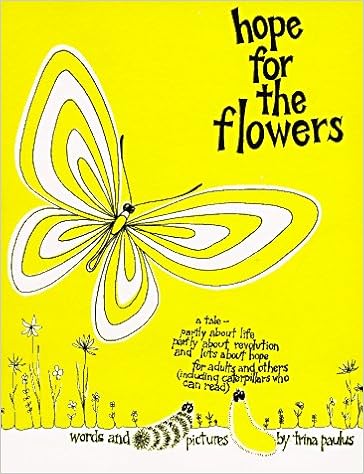
That was my intended insinuation in lasts week's post-lecture reflections Hope for the flowers, a title swiped from the classic graphic allegory of life, revolution, and hope "for adults and others (including caterpillars who can read)" by Trina Paulus.

I once received that book as a parting gift from coworkers at the old independent bookstore (the big one on Hillsboro Pike behind the clocktower that's now a bank). They meant to inspire my own confident hope in tackling the final phase of my formal education, on the way to transmogrifying into a settled academic.

Academia's not everyone's idea of a butterfly haven, but it was then mine. I don't guess I was wrong, as the transformation occurred a few short years later and now here I've lit, tenured and privileged with the opportunity to try and give encouragement and hope to successive waves of students seeking to shuck their own chrysalises.

I've always known John to be of the butterfly tribe, the sort of pragmatic stoic who indulges the hopeful mood and infects others with it. A generous man, in the way of Camus when he said "real generosity towards the future lies in giving all to the present," John always made his caterpillarish students believe they had an inner butterfly just waiting to burst forth.

That's one of the ways of hope, to breed confidence and embolden growth in timid or tentative souls. Social hope for life's eventual denouement, for the millennial butterflies we'll never know, is like that too. It should breed confidence in our species' long-term prospects, reflected in a growing sense of urgency to give all to the present.

Our highest hope was never entirely for ourselves in a personal sense, but for those on whose metamorphosed good fortune we'd be honored and gratified to have some small effect - whether we lived to see it or not.

6 am/5:57, 73/89/70

Tuesday, April 25, 2017

Rawls, Turing & Searle, Singer

It's our last class of the semester in CoPhi, wrapping up with John Rawls, Alan Turing, John Searle (who's lately joined an ignoble list of alleged philosopher/harassers, but that's another topic), and Peter Singer.

Rawls' "stroke of genius" was his Original Position thought experiment, seeking fairness and justice (for Rawls justice is fairness) via the imaginative contrivance of a "veil of ignorance." The idea is to acknowledge and lessen the undue influence of special interest pleading in our politics, allowing only those inequalities of wealth, status, privilege, opportunity, and resources that benefit all. The least well-off must be better off, when the veil is lifted, than otherwise. [SoL video]

Alan Turing's Imitation Game, "proposing the practical test of whether or not we would attribute intelligence to a system whose performance is indistinguishible from that of a human agent," says if it walks and talks like a smart duck it practically is one. John Searle countered with the Chinese Room, which "purports to show that even effective computer simulations do not embody genuine intelligence, since rule-governed processes need not rely upon understanding by those who perform them."

But some philosophers remain convinced that  we might someday use computers to achieve virtual immortality. That didn't work out so well for Johnny Depp in Transcendence. "I can't feel anything," says the uploaded semblance of his former self. If that's the singularity I hope it's nowhere near, Ray Kurzweil. "Transcending biology" might strip us of our humanity and not replace it with anything better.

Peter Singer says we should always be prepared to sacrifice "one or two of the luxuries that we don't really need" to help strangers. When you put it that way it doesn't really sound like "a hard philosophy to live up to," much as we love our branded shoes and suits, our cars and college funds, and our carnivorous ways. "But that doesn't mean Singer is wrong about what we ought to do." We ought to do a great deal more good for those in need than we do, most of us. Maybe we ought to stop eating sentient animals. Certainly we ought to stop inflicting gratuitous pain on all who can feel it. We ought to be less selfish and more cooperative.


Singer "represents the very best tradition in philosophy," if you agree that "constantly challenging widely held assumptions" like Socrates is the very best tradition. Kwame Anthony Appiah basically agrees, but would modify Singer's principle to something like: “if you are the best person in the best position to prevent something really awful, and it won’t cost you much to do so, do it.” [Singer slides]

We could say more, but there's a little exam we're itching to get on with. Suffice for now to say what Professor James always says on the last day of every class, as he said the last time he said anything at all. In the words of his favorite pluralistic mystic, “there is no conclusion. What has concluded, that we might conclude in regard to it? There are no fortunes to be told, and there is no advice to be given. — Farewell!”

Actually there is one important bit of advice all philosophers will endorse:
Albert Einstein
Learn from yesterday, live for today, hope for tomorrow. The important thing is not to stop questioning. #Einstein

And then there's some good advice about how to prepare for an exam.

And since it's poet Ted Kooser's birthday I'll add one more thing. Like Anthony Trollope, who said “A small daily task, if it be really daily, will beat the labors of a spasmodic Hercules,” Kooser had a habit of "rising early every morning so he could write for an hour and a half before going to the office." He wrote seven books that way, and became poet laureate. So the advice (which James also gave, notwithstanding his parting reluctance to say so) is: form good daily work habits and stick to 'em. "How we spend our days is how we spend our lives." -Annie Dillard

Good luck!

5:30/6:02, 53/80, 7:27

Monday, April 24, 2017

Rough road ahead

"Blackberry winter," my wife calls this late (for these parts) cold snap and deluge. But it's just weather, towards which (as Mr. Twain said) we're characteristically all talk and no action. These days, though, we have to wonder if weather is also climate change, and whether other things must now change as well. James Lovelock, the Gaia guru, has said we'll have to migrate northward before long to cope with it all. Hope he's wrong.

Human Migration (the course) concludes tomorrow evening, with an interdisciplinary roundtable featuring all of us content-providers: the philosopher, the political scientist, the sociologist, the dance instructor... As cosmopolitan a tableau as you'll ever see in the modern classroom, and an appropriate final punctuation mark for my block contribution,  "The Human Journey to Cosmopolitanism." My message has been simple: science supports our better ethical instincts, those that trust rather than fear the "stranger" among us. We are the stranger. We are stronger together.

That's what the Marchers for Science were saying too, on Earth Day Saturday. They had some great signs, including this one:
The Vulcans were always on board with cosmopolitanism, with their ethos of IDIC - infinite diversity from infinite combinations. Will humans join them? Will we become a Federation? Or will we devolve?

A recent essay in the Chronicle of Higher Education worries that Colleges Are Rejecting Our Common Humanity and the Science That Reveals It. That trend, if continued, would be devolution.

Anthony Appiah's latest moralizing in The Ethicist urges instead the moral high ground. To the woman whose husband criticizes her "moral superiority" for refraining from saying demeaning things about people in private she wouldn't say in public he observes: "We let ourselves off the hook when we reflexively use “morally superior” as disparagement, as a synonym for toxic condescension. News flash: It’s morally superior to be morally superior." We can do better.

We clearly have a long journey ahead of us. Cassini is a good role model, already imposing the Prime Directive. "One reason scientists want to make sure Cassini is incinerated at the end of its journey is to ensure that any of its earthborn microbes do not contaminate the biotic or prebiotic worlds out there. Just in case..."

Its grand finale began yesterday, while only last week it discovered "possible life-supporting hydrothermal vents" on the moon Enceladus." Will we discover unexpected sources of life-support, before we begin our descent? Per ardua ad astra, a rough road leads to the stars.
==
Happy birthday Anthony Trollope. "He would write 1,000 words an hour before breakfast; he said, 'A small daily task, if it be really daily, will beat the labors of a spasmodic Hercules.'”

6 am/6:03, 55/68/52, 7:26

Saturday, April 22, 2017

Hope for the flowers

Our annual Spring Lyceum featured Ron Aronson, author of We:Reviving Social Hope and 
Living Without God: New Directions for Atheists, Agnostics, Secularists, and the Undecided. 
Aronson proposes contemporary answers to *Immanuel Kant’s three great questions: What can I know? What ought I to do? What can I hope? Grounded in the sense that we are deeply dependent and interconnected beings who are rooted in the universe, nature, history, society, and the global economy, Living Without God explores the experience and issues of 21st-century secularists, especially in America. Reflecting on such perplexing questions as why we are grateful for life’s gifts, who or what is responsible for inequalities, and how to live in the face of aging and dying... Grds
I asked him about the intersection of secularism and social hope. He said the connection was very clear: we are on our own, help is not on the way, hope is ours for the making. Yes we can.

Night before last, John Lachs delivered this year's Berry Lecture at Vanderbilt: "Death and Self-Importance." Same premise, tone a little less hopeful. 
"Sad as it may sound to say it, probability favors the view that death is final. Our delights are like the joys of the butterfly that hovered over a flower for a precious minute a thousand years ago. And then it is over in a moment of grace.
Of course we can hope for more..."
On Earth Day, "the world’s largest secular holiday," we can and we must, to do less is to surrender to misanthropy and despair. Make Earth great again!

Lachs prefaced his talk by remarking on the lovely flowers near the Divinity School on Vandy's campus, and on the delight he ("on all fours") and we can take in their fleeting loveliness. If my talk seems too dark, he said, "remember the flowers."

And that's what Robert Frost said.
Oh, give us pleasure in the flowers today;
And give us not to think so far away
As the uncertain harvest; keep us here
All simply in the springing of the year... (A Prayer in Spring)
But I'm still thinking far away too, as Cassini plunges, with hope for the flowers and all who delight in them. And all who follow. Speaking with my former student at the reception last night about our now-common joy of raising precocious children (and feeling envious of his time now spent in the daily company of a smart seven-year old, and nostalgic for mine long gone), I was reminded of Michael Chabon's plea for hope both near and far away.
If you don’t believe in the Future, unreservedly and dreamingly... then I don’t see how you can have children. If you have children, I don’t see how you can fail to do everything in your power to ensure that... they, and their grandchildren, and their grandchildren’s grandchildren, will inherit a world whose perfection can never be accomplished by creatures whose imagination for perfecting it is limitless and free.
"The really vital question for us all" is still, for me, full of hope. “We can fly! “We can become butterflies! “There’s nothing at the top and it doesn’t matter!” Hope for the Flowers


Happy birthday *Immanuel Kant. “Two things fill the mind with ever-increasing wonder and awe [...] the starry heavens above me and the moral law within me.”

7 am/6:06, 55/65/48, 7:25, rain

Thursday, April 20, 2017

Wittgenstein, Arendt, Popper & Kuhn, Foot & Thomson

It's our penultimate semester class date, with Ludwig Wittgenstein, Hannah Arendt, Karl Popper, Thomas Kuhn, Philippa Foot, and Judith Jarvis Thomson today in CoPhi.


Wittgenstein was one odd duck. Or rabbit. Or duckrabbit. What do you see, and how do you see it? Why do you see it that way? He thought these were questions worth investigating, in his posthumous Philosophical Investigations. I'm more inclined to follow the instruction of proposition 7 in his pre-humous Tractatus Logico-Philosophicus: "Whereof one cannot speak, thereof one must be silent." Famous premature last words.

"Raised in a prominent Viennese family, Ludwig Wittgenstein studied engineering in Germany and England, but became interested in the foundations of mathematics and pursued philosophical studies with Moore at Cambridge before entering the Austrian army during World War I. The notebooks he kept as a soldier became the basis for his Tractatus, which later earned him a doctorate and exerted a lasting influence on the philosophers of the Vienna circle. After giving away his inherited fortune, working as a village schoolteacher in Austria, and designing his sister's Vienna home, Wittgenstein returned to Cambridge, where he developed a new conception of the philosophical task. His impassioned teaching during this period influenced a new generation of philosophers..."

The Tractatus said we can't speak meaningfully about our most important questions in ethics and religion (and maybe language), and so should hold our tongues. That may sound like Freddy Ayer's "nonsense," but Wittgenstein was not being dismissive, he was courting mysticism. He presumed that language fails to mirror reality because we cannot verify their correspondence, cannot faithfully and flawlessly replicate in words the facts and meanings that lie beyond them.

The Philosophical Investigations takes a linguistic turn. “The meaning of a word is its use in the language,” not its relation to something non-linguistic in the world. The uses of words are discovered and decreed in our "language games," which include but crucially are not limited to the games philosophers play about truth. Those games can get us stuck like a fly in a bottle, and he wanted to pop the cork. “Philosophy is a battle against the bewitchment of our intelligence by means of language.”

How do you avoid linguistic captivity in the first place? Not by inventing your own private language. Language is intrinsically public, and only other users of our language can call us out for the  language errors we don't catch. A private language is too much like Leibniz' private monadic theaters of mind, too much like a game of solitaire played with improvised rules.

But rules presuppose other rule-followers, and language games presuppose other players. So the question is how do we break the spell of language, when it bewitches and confuses us? It's tempting to say "it's only a game," we can always play a different one. Can we?  “A picture held us captive. And we could not get outside it, for it lay in our language and language seemed to repeat it to us inexorably.” Won't language always hold us captive in this sense?

The Investigations thus seem to bring Wittgenstein full circle, back to the concluding counsel of the Tractatus. “So in the end, when one is doing philosophy, one gets to the point where one would like just to emit an inarticulate sound.” I know what he means, I often feel that way when doing philosophy, and especially when watching others do philosophy. But now and then someone will say or write something that provokes an "ah-ha!" moment, and language seems less captor than liberator. Richard Rorty's Philosophy and the Mirror of Nature had that effect on many of my peers in grad school, with its proposal that the pictures holding us captive in philosophy are optional. We can just decide to give up the picture of words as mirrors? That's a game-changer.

“Language is a labyrinth of paths. You approach from one side and know your way about; you approach the same place from another side and no longer know your way about.” And vice versa. Peripatetics know this. You aren't necessarily lost, in language, you're exploring. Try another path. Start another conversation. Read another book. Write another sentence.
  Hannah Arendt covered Adolf Eichmann's war crimes trial for The New Yorker in 1963 ("Eichmann in Jerusalem"), finding him the very epitome of banality, "an ordinary man who chose not to think too hard about what he was doing." The banality of evil resides in the hearts and minds of heartless, thoughtless functionaries. “The trouble with Eichmann was precisely that so many were like him, and that the many were neither perverted nor sadistic, that they were, and still are, terribly and terrifyingly normal." And they pay that "normality" forward, to catastrophic and tragic result. “The sad truth is that most evil is done by people who never make up their minds to be good or evil.”

The Origins of Totalitarianism has suddenly again become must-reading. "The essence of totalitarian government, and perhaps the nature of every bureaucracy, is to make functionaries and mere cogs in the administrative machinery out of men, and thus to dehumanize them.... The ideal subject of totalitarian rule is not the convinced Nazi or the dedicated communist, but people for whom the distinction between fact and fiction, true and false, no longer exists...  one could make people believe the most fantastic statements one day, and trust that if the next day they were given irrefutable proof of their falsehood, they would take refuge in cynicism; instead of deserting the leaders who had lied to them, they would protest that they had known all along that the statement was a lie and would admire the leaders for their superior tactical cleverness.” 

Karl Popper's Open Society and Its Enemeies is must-reading too. "Unlimited tolerance must lead to the disappearance of tolerance. If we extend unlimited tolerance even to those who are intolerant, if we are not prepared to defend a tolerant society against the onslaught of the intolerant, then the tolerant will be destroyed, and tolerance with them... We should therefore claim, in the name of tolerance, the right not to tolerate the intolerant. We should claim that any movement preaching intolerance places itself outside the law, and we should consider incitement to intolerance and persecution as criminal, in the same way as we should consider incitement to murder, or to kidnapping, or to the revival of the slave trade, as criminal.”

Popper said science progresses when we find reasons to falsify, rather than confirm, a favored hypothesis. Science proceeds not by proving things but by pruning falsehoods. It skirts the problem of induction, the problem of our never having enough particular experiences of a phenomenon to support a generalized knowledge claim, by looking instead for falsifying counterexamples.

Thomas Kuhn said shift happens. Paradigm shifts are revolutions in though, when "normal science" fails to make sense of new observations and ways of thinking. “Normal science, the activity in which most scientists inevitably spend almost all their time, is predicated on the assumption that the scientific community knows what the world is like... Under normal conditions the research scientist is not an innovator but a solver of puzzles, and the puzzles upon which he concentrates are just those which he believes can be both stated and solved within the existing scientific tradition.” When the puzzles seem insoluble, researchers become receptive to new paradigms. The Copernican Revolution was a paradigm shift. Einstein's E=mc2 was another. Aren't we about due for a new one?

Thought experiments don't require a lab, just an experimental cast of mind and the integrity to report one's results honestly when they disconfirm one's prejudices. Philippa Foot (R.I.P./Guardian) and Judith Jarvis Thomson gave us runaway train and trolley thought experiments (YouT, toolkit).

"Critics of the trolley problem say it is too unrealistic to reveal anything important about real-life morality. But the rise of drones and self-driving cars makes the dilemma perhaps more relevant than ever before. For example, should a self-driving car protect the life of its passengers, even at the expense of a greater number of pedestrians? Here too, our intuitions are inconsistent: we want other people’s cars to maximize the number of lives saved – but think our own car should protect us at all costs. As our technologies become increasingly capable of making moral decisions, understanding our own moral intuitions becomes all the more crucial." Guardian

Thomson topped herself in "A Defense of Abortion" with an unsolicited surgically attached violinist. Not everyone think this bizarre scenario supports Thomson's fetal intentions, but it's certainly got people talking.
You wake up in the morning and find yourself back to back in bed with an unconscious violinist. A famous unconscious violinist. He has been found to have a fatal kidney ailment, and the Society of Music Lovers has canvassed all the available medical records and found that you alone have the right blood type to help. They have therefore kidnapped you, and last night the violinist's circulatory system was plugged into yours, so that your kidneys can be used to extract poisons from his blood as well as your own. The director of the hospital now tells you, "Look, we're sorry the Society of Music Lovers did this to you--we would never have permitted it if we had known. But still, they did it, and the violinist is now plugged into you. To unplug you would be to kill him. But never mind, it's only for nine months. By then he will have recovered from his ailment, and can safely be unplugged from you." Is it morally incumbent on you to accede to this situation? No doubt it would be very nice of you if you did, a great kindness. But do you have to accede to it? What if it were not nine months, but nine years? Or longer still? What if the director of the hospital says. "Tough luck. I agree. but now you've got to stay in bed, with the violinist plugged into you, for the rest of your life. Because remember this. All persons have a right to life, and violinists are persons. Granted you have a right to decide what happens in and to your body, but a person's right to life outweighs your right to decide what happens in and to your body. So you cannot ever be unplugged from him." I imagine you would regard this as outrageous...
And therefore...?
==
?? Should we be silent about things we can't prove? Should philosophy concern itself with more than understanding the logic of language? Do you use language as a pictorial medium, a tool for managing social relationships and expressing our thoughts and feelings, or what? Are ordinary people capable of great evil? Are you? How can we be sure that a Holocaust will never happen again? What will you teach your children about that? If the government attempted to round up, detain, and deport millions of Latinos and Muslims, how would you respond? Is "the banality of evil" relevant to our time?
==
"It's the birthday of one of the founders of psychiatry, Philippe Pinel, born in Saint-André, France (1745). He studied mathematics, theology, and internal medicine before becoming the chief physician at a Paris insane asylum in 1792. Before Pinel arrived, conditions at the asylum were horrible: Among other things, patients were chained to the walls, and people could pay a fee to come in and watch them..."  It's the anniversary of Columbine (1999) and Deepwater Horizon (2010)...

5:30/6:08, 63/87, 7:23

Monday, April 17, 2017

Cosmopolitanism

My block in Human Migration (MALA 6010), "The Human Journey to Cosmopolitanism," continues.

We began last week with the genetic science and anthropological mapping that documents our common lineage. We're all related, as the native Americans knew without benefit of population genetics, but now we can prove it. We'll glance back, with a look at our Spencer Wells posts, and then maybe do a little peripatetic migrating ourselves before the sun sets.

Nice genetics poem today at Writers Almanac, btw, prefaced by Richard Dawkins: "There is no gene which single-handedly builds a leg, long or short. Building a leg is a multi-gene cooperative enterprise." As is building a society. 

Also noteworthy: it's Isak Dinesen's birthday. She wrote Out of Africa, before we knew we all were.

This week we turn to the philosopher and ethicist Kwame Anthony Appiah's (emhasis on the first syllable) Cosmopolitanism: Ethics in a World of Strangers. His main message is nicely condensed in the shortest (if not simplest) answer to the question "Whose people made the Great Wall of China, the Chrysler Building, and the Sistine Chapel?": ours.

Krista Tippett's On Being conversation with Appiah, largely about how much he invests in the very concept of conversation itself as our last best tool of reconciliation and mutual comprehension (though decidedly not consensus), is typically self-validating.
How can unimaginable social change happen in a world of strangers? Appiah is a philosopher who studies ethics and his parents’ marriage helped inspire the movie Guess Who’s Coming to Dinner. In a tense moment in American life, he has refreshing advice on simply living with difference... (play episode) 
You do have to hear their conversation and not just read the transcript, to catch its nuance and its full humanity. But his best advice is to "sidle up" the big and divisive conversations by first establishing a context of trust through more mundane and unifying ones. Our differences over politics or religion will be less likely to spoil and end conversation after we've discussed, say, our shared love of baseball - even though you're a Cubs fan (like Younger Daughter) and I prefer the Cardinals (who couldn't buy a win against Older Daughter's Yankees this weekend).

Appiah is a respected advice-giver, having inherited "The Ethicist" weekly column in the New York Times Magazine. He sidles up to questions like: "Should a Family Member Expose a Niece’s Fake Food Allergy? My Friend Is Bankrupting Herself. Should I Speak Up? What Should You Do WIth Your Father's Nazi Keepsake? Should You Tell Uber Your Driver Wasw High? Can Therapists Fake Their Own Online Reviews? Is it OK to Marry an Amnesiac?" Dear Abby, Dear Abby. A recent sample reply characteristically pulls no punches.

The very idea of morality, thinks the ethicist, imposes global responsibilities. But our hearts and minds were formed locally and tribally. Our challenge, then, is to learn to think and act both globally and locally, to be true not only to our smaller tribes but also to the all-inclusive one that reaches "each person we know about and can affect," which in this wired world of instant information means everyone. That's not so slick on a sticker but it's true.

How deliciously ironic, that Cynics - Diogenes and his tribe - get credit for coining the concept of cosmopolitanism, and articulating the aspiration to be a citizen of the cosmos. The word may by now have acquired connotations of condescension, for some, but it's as noble an ideal as we've got. 

The irony continued with the Stoics, who "proved congenial" to many Christians even while the empire still sought to suppress them. Marcus Aurelius's Stoic humanism looked good in writing but lost something in translation to public policy. And that's still a problem, when the humane aspect of global understanding collides with the economic reality of globalism as corporate enterprise.

Appiah on Cosmopolitanism (video)... Appiah's personal philosophy (Big Think)... Is religion good or bad? (TED Talk)... Identity & cosmopolitanism (interview)... cosmopolitanism @dawn

6:30/6:12, 63/78/59, 7:20