Delight Springs

Tuesday, September 3, 2019

Cosmic philosophy; Life is good

[LISTEN] Nice long holiday weekend, must remember this is Tuesday... and not forget Happiness, where we had a delightful conversation last time about one of my favorite films by a morally-compromised director. What are the things that make life living, for me? Let's see...

I enjoyed how our upcoming Lyceum speaker from Vandy noted the irony of celebrating Labor Day as a prof "at a university founded by a notorious union-buster"... and couldn't resist echoing the observation. My university's "most prestigious scholarship is named for a Koch-funded alum whose campaign of extreme libertarian stealth has damaged our democracy." Our Buchanan scholars, not to mention our entire faculty and staff, should all read Democracy in Chains. Then maybe we can muster a movement to remove his name, along with Nathan Bedford Forrest's from the ROTC Building (and something like a gazillion streets in middle Tennessee). Names and symbols do matter.

BTW, The Times let me set the record straight Sunday: William James was not a "white-man's-burden" nationalist/imperialist/racist like his friend Kipling...

And on Sunday Morning, General Mattis pulled out his copy of Marcus Aurelius's Meditations. I'd wondered how he coped with working for an impossible Commander in Chief.
==
We're talking cosmic perspective in CoPhi today. Did you see the Super Blood Wolf moon last night? Or the big eclipse, August before last? Celestial events always dwarf the petty pace of politics and pop culture, and restore - however briefly - a sense of perspective so crucial to the philosophizing imagination. Even an ordinary everyday experience in the open air of dawn can evoke that cosmic feeling, as it did for me on my morning dog-walk today (I can't speak for the dogs, they didn't seem particularly moved. But they do always seem to have a sane perspective on things, from a canine point of view.) The moment we stepped out into the predawn we were met by a bright and brilliant post-supermoon, joined shortly thereafter by a fireball sunrise. Look up!


"The cosmic perspective flows from fundamental knowledge. But it's more than just what you know. It's also about having the wisdom and insight to apply that knowledge to assessing our place in the universe. And its attributes are clear:
The cosmic perspective comes from the frontiers of science, yet it's not solely the province of the scientist. The cosmic perspective belongs to everyone.
The cosmic perspective is humble.
The cosmic perspective is spiritual—even redemptive—but not religious.
The cosmic perspective enables us to grasp, in the same thought, the large and the small.
The cosmic perspective opens our minds to extraordinary ideas but does not leave them so open that our brains spill out, making us susceptible to believing anything we're told.
The cosmic perspective opens our eyes to the universe, not as a benevolent cradle designed to nurture life but as a cold, lonely, hazardous place.
The cosmic perspective shows Earth to be a mote, but a precious mote and, for the moment, the only home we have.
The cosmic perspective finds beauty in the images of planets, moons, stars, and nebulae but also celebrates the laws of physics that shape them.
The cosmic perspective enables us to see beyond our circumstances, allowing us to transcend the primal search for food, shelter, and sex.
The cosmic perspective reminds us that in space, where there is no air, a flag will not wave—an indication that perhaps flag waving and space exploration do not mix.
The cosmic perspective not only embraces our genetic kinship with all life on Earth but also values our chemical kinship with any yet-to-be discovered life in the universe, as well as our atomic kinship with the universe itself.
At least once a week, if not once a day, we might each ponder what cosmic truths lie undiscovered before us, perhaps awaiting the arrival of a clever thinker, an ingenious experiment, or an innovative space mission to reveal them. We might further ponder how those discoveries may one day transform life on Earth.

Absent such curiosity, we are no different from the provincial farmer who expresses no need to venture beyond the county line, because his forty acres meet all his needs. Yet if all our predecessors had felt that way, the farmer would instead be a cave dweller, chasing down his dinner with a stick and a rock.

During our brief stay on planet Earth, we owe ourselves and our descendants the opportunity to explore—in part because it's fun to do. But there's a far nobler reason. The day our knowledge of the cosmos ceases to expand, we risk regressing to the childish view that the universe figuratively and literally revolves around us. In that bleak world, arms-bearing, resource-hungry people and nations would be prone to act on their low contracted prejudices. And that would be the last gasp of human enlightenment—until the rise of a visionary new culture that could once again embrace the cosmic perspective." Neil deGrasse Tyson

And, the cosmic perspective dismisses all narrow parochialism. The Tennessee eclipse? Really?


In Nashville's sky, a ring of fire (nyt)...
==
Originally published August 21, 2017
====
[Posted just after the solar eclipse:]
...Weren't you happy to experience and share that cosmic diversion last Monday? But that gets it backwards. Politics, impactful though it is on lives and prospects, is the diversion. We need to remember that we're standing on a planet that's evolving, and revolving, etc. We need to retain a cosmic perspective. Then, we'll not be so inclined to discount the importance of our happiness.
If we were to ask the question: “What is human life's chief concern?” one of the answers we should receive would be: “It is happiness.” How to gain, how to keep, how to recover happiness, is in fact for most men at all times the secret motive of all they do, and of all they are willing to endure.
Thus spake my philosophical spirit-guide James, a little over a century ago. But if that's too current, you can go back to Aristotle. "Happiness is the meaning and the purpose of life, the whole aim and end of human existence." 

But the issue of our existence is never settled by the citing of authorities, no matter how lustrous. We have to work it out for ourselves, find a way to flourish in personal terms while also remaining responsibly committed to the welfare of our peers and the survival of our species. No simple task, but there's none more urgent.

That sounds almost grim, in an existentialist sort of way. "You will never be happy," said Camus, "if you continue to search for what happiness consists of. You will never live if you are looking for the meaning of life.”

Well, I disagree. That's too pessimistic, too Schopenhaurian.
“What disturbs and depresses young people is the hunt for happiness on the firm assumption that it must be met with in life. From this arises constantly deluded hope and so also dissatisfaction. Deceptive images of a vague happiness hover before us in our dreams, and we search in vain for their original. Much would have been gained if, through timely advice and instruction, young people could have had eradicated from their minds the erroneous notion that the world has a great deal to offer them.”
If that's the course you signed on for, this one will disappoint. The world does have a great deal to offer. It has a world. We get to live here. We're the lucky ones who got to live at all, who'll get to be happy if we apply ourselves just a bit to the question of how to do it.

 That, anyhow, is our working hypothesis. It makes me happy to begin working it out again. We'll see if we can verify the SoL's 60-second secrets, and its preference for eudaimonia.

There's nothing more fun, and often funny, that the pursuit of happiness.

Image result for happiness cartoons new yorker

Image result for happiness cartoons new yorker  Image result for happiness cartoons new yorker
Originally publish 8.__.17
====

"Life is good"

So said the Amazonian Piraha people, according to Daniel Everett, before it became a popular marketing slogan.

Image result for life is good

Happiness (the class) begins today with Daniel Haybron's Very Short Introduction, which includes that epigramatic reference to the Pirahas and then tells us that Socrates - so often exalted as a paradigmatically happy man, right up until the hemlock kicked in, in his 70th year - "didn't miss out on a thing." Well, he missed out on his 71st. Life might have been better, certainly longer.

Was Socrates happier than the average college student? "You might think the typical college student lives in a state of bliss," with minimal obligations and maximal opportunities to ruminate, socialize, and party, but apparently that would be wrong. How many of them are living the examined life? Ignorance is perhaps not bliss, after all? But what about enlightened Socratic ignorance? Either way, American students are apparently less happy than we thought.

Panama is most blissful, evidently. Or was. More recent results point elsewhere. Denmark? Iceland? (I think I recall Eric Weiner's Geography of Bliss giving them high marks.)

One way to chart our happiness index is to ask what's on your bucket list. Another: what's noton your deathbed list of things you just have to do one more time. Maybe not "another peck at the mobile phone, or one more trip to the mall." Maybe you won't wish you'd bought more crap.

"What sort of life ultimately benefits a person," wondered Aristotle. What, not shopping or iPhoning? How many of us can even imagine how bizarre those activities would seem to an old Greek philosopher?

A young Intro student yesterday told me it was his impression that philosophy was mostly about pondering and pontificating on our feelings. But Haybron quickly withdraws feeling theories from the field, in favor of "life satisfaction." But don't confuse that with "subjective well-being," a catch-all of psychologism he says we must confuse with our real quarry.

Has there really never been a better time to be alive? I wouldn't have said the first decade of this millennium was the best ever, but it depends on the yardstick. Steven Pinker's Better Angels makes the case for our good luck.

Many indigenous peoples say the only thing they envy about the western industrial lifestyle is healthcare (and we know how fraught that is). William James told his friend Schiller to "keep your health, your splendid health - it's worth all the truths in the firmament." Hard not to agree, especially after a bout with serious illness. If you've not experienced that, by the time you reach "a certain age," you're even luckier than most.

Haybron says "we need a theory - a definition - of happiness." Do we? What do you mean, we? We philosophers? We authors? We moderns? We shoppers and social media fanatics? Why can't we be happily undefined and atheoretical? Presumably because the absence of a good theoretical framework leaves us in the wrong "state of mind." [But maybe we just need an ever-shifting, changing, growing list of "things that make life worth living," and not a formal definition.]

Happiness is a state of mind, for sure, but it's even more a state of experience and expectation. No? 

Originally published 8.31.17

Thursday, August 29, 2019

More Epicurean (etc.) happiness

LISTEN. Following up on our first Happiness class discussion of Epicureans, Stoics, Skeptics, & Cynics Tuesday, here's an old post on Jennifer Michael Hecht's discussion of graceful-life philosophies...

Hecht @home


Jennifer Hecht contributes a weekly post to “The Best American Poetry” blog, ranging over all kinds of topics including happiness and atheism. Take a look.

She noted recently, at the passing of People’s Historian Howard Zinn (who inspired both impassioned admiration and criticism), that he blurbed Doubt.
And check out her musings on “poetic atheism“: How strange to find our little thinking and blinking faces amid a universe that is for the most part not alive at all. Believers say,  “If this weirdness is true, why not believe angels,” but adding nonsense is not helpful.

Hecht is one of the breed of kinder, gentler atheists, like Rebecca Goldstein (of whom a reviewer writes: “Whether or not God exists, in moments of transcendent happiness we all feel a love beyond ourselves, beyond anything. [She] doesn’t want to shake your faith or confirm it”).
Neither shaking nor confirming? Sounds agnostic, though it may simply be “doubtful” and pluralistic. In any case, she has a rich and largely-neglected story to tell. The New Atheists stand on the shoulders of giants. Atheism is not new.

About those Greeks…
Hecht really sheds fresh light, in Doubt: a historyon the naturalizing impulse of the pre-Socratic and Hellenic thinkers. For instance, Democritus (the beautiful regularity of the universe was neither created nor maintained by the guiding intelligence of a god), the Cynics (Diogenes‘ advice is that we stop distracting ourselves with accomplishments, accept the meaninglessness of the universe, lie down on a park bench and get some sun while we have the chance)and Stoics (feeling a part of the community of the universe) and Epicureans (there are no ghostly grownups watching our lives and waiting to punish us… we might as well make an art of appreciating pleasure… in this beautiful moment one is alive) and Skeptics (I do not lay it down that honey is sweet but I admit that it appears to be so), with fresh slants on Socrates (among those great minds who actually cultivated doubt in the name of truth) and Plato (whose form of the Good has been illicitly conflated with God for two millennia).
What I like most in her section on Greek doubt (or as I prefer, Greek spirit): the forest metaphor, which offers the most timeless but (in an age of restless spiritual “cherry [*berry?]-picking”) also timely wisdom: The experience of doubt in a heterogeneous, cosmopolitan world is a bit like being lost in a forest… we could stop being lost if we were to just stop trying to get out of the forest. Instead, we could pick some *blueberries, sit beneath a  tree, and start describing how the sun-dappled forest floor shimmers in the breeze. The initial horror of being lost utterly disappears when you come to believe fully that there is no town out there, beyond the forest… Hang a sign that says HOME on a tree and you’re done; just try to have a good time.

As Epicurus realized, it is accepting the finality of death that makes it possible to enjoy the pleasures of the garden. This is a very different garden than the one we got kicked out of in the Eden story. This time you have to eat from the tree of knowledge to get in.

That’s James and Sagan redux: at home in the universe, at ease with the human condition.
==
And, another old post that may be worth pondering today...

Back to Pyrrho and Epicurus... but first a quick follow-up on Plato and Aristotle. Check out this version of School of Athens.

As for Aristotle’s eudaimonia, in some ways it anticipated Epicurus’s garden and what Jennifer Michael Hecht calls “graceful-life philosophies” that proclaim in all simplicity: “we don’t need answers and don’t need much stuff, we just need to figure out the best way to live.” Then, and only then, will we be happy.

As for Pyrrho: If you’d asked him Who rules the Universe?, he might have replied: Lord knows. Cats, again. And pigs.
pig 

Reminding us of Pyrrho’s famous pig, who impressed Montaigne by riding out a storm at sea with much greater equanimity (and, crucially, much less comprehension) than his human shipmates, and of J.S. Mill’s declaration that it’s “better to be a human dissatisfied than a pig satisfied,” Hecht comments: “This whole pig-versus-philosopher debate is pretty hilarious, yes?”

Yes. But I agree with Spinoza and Hecht. “The happiness of a drunkard is not the happiness of the wise,” though of course there are happy occasions when it has its place too. Bottom line: “Knowledge and wisdom are worth it,” it can be everything to have found true love and meaningful work, and both– all-- can end in a flash, without warning. Stay on your toes, but don’t fret too much about the storm.
piranha
One more little animal image for Pyrrho, whose name I prefer to pronounce compatibly with this mnemonic trick: just remember that a pyrrhonic skeptic is like a piranha fish, toothily devouring every proposed candidate for belief. Cats and pigs too, probably.

And as for Epicurus, Jennifer Hecht‘s got his number. It’s listed.
For an Epicurean, somewhere there are beings that are truly at peace, are happy… The mere idea of this gentle bliss is, itself, a kind of uplifting dream. After all, we human beings know a strange thing: happiness responds to circumstances, but, basically, it is internal. We can experience it when it happens to come upon us; we can induce it with practices or drugs; but we cannot just be happy.

No, we must work to “solve the schism” between how we feel and how we want to feel. Happiness is a choice and a lifetime endeavor, and though it comes easier for some than for others there are tips and tricks we can use to trip our internal happy meters and achieve ataraxia, peace of mind, simple contentment, “tranquillity, or the freedom from disturbance and pain that characterizes a balanced mind and constitutes its first step toward the achievement of pleasure.”

Stop fearing the harmless and remote gods, Epicurus said. Stop fearing your own death, it’s not (as Wittgenstein would echo, millennia later) an event you’ll ever experience. “Life is full of sweetness. We might as well enjoy it.”

*Sissela Bok calls Epicurus a hedonist, but that's only technically correct. Yes, he said pleasure's at the heart of happiness. But what kind of pleasure?

A happy life is tranquil, simple, loving, and above all free from pain, fear, and suffering, available to all regardless of social status, nationality, or gender. Such a life of pleasure, Epicurus held, would of necessity have to be a virtuous one; ...


That’s Alain de Botton, author of a text I used to use in this course, and controversial proponent of religion for atheists. (Don’t confuse him with Boethius.) His interview with Krista Tippett was instructive. Like Jennifer Hecht, he wants us to use philosophy to enhance our bliss and sweeten our dreams.

Pyrrhonian deep skepticism and moral/cultural relativism share a common root. Simon Blackburn voices the right reply to those who say we can function without beliefs, or without discriminating between better and worse beliefs, when he points out that this is simply impractical and socially dysfunctional. Not only might you get run over by a racing chariot or step off a cliff, you also scatter seeds of discord within your community and perhaps even your family.

So I too “would defend the practical importance of thinking about ethics on pragmatic grounds.” To pretend  with “Rosy the Relativist” that we can all simply have and act on our own truths, our own facts, without confronting and negotiating our differences and critically evaluating our respective statements of (dis)belief, really is “farcical.” Lord knows.

I’ve been thinking some more, btw, about a student’s question whether Oprah is a philosopher. I’d say she has philosophical moments, sometimes asks the hard questions, and is indeed seeking to have and share a “graceful” (if opulent) life. So, sure. Same for the poets (like Whitman) who let us off the hook for contradicting ourselves (“I contain multitudes.”) I don’t think the Philosophy Club should be exclusive or restrictive. Many of my colleagues would disagree, amongst themselves, at their annual association meetings and in their ivory towers. They’ll never give me a car, either.

Anyway: we won’t suffer a meaning deficit, though, if we live simply and naturally in the company of friends who’ll help us conquer our fears and address our many questions about life, the universe, and everything. That’s the Epicurean way, when we decide nature’s already provided enough for our peace of mind and our contentment. That’s ataraxia.

So finally there are these dots, connecting Epicurus and Pyrrho:
Epicurus, though no friend to skepticism, admired Pyrrho because he recommended and practiced the kind of self-control that fostered tranquillity; this, for Epicurus, was the end of all physical and moral science. Pyrrho was so highly valued by his countrymen that they honored him with the office of chief priest and, out of respect for him, passed a decree by which all philosophers were made immune from taxation.

Tranquility and a free ride: now that would make me happy. A free ride to the APA, not so much.
==
More oldies on this theme: Happily home... Safe at home... The triumph of experience... "Brave thinking about truth is the secret to happiness"

Tuesday, August 27, 2019

Opening Day part 2

Get to meet another section of CoPhi today, followed by Happiness. LISTEN

In Philosophy of Happiness we'll commence our inquiry into the ancient "Graceful-life" philosophies, especially my favorite: Epicureanism.

But we'll also consider Stoicism, Cynicism, and Skepticism.

As Jennifer Michael Hecht says in The Happiness Myth,
Ancient ideas of knowing yourself were about coming to be a better person. The process was psychological, but more in the realm of conditioning one's mind than in finding out why the mind does what it does. Marcus Aurelius said, "Cast away opinion and you are saved. Who then hinders you from casting it away?" Can we really control our emotions by decision? The best of the ancient writers, including Aurelius, acknowledged that we could not do it, and with a smile and a shrug provided exercises for teaching ourselves to improve what self-control we have. That's what religion and graceful-life philosophies are doing with their rituals and their meditations: teaching us to wake up to ourselves, for the sake of happiness. Not all philosophy overtly calls for ritual meditation. For instance, epistemology, the study of how we know things, and eschatology, the study of how things end, involve conceptual investigation. But some philosophies, throughout history, have been about how we should live. Much life advice comes as part of a particular religion or politics. To indicate a philosophy primarily concerned with advice for living, I use the term "graceful-life philosophy." The important ancient ones were Epicureanism, Stoicism, Cynicism, and Skepticism, and the term is also useful for referring to the work of the Renaissance thinker Montaigne, and of any modern thinker who offers secular, philosophical arguments for how individuals should best live their lives. . . LISTEN
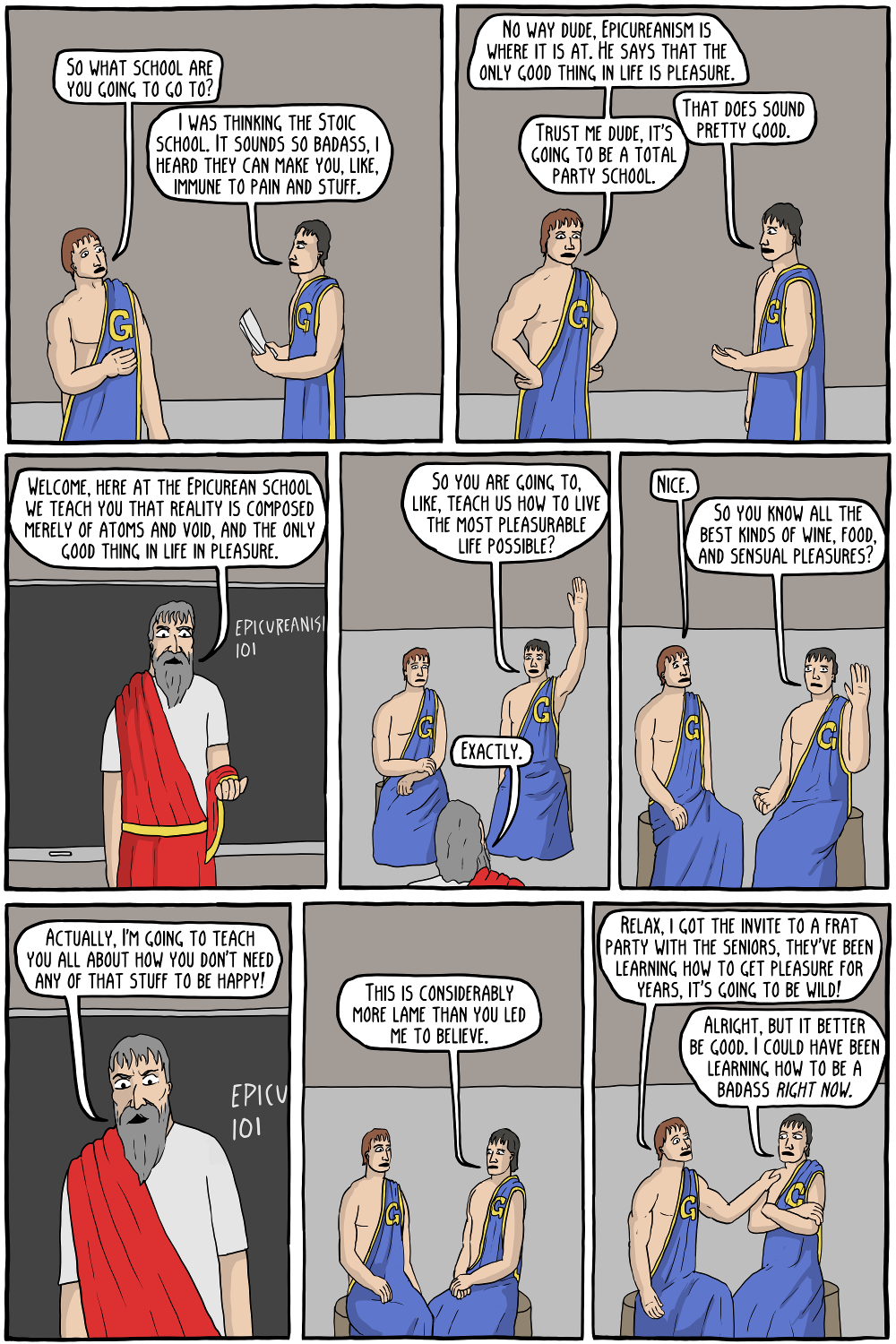
My own view is that  happiness is best pursued somewhere on the road between the stoics and epicureans, with an edge going to the latter. "The Stoics cared about virtuous behavior and living according to nature, while the Epicureans were all about avoiding pain and seeking natural and necessary pleasure." (Daily Stoic)

They were both right. But I think Epicureans have more fun, and are less likely to disengage from life's more pitted challenges-like the battle against mortality. Of course that's one we'll all lose in the end, but who knows when that will be? The brevity of life is no matter of indifference to me.

Image result for stoic epicurean cartoon

Epicureanism: the original party school

Also, we know Thomas Jefferson was no Saint. But he was an Epicurean... and sort of a Stoic too. He pursued happiness and (says Maira Kalman) everything.
"Before he attained domestic happiness he had probably worked out his enduring philosophy of life; it was marked by cheerfulness not gloom, and he afterwards described it as Epicurean, though he hastened to say that the term was much misunderstood. He came to believe that happiness was the end of life, but, as has been said, he was engaged by the "peculiar conjunction of duty with happiness"; and his working philosophy was a sort of blend of Epicureanism and Stoicism, in which the goal of happiness was attained by self-discipline." Dumas Malone, Jefferson the Virginian
And as for cynics and skeptics:

Most philosophers are moderate (not extreme) skeptics: their default mindset is to doubt and question what "everybody knows," so that truth, facts, and reality may emerge. George Santayana said skepticism is the chastity of the intellect, and you should guard it. But don't get stuck in doubt, like this guy (who very much resembles my dog Pita) on my desk at home. (Did you know, btw, that "cynic" means doglike?)


Also, don't get stuck in epicurean hedonism, stoic resignation (Stoic Pragmatists understand this), or cynical impropriety. You'll be happy not to live in a barrel or under a cloud.


Monday, August 26, 2019

Opening Day Fall 2019

Deja vu, all over again (but did you really say that, Yogi Berra? "I didn't say most of the things I said."): It's Opening Day! I get to introduce myself (and my dogs) to a batch of new students, and they get to reciprocate.
 [LISTEN... 2016...2013-"You don't have to follow me"... What college is for... Success at school vs. success in life]
And who said history doesn't repeat, but it definitely rhymes? Mark Twain? (When in doubt, attribute random witticisms to him.)

Whoever said whatever, history definitely does rhyme, and it echoes, on the first day of each new semester. I love Opening Day, when we're all still working with a clean slate and nobody's in the proverbial cellar. Yet.

I've been on an Alan Watts kick lately, for reasons somewhat obscure to myself. He said "you have no source," we're all source material, we're "IT"... but that doesn't mean we don't each have a series of starts. Ready, set, Goo (as in "Prickles & Goo")... [Alan Watts in "Her"... MALA report]

On an episode of Madam Secretary last season, Blake told his friend (who got booted from his government job because his girlfriend was apparently spying on the State Department) he ought to go into teaching. "You're just saying that because I like to rant." Well, that's one reason to do this job. I confess to the occasional rant, though I prefer to call it a spontaneous and impassioned moment of inspired righteous eloquence. You'll be the judges, at evaluation time.

Another and better reason to teach is because that's the best possible way to learn. My students have always taught me more than I taught them, as much when in error as not. The entire process of preparing to teach, class after class, is an education in itself.

So, Fall '19 co-philosophers, welcome! I look forward to learning from you. I'll try to hold the rants in check, and we'll hit the ground more softly than that benighted whale in Douglas Adams' odd guide to life, the universe, and everything. You didn't come here for an argument [yes they did/no they didn't], but you'll get that and more. ("You see," Alan says, "I'm a philosopher, and if you don't argue with me I don't know what I think. So if we argue, I say 'Thank you,' because owing to the courtesy of your taking a different point of view, I understand what I mean.")

And maybe we'll get just a little wiser.

If we don't get stuck.

Saturday, August 24, 2019

Big and bold

Continued moving Younger Daughter into her new digs yesterday, countless more schleps up steps, on an August afternoon that could have been worse. A nice breeze filled the breezeway, and I reminded myself that I'm lucky to have the opportunity to help. We're all lucky to have any opportunities at all, after all. We are the lucky ones, we must remember. After helping Older Daughter move to California three months ago, our luck this summer runneth over.

[LISTEN]

Besides schlepping, my job was to procure the right electronic cables to plug her into the virtual world. Ethernet, but one end had to be USB, and blah blah... it was a challenge. And the router was wrong, apparently. I'd rather just haul boxes up stairs, thank you. But she can get the right hardware. Do we have the right mental software to handle the silence of the again-emptied nest?

Next up, convocation. But I get to sit in the gallery this time, as a parent and not a faculty host. Interesting shift of perspective, as at new student orientation in June. Like standing on Mr. Keating's desk, seeing things from a different angle. A good thing to do, when you can.

 The speaker is Tara Westover,  who wrote her own harrowing and inspiring tale of surviving a wacko fundamentalist childhood and gaining a great education. If she could do it, why can't everyone? That's part of the message our First Years are supposed to have gleaned from the summer read. How'd she do it? Well, she read a lot. Eventually. That's another message: it's not too late to form studious habits, kids. Step away from the Ethernet. Discover some of the big bold ideas you came here for.

President McPhee concluded his State of the University address Thursday with a promise to "aggressively endeavor to pursue three big bold ideas," though the details were a little vague and the ideas a little less bold than Tara Westover will talk about.
Sidney A. McPhee (@PresidentMcPhee)
Outlined several bold ideas ⁦‪@MTSU‬⁩ will pursue in the coming academic year, including working with ⁦‪@cityofmborotn‬⁩ & ⁦‪@smcfarlandmboro‬⁩ to develop ideas to make both ends of our wonderful Middle Tennessee Blvd more vibrant! #TRUEBLUE mtsunews.com/fall-faculty-s…


Big Bold Idea #1:  to "leverage the future potential that the enhancements to Middle Tennessee Boulevard bring..." Those enhancements to the thoroughfare that runs past our building, the James Union Building, took years. I'm not sure quite what kind of potential he means, right now we're just grateful for the reduction in noise and inconvenience.

We'll be getting that back in spades, if we do boldly go on "to create a campus district to bolster student experience and tourism by transforming the area surrounding our campus into a vital and active educational, cultural, and commercial district."

Big Bold Idea #2:  to "build a business partnership hub closer to Nashville... and further respond to business and industry demands for employee education." Responding to "business and industry demands" is not what we educators, at least not those in the Liberal Arts, signed on for. We're here to educate and reflect upon and sometimes derail the demands of the society we serve, not surrender to them.

Big Bold Idea #3:  to "establish a tradition of immersive learning by incorporating a high-impact learning experience into each major." High-impact, huh? Just listen to Tara Westover. We already belong to that tradition, as custodians and practitioners of higher learning. There's no higher impact than the inner transformation that comes from immersing yourself in the best that's been thought, said, and done.

"We must continue to create innovative academic programs to anticipate the jobs of tomorrow and to prepare our students with the knowledge and skills to fulfill them and become productive citizens." Becoming a productive citizen, if productive doesn't just mean compliant and consumptive, is more than filling a job slot and being a cog in the industrial machine. I'd like to hear more from my president about the true meaning of education, the point of college.

Steel Barrel Raider IPA Then, the "True Blue spirit of passion and commitment" can be truly and meaningfully big and bold.

Meanwhile, I can report that the Steel Barrel Raider IPA they served up to faculty and staff at the stadium Beer Garden Thursday afternoon was plenty big and bold. Cheers!


Thursday, August 22, 2019

Begin again

Emerson wasn't talking about summer's end and the new school year's beginning, was he, when he said power ceases in repose and resides in transition? Coulda been.

Yesterday was another college move-in day, schlepping stuff up three flights in oppressive heat, this time off-campus but much closer to home as Younger Daughter transfers to my school this year. The annual anticipation of a clean slate, a fresh start, and a roster of unblemished courses never gets old. The promise of a new year is almost intoxicating, no less so for being vicarious. I have my own new year coming too, of course, as a professor. But the student's-eye-view is more expectantly thrilling, and I'm grateful for the opportunity to experience it again at immediate second-hand. (But do you really need such a big mirror, TV, etc.?)

It's kinda all down-hill from here, though a bit less steeply than usual. Tomorrow morning is the annual Fall Faculty meeting, when my colleagues and I are enjoined to pack Tucker Auditorium - the space normally reserved for dramatic entertainments of a higher order - and receive our university president's benediction for the new academic season. He'll crow about our inclusion in this year's Princeton Review. "One student says, 'You can literally major in fermentation and learn about the process of brewing beer.'" Literally. "Overall, students agree: 'This school is amazing, and it is such a hidden gem.'” Well alright us! 

Free lunch in the Student Union after the president dismisses us is always a good thing. Then a department staff meeting, which is apparently a necessary thing. Then, the new stadium beer garden will be inaugurated with a reception for faculty and staff. That's an event with potential.

Friday, a bit more schlepping is scheduled. Saturday is convocation, which I'm excited about this year because the speaker will be Educated author Tara Westover. Her story, from Idaho to Cambridge, is astonishing. It should inspire our students. It inspires me.

Monday is Opening Day. Hope springs eternal. Transition is power.

Wednesday, August 21, 2019

Mill's marketplace

The marketplace of ideas metaphor has been around for some time, notably in John Stuart Mill's 1859 On Liberty but not only there, as MTSU's helpful online First Amendment Encyclopedia reminds.

Mill: 
He who knows only his own side of the case, knows little of that. His reasons may be good, and no one may have been able to refute them. But if he is equally unable to refute the reasons on the opposite side; if he does not so much as know what they are, he has no ground for preferring either opinion. The rational position for him would be suspension of judgment, and unless he contents himself with that, he is either[Pg 68] led by authority, or adopts, like the generality of the world, the side to which he feels most inclination.
We don't see a lot of rational "suspension of judgment" lately, or even acknowledgement that there might be something negligent or amiss in allowing oneself to be "led by authority" or in surrendering to untutored inclination. We don't really have a thriving marketplace of ideas. It's more a marketplace of partisan malevolence, misrepresentation, misinformation, and misogyny. Was it ever thus? Was there a time when Mill's marketplace was vital, vibrant, and instructive? A time when collaboration, not vicious confrontation, was the marketplace norm?

Good questions for historians. For the rest of us, a better question is: what can we do to improve public discourse now and tomorrow? And for those of us in my corner of the university, we must ask what we can do to realize that "genuine philosophic universe" of healthy plurality and mutually-satisfying instigation that William James found so alluring in the Harvard philosophy program of his day. If we can learn to model even a modest version of that, the market may one day prosper us after all.