Delight Springs

Wednesday, September 23, 2020

Descartes Pascal Montaigne, rafts of trash...

LISTEN. It was good to have a change of scene for yesterday's Zoom classes, and great to stroll and dine with Younger Daughter on the first day of fall. 2020's been a down year but the days can still be gods.

Today in CoPhi we'll turn to three French philosophers, Descartes the pretend-skeptic, Montaigne the real one, and Pascal the gambler who wanted desperately to suppress his doubts in deference to the promises of faith.

Rene Descartes "meditated" himself into a conjured and contrived form of doubt, but never really doubted for an instant that the world revealed by the senses--beginning with the senses themselves, and our perception of ourselves as sensate creatures capable of encountering a world--is real enough. What he doubted was not his and our existence as embodied knowers, but the status of that knowledge. For him, if we're not indubitably certain then we know nothing.

C.S. Peirce the fallibilist, as noted in How the World Thinks, said it's an error to pretend to doubt in philosophy what we do not doubt in real life. That's one of Descartes's errors. His mind-body "ghost in the machine" dualism is another. The worry that life is but a dream is fun to discuss and make movies about (Matrix, Inception etc.) but whether we're dreams or dreamers may, as the Chinese sage said, be a distinction without a practical difference.

Blaise Pascal is best known for his famous Wager and its "What have you got to lose?" premise, but I'm more struck by his statement that the immensity and silence of the night sky terrified him. Fear in general seems to have motivated his approach to theology, specifically fear of eternal damnation. As we said in one of our Zoom sessions yesterday, fear-based thinking and living is ill-advised in politics. Probably in religion too. 

Michel du Montaigne's rhetorical/skeptical question was Que sais-je? What do I know? The answer depends on what we want from knowledge. If not Cartesian certainty, but practical guidance tempered by humility and a willingness to revise our beliefs and practices in the light of what we learn, then I think he knew quite a lot. He learned to get back on the horse that throws you, and knew that life should not be lived in fear of dying or anything else.

In Fantasyland today Kurt Andersen says Christian religiosity is "the grandest and greatest conspiracy of all" (89), and that Enlightenment skepticism received a religious make-over in America that predisposed the national mind to become an incubator of conspiracy-mindedness. The QAnon nonsense is just the latest incarnation of an old tendency, going back to the Freemasons whose big secret mission, said Ben Franklin, was that they had none.

Wouldn't it be nice if nations and traditions just stopped insisting on exclusive divine sanction for their beliefs?

In How the World Thinks today we wonder about Islamic notions of "perfect divine transcendental unity" and their dis-unifying consequences. 

Is ordinary experience, day to day, "nothing more than a powerful illusion"? 149 Does anyone ever really act as if they believed that? Is it possible to function effectively and happily with such an attitude? Or  in predestination and one's pre-"recorded destiny"? 154 Or in natural disasters that kill innocent people according to "God's will" for which the victims are nonetheless "culpable"? 155 

More too on Harry Frankfiurt's "bullshit" (162) and Jeremy Bentham's "felicific calculus" and Stephen Hawking's greatly exaggerated reports of the demise of philosophy (167). And a question about reductionism that reminds me of a mantra we met in the Atheism course several years ago: "physics fixes the facts." But not all of them, Baggini says, not if fixing means reducing. There are no car batteries in fundamental physics.

Speaking of cars, we'll start with them (see yesterday's post) in Environmental Ethics.

Then, that lovely passage about the Panthalassa Sea (etc.) Barbara Kingsolver had Hope Jahren read in their conversation at Harvard Bookstore. "The plants we burn," that flourished in sea and forest and 200-300 million years ago and became the coal, oil, and gas we fuel our lives with today, are not forever. They're non-renewable, and they may not last the century.

We fool ourselves into a false sense of complacency about that, with our innovations and our general confidence in the magic (in Arthur C. Clarke's ironic phrase) of technology. Take biofuels. "Today, 20 percent of the grain grown on planet Earth is converted to biofuels--that's a huge fraction for a planet that is also home to eight hundred million starving people." And biofuel energy wouldn't last the week, if we tried to substitute it for fossil fuels. (109)

And then there's plastic...

Remember The Graduate, and the word Benjamin Braddock was told to remember? "Almost ten percent of the plastic we throw away makes its way out to sea, where it has congregated into massive floating rafts of trash..." Some legacy.

But Hope's last words today are the ones I hope we'll hear. "I've found that fear makes us turn away from an issue, whereas information draws us in... It's not time to panic, it's not time to give up--but it is time to get serious. Fate has placed you and me squarely at the crossroads of environmental history."


Tuesday, September 22, 2020

Commuted

LISTEN. It's the autumnal equinox, the beginning of fall (and spring down under). The pool's too cool, the oatmeal suddenly appeals. “It is the summer’s great last heat, / It is the fall’s first chill: they meet.” Sarah Morgan Bryan Piatt (WA)


It'll soon be time to drive and peep at leaves, for those who do that sort of thing and who aren't conscientious about the recreational burning of fossil fuels in a warming world. Seeing the USA in your Chevrolet (or Corolla) isn't the responsible thing now, if you're concerned to set a good example and be the change we need. But I can't help it, Dinah's jingle makes me nostalgic. 

Dinah's ditty, though, is from decades ago, from the days when gas was cheap and our parents thought it would never run out. My late dad loved to drive, the longer and further the better. He was a veterinarian, but his true ambition growing up on the farm was to be a long-haul trucker and see the country. I don't think he ever got over that.

We didn't quite get around to discussing the last section of our reading in Environmental Ethics yesterday, "Moving Around" in Hope Jahren's Story of More. She gets off some good lines. "If I have a single bias as the author of this book, it is that I hate cars... Because I hate cars more than the Devil hates Jesus, it does not make me happy to tell you that the world currently contains close to one billion passenger vehicles."  

I don't feel quite so hostile to them myself, though my attitude took a big shift in that direction one chill night late in February 2018 when the I-24 commute I'd so long taken for granted nearly killed me. Well, not the commute per se, but a FedEx tractor trailer and a small passenger vehicle it swerved into my lane to miss. 

It's true that more people die in cars than are murdered and commit suicide combined, each year. It's almost certainly true that autonomous vehicles will ameliorate that. But it's truer still that we'd be smart to ditch cars for public transport. 20% of us drive 45 minutes or more to work and home each way, each day (typically closer to an hour for me, 42 miles, Nashville to Murfreesboro). Polls consistently reveal that to be one of our greatest aggravations and sources of stress. Losing my daily commute during the pandemic, I confess, and "biking to work" (to Zoom)--like Henry walks to work--has been its silver lining. 

Today, though, I'm looking forward to doing that commute so I can have lunch with my daughter and then Zoom from her balcony. Jahren complains that "most of what our cars do is take us away from the people we love, so that we can do the things that we have to do in order to buy more gas to put into our cars." Not today. Today my driving sentence is commuted. Today it'll be a pleasure.

Monday, September 21, 2020

Machiavelli, Hobbes, Draper, Dinah...

 LISTEN. We might be tempted in CoPhi today to describe the GOP's intentions of jamming RBG's successor through the Senate before November 3 as Machiavellian, in its ruthless abandonment of principle, or even Hobbesian in its monstrous display of authoritarian impugnity. But Machiavelli meant to inspire respect and fear, Hobbes awe. Trump, McConnell and their minions more inspire contempt and revulsion. RBG set the far better example. "Fight for the things that you care about, but do it in a way that will lead others to join you." Too bad they've only followed it in Lego-land.

But that's not what I want to wake thinking about this morning, I'd rather recall yesterday's lovely almost-Fall weather. Spent almost every moment of it in the wonderful open air, quality-hammock hanging time interrupted only by dogwalks and a bikeride. They've finally re-opened the lower loop at Percy Warner, making it feel like proper Sunday cycling again.

Margaret Renkl's paean to Fall captures the feeling of seasonal transition, with a reminder to make the most of these fine fleeting days that, for those of us of a certain age, symbolize sands through the hourglass. "Every day I'm given is as real as life will ever get. Now I understand that we are guaranteed nothing, that our days are always running out. That they have always, always been running out." Like Emerson said, the days are gods. Finite gods.

Roger Angell is no god, but as of Saturday he's a centenarian as well as a Hall of Famer. He says baseball’s “a great game for writers, just the right pace. You can watch the game and keep score and look around and take notes. Now and then you even have time to have an idea, which in many sports you don’t have room for.” (WA)

Here's an idea: wear a damn mask!

We went to family dinner in a restaurant Friday night, three of the four of us, surrounded by unmasked patrons. Jack Brown's burgers and beer (and cider) were magnificent, notwithstanding our fellow diners' indifference to public health and mutual support. The Ethicist has thoughts on people who act as though they're  among the “immune elite”.
"...Even if your optimistic assumptions were borne out, though, you should still join others in wearing a mask in public places. After all, people aren’t going to know why you aren’t wearing one. They may infer that you’re anti-mask or fear that you might pose a threat to them. At the same time, you would be eroding an important social norm. Whatever your personal risk profile, wearing a mask signals your support for a practice that can save lives; it helps maintain a public realm in which all of us do our share to contain transmission. For the same reason, you should continue with social distancing in public places..."


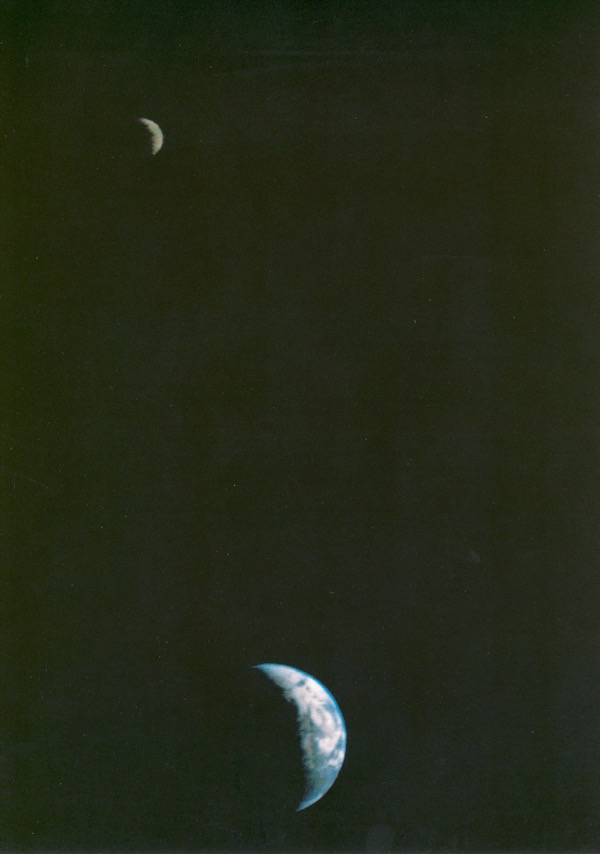
"Signaling" is not about self-righteousness in this instance, it's about upholding a shared commitment to making sure all our dwindling days don't run out before they have to. We're all riding this vulnerable space rock together, as that first Earth-Moon selfie from Voyager (9.18.77) first made graphic.

Voyager 1, 9.18.77

To those un-public spirited Machiavellian manques (not monkeys, resemblance aside) who think mutual support is for losers, I refer you to the Spanish triathlete who says it's simply a matter of fairness and just-dessert. He wins, at something far more important than a footrace. People like him (let's never forget that there still are people like him) remind us that we're not living in a nightmarish Hobbesian state of nature, a war of all against all, after all. They're the ones who truly redeem our species. 

And they answer Camus's question, Can one be a saint if God does not exist? Well, if by "saint" you mean an exemplary, kind, compassionate human, then of course. If you mean miracle-worker though... we'll talk about it when we get to David Hume. (No saint, he, but he had some good ideas nonetheless. And they say he was cheerful company, through the dwindling days.)

In Fantasyland, among other things we note Arthur C. Clarke's famous statement about technology and magic, the magic of homeopathy and Christian Science and get-rich-quick thinking. 

In How the World Thinks we wonder if the space between things is really so "empty," if it's what makes the relations and relationships between people and things meaningful. And we follow up our previous Augustine-inspired discussion of the nature of time. The Big Think is worth your time, on this topic.

And (this is not an after-though but, Time being what it is, my dawn-time’s about to expire this time) in Environmental Ethics today it's High Fructose Corn Syrup, the high cost of "convenience," over-consumption and its scaling-back as the great trial of our time, and other dire matters I may be taking much too lightly when I try to turn our attention to Don Draper's Coke (that's Coca-Cola) epiphany. Would you like to teach the world to sing? Would you like to see the U.S.A. in your Chevrolet? That song has just about run its course.


Thursday, September 17, 2020

Sisyphus on the lawn mower

 LISTEN. I was complaining yesterday, first in a tweet inspired by @MargaretRenkl's appreciation of a new book about turning boring lawns into multiform meadows, and later in class, about the lawn mowers next door upsetting my calm and disrupting my attempt to record a video. And then, they showed up in our yard. Good opportunity to practice what I've been preaching about stoicism, patience, ataraxia and all that.

I was still complaining, in Environmental Ethics, and musing about why it is that we've bought in to the whole lawn aesthetic. Why don't we all let a hundred flowers bloom, figuratively speaking? Why don't we let our grounds become the gardens they could be, let them grow and multiply and variegate, let our flora flourish, let our non-conformist freedom flags fly? 

Then I recalled reading Michael Pollan's first book Second Nature: A Gardener's Education, back in the early '90s before he became our leading authority on the ethics of food, farm policy, and the challenges and opportunities that accrue to omnivores like most (still?) of us. And, I recalled how much I used to hate riding the lawn on that "infernal machine" that left my nerves jangled and my mind in disarray. Pollan understood.

“Mowing the lawn, I felt like I was battling the earth rather than working it; each week it sent forth a green army and each week I beat it back with my infernal machine. Unlike every other plant in my garden, the grasses were anonymous, massified, deprived of any change or development whatsoever, not to mention any semblance of self-determination. I ruled a totalitarian landscape.
Hot monotonous hours behind the mower gave rise to existential speculations. I spent part of one afternoon trying to decide who, in the absurdist drama of lawn mowing, was Sisyphus. Me? The case could certainly be made. Or was it the grass, pushing up through the soil every week, one layer of cells at a time, only to be cut down and then, perversely, encouraged (with lime, fertilizer, etc.) to start the whole doomed process over again? Another day it occurred to me that time as we know it doesn't exist in the lawn, since grass never dies or is allowed to flower and set seed. Lawns are nature purged of sex or death. No wonder Americans like them so much.”

Sisyphus on a Zero-Turn John Deere, the "whole doomed process." 

Ed said he loves it. I don't. This one tests the limits of my pragmatic-pluralistic sensibilities, but okay. To each their own. Just think, though, how much more interesting our landscapes would be if we gave up the collective unspoken conspiracy against lawn diversity. Bio-diversity. We've got to get ourselves back to the meadow. Let's cultivate our garden.


Tuesday, September 15, 2020

WEIRD, in a good way

LISTEN. We're WEIRD, we westerners, says a new book by Harvard anthropologist Joseph Henrich (THE WEIRDEST PEOPLE IN THE WORLD: How the West Became Psychologically Peculiar and Particularly Prosperous). It's the subject of a glowing Times review by Daniel Dennett. 

That's an acronym, and not necessarily an aspersion. It means we're western, educated, industrialized, rich, and democratic. Being weirdly western predicts that a great many of us 

are individualistic, think analytically, believe in free will, take personal responsibility, feel guilt when we misbehave and think nepotism is to be vigorously discouraged, if not outlawed. Right? They (the non-WEIRD majority) identify more strongly with family, tribe, clan and ethnic group, think more “holistically,” take responsibility for what their group does (and publicly punish those who besmirch the group’s honor), feel shame — not guilt — when they misbehave and think nepotism is a natural duty.

These traits are hallmarks, generally, of what we call western civilization. We were talking about that in Environmental Ethics yesterday, some of us wondering whether there's a baby worth saving in the murky bath of the western imperialist aggression  that began by displacing indigenous Americans and has proceeded to walk not so softly and wield a rude self-aggrandizing stick in foreign policy ever since... all while committing and excusing domestic sins of social injustice and oligarchic corruption.

Some of us actually weren't wondering that, so much as insisting that bath and baby were all too far gone to save, too stained by past bad behavior and present venality to defend.

I say the west at its best has been an advocate for reason and the light of science, the very tools we need to critique and reform our tradition's worst excesses. To those who say we're beyond redemption, at least in the shrinking time-frame in which we must reconstruct the meaning of our democratic experiment, I say you may be right. Hope not.

So what in our WEIRDness is worth conserving and preserving?

The freedom to be Stoics and Epicureans, to move to the country and eat a lot of peaches etc. We spoke yesterday of communal experiments in non-conventional living, of voluntary simplicity and the rights of individuals to seek their own good in their own way. (William Morris was mentioned, and Brooke Farm, and The Farm, and even the aspirant non-commercial spirit of Bonnaroo and Burning Man.) Doing the counter-cultural thing in a non-conformist way requires courage of the Kantian sapere aude variety.

The freedom to scissor your bible, Jefferson-style, is an Enlightenment exercise in personal self-governance it'd be a shame to abandon.

The freedom to defy "tradition" in the pursuit of happiness is wonderfully WEIRD too.

The advent and continuing refinement of Pragmatism has been one of western culture's better contributions to world philosophy. Baggini's discussion of James, Dewey, Peirce, and Rorty in How the World Thinks comes just in time to address what's missing from any pure Stoicism. Epictetus the slave might understandably have been indulged in such purity, but western culture's expansion of individual liberty gives most of us now the opportunity to act and at least try to alter events. Before we resign ourselves to impotence, before we seek refuge in mere understanding and acceptance as the fullest extent of our freedom, we can do something. "Even if it's wrong," as my old friend in Carolina says.

I composed and thought I'd posted a bunch of questions for discussion, pertaining to the Baggini chapters. They've vanished, maddeningly, but I do want us today -- or eventually, we'll revisit the subjects of Pragmatism and Tradition later in the semester -- to ponder Peirce's statement about not pretending to doubt in philosophy what we do not doubt in our hearts, Dewey's repudiation of "the problems of philosophers" in favor of "the problems of men," and James's quintessentially pragmatic question, "What concrete difference will its being true [or being believed to be true] make in anyone's actual life?" 

Baggini proposes finally that Americans "appreciate better the virtues of their indigenous pragmatic philosophers," by whom I think he means the likes of Peirce, James, and Dewey, with their roots in British empiricism. 

But of course there were truly indigenous American philosophers on the North American continent before them. See Scott Pratt's Native Pragmatism: Rethinking the Roots of American Philosophy and Bruce Wilshire's Primal Roots of American Philosophy for details. Our willingness to rethink our tradition, to reject chauvinism and reclaim those roots, is itself one of the finer flowers of enlightened western culture. I think it's worth cultivating. Not eradicating. Let's cultivate our garden.

Monday, September 14, 2020

Hope in stressful times

LISTEN. Margaret Renkl has once again found and borrowed the just-right words for what so many of us are feeling.

The news feels nothing less than apocalyptic. Climate change on irrefutable display as wildfires turn California and the Pacific Northwest into a furnace, as hurricanes gather and floodwaters rise. Universities returning to in-person classes just in time to worsen the already raging pandemic. Deepening economic pain as aid to our most vulnerable communities expires. Black men still getting shot in the back. Russia interfering with our election, and a Russia-supported president using the White House — our house — as a backdrop for a political convention that promulgated nothing but lies.

I could keep going, nonstop, until Nov. 3, but I’ll end the list right here lest your own blood pressure rise to a worrisome level.

I have friends who tell me that they can’t follow the news anymore, that it makes them too upset to sleep. It’s like the topless dancer’s advice in John Prine’s song “Spanish Pipedream”:

Blow up your TV, throw away your paper
Go to the country, build you a home
Plant a little garden, eat a lot of peaches
Try and find Jesus on your own

Blow up all your news and social media appliances, I'm tempted to add. I'm not looking for Jesus, but more peace and peaches would be great. Actually Jesus in this song does mean peace and equanimity, something like what the Greeks called ataraxia - "the ability to remain calm despite fear, anger, sadness, or stress." Prine's Jesus, like Tom T. Hall's, was a Stoic of sorts. But, not the sort that renounces all hope. Alain de Botton of the School of Life is that sort, or says he is, but I still like his videos about the Stoics. They're upbeat and fun, words we don't usually associate with the likes of Seneca.

And by a happy coincidence, we're talking Stoicism in CoPhi today. 

And Epicureans. (And the Enlightenment, as fathomed in  Andersen's Fantasyland by Kant and Jefferson... And "tradition,"  and Pragmatism as apprehended by Baggini in How the World Thinks, as we conclude Part One of that book... Lots to work out. Good distraction from the news.) 

But Renkl's right, we can't just retire to the country and leave the country in the hands of the lying liars and reality-deniers. We've got to do something about them. We've got to vote, for a start. That's only a start, she concludes. 

It always helps to plant a little garden, that’s true, but Mr. Prine understood, even as he wrote, that hiding out from bad news was only ever a dream.

Commitment is what changes things. Hard work is what changes things. Powerless outrage doesn’t help anyone, the outraged least of all. nyt

So be a Stoic, but be a Pragmatist too. Stoic Pragmatists like John Lachs have a good thing going. They're "committed to making life better until their powers are overwhelmed." They're not yet ready to pack it in.

Today in Environmental Ethics we pick up a new book, paleobiologist Hope Jahren's The Story of More: How We Got to Climate Change and Where to go from Here. She's a terrific writer, one of the charmed few who can speak both Science and English fluently, bridging the "two cultures" and making you laugh -- even at something so dire and depressing as climate change -- in the process. 

Hope's not ready to pack it in yet either. I've recommended that the class take a look at the conversation she had with the great novelist/environmentalist Barbara Kingsolver at Harvard Bookstore last month. They're both my kind of pragmatists, committed to doing something on the immediate and personal scale about climate change rather than surrender to the Overwhelm. Hope trumps fear. But of course, we must also act collectively with our peers. Personal action is no substitute for activism.

In her earlier book Lab Girl, she said “My laboratory is like a church because it is where I figure out what I believe." I like that a lot, and will borrow it. My classroom, my desk, my recliner, my hammock, my dogwalks, my bikerides... they are my churches. And oh yeah, the ballparks... if they ever let me back in. I'm an unintentional lapsed congregant of the Church of Baseball, which does not play well for me on TV in front of cardboard cutouts. And football, if anything, is even weirder without spectators. 

(Speaking of WEIRD, Dan Dennett has a glowing review of a new book by Joseph Henrich that says we westerners are just that: "Western, educated, industrialized, rich, democratic". But what does he mean, we?)

I also like that, like the Lorax and Bill McKibben, she speaks for the trees. "Planet Earth is nearly a Dr. Seuss book made real: every year since 1990 we have created more than eight billion new stumps. If we continue to fell healthy trees at this rate, less then six hundred years from now, every tree on the planet will have been reduced to a stump. My job is about making sure there will be some evidence that someone cared about the great tragedy that unfolded during our age.”

I also like the serendipity of the fact, on Stoic day in CoPhi, that Hope begins with an old Stoic. The universe is change; our life is what our thoughts make it, said Marcus Aurelius Antonius. For an emperor he was a pretty good thinker, but of course our thoughts only make something better of the universe because thought drives action.

And as for Enlightenment, Mr. Light Bulb: too bad the guys who first drove us to drive to excess, Edison, Ford, and Firestone, didn't act on the thought Edison expressed: The sun and solar energy. What a source of power! I hope we don't have to wait until oil and coal run out before we tackle that.

What a change in our present circumstances they might have driven.

Sunday, September 13, 2020

Democracy in America (MALA 6050)

Coming to MTSU, Spring 2021 (Tuesdays 6-9 pm on Zoom)

MALA 6050 -
Democracy in America

WATCH. This 3-credit Master of Liberal Arts remote course will begin with a nod to the eponymous 19th century classic by Alexis de Tocqueville, then glance at John Dewey's Democracy and Education (1916), and proceed to examine the condition and prospects for American democracy as assessed by contemporary observers Nancy MacLean, Anne Applebaum, and Robert Talisse. We'll conclude by venturing our own evaluations, understanding the always-tentative nature of political prognostication that must be even more uncertain in unsettled times like our pandemic present. But we'll risk it.

Much, of course, depends on the outcome and integrity of the November presidential election and its aftermath. Our course will address that as well.

Genuine democracy in the world has been a rare and precious achievement, historically. Is our democracy now really "in chains" (MacLean), in "twilight" (Applebaum), are we "overdoing" it to the point of possible extinction (Talisse)? A nation that values its freedom must face these questions. That's our mission in this course.


~~~~~

"Alexis de Tocqueville, a young French aristocrat, came to the young nation to investigate the functioning of American democracy & the social, political & economic life of its citizens, publishing his observations in 1835 & 1840...many of the observations still hold true: on the mixed advantages of a free press, the strained relations among the races & the threats posed to democracies by consumerism & corruption." g'r


He wrote: “Without common ideas, there is no common action, and without common action men still exist, but a social body does not. Thus in order that there be society, and all the more, that this society prosper, it is necessary that all the minds of the citizens always be brought together and held together by some principle ideas.”

And: “[Patriotism] is in itself a kind of religion: it does not reason, but it acts from the impulse of faith and sentiment.”

And: “Nothing is more necessary to the culture of the higher sciences, or of the more elevated departments of science, than meditation; and nothing is less suited to meditation than the structure of democratic society.”

And: “It was never assumed in the United States that the citizen of a free country has a right to do whatever he pleases; on the contrary, social obligations were there imposed upon him more various than anywhere else.”

And: “Nothing is more wonderful than the art of being free, but nothing is harder to learn how to use than freedom.”

And much, much more that seems to speak directly to us in our day.

Democracy and Education Conference | Center for American Studies


John Dewey
“If a plague carried off the members of a society all at once, it is obvious that the group would be permanently done for. Yet the death of each of its constituent members is as certain as if an epidemic took them all at once. But the graded difference in age, the fact that some are born as some die, makes possible through transmission of ideas and practices the constant reweaving of the social fabric. Yet this renewal is not automatic. Unless pains are taken to see that genuine and thorough transmission takes place, the most civilized group will relapse into barbarism and then into savagery.” Democracy and Education (1916)

Nancy MacLean
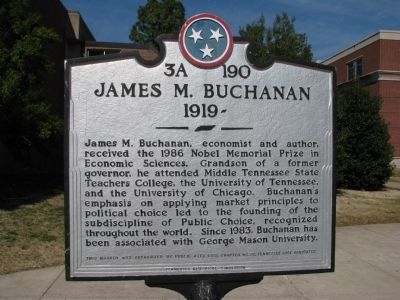
"Behind today’s headlines of billionaires taking over our government is a secretive political establishment with long, deep, and troubling roots. The capitalist radical right has been working not simply to change who rules, but to fundamentally alter the rules of democratic governance. But billionaires did not launch this movement; a white intellectual in the embattled Jim Crow South did. Democracy in Chains names its true architect—the Nobel Prize-winning political economist James McGill Buchanan—and dissects the operation he and his colleagues designed over six decades to alter every branch of government to disempower the majority... MacLean shows how Buchanan forged his ideas about government in a last gasp attempt to preserve the white elite’s power in the wake of Brown v. Board of Education. In response to the widening of American democracy, he developed a brilliant, if diabolical, plan to undermine the ability of the majority to use its numbers to level the playing field between the rich and powerful and the rest of us..." g'r
James M. Buchanan Historical Marker
On MTSU's campus
MacLean writes: “Public interest has been subordinated to private interest, and when there is no clear distinction between them, it opens the door to endless opportunities for corruption.”

And: “Those who subscribe to the libertarian philosophy believe that the only legitimate role of government is to ensure the rule of law, guarantee social order, and provide for the national defense. That is why they have long been fervent opponents of Medicare, Medicaid for the poor, and, most recently, Obamacare. The House budget chairman, Paul Ryan, has explained that such public provision for popular needs not only violates the liberty of the taxpayers whose earnings are transferred to others, but also violates the recipients’ spiritual need to earn their own sustenance.”

And: “For all its fine phrases, what this cause really seeks is a return to oligarchy, to a world in which both economic and effective political power are to be concentrated in the hands of a few. It would like to reinstate the kind of political economy that prevailed in America at the opening of the twentieth century, when the mass disfranchisement of voters and the legal treatment of labor unions as illegitimate enabled large corporations and wealthy individuals.” Democracy in Chains: The Deep History of the Radical Right's Stealth Plan for America 

Anne Applebaum
"Across the world today, from the Americas to Europe and beyond, liberal democracy is under siege while populism and nationalism are on the rise. In Twilight of Democracy, prize-winning historian Anne Applebaum offers an unexpected explanation: that there is a deep and inherent appeal to authoritarianism, to strongmen, and, especially, to one-party rule--that is, to political systems that benefit true believers, or loyal soldiers, or simply the friends and distant cousins of the Leader, to the exclusion of everyone else. People, she argues, are not just ideological; they are also practical, pragmatic, opportunistic. They worry about their families, their houses, their careers. Some political systems offer them possibilities, and others don't. In particular, the modern authoritarian parties that have arisen within democracies today offer the possibility of success to people who do not thrive in the meritocratic, democratic, or free-market competition that determines access to wealth and power." g'r

She writes: “Throughout history, pandemics have led to an expansion of the power of the state: at times when people fear death, they go along with measures that they believe, rightly or wrongly, will save them—even if that means a loss of freedom.”

And: “To some, the precariousness of the current moment seems frightening, and yet this uncertainty has always been there. The liberalism of John Stuart Mill, Thomas Jefferson, or Václav Havel never promised anything permanent. The checks and balances of Western constitutional democracies never guaranteed stability. Liberal democracies always demanded things from citizens: participation, argument, effort, struggle. They always required some tolerance for cacophony and chaos, as well as some willingness to push back at the people who create cacophony and chaos.” Twilight of Democracy: The Seductive Lure of Authoritarianism 

Robert Talisse
"We live in an age of political polarization. As political beliefs on the left and the right have been pulled closer to the extremes, so have our social environments: we seldom interact with those with whom we don't see eye to eye. Making matters worse, we are being appealed to--by companies, products, and teams, for example--based on our deep-seated, polarized beliefs. Our choice of Starbucks or Dunkin' Donuts, Costco or Sam's Club, soccer or football, New York Times vs. Wall Street Journal is an expression of our beliefs and a reinforcement of our choice to stay within the confines of our self-selected political community, making us even more polarized. Letting it bleed into these choices in every corner of our lives, we take democracy too far and it ends up keeping us apart. We overdo democracy.

When we overdo democracy, we allow it to undermine and crowd out many of the most important social goods that democracy is meant to deliver. What's more, in overdoing democracy, we spoil certain social goods that democracy needs in order to flourish. A thriving democracy needs citizens to reserve space in their social lives for collective activities that are not structured by political allegiances. To ensure the health and the future of democracy, we need to forge civic friendships by working together in social contexts in which political affiliations and party loyalties are not merely suppressed, but utterly beside the point.

Drawing on his extensive research, Talisse sheds light on just how deeply entrenched our political polarization has become and opens our eyes to how often we allow politics to dictate the way we see almost everything. By limiting our interactions with others and our experience of the world so that we only encounter the politically like-minded, we are actually damaging the thing that democracy is meant to preserve in the first place: the more fundamental good of recognizing and respecting each other's standing as equals."Overdoing Democracy: Why We Must Put Politics in its Place g'r

Thursday, September 10, 2020

Glorious good luck

LISTEN. It's Cousin Mary's birthday. Poet Mary Oliver is one of my favorite dawn role-models. She said "If anybody has a job and starts at 9, there’s no reason why they can’t get up at 4:30 or five and write for a couple of hours, and give their employers their second-best effort of the day — which is what I did.” Her best efforts were marvelous. I mentioned Ursula Goodenough's Sacred Depths of Nature in Environmental Ethics yesterday, that was her great theme: sacred nature, precious and fragile and finite. "...the world offers itself to your imagination, calls to you like the wild geese, harsh and exciting—over and over announcing your place in the family of things."

And she loved dogs too. If only we could be as happy as they seem, always ready to be transfixed and transported by the simple sights, sounds, and especially scents of "the heaven of earth."

The Almanac also reports that it's Stephen Jay Gould's birthday. “Homo sapiens [are] a tiny twig on an improbable branch of a contingent limb on a fortunate tree.” In other words, we're darned lucky. I'm grateful for our good luck. It's important to remember, especially lately, that we're the lucky ones. 

I felt lucky the other day when I turned on YouTube and the top of my recommendations featured Gould, Dennett, Sacks, Dyson, and others in that Glorious Accident Dutch banquet that so captivated my imagination when I first encountered it on public television in the '90s. "Six smart guys sitting around talking," even six middle-aged white guys, can be surprisingly thrilling. Just like class, when we're lucky. 


But as Dennett suggests, echoing Branch Rickey, our best good luck is not a total accident. There's no master Plan, but there's planning.

"One thing that does make us unique as a species is that for the last five or ten thousand years we have been the beneficiaries of conscious planning by our parents and their parents and the cultures in which we've resided. Today we are actively concerning ourselves with what the world is going to be like in the future. We have strong beliefs about this. They play a role in what Homo sapiens is going to be like a thousand years from now." Springs

They will, if we're lucky.

Wednesday, September 9, 2020

Cosmic, peripatetic, and environmental philosophy-an unsilent rebuke

LISTEN. WATCH. Exciting day in Zoom-land ahead, beginning with a visit from our regional Peace Corps rep.

The best reason to consider serving in the corps may be the same that Pico Iyer offers for going to college: "to learn that the world is more than the issues that divide us." And, "the best reason to go to school, even if you’re a so-called teacher, is to find out how much you don’t know." Socrates never said it better.

Then, in CoPhi, two of the topics nearest my heart: cosmic and peripatetic philosophy. But from the perspective of motion they're the same topic, as I was saying yesterday in class: it's all about getting up and moving, investigating your environs, indulging your curiosity, giving your imagination free reign, wondering and wandering. It's about the adventure and the journey (wherein lies the nectar, as John McDermott always said), and about boldly going to see what's out there.

“Although walking arises from our deep, evolutionary past, it is our future too: for walking will do you all the good that you now know it does.” And,

"walking enhances every aspect of our social, psychological and neural functioning. It is the simple, life-enhancing, health-building prescription we all need, one that we should take in regular doses, large and small, at a good pace, day in, day out, in nature and in our towns and cities. We need to make walking a natural, habitual part of our everyday lives.” Shane O'Mara, In Praise of Walking: A New Scientific Exploration, g'r

In Environmental Ethics we'll finish Attfield's Very Short Intro. The penultimate chapter on religion and the environment seems to me to give a pass to those who insist that the world is in His hands, not ours, and that we're all covered by The Plan. On cosmic philosophy day I have to recall Carl Sagan's Pale Blue Dot reminder that we've seen no sign of help coming to rescue us from our own cupidity and Oncelerism.

Sagan's little book The Cosmic Connection was mind-expanding and perspective-multiplying for me, when I discovered it in youth. It propelled me to philosophy as surely as anything. Then, as I commenced grad school, Cosmos came along and confirmed my emerging cosmopolitanism.

Sagan's The Varieties of Scientific Experience: A Personal View of the Search for God (based on his 1985 Gifford Lectures in Scotland, echoing William James's Gifford Lectures of the early 20th century which became The Varieties of Religious Experience, also makes an important point that most religion heretofore has been not only anthropocentric, but geocentric: “we have a theology that is Earth-centered and involves a tiny piece of space, and when we step back, when we attain a broader cosmic perspective, some of it seems very small in scale. And in fact a general problem with much of Western theology in my view is that the God portrayed is too small. It is a god of a tiny world and not a god of a galaxy, much less of a universe.” We're going to need a bigger god, if religion is going to serve in the present crisis.
I fear the extremity of our politicized fundamentalist/evangelical religious culture in the U.S. makes E.O. Wilson's appeal for unity across the religious-political divide futile, though still noble.
We have not met, yet I feel I know you well enough to call you friend. First of all, we grew up in the same faith. Although I no longer belong to that faith, I am confident that if we met and spoke privately of our deepest beliefs, it would be in a spirit of mutual respect and goodwill. I write to you now for your counsel and help. Let us see if we can, and you are willing, to meet on the near side of metaphysics in order to deal with the real world we share. I suggest that we set aside our differences in order to save the Creation. The defense of living Nature is a universal value. It doesn't rise from nor does it promote any religious or ideological dogma. Rather, it serves without discrimination the interests of all humanity.
Pastor, we need your help. The Creation—living Nature—is in deep trouble. The Creation: An Appeal to Save Life on Earth
The appeal is admirable, if now a little desperate.

In the final chapter, Attfield makes a direct and startling appeal of his own, to American readers in particular, "encouraged to use their voices (and if necessary their votes)..." to get their country back on the right side of eco-responsibility.

And he ends with a plea for unity among Deeps, Greens, ecofeminists, seculars, et al, to "preserve the Earth and its sacred places. For the future of the planet and all its species is at stake." Again, an admirable appeal. But the game is in its late innings. As Pico Iyer says, we must understand that the world is more than the issues that divide us.

And as Ann Druyan says, for that we need a global spiritual awakening. 
"The pale blue dot is a silent rebuke to the fundamentalist, the nationalist, the militarist, the polluter -- to anyone who does not put above all other things the protection of our little planet and the life that it sustains in the vast cold darkness... We all feel the chill our present casts on our future. Some part of us knows that we must awaken to action or doom our children to dangers and hardships we ourselves have never had to face.  How do we rouse ourselves and keep from sleepwalking into a climate or a nuclear catastrophe that may not be reversed before it has destroyed our civilization and countless other species? How do we learn to value those things we cannot live without -- air, water, the sustaining fabric of life on Earth, the future -- more than we prize money and short-term convenience?" Cosmos: Possible Worlds
I ask a lot of questions. None are bigger than those.  

Tuesday, September 8, 2020

Harmony

LISTEN. WATCH (please pardon the abrupt phone interruption at the end). Speaking of harmony, and visions of a harmonious world that seems beyond present reach but is still worth reaching for... Today in 1966, Star Trek (the original, with Shatner's Kirk and Nimoy's Spock and Takei's Sulu, et al) debuted. It featured Gene Roddenberry's vision of a harmonious earth, c.Century 24. A harmonious federation of planets, in fact. There are still Klingons and Romulans, but their aggression is seen as incongruous and on the wrong side of galactic history. And btw, Spock's Vulcan philosophy of IDIC ("infinite diversity from infinite combinations") sounds a lot like Confucian harmony as explicated by Julian Baggini (more on that shortly). Total harmony eludes the half-human science officer, as it eludes us wholly-human earthlings. But we can continue to evolve, if we remain open to that harmonious vision.

Also worth noting: Taoist harmony is about one's relation to, or place in, nature. The Tao is the way, the road, the path forward to greater natural accord. So, as my bumper sticker says, walk your path to enlightenment. Later this week we'ere going to look at cosmic and peripatetic philosophy. Both are ways forward. Ad astra, per aspera, to the stars, through hardship... but before we can navigate the stars we must learn to tread the earth together in peace.

(Someone asked me the other day, coincidentally on the same day I published another paean to Trek, if I liked sci-fi. I do. Cli-fi too, as noted in Environmental Ethics.)

Star Trek Vulcan IDIC | Etsy

Labor Day this year should have had a particular resonance for a society, a world, suddenly forced to realize just how essential are the workers who do most of the heavy lifting for us all, who stock and sell and deliver the goods and services we now find we really can't (or don't want to) do without, and who've been taken for granted for too long. It's past time we compensated and appreciated them more tangibly.

We're taking a day in CoPhi to glance back at what we've read so far in How the World Thinks. Julian Baggini's lecture in The Netherlands last Fall is worth a look, with its particular insights into key differences between eastern and western ideas about things like "harmony" (as we'll read in a later chapter). Westerners generally seem more accepting of strife and conflict, as the natural accompaniment to what we call our individual liberty. But the disharmony this pandemic has blasted into our lives may have many of us reconsidering.

When I think of harmony I recall the discussion in the first text I ever used in my Intro course, back before it became CoPhilosophy. 
"Confucius and Lao Tzu agreed on their overall emphasis on harmony as the ideal state of both society and the individual, and they insisted on an all- encompassing or "holistic" conception of human life that emphasizes a person's place in a larger context. For both Confucianism and Taoism, the development of personal character is the main goal in life, but the personal is not to be defined in individualistic terms. For the Confucian, the personal is the social. For the Taoist, the personal is the relation to nature ...[they] were in considerable agreement on the necessity of harmony in human life and a larger sense of the "person" than the mere individual." Robert C. Solomon and Kathleen Higgins, A Passion for Wisdom: A Very Brief History of Philosophy
The mere individual, we've seen, when given a megaphone and a following in the age of Twitter and other social media, can create unsettling waves of disharmony that many of us find too high a price to pay for our vaunted self-importance.

You know which "mere individual" I'm thinking of, in particular. He has so much to be modest about, but so little modesty. Or dignity, or decency. In the name of harmony, and the urgent need for a model of leadership our children can respect and emulate as they pursue the harmonious development of their own personal characters -- not to mention peace, justice, social stability, and environmental sustainability -- it's time for him to go. Delete his account.

Thursday, September 3, 2020

Logic, cherries, boxes, pragmatists...

LISTEN. "The stress on logic has been the most distinctive feature of Western philosophy," ever since Aristotle. (HWT 54). It's important to be "logical," as Mr. Spock was always impatiently urging his more-than-half-human shipmates, if you want to sustain a rational comprehension of your place in the galaxy and if, at least in the western tradition, you want to be philosophically correct. It's hard to live long and prosper if you consistently hold and act upon logically inconsistent or incompatible beliefs.

In his first Pragmatism lecture William James pointed out that most of us mix and match our philosophical beliefs and tendencies in ways that challenge the call for consistency. He gives us two broad types of thinker, tough and tender-minded, enumerates their respective traits, and then notices how often we cherry-pick our preferences in ways that don't quite hang together with logical transparency.

THE TENDER-MINDEDTHE TOUGH-MINDED
Rationalistic (going by 'principles'),
Intellectualistic,
Idealistic,
Optimistic,
Religious,
Free-willist,
Monistic,
Dogmatical.
Empiricist (going by 'facts'),
Sensationalistic,
Materialistic,
Pessimistic,
Irreligious,
Fatalistic,
Pluralistic,
Sceptical.

"Most of us have a hankering for the good things on both sides of the line. Facts are good, of course -give us lots of facts. Principles are good - give us plenty of principles. The world is indubitably one if you look at it in one way, but as indubitably is it many, if you look at it in another. It is both one and many -let us adopt a sort of pluralistic monism. Everything of course is necessarily determined, and yet of course our wills are free: a sort of free-will determinism is the true philosophy. The evil of the parts is undeniable; but the whole can't be evil: so practical pessimism may be combined with metaphysical optimism. And so forth -your ordinary philosophic layman never being a radical, never straightening out his system, but living vaguely in one plausible compartment of it or another to suit the temptations of successive hours." The Present Dilemma in Philosophy
We talked about this, sort of, in Environmental Ethics yesterday. Cherry-picking (or box-shuffling, by Ed's preferred mix-and-match metaphor) among approaches and methods is perhaps unduly flattered and dignified by the designation "pragmatic pluralism." Mr. Spock likely would not be impressed, nor would those of my colleagues whose Excluded Middle attitude is typically, with respect to a given problem and proposed solution in philosophy: "I'm right, you're wrong." And, they sometimes add, $%*# you.

Well $%*# them, is my "Rocky Mountain tough" riposte. It's a big and often-unpredicted (maybe in principle unpredictable) galaxy, there just are times when it makes more sense to take a utilitarian tack, others deontological, others Aristotelian etc. How do you like them cherries?

But our philosophic culture is intransigently "dualistic," deep in its bones, allowing only for "true or false, winner and loser." (59) At the same time "we [humans] are intuitive, emotional and heavily influenced by others and our environment." (68)... so, can we be consistently rational? We can only try, and hope to get better at it. By my reckoning, as a pragmatic pluralist, that means getting better at discerning when to cross a line and take a different tack. To the critics, this strategy will never be rational and this logic will never parse. But that's alright. As James also said, “Our errors are surely not such awfully solemn things. In a world where we are so certain to incur them in spite of all our caution, a certain lightness of heart seems healthier than this excessive nervousness on their behalf.” (Will to Believe)

And so I forgive the anti-pragmatists their errors.

Many in our tradition continue to invoke supernaturalism as an ultimate non-explaining explainer, but "the human mind works without supernatural assistance" (HWT 70). Logic is definitely one of secular reason's indispensable tools, but logic alone wouldn't motivate us to think for ourselves. Curiosity and a feeling for the wonder of discovery must be there too, as Spock's half-submerged human half had to keep reminding him.

Star Trek Live Long and Prosper" Greeting Card by seaning | Redbubble

Wednesday, September 2, 2020

Sustained

Today in Environmental Ethics we ask if a sustainable civilization must at some point, possibly the point we passed the day before yesterday, impose limits on its own growth. Or whether it must acknowledge nature's ecological limits. But because whatever is sustainable is not necessarily good, we must also ask what in our present ways of living we ought to cease sustaining.


I say: sustain life, diversity, renewability, survival, and ultimately the conditions of human flourishing. Stop sustaining consumption for its own sake, work for the sake of consumption, environmental degradation and destruction for the sake of the work-consume-work-consume cycle of "growth."

We were talking Aristotle in CoPhi, he'd have something to say to us about real growth and flourishing, and how our infatuation with Gross Domestic Product and the like under-serves our greatest potential for arete, excellence, virtue in the deepest sense. He'd side, I'm pretty sure, with the Bhutanese and others who've proposed better measures like Gross National Happiness.

But he'd challenge us all to think more deeply than American pursuers of happiness typically do, about what happiness is really all about. Eudaimonia, I love to say, does not mean you work hard, consume excessively, and then you die. It means you only begin to live when you give up the false conceit that living successfully means getting and spending, depleting resources and accumulating consumer crap.

We're like acorns and oaks, but with a sense of self and an awareness of possibility and choice. We're happiest in the fullest eudiaimonic sense when we've indentified and then commited and strived to achieve our ownmost virtuous excellence  in every facet and dimension available to us... and have done so in a harmonious community of our peers.

"Success"--What's that, Willy James? “The moral flabbiness born of the exclusive worship of the bitch-goddess SUCCESS. That - with the squalid cash interpretation put on the word 'success' - is our national disease.” So he told Time Machine inventor H.G. Wells. Just wish he'd not confused things by calling Pragmatism a quest for "cash value." Metaphors can enlighten but can also mislead. Point is, successful living does not correlate with your bank balance or your contribution to Jeff Bezos's bottom line.

So to answer my first discussion prompt today, Yes. I do think there are inherent "limits to growth" that should constrain cultural and personal behaviors that cannot be sustained indefinitely. As one of us pointed out in class the other day, many of us would need 3 or more earths to sustain the consumptive lifestyles we've so casually fallen into.

But here's something positive the pandemic's brought about, if only temporarily: the personal practice of mine that from an ecological standpoint has most troubled me, these many years of my employment by the big school nearly an hour down the road, has been halted since March. My daily fossil fuel burn, my commute down and back on I-24, has halted in its tracks. When we go back to "normal" I'm going to have to give serious consideration to becoming a bus commuter, even though it will lengthen the time of my commute.

Or else we're going to have to revisit a move.

But I'm still skeptical that either of those personal lifestyle changes, or any lifestyle changes no matter how prevalent across our culture, will really address the greatest threats to a sustainable civilization. To do that, we've got to go after those with a vested interest in fossil fuels. We've got to keep their reserves in the ground.

I'm skeptical in the sensible sort of way about that, not the Pyrrhonic self-devouring way. That's what we'll begin talking about today in CoPhi. Is it advisable, or even possible, to go through life without firm opinions? Is it a promising strategy for happiness to "free yourself from desires and not care how things turn out"? No and no. We've got to desire a sustainable and gratefully-inheritable home for ourselves and our successors. We've got to care.

Tuesday, September 1, 2020

More "How the World Thinks"

More musings prompted by Baggini's How the World Thinks...

"Doctrines are less important [in Buddhism etc.] than they are in Western Christianity in part because it is believed that the purest knowledge of reality comes from direct experience..." (26) A belief about the relative un-importance of belief makes belief less important, "if (as so many students like to punctuate and safeguard even their safest assertions) that makes sense." I don't think it makes much.

"To know that one does not know is best..." (27) -- That's Daoism, but it's also Socrates. These traditions, superficially so different, converge at the source.

"This is why we need poetry: to give us some sense of what we cannot precisely capture in language." (29) Actually I think poetry sometimes does that, evocatively and subtly, but other times it gives us precision in language that we otherwise cannot fully capture in feeling. 

Consider, on September 1, 2020, Auden's poem September 1, 1939: "The unmentionable odor of death/Offends the September night." Toward the end of the poem, he says, "We must love one another or die." (WA) That's precision in language, aligning with an inchoate feeling of outrage and futility as street violence in places like Portland spirals beyond control.

John Locke, vaunted champion of tolerance and individual liberty, said we should not tolerate atheists because they can't be trusted to keep promises. (41) What would he think of the fastest-growing belief being non-belief? He might just have to write a poem.