Delight Springs

Wednesday, October 6, 2021

Talking cures (James, Peirce, Nietzsche, Freud)

LISTEN (recorded Oct.'20)... Speaking of moral holidays, William James is up today in CoPhi. So is his old pal Peirce, who ungraciously deflected James's praise (accusing him of "kidnapping") and tried to rebrand and insulate his philosophy as "Pragmaticism." Nonetheless, it was James who introduced the term pragmatism to the world in 1898 (in a lecture at Berkeley called "Philosophical Conceptions and Practical Results"*) and later elaborated on the permission it grants us all to preach and practice the gospel of relaxation.**
James: "The universe is a system of which the individual members may relax their anxieties occasionally, in which the don't-care mood is also right for men, and moral holidays in order..." Holidays aren't forever, but they should be frequent. They're tonic. Lecture II, What Pragmatism Means

And,

* "...Philosophers are after all like poets. They are path-finders. What everyone can feel, what everyone can know in the bone and marrow of him, they sometimes can find words for and express..." Sometimes. Other times, they feel the frustration and irrelevance of elusive words. ("I am tiring myself and you, I know, by vainly seeking to describe by concepts and words what... exceeds either conceptualization or verbalization." --Talk talk talk words words words @dawn..."What an awful trade that of professor is...")

And,

** "The advice I should give to most teachers would be... Prepare yourself in the subject so well that it shall be always on tap: then in the class-room trust your spontaneity and fling away all further care.

My advice to students: If you want really to do your best in an examination, fling away the book the day before, say to yourself, 'I won't waste another minute on this miserable thing, and I don't care an iota whether I succeed or not.' Say this sincerely, and feel it; and go out and play, or go to bed and sleep, and I am sure the results next day will encourage you to use the method permanently."

My (additional) advice to students: if the results the next day are not instantly encouraging, don't give up on the method just yet. Give it another shot, and another. Don't pull habitual all-nighters. (Are you listening, Younger Daughter?)

Peirce's best insights, for my money: Do not pretend to doubt in philosophy what you do not doubt in life. Do not block the way of inquiry. Do seek wisdom in collaboration with our fellow inquirers, past present and future. Do your part to move down the road towards truths, the views destined to be arrived at, when all the questions have finally been asked and the experiments run.

We're also talking Nietzsche, Ayn Rand's favorite philosopher, again today. That's not an endorsement I'd want, any more than the Senate candidate in Tennessee wants Drumpf's. (We've noticed that your signs have changed, Mr. Hagerty.) I have little use for "poor Nietzsche's antipathies" (as James named them) and misanthropy and misogyny, his anti-democratic and anti-utilitarian contempt for what he called human weakness and I'd just call the human condition of vulnerability and mutual dependence. But I do still enjoy talking Eternal Recurrence.

And Freud also makes an appearance today. It will be interesting to compare his "talking cure" with James's views on the insufficiencies and limits of talk.

Philosophy lives in words, but truth and fact well up into our lives in ways that exceed verbal formulation. There is in the living act of perception always something that glimmers and twinkles and will not be caught, and for which reflection comes too late. No one knows this as well as the philosopher. He must fire his volley of new vocables out of his conceptual shotgun, for his profession condemns him to this industry; but he secretly knows the hollowness and irrelevancy. Talked out @dawn

The philosopher's conceptual shotgun is a scattershot weapon. James and I would both trade it for a POV phaser. "Give me that thing." And put down that cigar, Sigmund.

10.13.20

P.S. I've been on a podcast kick lately, particularly the BBC's In Our Time. I may just start assigning these, next semester.
WILLIAM JAMES. Melvyn Bragg and guests discuss 'The Varieties of Religious Experience' by William James. The American novelist Henry James famously made London his home and himself more English than the English. In contrast, his psychologist brother, William, was deeply immersed in his American heritage. But in 1901, William came to Britain too. He had been invited to deliver a series of prestigious public lectures in Edinburgh. In them, he attempted a daringly original intellectual project. For the first time, here was a close-up examination of religion not as a body of beliefs, but as an intimate personal experience. When the lectures were printed, as 'The Varieties of Religious Experience', they were an instant success.They laid the ground for a whole new area of study - the psychology of religion - and influenced figures from the psychiatrist Carl Jung to the novelist Aldous Huxley. To date, James's book has been reprinted thirty-six times and has been hailed as one of the best non-fiction books of the twentieth century.With:Jonathan ReeFreelance philosopherJohn HaldaneProfessor of Philosophy at the University of St AndrewsGwen Griffith-DicksonEmeritus Professor of Divinity at Gresham College and Director of the Lokahi FoundationProducer: Natasha Emerson.

PRAGMATISM. Melvyn Bragg and guests discuss the American philosophy of pragmatism. A pragmatist "turns away from abstraction and insufficiency, from verbal solutions, from bad apriori reasons, from fixed principles, closed systems, and pretended absolutes and origins. He turns towards concreteness and adequacy, towards facts, towards action and towards power". A quote from William James' 1907 treatise Pragmatism: A New Name for Some Old Ways of Thinking. William James, along with John Dewey and Charles Sanders Peirce, was the founder of an American philosophical movement which flowered during the last thirty years of the nineteenth century and the first twenty years of the 20th century. It purported that knowledge is only meaningful when coupled with action. Nothing is true or false - it either works or it doesn't. It was a philosophy which was deeply embedded in the reality of life, concerned firstly with the individual's direct experience of the world he inhabited. In essence, practical application was all. But how did Pragmatism harness the huge scientific leap forward that had come with Charles Darwin's ideas on evolution? And how did this dynamic new philosophy challenge the doubts expressed by the Sceptics about the nature and extent of knowledge? Did Pragmatism influence the economic and political ascendancy of America in the early 20th century? And did it also pave the way for the contemporary preoccupation with post-modernism? With A C Grayling, Professor of Applied Philosophy at Birkbeck College, University of London and a Fellow of St Anne's College, Oxford; Julian Baggini, editor of The Philosophers' Magazine; Miranda Fricker, Lecturer in Philosophy at Birkbeck College, University of London.

3.11.21 

Tuesday, October 5, 2021

Back to the garden

LISTEN. Hedonism was a report topic in CoPhi yesterday, when we spoke of the intra-Utilitarian dispute between followers of Bentham and Mill over qualities of pleasure.

It will be a report topic today too, in Happiness, when we discuss Buddhist and Stoic perspectives on our "animal and divine nature" and the meaning of human life. 

Clearly, we humans are confused and conflicted about the place of pleasure in a good life.

My own view (though not my lifestyle, I'm certainly not one to burn the candle at both ends no matter how "lovely a light" it might produce) aligns pretty closely with that of the late Christopher Hitchens:

A life that partakes even a little of friendship, love, irony, humor, parenthood, literature, and music, and the chance to take part in battles for the liberation of others cannot be called ‘meaningless’ except if the person living it is also an existentialist and elects to call it so. It could be that all existence is a pointless joke, but it is not in fact possible to live one’s everyday life as if this were so. Whereas if one sought to define meaninglessness and futility, the idea that a human life should be expended in the guilty, fearful, self-obsessed propitiation of supernatural nonentities… but there, there. Enough.”--Christopher Hitchens, Hitch 22: A Memoir

We've often alluded in class to the "hedonic treadmill," and the idea that we must inevitably find ourselves inured and bored with every anticipated life-enhancing pleasure. But must we step off the treadmill and abandon life's simpler pleasures, to find real meaning?

No. Pleasure of every sort, proportionate to our capacity for varieties of experience, is appropriate for the human animal. Sensual, carnal, embodied pleasure has its place. Same for intellectual, cerebral pleasure too. And the pleasure of social solidarity. Buddhists and Stoics, in their haste to identify the sources of our suffering and impotence, can both seem puritanical and self-abnegating in their reluctance to acknowledge the range of pleasure and its rewards. 

And so, I find my Epicurean loyalties largely intact as we approach the conclusion of More Than Happiness. There's much wisdom in detachment, and on occasion even in resignation. But there's more, I think, in the commitment to simple pleasures, and to living with attentive presence in the company of friends who've also made a mission of repudiating fear and enjoying what Cousin Mary called our one wild and precious life.


Monday, October 4, 2021

Macfarlane, Mill, Darwin, Marx, Kierkegaard

It's October, a transitional month. I took my elegiac last dip in the pool before it filled again with falling leaves Friday. Time for MLB's postseason, lawn displays that frighten the dogs on our daily walks, and in just a few days Fall Break and a flight out to California to see Older Daughter. 

Jimmy Carter is 97 and still an inspiration, the anti-Machiavelli. I've learned that Charlie Brown depended on donuts. Mark Zuckerberg knows we're Fantasyland. Anthony Doerr's literary ambition is matched by his personal humility and love of libraries. The house across the street is scheduled for demolition. 

And it's time for midterm report presentations. 
==
LISTEN. Robert Macfarlane, who tweets obscure and fascinating words (for instance, one of his recent Words of the Day: “waymark” - a sign or mark placed to guide walkers along a route) and writes about the hidden dimensions of naturalistic spirituality, was on On Being yesterday. (tr/g'r)

His conversation with Krista Tippett was about a subject I don't think I've ever heard discussed before at such length and depth. It was mesmerizing. “Since before we were Homo sapiens,” he writes, “humans have been seeking out spaces of darkness in which to find and make meaning.” Darkness as a medium of vision? Well, I suppose that's why I'm up and typing at 5 a.m.

Macfarlane is a peripatetic, on the surest path to naturalistic spirituality. “A walk is only a step away from a story, and every path tells.” And, “Humans are animals and like all animals we leave tracks as we walk: signs of passage made in snow, sand, mud, grass, dew, earth or moss.... We easily forget that we are track-markers, through, because most of our journeys now occur on asphalt and concrete--and these are substances not easily impressed.”

A walker on Towards Sail from Scar Crag, the Lake District, Cumbria 
Macfarlane's The Old Ways: 
A Journey on Foot rev. by Jan Morris... Guardian


J.S. Mill was a peripatetic too. He's up first today in CoPhi.

From A.C. Grayling's new History of Philosophy -
Achieving happiness is to be done, J.S. Mill said, not by seeking happiness – 'Ask yourself whether you are happy, and you cease to be so' – but by seeking the happiness of others, helping to improve mankind, or pursuing artistic or other goals ...
What I like most about Mill, apart from his pioneering feminism (“I consider it presumption in anyone to pretend to decide what women are or are not, can or cannot be..."), is his recovery from an indentured and abusive childhood and subsequent post-adolescent breakdown, at the instigation of his father James and his godfather Jeremy Bentham. They colluded in raising young John Stuart as a pressured prodigy, with an astonishing experiment in hothouse home schooling--Greek, Latin, & Euclid beginning at age three...
He read histories, many of the Greek and Roman classics, and Newton by eleven. He studied logic and math, moving to political economy and legal philosophy in his early teens, and then went on to metaphysics. His training facilitated active command of the material through the requirement that he teach his younger siblings and through evening walks with his father when the precocious pupil would have to tell his father what he had learned that day. IEP
The pedagogical/utilitarian experiment was arguably a success (if also an incursion on the personal liberty of the future author of On Liberty); but I'll bet he was going to be a world-class philosopher even if he'd been allowed a normal childhood.

He credited his recovery largely to the late discovery of music and poetry, specifically the poetry of Wordsworth.
What made Wordsworth's poems a medicine for my state of mind, was that they expressed, not mere outward beauty, but states of feeling, and of thought coloured by feeling, under the excitement of beauty. They seemed to be the very culture of the feelings, which I was in quest of. In them I seemed to draw from a source of inward joy, of sympathetic and imaginative pleasure, which could be shared in by all human beings; which had no connection with struggle or imperfection, but would be made richer by every improvement in the physical or social condition of mankind. From them I seemed to learn what would be the perennial sources of happiness, when all the greater evils of life shall have been removed. And I felt myself at once better and happier as I came under their influence... I needed to be made to feel that there was real, permanent happiness in tranquil contemplation. Wordsworth taught me this, not only without turning away from, but with a greatly increased interest in, the common feelings and common destiny of human beings. And the delight which these poems gave me, proved that with culture of this sort, there was nothing to dread from the most confirmed habit of analysis... The result was that I gradually, but completely, emerged from my habitual depression, and was never again subject to it. J.S. Mill, Autobiography
 

2016-11-07 | Democracy is flawed: Citizens lack knowledge and judgment. John Stuart Mill proposed giving extra votes to those with university degrees. An idea whose time has come more » 2018-02-17 | The comprehensive John Stuart Mill. He was out to combine Bentham with poetry, the Enlightenment with Romanticism, and to span the entire philosophy of his time more » More Mill @aldaily

Also today, Darwin...
“Thus, from the war of nature, from famine and death, the most exalted object which we are capable of conceiving, namely, the production of the higher animals, directly follows. There is grandeur in this view of life, with its several powers, having been originally breathed into a few forms or into one; and that, whilst this planet has gone cycling on according to the fixed law of gravity, from so simple a beginning endless forms most beautiful and most wonderful have been, and are being, evolved." Charles Darwin, The Origin of Species
"Two billion years ago, our ancestors were microbes; a half-billion years ago, fish, a hundred million years ago, something like mice; ten million years ago, arboreal apes; and a million years ago, proto-humans puzzling out the taming of fire. Our evolutionary lineage is marked by mastery of change. In our time, the pace is quickening." Carl Sagan
"If I were to give a prize for the best idea anyone ever had, I'd give it to Darwin for the idea of natural selection - ahead of Newton, ahead of Einstein - because his idea unites the two most disparate features of our universe: the world of purposeless, meaningless matter in motion on the one side, and the world of meaning, purpose, and design on the other. He understood that what he was proposing was a truly revolutionary idea." Daniel Dennett
"The Darwinian revolution is about who we are, what we're made of, it's what our life means insofar as science can answer that question." Stephen Jay Gould 
An old post:

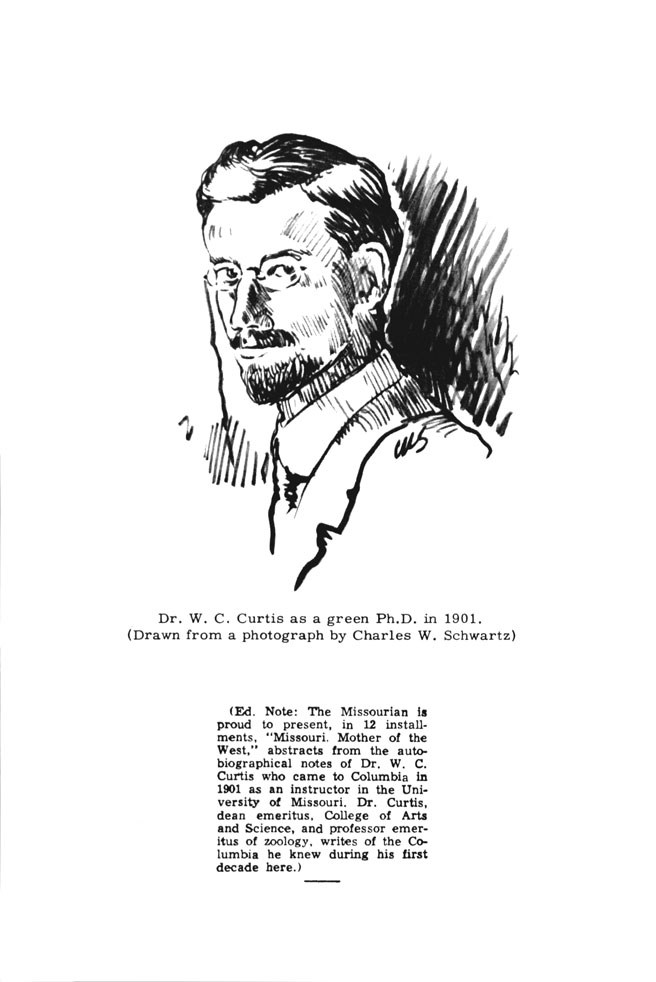
I’ve had a lifelong obsession with an old zoologist at my alma mater, Winterton C. Curtis (1875-1966), who happens to have been my first real landlord: my parents rented rooms in his home soon after my birth, while my Dad was finishing his veterinary degree at Mizzou.

I remember him visiting our family in the years just prior to his death. He pulled dollars from my ear.

Later I’d learn of his historical importance, as one of the expert witnesses not allowed to testify at the infamous 1925 trial of John Scopes in Dayton TN.

Well, during our recent visit to Columbia, MO, Older Daughter and I rode by the place with my old roomie RD (still a Columbia resident).

And that’s what got me hunting for the little offprint of the memoir Dr. Curtis published in the Columbia Missourian in 1957, that belonged to my Dad. Found it yesterday. And, found it again this morning online: “A Damned-Yankee Professor in Little Dixie.” (The house is pictured on p.37.)

And check out the last page, where he talks about how the former university president “admitted publicly” that faculty positions were rotated among “the various Protestant denominations…” What a different world it was, not so long ago.
I’m just intrigued by the single degree of separation between myself and someone who was born in 1875, who began his university teaching career at my old school in 1901, who was in Tennessee literally alongside H.L. Mencken in 1925, and who used to entertain a little boy who would one day move to Tennessee to philosophize about things like the Scopes Trial.

Somewhere in a box I have my dad’s personal correspondence with Dr. C...

A Defense Expert's Impressions of the Scopes Trial
from "D-Days at Dayton: Fundamentalism vs Evolution at Dayton, Tennessee" by Winterton C. Curtis (1956) - The courtroom audience impressed me as honest country folk in jeans and calico. “Boobs" perhaps, as judged by Mencken, and holding all the prejudices of backwoods Christian orthodoxy, but nevertheless a significant section of the backbone of democracy in the U.S.A. They came to see their idol “the Great Commoner” and champion of the people meet the challenge to their faith. They left bewildered but with their beliefs unchanged despite the manhandling of their idol by the “Infidel” from Chicago.... W. C. Curtis at the Scopes Trial

2015-04-06 | Half of Americans reject evolution, the second-lowest acceptance rate of 34 developed countries. Just try defending Darwin in Kentucky more » More Darwin @aldaily
And Marx...

“The philosophers have only interpreted the world, in various ways. The point, however, is to change it."

"Religion is the sigh of the oppressed creature, the heart of a heartless world, and the soul of soulless conditions. It is the opium of the people.

"The abolition of religion as the illusory happiness of the people is the demand for their real happiness. To call on them to give up their illusions about their condition is to call on them to give up a condition that requires illusions. The criticism of religion is, therefore, in embryo, the criticism of that vale of tears of which religion is the halo."

Karl Marx, Yesterday and Today, by Louis Menand...

And Kierkegaard...

"Life must be understood backward, but it must be lived forward”

“The function of prayer is not to influence God, but rather to change the nature of the one who prays.”

“Life is not a problem to be solved, but a reality to be experienced.” - why not both, not Either/Or but Both/And?

“Marry, and you will regret it; don’t marry, you will also regret it... Hang yourself, you will regret it; do not hang yourself, and you will regret that too... This, gentlemen, is the essence of all philosophy.” I think not.

But cut him some slack, he was a sometimes-cheerful peripatetic... and apparently a philosophical counselor too. How Kierkegaard Can Help Us Cope With Drumpf-Related Anxiety...

Image result for kierkegaard walking

2019-05-04 | The afterlives of philosophers. Nietzsche’s reputation fell almost immediately into disrepute; Kierkegaard, on the other hand, became an inspiration for “mindfulness.” Why? more » 2019-11-04 | Reading Kierkegaard can be dispiriting. He seems so dour, so tortured by inner turmoil. But he was, in some odd way, a happy writer more » More Kierkegaard @aldaily
11.18.19

Thursday, September 30, 2021

Just say Yes

LISTEN. Today in Happiness, after our little exam, we'll discuss what it means to Stoics to live in accordance with nature. We'll also consider the shared Stoic-Buddhist aversion to "drug-induced bliss." That's my cue to bring Michael Pollan and William James into the conversation.

The sway of alcohol over mankind is unquestionably due to its power to stimulate the mystical faculties of human nature, usually crushed to earth by the cold facts and dry criticisms of the sober hour. Sobriety diminishes, discriminates, and says no; drunkenness expands, unites, and says yes. It is in fact the great exciter of the Yes function in man. It brings its votary from the chill periphery of things to the radiant core. It makes him for the moment one with truth. Not through mere perversity do men run after it. To the poor and the unlettered it stands in the place of symphony concerts and of literature;

That's a remarkable observation, which he quickly tempered with the crushing corollary that 

it is part of the deeper mystery and tragedy of life that whiffs and gleams of something that we immediately recognize as excellent should be vouchsafed to so many of us only in the fleeting earlier phases of what in its totality is so degrading a poisoning.
So, much as we should wish to affirm the Yes function, we can't sanction the degradation and poisoning. 

Does the same caveat apply to all drugs? James had (pardon the pun) high hopes for nitrous oxide, saying it taught him that 
our normal waking consciousness, rational consciousness as we call it, is but one special type of consciousness, whilst all about it, parted from it by the filmiest of screens, there lie potential forms of consciousness entirely different.

And we mustn't dismiss the other forms. "No account of the universe in its totality can be final which leaves these other forms of consciousness quite disregarded." (Also see "The Nitrous Oxide Philosopher")

Michael Pollan agrees. Nitrous was not his drug of choice, even under tightly-controlled conditions, but psilocybin and other hallucinogens did bring him to conclude that "I am not identical with my ego..." In How to Change Your Mind: What the New Science of Psychedelics Teaches Us About Consciousness, Dying, Addiction, Depression, and Transcendence he writes:


The usual antonym for the word “spiritual” is “material.” That at least is what I believed when I began this inquiry—that the whole issue with spirituality turned on a question of metaphysics. Now I’m inclined to think a much better and certainly more useful antonym for “spiritual” might be “egotistical.” Self and Spirit define the opposite ends of a spectrum, but that spectrum needn’t reach clear to the heavens to have meaning for us. It can stay right here on earth. When the ego dissolves, so does a bounded conception not only of our self but of our self-interest. What emerges in its place is invariably a broader, more openhearted and altruistic—that is, more spiritual—idea of what matters in life. One in which a new sense of connection, or love, however defined, seems to figure prominently.
If dissolution of the ego results in greater heart, more altruism, a deeper spirituality and a clearer understanding of what matters in life, I say let's dissolve. But I'm still looking for ways to accomplish that in the more familiar and seemingly less risky forms of trip that don't require me to violate statutes or disorient my consciousness in ways that may feel violently disruptive. That time may come, if the predictable health trajectory of many of my cohort holds in my own case. If and when it does I hope our laws will by then have caught up to the science and the humanism of judiciously dispensed psycho-activity. I don't want to take a trip to jail. But neither do I want to suffer needlessly, or for anyone else to either.


Wednesday, September 29, 2021

What would Kant say?

17! LISTEN.
“Well, it starts with perseverance. I mean, it starts there,” said Adam Wainwright, whose poetic 17th win of the season in his 17th year with St. Louis led his club to its 17th consecutive victory. “We had to overcome probably the worst baseball I've ever seen a Cardinals team play. We just weren't doing anything right. … It was just understanding that we're a better team than what we were showing and we could go out there and compete with anybody when we play right.
And now I'll stop crowing about my team. For now. Kant probably wouldn't have much to say about them. 

But he had plenty to say about rationality, as has Steven Pinker...

LISTEN (10.20). “I am struggling for words — this is crazy. It is just utterly irresponsible,” says one medical ethicist about Drumpf's "don't be afraid of COVID" tweet. That's the one norm he's established and never flouts. When crazy becomes normal, how do we stay sane?

What would Kant say?

Kant's life was pretty dull, his routines rigid. See The Last Days of Immanuel Kant for cinematic documentation of this. "It follows the famously abstemious and abstruse philosopher as he’s anticipating his death, yet it’s a physical comedy filled with neo-slapstick intimacy." It's funny, and broadly affectionate. The depiction of his vaunted daily walks, at snail's pace, is hard for a peripatetic like me to watch. My pal the Kantian in Carolina was offended by it, but I find it an ingratiating portrait of an eccentric for whom the excitement of life was almost entirely about thinking. I wouldn't want to have lived that life myself, nor do I much like reading its results. But I'm glad someone did.


Kant really needed a dog, though. Schopenhauer at least had his poodles, one Atman after another.


His philosophy, though, shook things up and enticed admiring competitors and successors to challenge his biggest caution: don't try to describe reality-in-itself. Don't forget: everything we know comes with a built-in point of view, a perspective rooted in the knowers' categories of mind.


I shouldn't have gone looking for that film on YouTube just now, the rabbit hole is hard to resist. Did you know that Joacquin Phoenix taught Kant? Like Chidi in the Good Place? "The wave returns to the ocean... Whenever you're ready, just walk through."

Ready or not...

Was Kant's metaphysic of mind-as-projector of categories (quantity, quality, relation, modality... plurality, reality, cause & effect, possibility...) and of space and time the Copernican revolutionary breakthrough he and his acolytes thought? For Hegel and Schopenhauer it didn't break on through to the other side, the noumenal view from nowhere. That was a deficiency, they thought. But was it ever even a possibility? My biggest concern about Kant's metaphysics is that if he's right we might never get to make first contact with ET (whose categories and resulting "conceptual scheme" might be too alien to know)...

We'll also consider Kant's ethics, and Bentham's. Of course we should help people when we feel sorry for them. There's nothing wrong with that, and much right. But Jeremy Bentham's auto-icon?

How about the Experience Machine? We've already got one, haven't we? And when the holo-deck comes along we'll find out how the experiment really turns out.

If wisdom and understanding come only at a "later stage" of history, Hegel, in twilight, is philosophy worth doing now? At dawn? It's the very best time to do it, in my experience, rght before our daily morning dog walk. That's when Geist is most real for me. But my geist is probably not yours, or "ours"... Anyway, the great rational optimist and cynical pessimist are ultimately (like us all) in the same boat. "Shipwreck is a permanent possibility," said William James...

Schopenhauer on Hegel: “But the height of audacity in serving up pure nonsense, in stringing together senseless and extravagant mazes of words, such as had previously been known only in madhouses, was finally reached in Hegel, and became the instrument of the most barefaced general mystification that has ever taken place, with a result which will appear fabulous to posterity, and will remain as a monument to German stupidity.”

Schopenhauer's Will still seems wildly speculative and idiosyncratic, to me, truly a projection of the philosopher's personal temperament. But it shows that pessimists are people too. I don't think it shows the value of asceticism, though, as "the ideal way to cope with existence." But as always, to each their own.

In Fantasyland we're invted to wonder if the film industry narrowed the perceived distance between fantasy and reality and acts like a drug. I'll ask Older Daughter about that. And about online videogaming.

Also, advertising. It's manipulative and misleading, it engenders false desires and a confusion about what will make us happy. Or, you can do what I've been doing for decades, ever since I went to Radio Shack and purchased a little device that screwed into the back of the tee-vee. That was before hand-held remote controls, kids. But muting the noise, I've found, enhances the day-to-day quality of my life like almost nothing else.

And: Wells's War of the Worlds, our infatuation with celebrity, and celebrities. Suburban nostalgia and racism. LA and South Florida as fantasylands. Confucius Institutes. Should there be a Western Philosophy Institute in China? The difference between harmony and conformity, compliance, sameness, and uniformity. Would we have a more eastern attitude about harmony and cosmic order in the west if Heraclitus (and Hegel) had "won out" over Plato? 225 Kant's Enlightenment "maturity"... Parents who try "to maintain their authority over their children after those children have grown up"? 231 People who are "beyond care" and have "given up"? 235 "Yin/yang"/// "picking yin"? 239 (Keep it clean please.)
Is the Confucian principle of quan anti-Kantian? 243 How about the African concept of ubuntu? 246

10.6.2020

Tuesday, September 28, 2021

Into the woods

LISTEN. Today in Happiness we consider Buddhist and Stoic prescriptions for  the "existential illness" that finds us deluded, grasping, and erroneously attaching to the impermanent world's chintzy shiny baubles. Both traditions propose therapies.

Our campus counseling center sent out a flyer yesterday, advertising its services "free of charge" to the campus community. Freer still for many of us, and more effective, might simply be a walk in the woods or down the street. Or on a sandwalk.


Positive emotions come into play on a good walk. For the Stoics emotions were "problematic because they are inseparable from faulty beliefs," but that surely is a faulty overstatement. Some emotions lead us down the wrong path, others make us feel at home in the woods and the universe and our own skin. Jennifer Michael Hecht puts it well in Doubt: A History, in her discussion of "graceful-life philosophies" which offers a lovely forest metaphor for happiness:

The experience of doubt in a heterogeneous, cosmopolitan world is a bit like being lost in a forest… we could stop being lost if we were to just stop trying to get out of the forest. Instead, we could pick some *blueberries, sit beneath a  tree, and start describing how the sun-dappled forest floor shimmers in the breeze. The initial horror of being lost utterly disappears when you come to believe fully that there is no town out there, beyond the forest… Hang a sign that says HOME on a tree and you’re done; just try to have a good time.

Maybe that's the sort of therapy Cicero had in mind when he said we can be our own physicians (not meta-) when treating "diseases of the soul." No license required. Just hang a sign.

RAIN is a nice counseling acronym (Recognize, Allow, Investigate, Non-identification), the gist of which is that you are not your pain. Let it go.

Buddhist awakening involves an end of rebirth, when karma stops "accumulating." Doesn't that just mean an end, full-stop? Is that cure possibly not worse than the disease? Or is that very question emblematic of western delusion?

Jhanas are states of "deep concentration" or "absorptions" meant to facilitate "detachment from worldly delights." I've written about that, I'm still trying to understand why I'd ever want to plug my springs of delight. For the attainment of nirvana, presumably. But that sounds mystical. Doesn't have to, according to our author. "A 'little nirvana' could consist in a state of more contentment and less reactivity." Nothing wrong with that. We're all suffering from less contentment and more reactivity than is healthy, mentally or physically. A little forest bath couldn't hurt.


Monday, September 27, 2021

Playing right

 LISTEN. 16.

One more clinches the wildcard, but more importantly the streak has already clinched Grantland Rice's point about living: winning (as Nuke LaLoosh learned) is more fun than losing, but winning and losing matters less than playing the right way. Playing with confidence and style and mutual support and a spirit of fair play will look great on the last scorecard, whether you get to fly the W or not.

But my team does, today. Again. Hey Chicago, what do you say? I say I want to play life the way Harrision Bader plays centerfield.


This was a good weekend all around for me, with the sun shining brightly I finally got back on the bicycle for some lovely extended rides, not just short class-to-class campus commutes. 

And I thoroughly enjoyed Richard Powers's new novel Bewilderment, which takes its title straight from Plato's cave: "the bewilderments of the eyes are of two kinds, and arise from two causes, either from coming out of the light or from going into the light." That's just what we were talking about at the end of Happiness
class last time, as we ambled back to the Naked Eye observatory. The crack of light between two eternities of darkness, the bird that flies into the lighted chamber. We're lucky to have found the light, however briefly. We should open our eyes.

Next in CoPhi we turn to Berkeley, Voltaire & Leibniz, Hume, & Rousseau. To be is not merely to be perceived, but the absence of acute perception afflicting so many is definitely a deficient state of being. I still think Voltaire and James were right about Leibniz's (and Pope's) thundering incarnation of superficiality in metaphysics. Everything's not right with the world, yet. Not even when you're winning. 

Leibniz's best biographer (or most entertaining, at least) is Matthew Stewart. I don't suppose he's related to Jon (not the comic but the philosopher who's about to publish a fresh look at Hegel). I look forward to seeing if he can render the philosopher who inspired James to inhale nitrous oxide in search of Hegelian clarity (was there ever a squarer circle?) any less superficial. (Some Subjective Effects...)

I'm enjoying Julian Baggini's new book on Hume, which takes us "to the places that inspired Hume the most, from his family estate near the Scottish border to Paris, where, as an older man, he was warmly embraced by French society" and "includes 145 Humean maxims for living well, on topics ranging from the meaning of success and the value of travel to friendship, facing death, identity, and the importance of leisure." g'r... g'b

The importance of leisure, indeed. Go Cards go. Go on reminding us how important it is to play well with others, and to care. Leave the great scorer out of it, if you like. What still matters is how you play the game.
==
 My Own Life (Oliver Sacks)... Unweaving the Rainbow (Richard Dawkins)... The Courtier and the Heretic (M.Stewart)... "superficiality incarnate" (WJ on Leibniz)...

Thursday, September 23, 2021

More than happiness

LISTEN. Who could ask for anything more? Cards have now won eleven in a row. I want twelve. 

Stoics and Buddhists, according to our new author in Happiness today, want more. But more what? More life? More time? More equanimity? More acceptance? Just more, says Thor. "I just think that’s what being a New Yorker is all about, being hungry for more," says the star hurler with the high school education who is also "a  multidimensional human being with feelings and problems and goals outside of sports."

 More Than Happiness: Buddhist and Stoic Wisdom for a Sceptical Age is Antonina Macaro's contribution to the growing body of literature commending "mindfulness" and (in the blurbed words of secular Buddhist Stephen Batchelor) "the pragmatic and therapeutic dimensions of philosophy." 

Owen Flanagan is another secularist who finds natural wisdom in Buddhism. Robert Wright (Why Buddhism is True) too. “Ultimately, happiness comes down to choosing between the discomfort of becoming aware of your mental afflictions and the discomfort of being ruled by them.” Wright and Stoic resurrector Massimo Pigliucci agree that Buddhists and Stoics like Marcus Aurelius come to similar conclusions "from a different metaphysical starting point."

“Think, remind yourself every time do you have a problem, every time you have an issue with other people, remind yourself of the big picture. You think about the extent of time, think about the extent of space, and the part that you are within it, and you will see that, (a) your particular concerns are actually not that important, but also, (b) that you are connected to everything else and that therefore the rational thing to do for you as a human being is to try to do your best to improve society at large."
“The Four Noble Truths are pragmatic rather than dogmatic. They suggest a course of action to be followed rather than a set of dogmas to be believed. The four truths are prescriptions for behavior rather than descriptions of reality. The Buddha compares himself to a doctor who offers a course of therapeutic treatment to heal one’s ills. To embark on such a therapy is not designed to bring one any closer to ‘the Truth’ but to enable one’s life to flourish here and now, hopefully leaving a legacy that will continue to have beneficial repercussions after one’s death.” ― Stephen Batchelor, Confession of a Buddhist Atheist

Macaro declares herself neither Buddhist nor Stoic, favoring Aristotle and noting that Epicurus has yet to enjoy a resurgence of interest and attention akin to that lately visited on the Stoics. She notes as well the Stoic connection to Cognitive Behavioral Therapy.

Therapy is of coure the keyword, and the binding thread of most ancient philosophies. Relieving distress and improving the experienced quality of lives was pretty much the entire point. But that's not to say that happiness is the entire point. "Happiness is not everything." But it may be the thing most indicative of whether our therapeutics are working. 

Stoics are not Skeptics, but if there's a significant connection between Stoics and Buddhists it's natural to wonder about the connection between Buddhists and Skeptics too. Was Pyrrho influenced by Buddhists? Committing to firm beliefs about the nature of reality, for instance, seems to have been anathema to both traditions. Not to commit to beliefs, even provisionally and experimentally, is to travel without a map (or gps). It doesn't seem smart. It doesn't seem likely to work, if one of the points of a journey is to arrive at a destination. Or at least approach it. So: is happiness a destination, or a journey?

Well it's both, isn't it? So shouldn't we want more reliable maps, more accurate satellite positioning, more stable infrastructure of all kinds, smooth roads and clear skies and plenty of pleasant diversions along the way? And more charging stations for our more efficient and eco-friendly vehicular conveyances?

Lots of metaphors to unpack, then, on the road to less suffering and more happiness.  Will metaphysics help or hinder? Will god-talk? James said his religious act was to defend experience against "philosophy," and that in general the religious impulse for most of us is driven not by a yearning for that sort of transcendence. What do Buddhists and Stoics think about that?

And what do they think about Nabokov's "common sense" view of our predicament, our "cradle above the abyss," our "brief crack of light between two eternities of darkness"?  What do we?

I think Humbert-squared's creator was on to something uncommonly acknowledged, with those stark images. As was the Venerable Bede, which is why this was our wedding scroll:

“The truest vision of life I know is that bird in the Venerable Bede that flutters from the dark into a lighted hall, and after a while flutters out again into the dark...It is something--it can be everything--to have found a fellow bird with whom you can sit among the rafters while the drinking and boasting and reciting and fighting go on below; a fellow bird whom you can look after and find bugs and seeds for; one who will patch your bruises and straighten your ruffled feathers and mourn over your hurts when you accidentally fly into something you can't handle." --Wallace Stegner, The Spectator Bird

Contrary to the popular notion of cold dispassionate Stoics and monkish meditating Buddhists, then, we'll treasure human connection above all, if we truly seek a life of more happiness. We'll value community, we'll work on relationships, we'll want to leave a legacy. We'll care about what life is going to be like here, after we're gone.

And in the words of the late psycho-novelist Irvin Yalom, we'll learn to "temper the anguish of our finitude" in the face of life's brevity, fragility, and beauty. We'll realize the rainbow wisdom that "we are going to die, and that makes us the lucky ones..."

We'll ride our winning streaks. Life brings suffering, of course, lots of it. But it also brings pleasure and joy. Happy people get this. And they want more.

Wednesday, September 22, 2021

Catching up

LISTEN. Ten in a row for the Cards. And they've not had a losing season in fourteen years. The manager credits players, teams, and organizational leaders over the years for being "very intentional about passing on to the next group.” There's a life-lesson for us all there. Even Cubs fans.

As Crash Davis said in Bull Durham, sometimes you win, sometimes you lose. And sometimes it rains. Maybe the secret of happiness is to enjoy the wins, look beyond the losses, and carry an umbrella.

Seriously. You can't win 'em all, but win or lose tomorrow's always another day. Lose or win, we'll never be precisely here again. So take it easy. Give 110%. And practice your cliches. 

Lots to catch up on in CoPhi today, on the heels of Constitution Day and Library Day, from Hobbes to Descartes to Spinoza to Locke...

But it was time well spent over in Walker Library with Writing Center staff and librarian Rachel Kirk, preparing to succeed with midterm presentations and school and life.

“The most successful students are those who know that they can do better than grasp at the closest source of information. Reference librarians, who spend their days learning what is available in a broad range of fields and how to search for it, provide a great service for students and other library patrons... Democracies can work only if all citizens have access to information and culture that can help them make good choices, whether at the voting booth or in other aspects of public life.” --John Palfrey, BiblioTech: Why Libraries Matter More Than Ever in the Age of Google g'r

"Reading is at the center of our lives. The library is our brain. Without the library, you have no civilization...If you know how to read, you have a complete education about life, then you know how to vote within a democracy. But if you don’t know how to read, you don’t know how to decide... You don't have to burn books to destroy a culture. Just get people to stop reading them." --Ray Bradbury


And one more thing: A delightful trip to New Hampshire and a hike up Mt. Chocorua, across from William James's summer place, with Kyle Finn Dempsey...

LISTEN (9.'20). Today in CoPhi we'll turn to three French philosophers, Descartes the pretend-skeptic, Montaigne the real one, and Pascal the gambler who wanted desperately to suppress his doubts in deference to the promises of faith.

Rene Descartes "meditated" himself into a conjured and contrived form of doubt, but never really doubted for an instant that the world revealed by the senses--beginning with the senses themselves, and our perception of ourselves as sensate creatures capable of encountering a world--is real enough. What he doubted was not his and our existence as embodied knowers, but the status of that knowledge. For him, if we're not indubitably certain then we know nothing.

C.S. Peirce the fallibilist, as noted in How the World Thinks, said it's an error to pretend to doubt in philosophy what we do not doubt in real life. That's one of Descartes's errors. His mind-body "ghost in the machine" dualism is another. The worry that life is but a dream is fun to discuss and make movies about (Matrix, Inception etc.) but whether we're dreams or dreamers may, as the Chinese sage said, be a distinction without a practical difference.

Blaise Pascal is best known for his famous Wager and its "What have you got to lose?" premise, but I'm more struck by his statement that the immensity and silence of the night sky terrified him. Fear in general seems to have motivated his approach to theology, specifically fear of eternal damnation. As we said in one of our Zoom sessions yesterday, fear-based thinking and living is ill-advised in politics. Probably in religion too.

Michel du Montaigne's rhetorical/skeptical question was Que sais-je? What do I know? The answer depends on what we want from knowledge. If not Cartesian certainty, but practical guidance tempered by humility and a willingness to revise our beliefs and practices in the light of what we learn, then I think he knew quite a lot. He learned to get back on the horse that throws you, and knew that life should not be lived in fear of dying or anything else.

In Fantasyland today Kurt Andersen says Christian religiosity is "the grandest and greatest conspiracy of all" (89), and that Enlightenment skepticism received a religious make-over in America that predisposed the national mind to become an incubator of conspiracy-mindedness. The QAnon nonsense is just the latest incarnation of an old tendency, going back to the Freemasons whose big secret mission, said Ben Franklin, was that they had none.

Wouldn't it be nice if nations and traditions just stopped insisting on exclusive divine sanction for their beliefs?

In How the World Thinks today we wonder about Islamic notions of "perfect divine transcendental unity" and their dis-unifying consequences.

Is ordinary experience, day to day, "nothing more than a powerful illusion"? 149 Does anyone ever really act as if they believed that? Is it possible to function effectively and happily with such an attitude? Or in predestination and one's pre-"recorded destiny"? 154 Or in natural disasters that kill innocent people according to "God's will" for which the victims are nonetheless "culpable"? 155

More too on Harry Frankfiurt's "bullshit" (162) and Jeremy Bentham's "felicific calculus" and Stephen Hawking's greatly exaggerated reports of the demise of philosophy (167). And a question about reductionism that reminds me of a mantra we met in the Atheism course several years ago: "physics fixes the facts." But not all of them, Baggini says, not if fixing means reducing. There are no car batteries in fundamental physics...
==
Spinoza didn't make it easy on himself by affirming pantheism, but perhaps he found the solace of solidarity with nature and the universe sufficiently off-setting and worth the cost in personal terms. He thought he'd touched all the bases: God, nature, freedom, emotion, everything. QED (Not quite easily done.)

He "claimed to demonstrate both the necessary existence and the unitary nature of the unique, single substance that comprises all of reality. Spinoza preferred the designation "Deus sive Natura" ("god or nature") as the most fitting name for this being, and he argued that its infinite attributes account for every feature of the universe."

An infinite God leaves no remainder, but also leaves individuals without a personal savior. He didn't think he needed one, with his rationalist's intellectual love of God. Free will may be an illusion, but a Spinozism of freedom is supposed to free us from reactionary passions like anger and self-pity. He would have been pleased by Einstein's endorsement. “I believe in Spinoza's God, who reveals Himself in the lawful harmony of the world, not in a God who concerns Himself with the fate and the doings of mankind..."

But, freedom? "It would be moral bondage if we were motivated only by causes of which we remain unaware, so genuine freedom comes only with knowledge of what it is that necessitates our actions. Recognizing the invariable influence of desire over our passionate natures, we then strive for the peace of mind that comes through an impartial attachment to reason." Much easier said than done. But again, Spinoza wasn't about easy.

Anthony Gottlieb's Spinoza brought "a breeze of the future," a foretaste of our present, with determinism and secularism in the ascendant in the most enlightenend quarters. Was he really "the noblest and most lovable of the great philosophers," as Bertrand Russell averred? "Those who were acquainted with him," said Bayle in his Historical and Critical Dictionary, called him "social, affable, honest, obliging, and of a well-ordered morality." But they didn't confirm his mythic identity as a humble lens grinder scrabbling to sustain himself for his philosophic labors. "[H]is lens-making was primarily a scientific pursuit rather than a commercial one."

If we "understood clearly the whole order of Nature," according to Spinoza, we'd come to his conclusion that "all things [are] just as necessary" as a true mathematical proposition. "Unfortunately, people did not come to see this at all." Fortunately, I say, lest we stop trying to be the change we want to see in the world. He'd say not to sweat that, if we want change then we necessarily will do what we think we must to achieve it... but we can't bank on making a difference that confounds the "whole order." And I say, again, I'm banking on it.

This God-intoxicated man has many secular and atheistic intellectual descendants, who are tarred by "no stigma in economically developed countries except the United States." Still, "he believed that he believed in God." Maybe Einstein did too, Gottlieb's judgment that he was "probably just being diplomatic" notwithstanding.

John Locke's empiricism overstated the blankness of our slates, and relied too heavily on memory as a guarantor of personal identity. Thomas Reid was not in his league, but may still have had a better idea with his overlapping memories thesis. Until we become cyborg, total recall will not be an option.

"Locke's grand work," said C.S. Peirce, "was substantially this: Men must think for themselves."

Thomas Jefferson may have overstated the case for Locke's influence on the founding generation of the American republic, but if he influenced the sage of Monticello it would seem to follow that in fact his shadow has loomed large. A direct line can be drawn from his social contract to John Rawls's, and from there to the current generation of progressive politics in America... to say nothing of his namesake on Lost. The authority of a rulers derives from the freely-contracted consent of the governed, or from nowhere. It doesn't come down from heaven nor out of the barrel of a gun.

Locke "greatly admired the achievements that his friends in the Royal Society had made in physics, chemistry, and medicine, and he sought to clear the ground for future developments by providing a theory of knowledge compatible with such carefully-conducted study of nature. The goal of his An Essay Concerning Human Understanding (1690) was to establish epistemological foundations for the new science by examining the reliability, scope, and limitations of human knowledge in contrast with with the pretensions of uncritical belief, borrowed opinion, and mere superstition. Since the sciences had already demonstrated their practical success, Locke tried to apply their Baconian methods to the pursuit of his own philosophical aims. In order to discover how the human understanding achieves knowledge, we must trace that knowledge to its origins in our experience."

The Essay Concerning Human Understanding sounded the Enlightenment keynotes: think for yourself, question conventional and inherited wisdom, stop quibbling and splitting hairs about angels on pinheads... 

4.17