Delight Springs

Friday, June 12, 2020

Stretching habits

I have a long-standing habit of stretching after our daily morning dogwalk, with a routine improvised decades ago from a popular book on the subject. It began mostly as an exercise in meditation and (before the word was cliche) "mindfulness," continued as a comfortable and comforting habit, and has become an indispensable form of physically-therapeutic self-maintenance I can't afford to miss.

The last couple of years I merged the stretching habit with my baseball obsession, always tuning in to the MLB highlights show while going through my routine. Then the pandemic ended the highlights, among other things, but reruns of old games in March, April, and May called by revived Hall of Fame voices (Vin, Joe, Tony, Jack...) more than managed to fill the gap.

Until it didn't.

There came a day, just days ago, when my appetite for old games suddenly wilted. Maybe it's the time of year. Or maybe it's the time of man... (see postscript below*)

The Smithsonian channel's Aerial America program was good stretching company at first, I used to tune it in a few winters back when we first got our stationary bike. I liked to pretend I was powering a pedal-driven glider like the one in Kim Stanley Robinson's cli-fi novel Pacific Edge. "Hard work; it was one of the weird glories of their time, that the highest technologies were producing artifacts that demanded more intense physical labor than ever before..."

But the pretense and the novelty of the new immobile machine eventually wore off. I learned that I prefer pedaling my non-stationary bikes through middle Tennessee's generally-mild winters (and springs, summers, and falls). And now there's talk in our household of consigning the stationary bike to my Little House, cut off from the cable umbilicus.

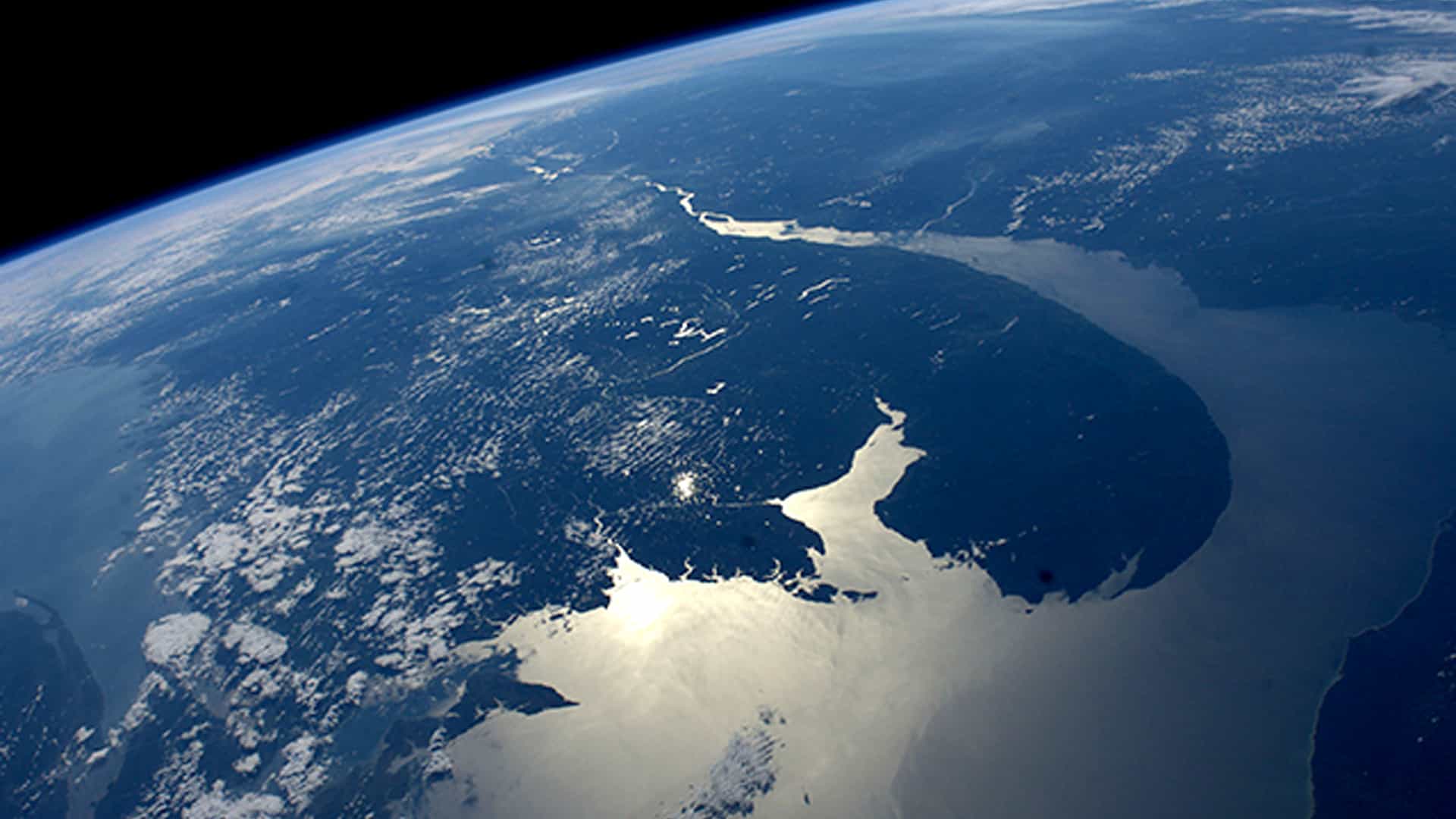
When Elon Musk's Dragon launched recently I found myself briefly hooked on the NASA channel, during the morning stretch. The live feed from ISS was, as documented here, calming accompaniment. But that too has acquired a measure of tedium. Round and round and round we go, but are we getting anywhere?

So now I've started catching up on the gazillion (and growing) TED Talks I missed the first time. Really liked Jill Tarter's SETI talk, and Michael Patrick Lynch on truth, facts, and reality, and Wendy Suzuki's "Brain-changing benefits of exercise"...


So what would Aristotle say about my stretching habit? Or William James? Or Charles Duhigg and James Clear? A few things...

"It makes no small difference, then, whether we form habits of one kind or of another from our very youth; it makes a very great difference, or rather all the difference." Nichomachean Ethics, Book II

"Habit is thus the enormous fly-wheel of society, its most precious conservative agent. It alone is what keeps us all within the bounds of ordinance... we must make automatic and habitual, as early as possible, as many useful actions as we can, and guard against the growing into ways that are likely to be disadvantageous to us, as we should guard against the plague." William James, Habit/Principles of Psychology I 

“Habits are powerful, but delicate. They can emerge outside our consciousness, or can be deliberately designed. They often occur without our permission, but can be reshaped by fiddling with their parts. They shape our lives far more than we realize—they are so strong, in fact, that they cause our brains to cling to them at the exclusion of all else, including common sense.” Charles Duhigg, The Power Of Habit

“The ultimate form of intrinsic motivation is when a habit becomes part of your identity. It’s one thing to say I’m the type of person who wants this. It’s something very different to say I’m the type of person who is this.”James Clear, Atomic Habits

One thing for sure: they'd all say not to miss your dogwalk on this beautiful crisp morning.

Man with two dogs | Silhouette Artist - Portrait Cuttings - UK
Solvitur Ambulando
LISTEN

* Postscript--

Thursday, June 11, 2020

Scoot's legacy

In April Older Daughter had to say a far-too-soon farewell to her sidekick Scooter, who we first met late in 2016 at the Nashville Humane Shelter. He followed her to college in Illinois, then back to Tennessee (when he and I really bonded), then to California. He was a fixture, seen and heard (afflicted with chronic, constant asthmatic coughing and wheezing), in many of her YouTube film reviews and blog posts. He succumbed a few weeks ago to cancer. She wrote: "To say that Scooter was important to me is such a radical understatement. Losing him so quickly has been devastating... Scoot was with me through love, loss, three different states, five different living situations, long night, early mornings, and the shortest walks a dog will ever take. One time I had to carry him a mile back to campus because he refused to walk anymore. What an opinionated little jerk. I miss him so dearly..." He was her "true love."

I thought of him, with the greatest fondness and gratitude yesterday, when I came across this lovely reflection on what we can learn from our four-legged friends about sadness and joy, and being here now.

We need a trick to feel our joys as deeply as our griefs...


"Just when the coronavirus started to hit Los Angeles, my dog, Ori, stopped eating. I was afraid he had cancer, and I was worried I would have to have him euthanized because it would be dangerous and wrong to be driving a dog around for cancer treatments while we were trying to avoid contact to save human lives, including my mother-in-law’s..." (Eric Kaplan & Eleanor Davis, nyt continues)

Wednesday, June 10, 2020

Defying demography

Scott Simon is one of the more thoughtful voices on NPR and CBS (if sometimes, to my taste, a bit too earnest and courteously formal). I've long admired his honesty and transparency, in sharing intimate details of life such as the experience of saying goodbye to his dying mother, or expressing his unvarnished joy at becoming an adoptive parent. His tweet yesterday caught my eye. 
@nprscottsimon What artist? My daughter also defies demographic expectations, has lately discovered Neil Young & CSNY (especially “Ohio”)
June 9, 2020
(The verdict is still out on Jefferson Airplane's "Volunteers of America," not to be confused with the Tennessee variety.)


Our oldest daughter is in the kitchen, born in China, reared in big cities, is in the kitchen, making tofu, listening to country music, shattering every demographic assumption made about her, and I love that, about her and life.
What artist? My daughter also defies demographic expectations, has lately discovered Neil Young & CSNY (especially “Ohio”)

Tuesday, June 9, 2020

Odds against

Yesterday afternoon's virtual staff meeting on zoom, at which we were tasked to declare our plans for Fall semester, was a dash of cold water and a wake-up call. 

I'd assumed most of us were anticipating a guarded return to campus and the physical classroom, at least a partial return. But with social distancing restrictions in place, coupled with the perennial challenge of finding enough classrooms, and in light of a looming threat that COVID could suddenly roar back and target our demographic (the aging class of Boomer academics). it is now clear that the logistical challenge of placing most of us back "on ground" is prohibitive. 

With just one exception, my colleagues yesterday all opted for "remote" when given a choice of preference for Fall. (There had been a second exception, until she reflected further on the unpleasantness of trying to lecture through a mask. Or shield. Or space helmet.)

Disappointing. But now we’re all “woke” to the bad dream that won’t end anytime soon. The fact that other bad dreams have distracted and lulled some of us — well, me — into supposing that the worst viral disruptions of routine were behind us is immaterial.

But I’m the other remaining stubborn exception, holding out and intending to do Environmental Ethics in an actual physical environment come August. Of course a lot can happen in two months, don’t we know! So we’ll see.

Meanwhile the greater question for us all has to do with the physical space of our streets, and with the social environment in which — virus or not — too many of our fellow travelers remain threatened less by any invisible microscopic threat than by malevolent macroscopic peers, specifically those charged to protect and to serve.

The most arresting thing a colleague said in the meeting yesterday was that he considered his odds of surviving the academic year no better than 50-50, mostly “because I like to go to protests.” He exaggerates. I hope.

Monday, June 8, 2020

A Chocorua of the mind

I was cheered last night when I saw John Kaag's tribute to Mount and Lake Chocorua, William James's New Hampshire getaway from academia and the stresses of daily life in Cambridge (MA) over a century ago. The James Society's centenary gathering there in 2010 was for me the Platonically-perfect paradigm of a professional scholarly symposium.
I revisit this image often, a Chocorua of the mind is a good place for moral holidays. (And if anyone ever wants to organize another conference there...) https://t.co/0Ecel4CNnd — Phil Oliver (@OSOPHER) June 8, 2020 
Those environs were deeply consoling to James, and redolent of a mental freedom he could not find in the thrust and parry of philosophical polemic. He particularly doted on the architectural expansiveness of the lakeside summer house, and its near-dozen doors "all opening out."

That's a lovely simile for his own personal sensibility and sociability, so plural and so "co-" in its eagerness to make significant connection with others beyond the borders of his own personal experience.

He was of course, as we all are to an extent, a trapped specimen of his time and its limitations. But I'd like to think his friendship with W.E.B. Dubois and his contempt for jingoistic American imperialism imply the strong likelihood of his revulsion at the endemic racism in American life that continues to torment us.

That's what I was thinking when we tuned in to 60 Minutes and saw the bravura performance of NAACP Legal Defense Fund chief Sherrilyn Ifill. She made so many sound and insightful points about the wages of denial and indifference, points so constructively instigating of an irresistible impulse to stand and do something, if only (at first) to join a march for justice.

That's the kind of instigation that made James want to spend time in Chocorua, readying for the good fight that's required for a truly righteous and justice-seeking life. Moral holidays -- "we have a right ever and anon to take a moral holiday, to let the world wag in its own way" --  aren't simply an escape from the grind and its responsibilities, they're an essential refueling stop. It's beginning to look like that's what the pandemic quarantine has been for many of us, a period of fortifying sequestration before the change that has to come. And suddenly, finally, it's coming fast. Police forces are being deconstructed. Even Mitt's joined the parade.*

LISTEN

*Postscript. Why Romney Marched

Friday, June 5, 2020

The force is with them

Human crowds in time-lapse look like a large single organism, don't they, or maybe a collective to which resistance is futile. What can I do, people say to rationalize their apathetic inactivity. You can get in step with progressive peers and become a force.

It's about the journey, sure, but this looks like it's going to get somewhere. Disengagement is disingenuous.


On ordinary days we each walk alone or with a companion or two on the sidewalks, and the streets are used for transit and for commerce. On extraordinary days—on the holidays that are anniversaries of historic and religious events and on the days we make history ourselves—we walk together, and the whole street is for stamping out the meaning of the day. Walking, which can be prayer, sex, communion with the land, or musing, becomes speech in these demonstrations and uprisings, and a lot of history has been written with the feet of citizens walking through their cities... It could be called marching, in that it is common movement toward a common goal, but the participants have not surrendered their individuality... Rebecca Solnit, Wanderlust

Thursday, June 4, 2020

Do the right thing

"[L]ess than five per cent of a population engaged in resistance is often enough to cause huge shifts in the zeitgeist and make it much harder for illegitimate authority to rule."

Younger Daughter insists that participation in public demonstrations is something she has to do. In the current anxious environment in which so much is so unclear, when sinister provocations to violence arise from hidden nefarious sources, a parent wants to say no you don't. You don't have to be part of the 5%.

But a parent who remembers the fervent activism of his youth, and who has decried the complacency and disengagement of so many young people ever since, also glows with pride for the conscientious young adult who's willing to put it all on the line for social justice. You don't have to, but maybe you have to. The fact that you want to, for all the right reasons, speaks admirably of your character and commitment.

So do what you have to do. Just be smart about it, on "UN International Day of Innocent Children Victims of Aggression."

LISTEN 
==
"I've been hearing a little bit of chatter in the Internet about voting versus protest, politics and participation versus civil disobedience and direct action," he recounted. "This is not an 'either or' — this is a 'both and' — to bring about real change we both have to highlight a problem and make people in power uncomfortable."
“Your lives matter,” he said, addressing young people in his virtual audience. “You should be able to learn and make mistakes and live a life of joy without having to worry about what’s going to happen when you walk to the store or go for a jog, or driving down the street, or looking at some birds in the park.”
 ==
Bryan Stevenson, founder of the Equal Justice Initiative and 2018 MTSU convocation speaker:

Bryan Stevenson on the Frustration Behind the George Floyd Protests
...as courageous black people began to advocate for civil rights in the nineteen-fifties and nineteen-sixties, when these older, nonviolent black Americans would literally be on their knees, praying, they were battered and bloodied by uniformed police officers. That identity of violence and oppression is not something we can ignore. We have to address it. But, rather than address it, since the nineteen-sixties, we have been trying to distract ourselves from it and not acknowledge it, and not own up to it, and all of our efforts have been compromised by this refusal to recognize that we need to radically change the culture of police.

Now, the police are an extension of our larger society... (NYer, continues)
So, defunding police or just focusing exclusively on them does not address the larger problem. As our last real president said, "to bring about real change we both have to highlight a problem and make people in power uncomfortable."
==
Postscript. The rally seems to have been peaceful and constructive, the right thing to do.


https://twitter.com/search?q=%23NashvilleProtests&src=trend_click

Wednesday, June 3, 2020

Hope and change, the next generation

It was very much in the spirit of yesterday's dawn post, specifically its confidence in the rising generation's capacity to finally grapple with the climate crisis and the other horrible challenges my generation has in its turn punted to them, that I sat down to draft and record a promotional blurb for my upcoming Environmental Ethics course in the Fall. Yes they can. 
For the past several years, in alternate Fall semesters, I've taught the Environmental Ethics course at MTSU--always a little differently, with a variety of texts and approaches, but always with the firm conviction that no greater challenge faces humanity than that of learning to live responsibly, respectfully, and sustainably on the earth, "the only home" (as Carl Sagan said of our "pale blue dot") we've ever known."
That conviction once again fuels the approach we'll take this Fall, along with a sobering recognition that, like the other pressing challenges of our time including the COVID-19 pandemic of the past several months and the recent civil unrest protesting tragic incidents of racial injustice, meeting the climate challenge will require mutual support and concerted, constructive action.
Environmental Ethics is not just another arid academic research subject, it's an existential roadmap to a livable future for our children and theirs, and for the myriad other forms of life that make up what pioneering ecologist Aldo Leopold called the biotic community.
This fall's course will also reflect the hopefulness of a new generation, your generation, class of 2020-something, that in many ways is beginning to stand up, speak up, and insist (with the courageous young woman Greta Thunberg) that there is a tomorrow and you'll not stand for the short-sighted indifference of an older generation that acts, like Dr. Seuss's "Onceler" in The Lorax, as if their time was the only time that matters.
 I saw a tweet from Julian Castro last night that reinforces my hopefulness, not least because it shines a positive light on young people in the St. Louis suburb I grew up in, a place I never knew to be progressive in any but an avaricious booster's sense. It was red, before that color was co-opted by the Grand Old Party.


I think Jalen speaks for many more of his cohort than has generally been appreciated. If they can march, they can vote. Again, the slogan of hope redux: Yes they can. 

Tuesday, June 2, 2020

Fixing the broken world

Waking the morning after your youngest child's 21st birthday ought to be a milestone-moment of deep life-satisfaction, oughtn't it? Especially when that young woman is smart, kind, charming, generous, and so evidently on track for a good and munificent future? And likewise, for her older sister?

It is. It really does seem like only yesterday, when people were cautioning that we'd "turn around twice and they'll be grown." Cliches exist for a reason.

But what a world young people are being handed. When the emergency alert sounded at 10 pm last night it was almost reassuring to discover that it was "only" reporting an extension of the curfew. The largest looming crisis on our global horizon, the climate crisis, had been shoved practically out of sight by the pandemic, which itself has now been eclipsed by police brutality.

The president's cupidity and stupidity, which in "normal" times would already have resulted in his disgraced ouster, barely get noticed now. Or rather, they're noticed in the same way gravitation and a breathable atmosphere are noticed -- they're taken for granted, for the way things just are. He literally attacks a peaceable crowd for a photo-op with a Bible he's likely never beheld in his life (not just that book, any book), and it's merely a fleeting social media meme signifying nothing.

So, I say to all young people today what I said to Younger Daughter yesterday, a jokey amendment to the jokey gift of Adulting: How to Become a Grown-Up in 535 Easy(ish) Steps:
#536 -- Always listen to your dad (and laugh at his jokes). Also, please fix the broken world. You and the best of your generation can do it.
It's increasingly obvious that mine can't. If hers will vote their consciences in November, though, change can come. Yes you can.

LISTEN

Monday, June 1, 2020

Right of way

An ugly weekend of violent protests, charges and counter-charges of extremist instigation, curfews, this scary headline -- "Protests Could Set Off a Second Coronavirus Wave, Experts Warn"...

But amidst it all, this weekend, there was an inspiring magic-carpet rocket ride, the most gorgeous weather imaginable here, my wife and I celebrated our anniversary at an actual sit-down restaurant, Younger Daughter turns 21 today, and I've just discovered two new books about the physiological and emotional upside of the peripatetic life -- In Praise of Walking and In Praise of Paths. "What interests me, however, is less physiological, more elusive: walking as a way of life." (David Ulin)

Always look on the bright side.

Ulin wrote a fine book himself, on walking in Los Angeles -- Sidewalking -- which I need to send to Older Daughter.

Ulin's review concludes with a line we'd do well to remember, as the "news"-worthy world continues to spiral frighteningly out of kilter: "Each stage of the journey has value on its own terms — which means it is the journeying rather than the arriving that offers the most necessary right of way."

The way John McDermott said that was: the nectar is in the journey.

The way I say it is: walk on. If you happen to be a young person who just attained the age of legal adulthood, walk in confidence of your ability to change a troubled world. You have the right of way. You are go for launch!


Friday, May 29, 2020

Walk on

Protests in the streets against police brutality, stoked by the racist psychopath in the White House... an ugly, primitive moment when it's easy to forget that our species has in fact evolved and advanced from humble origins. I return again and again to Carl Sagan's inspired and encouraging words.

"We humans have set foot on another world in a place called the Sea of Tranquility, an astonishing achievement for creatures such as we, whose earliest footsteps three and one-half million years old are preserved in the volcanic ash of east Africa. We have walked far."

That's why I'll be watching closely again when they try to launch that rocket in Florida tomorrow. We've still got a long way to go, and we need to go together.

Thursday, May 28, 2020

Philosophers in the rain

Well I was really geeking out with all the pre-launch coverage on NASA's livestream when they scrubbed the launch due to weather at about T-minus 18 minutes.

I'd been texting E & K, each independently assuring me they'd see to it I get to check attending a launch off my bucket list someday. That's generous of them. I prefer to go while I'm still alive, and hope to live long enough to actually go for the ride. Joining Scotty (James Doohan) and Timothy Leary in orbit would be a nice fallback (though no cheaper any time soon, probably).

Can I get to Cape Kennedy before Saturday's re-launch? Better not, that's our anniversary.

So that was disappointing, but also an opportunity to practice my stoic chops and transition from disappointment to expectation. What can you do about the weather but accept it?

Guess there's more to the philosophy of weather -- and more to climate than weather -- than stoic acceptance (which need not collapse wistfully in resignation). I'm kind of a skeptic and cynic, but not this kind. Sometimes I'm an epicurean. I'm almost always a peripatetic. I have a stick to notch. So the eclectic philosophy makes sense. Taking the long view takes us well beyond the morning forecast.

"In any weather, at any hour of the day or night, I have been anxious to improve the nick of time, and notch it on my stick too; to stand on the meeting of two eternities, the past and future, which is precisely the present moment; to toe that line." Walden

We ambulatory peripatetics, unlike astronauts, tend to be pretty defiant of inclement weather. We can "toe that line" because crossing it is rarely catastrophic, our source of locomotion is not explosively combustible. Our defiance (of weather) is rarely life-endangering.

"Everybody talks about the weather, but nobody does anything about it." I always credit Mr. Twain with that witticism but apparently it was Mr. Warner who said it. Whatever. The implied advice, as William James Buffet said, is to take the weather with you and "sing like a bird released." Sing in the rain. Or think. Or just be.

Point is, we can't control externals but we can surely push ourselves to get up and out and do what needs to be done. We need to explore our world, close in and as far out as we can push. We're wonderers and wanderers who've already walked far, undeterred by a few droplets.

Wednesday, May 27, 2020

Circling

This afternoon we'll find out if Elon Musk can successfully launch astronauts into the next frontier. "If a private company can loft humans to orbit today, why not the moon next or Mars some years in the future? A successful launch could ignite a future long imagined by science fiction writers in which space is a destination for more and more people." nyt 


Or, it could escalate the monetization and militarization of space. Today, though, I’m going to focus on the brighter prospect and just enjoy the ride.

In anticipation, yesterday I tuned in to the NASA channel’s livestream from the ISS. Round and round the old globe spun, sunrise sunset... It was mesmerizing and, in a way I suppose many others might not fathom, joyously reassuring. Call it the joy of circling the rock.

A section of Sunday’s Times celebrated the unanticipated joys of life in quarantine, including “the joy of circling the block.” That’s nothing new to a peripatetic, we already knew the pleasures of close attention to the expanding circles of one’s native ground.

Ralph Waldo Emerson, who just turned 217, was a peripatetic and thus a circler. “This surface on which we now stand is not fixed, but sliding...There are no fixtures in nature. The universe is fluid and volatile.” Circles

Circling day after day after day, the volatility becomes manageable for those who’ve learned the art of sliding steadily and constantly onward. “We live best as appreciators of horizons, whether we reach them or not,” says my new favorite poet/philosopher David Whyte (“What to Remember When Waking”). 

Hold that thought, it’s full of  evolutionary and  environmental implications I look forward to exploring  in July’s virtual classroom (my reprised summer course Evolution in America) and in a real (!) classroom this fall (Environmental Ethics).

What I remember when waking and walking is what I tend to forget when caught up in everydayness, especially the beckoning horizon. That’s what makes today’s rocket launch so peripatetically compelling. Let’s get out there and see what’s just around the corner. LISTEN

Space Cam - watch live video from the International Space Station ...

(Postscript, 3:18 pm -- launch scrubbed due to weather, rescheduled for Saturday.)

Tuesday, May 26, 2020

Memorial

That was a different sort of Memorial Day out in the public sphere, more subdued than the traditional kickoff of summer in years past--even for a holiday officially dedicated to solemn remembrance.  I biked past the empty public pool in our neighborhood, just to confirm that my neighbors have more sense than those oblivious revelers at Lake of the Ozarks. They do. No public bathing here.

But it was a pretty typical Memorial Day in our backyard, with near-90 temperatures making our own little pool inviting, before yet another sudden storm blew in. The grilled burgers and dogs were great, as was the partial family reunion.

I spent much of the morning revisiting old home movies and memorializing my late dad, who passed in the fall of '08. That May, twelve (!) years ago, I sat down with him for a series of meaningful conversations. Yesterday felt like the right time to revisit them. It was a pleasantly-jolting reminder that Faulkner and the old Irish proverb are right: the past isn't dead, it isn't even past.

He reminisced about life on the farm in the '30s, recalling meteor showers and nights sleeping under the stars, and the half-moon "privy" house, and the news of the day that got his attention -- things like the crash of the Hindenburg, the construction of Mount Rushmore and the Golden Gate Bridge, sitdown strikes in Michigan...

Then the conversation turned philosophical, and I had an opportunity to share a remarkable 1882 letter William James sent to his dad when word of Henry Sr.'s impending demise reached his son abroad. Having quite recently lost my mother that spring twelve years ago, the aptness of the letter seemed to me quite striking. Dad knew I did not believe in "the other side" where "dear old Mother" might be waiting, but I wanted him to know I understood why such belief might for some, and possibly for him, be irresistibly compelling.
We have been so long accustomed to the hypothesis of your being taken away from us, especially during the past ten months, that the thought that this may be your last illness conveys no very sudden shock. You are old enough, you've given your message to the world in many ways and will not be forgotten; you are here left alone, and on the other side, let us hope and pray, dear, dear old Mother is waiting for you to join her. If you go, it will not be an in harmonious thing. Only, if you are still in possession of your normal consciousness, I should like to see you once again before we part. I stayed here only in obedience to the last telegram, and am waiting now for Harry who knows the exact state of my mind, and who will know yours - to telegraph again what I shall do. Meanwhile, my blessed old Father, I scribble this line (which may reach you though I should come too late), just to tell you how full of the tenderest memories and feelings about you my heart has for the last few days been rilled. In that mysterious gulf of the past into which the present soon will fall and go back and back, yours is still for me the central figure. All my intellectual life I derive from you; and though we have often seemed at odds in the expression thereof, I'm sure there's a harmony somewhere, and that our strivings will combine. What my debt to you is goes beyond all my power of estimating, so early, so penetrating and so constant has been the influence.... As for us; we shall live on each in his way, - feeling somewhat unprotected, old as we are, for the absence of the parental bosoms as a refuge, but holding fast together in that common sacred memory. We will stand by each other and by Alice, try to transmit the torch in our offspring as you did in us, and when the time comes for being gathered in, I pray we may, if not all, some at least, be as ripe as you. As for myself, I know what trouble I've given you at various times through my peculiarities; and as my own boys grow up, I shall learn more and more of the kind of trial you had to overcome in superintending the development of a creature different from yourself, for whom you felt responsible. I say this merely to show how my sympathy with you is likely to grow much livelier, rather than to fade and not for the sake of regrets. As for the other side, and Mother, and our all possibly meeting, I cant say anything. More than ever at this moment do I feel that if that were true, all would be solved and justified. And it comes strangely over me in bidding you good-bye how a life is but a day and ex presses mainly but a single note. It is so much like the act of bidding an ordinary good-night. Good-night, my sacred old Father! If I don t see you again Farewell! a blessed farewell! Your WILLIAM.
We talked -- well, conversed remotely -- a lot this past semester in A&P (the atheism course) about whether belief in a supernatural afterlife is fully compatible with a meaningfully-human life on earth. I'm on the side of those, like Martin Hagglund (This Life: Secular Faith and Spiritual Freedom), who think not. Or at least not for most of us, and definitely not for me. But a happy reunion surely would solve and justify much.

More to the point for me is the recognition that days like yesterday, days of pleasant memory and grateful memorial, are sufficient justification of our personal finitude. Dad is still alive to me, I still listen to his words and seek his guidance, wondering in countless circumstances and situations what he would do in my place.

Again, the past is not even past.

May 28, 2008:

Friday, May 22, 2020

Darrow's creed

I've always dismissed the form of magical thinking that imagines it possible to "attract" people and things merely by thinking them, but yesterday was fleetingly tempted to entertain it when I received an unsolicited email from someone I happened just then to have been thinking of.  Then I tried to recall all the times I've not opened emails from people I happened to have been thinking of, and realized the magic is merely a slick trick. Impressive in the moment, though.

Anyway, that email from a respected younger colleague discussed our mutual interest in the famous Scopes defender Clarence Darrow. My correspondent reflected on Darrow's striking views concerning free will and criminal responsibility, and their relevance to conversations we'd had this past semester surrounding "neuro-existentialism" and the challenges posed by neuroscience to conventional notions of blame, punishment, "correction" etc.

I was reminded of a passage in John Farrell's biography Clarence Darrow: Attorney for the Damned, from which I'd learned that Darrow and "my first landlord" Winterton Curtis, who made such an impression on me in my early youth, had conversed in Dayton Tennessee in 1925. Curtis divulged to Darrow that he'd just received a terminal cancer diagnosis and thought he had no more than a year to live.

I wonder how the dominoes of my life would have fallen, if Curtis had died three decades before my birth. My parents would have never rented rooms in his home, he'd never have "pulled" dollar bills from my 6-year old ears, my father would never have speculated that the Curtis connection had something to do with my subsequent scholarly interest in evolution.

But that's magical thinking too, isn't it, to pluck particular contingencies from the converging streams of our lives and imagine that they were inordinately pivotal? Still, I'm fascinated by this particular what-if. And by another...

Curtis wrote to Darrow later, Farrell recounts, thanking him for "sharing a creed--'that those who strive to live righteously as they see fit in this life need not fear the future.'" What if we all shared that creed? We might think the resulting ethos of toleration and social comity was magical, indeed.

Thursday, May 21, 2020

Growing up

LISTEN. Maturity in the Kantian sense is going to be an anchoring theme in my CoPhi (Intro) classes this Fall, with Susan Neiman's Why Grow Up? one of our new texts. She's a Kantian, and while I'm generally not one in the ethical sphere (leaning pragmatic/utilitarian) I do also endorse the sentiment that accepting responsibility for one's own thought is central to philosophy's civilizing mission.

The Kantian point is another of those crucial remembrances our conformist natures, and culture, press us to forget.
Enlightenment is man's emergence from his self-incurred immaturity. Immaturity is the inability to use one's own understanding without the guidance of another. This immaturity is self-incurred if its cause is not lack of understanding, but lack of resolution and courage to use it without the guidance of another. The motto of enlightenment is therefore: Sapere aude! Have courage to use your own understanding! What is Enlightenment?
Growing up is letting go of the false security that comes when we defer to what "they" all say and know, and realizing our own voice -- but also realizing that our voice is finite, and part of a vast trans-temporal chorus. Self-possession of this sort goes hand-in-hand with a humanizing humility and species solidarity.

It's a late-dawning awareness for most of us, that at last brings real maturity and generosity. David Whyte, again, expresses this so well.

From his 2016 On Being conversation:
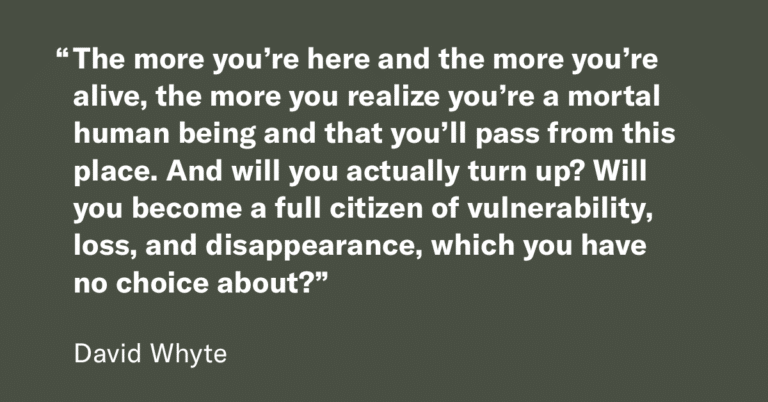
I often feel that one of the real signs of maturity is not only understanding that you’re a mortal human being and you are going to die, which usually happens in your mid-40s or 50s — “Oh, I am actually going to die. It’s not someone else I’m going to become.” But another step of maturity is actually realizing the rest of creation might be a little relieved to let you go [laughs] — that you can stop repeating yourself, stop taking all this oxygen up and make way for something else, which you’ve actually beaten a trail for. And it could be your son, your daughter, could be people you’ve taught or mentored; it could be — the more generous you are, the more that circle extends into our society and those who go after us.
More pithily, to repeat that marvelous line about the deepest source of unhappiness:

Why are you unhappy? -"Because 98.98% of everything you do is for yourself, but there isn't one."

So get over yourself, is the lesson. Grow up.

But that doesn't mean you shouldn't still have fun, which is why it delighted me to surprise Older Daughter with Ava Duvernay in her mailbox yesterday.

Wednesday, May 20, 2020

What else to remember

So many things, we're so forgetful.

What do you mean we?, you may say, Speak for yourself. 

Well of course, nobody elected me to speak for The People. We first of all means me, whenever we say it. But I'm not the only one, and I have a strong hunch I'm not alone in noticing that the simplest and most nourishing home-truths, the lessons of a lifetime that make the most tangible, practical, emotionally-sustaining difference  day by day, are also the  hardest to hang onto. David Whyte noticed, for one, lest I too quickly forget yesterday's dawn post.

Remembering how much I like to catch random reflections at daybreak, after sharing Whyte's poem, I pointedly set my alarm for the wee hours and then, predictably as the evening wore on, un-set it. But I awoke this morning well in advance of the designated and abandoned pre-dawn moment, anyway.

Some part of me remembered. I'll sleep when I'm dead, meanwhile there are important conversations to be had, to be rehearsed. Whyte's right, I think, it's the nature of reality to aspire to wakeful words, reflections, recollections, perceptions, and (when the sun's fully present, even on cloudy days in the mode of absence) immediacies beyond words.

Inspired by Whyte, yesterday, I also remembered the wise words of the industriously wakeful Trollope. “A small daily task, if it be really daily, will beat the labours of a spasmodic Hercules.”

Really daily: remember not to forget. Every day. Or at least every weekday, more or less. Allowances must be made for Memorial Day, and anniversaries, and milestone birthdays... (I can see you frowning, Tony.)

And remember what Trollope also said, just a couple of paragraphs on (in his autobiography), about Mens sana in corpore sano. Health, in body and mind, is always a matter of balance, and of persistent habit. What worthy achievement isn't, after all?
==
Whyte relates an anecdote about an "articulate Irishman" who, writing under an adopted Chinese nom de plume and style of mystic sagacity, asked and answered Why are you unhappy? -"Because  98.98% of everything you do is for yourself, but there isn't one."

And, from Wallace Stevens: "Sometimes the truth depends on a walk around a lake."

Or a creekside, a greenway, a suburban neighborhood... Solvitur ambulando, it is "solved by walking," Diogenes. Q.E.D.

That's today's truth, anyway.
The 'absolutely' true, meaning what no farther experience will ever alter, is that ideal vanishing-point towards which we imagine that all our temporary truths will some day converge. It runs on all fours with the perfectly wise man, and with the absolutely complete experience; and, if these ideals are ever realized, they will all be realized together. Meanwhile we have to live to-day by what truth we can get to-day, and be ready to-morrow to call it falsehood. Ptolemaic astronomy, euclidean space, aristotelian logic, scholastic metaphysics, were expedient for centuries, but human experience has boiled over those limits, and we now call these things only relatively true, or true within those borders of experience. 'Absolutely' they are false; for we know that those limits were casual, and might have been transcended by past theorists just as they are by present thinkers. Pragmatism, Lecture VI
Important to remember that too.

LISTEN... postscript

Tuesday, May 19, 2020

What to remember

David Whyte's 2010 poem  speaks to our historical moment, as well as to the break of day.

The "other world" might be darkness and dreams, it might be the interior mind struggling to emerge into daylight, it might just be a more functional self. My own view is that, as Emerson said, "there is no other world" in any supernatural sense, but nature permits countless possible worlds of the imagination. And there are countless other worlds in the astro-physical sense too, of course.

Whatever our particular "secret" world is, we're quick to forget it. Good poetry remembers.

WHAT TO REMEMBER WHEN WAKING
In that first
hardly noticed
moment
in which you wake,
coming back
to this life
from the other
more secret,
moveable
and frighteningly
honest
world
where everything
began,
there is a small
opening
into the day
which closes
the moment
you begin
your plans.
What you can plan
is too small
for you to live.
What you can live
wholeheartedly
will make plans
enough
for the vitality
hidden in your sleep.
To be human
is to become visible,
while carrying
what is hidden
as a gift to others.
To remember
the other world
in this world
is to live in your
true inheritance…
Excerpt from ‘What to Remember When Waking’
From RIVER FLOW: New and Selected Poems
Many Rivers Press. ©David Whyte

David Whyte fb

==
I wasn't previously familiar with David Whyte's work, before coming across What to Remember just yesterday. But after imbibing just a bit of it, I guessed that he was just the sort of person who might have been a past guest of Krista Tippett's. Sure enough: 4.7.16 (The Conversational Nature of Reality) ... 9.10.18 (The Gathering)