Delight Springs

Wednesday, January 15, 2025

See this Instagram post by @dremilyherring

"This week the New York Times ran the review of my biography of Bergson in print! If anyone knows how I can get my hands on a copy in Paris let me know!" --
osopher's profile picture
Great to see the book getting this attention! But Bergsonians (and Jamesians) will rightly resent Anthony Gottlieb's dismissive condescension. If subjective human experience is not relevant to our grasp of the significance of time, what in the world is??
@dremilyherring: https://www.instagram.com/p/DE0HV1_MCah/?igsh=ZGUzMzM3NWJiOQ==

==
I'm tempted to write a letter to the Times Book Review.

I wrote The New Yorker a letter, taking issue with Gottlieb's Leibniz, which they won't publish so soon on he heels of my last one. But I needed to write it:

Anthony Gottlieb wants us to overlook Gottfried Leibniz's "best of possible worlds" theodicy and give the old philosopher a break. [The Man Who Knew Too Much, Jan.6]


William James was an ecumenical philosopher prepared to give just about every variety of experience-based philosophy more than an even break. But he rightly drew the line at Leibniz,


a rationalist mind, with infinitely more interest in facts than most rationalist minds can show. Yet if you wish for superficiality incarnate, you have only to read that charmingly written 'Theodicee' of his, in which he sought to justify the ways of God to man, and to prove that the world we live in is the best of possible worlds. --William James, Pragmatism Lecture I: The Present Dilemma in Philosophy


The notion that suffering on earth could ever be adequately compensated by its hypothetical absence elsewhere in the cosmos is indeed a feeble attempt to rationalize the insufferable.


#try

We pragmatists must frequently remind ourselves, as WJ did when he mocked himself for thinking he could "settle the universe's hash" with a grand final statement in philosophy:

"You have power over your mind - not outside events. Realize this, and you will find strength." ― [falsely attributed, probably, to Marcus Aurelius, Meditations]

And yet we must try. Fools and authoritarians do seem to have an outsize influence on events. #meliorism

Monday, January 13, 2025

"to work for something because it is good"

That's hope.

"F. Scott Fitzgerald famously said, “The test of a first-rate intelligence is the ability to hold two opposed ideas in the mind at the same time, and still retain the ability to function,” but the summations of the state of the world often assume that it must be all one way or the other, and since it is not all good it must all suck royally. Fitzgerald’s forgotten next sentence is, “One should, for example, be able to see that things are hopeless and yet be determined to make them otherwise.”

You wonder what made Vaclav Havel hopeful in 1985 or 1986, when Czechoslovakia was still a Soviet satellite and he was still a jailbird playwright. Havel said then, The kind of hope I often think about (especially in situations that are particularly hopeless, such as prison) I understand above all as a state of mind, not a state of the world. Either we have hope within us or we don’t; it is a dimension of the soul; it’s not essentially dependent on some particular observation of the world or estimate of the situation.

Hope is not prognostication. It is an orientation of the spirit, an orientation of the heart; it transcends the world that is immediately experienced, and is anchored somewhere beyond its horizons. Hope, in this deep and powerful sense, is not the same as joy that things are going well, or willingness to invest in enterprises that are obviously headed for early success, but, rather, an ability to work for something because it is good, not just because it stands a chance to succeed."

"Hope in the Dark: Untold Histories, Wild Possibilities" by Rebecca Solnit: https://a.co/2ykoSIT

Saturday, January 4, 2025

William James Society - A Note from the President

 Now, to work on that Presidential Address in D.C. in March...
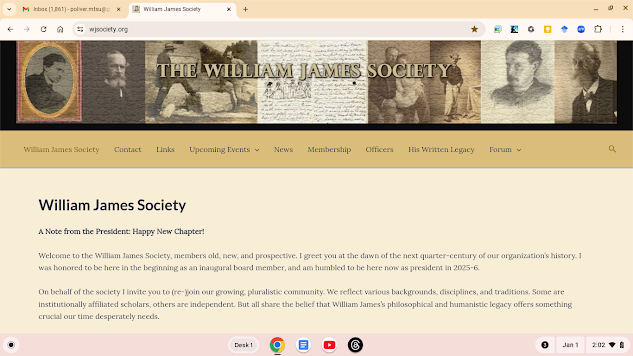

William James Society

A Note from the President: Happy New Chapter!


Welcome to the William James Society, members old, new, and prospective. I greet you at the dawn of the next quarter-century of our organization’s history. I was honored to be here in the beginning as an inaugural board member, and am humbled to be here now as president in 2025-6.

On behalf of the society I invite you to (re-)join our growing, pluralistic community. We reflect various backgrounds, disciplines, and traditions. Some are institutionally affiliated scholars, others are independent. But all share the belief that William James’s philosophical and humanistic legacy offers something crucial our time desperately needs.

The future is (as ever) uncertain but, we Jamesians believe, is also malleable and at least partly, potentially responsive to our most thoughtful and committed exertions in the present. “The really vital question for us all,” he said, “is What is this world going to be? What is life eventually to make of itself?”

James also liked to say life feels like a “real fight,” not a mere game of inconsequential “private theatricals from which one may withdraw at will.” That rings at least as true in 2025 as it must have in 1884, when in Dilemma of Determinism he sought to rally his peers to the spirit of “meliorism”–of trying to improve the human prospect, without any advance guarantees of success.

But because James was a happy fighter, a seeker and celebrant of what he called our “springs of delight,” I think an organization devoted to promoting his distinctive mode of thought and action must also court joy, hope, and a resolute resilience in the face of whatever hard challenges await us.

And because he was a pluralistic humanist, we should also embrace his philosophy of ‘co’: “The pluralistic form [of philosophy] takes for me a stronger hold on reality than any other philosophy I know of, being essentially a social philosophy, a philosophy of ‘co’…”

As so, my fellow James Society cohorts, we can afford neither of the twin luxuries of excessive optimism or pessimism in these challenging times. Neither of those attitudes can summon our best efforts. Let us get on with doing our small bit to try and build a better world.

The great essayist E. B. White said “I arise in the morning torn between a desire to improve (or save) the world and a desire to enjoy (or savor) the world. This makes it hard to plan the day.” Hard, sure. But a Jamesian will insist on both.

So let us be meliorists. And let us have a good time doing it.

Happy New Year!

Phil Oliver
President, William James Society
==

About WJS

Membership in the Society is open to anyone interested in issues related to the thought and character of William James, and joins you to a growing community of scholars and others with related academic interests.

The William James Society (WJS) is a multidisciplinary professional society which supports the study of, and communication about, the life and work of William James (1842-1910) and his ongoing influence in the many fields to which he contributed.

The William James Society was founded in 1999 by Randall Albright and quickly grew to include members from across the USA and around the world. In 2001, the Society ratified an organizational constitution, held its first annual meeting, and elected executive offices. For many years, WJS published the in-house newsletter and scholarly outlet Streams of William James. In 2006, the society shifted gears and began publishing the academic, peer reviewed, online journal William James Studies.

Joining the Society helps to fund the following:The offering of the annual WJS YOUNG SCHOLAR PRIZE.
Co-hosting academic panels at:The American Philosophical Association
The American Academy of Religion
Society for the Advancement of Philosophy
European Pragmatism Conference
Making and making freely available our online journal: William James Studies.

If you are also interested in the life and work of William James, we hope that you will consider joining us in our endeavors.


https://wjsociety.org/


Waking on the mountain

Good to begin 2025 in such a peaceful calming place.

Monday, December 30, 2024

Faith, hope, gratitude, decency: James Earl Carter, 1924-2024

Has there been a more admirable, estimable, and under-valued public figure in our time than Jimmy Carter? Every semester, I talk about him in class as the anti-Machiavelli (and obviously the anti-Trump).

"A strong nation, like a strong person, can afford to be gentle, firm, thoughtful, and restrained. It can to extend a helping hand to others. It is a weak nation, like a weak person, that must behave with bluster and boasting and rashness and other signs of insecurity." [HCR]

If this decency and quiet strength came from his enduring faith, a Jamesian pragmatic pluralist must applaud its value for living. Fruits, not roots. “I found I was absolutely, completely at ease about death. I’m going to live again… Faith in something is an inducement not to dormancy but to action.”

And yet, I have to say I’m even more impressed by those whose decency flows not from belief in everlasting life but from recognition of its finitude. That’s the value, to me, of a humanistic sensibility. 

My form of faith, I’ve been told. 

I’m not sure faith is the right word, though. I prefer hope. And gratitude. “What a precious privilege, to be alive…”

We are, as Dawkins said, lucky to get to die. We got to live. The great challenge is to live well. Jimmy did.

I think he had plenty of hope and gratitude too. Whatever the deepest roots of his exemplary life, its fruits will continue to inspire. We need to hold that example before us in the years just ahead. We're going to need it.

Sunday, December 29, 2024

The fragment novel

"...William Gass complained about the effects of the American penchant for simplicity on the country’s writing, so often reduced to the meat and potatoes of straightforward storytelling. In the contemporary fragment novel, the inverse has occurred. What a plainly narrated adventure was to Gass’s pioneers, a performance of profundity is to the fragment novelist. Oracularities, the more muddled and gently elegiac the better, are offered as evidence of sophistication. “Can you think of writing as a gaze?” the narrator of Drifts asks her students. “Maybe writing was about being visible when I felt invisible,” she reflects later. “Or maybe writing was about becoming invisible again after having become too visible. Maybe it was both. I wasn’t sure anymore.” Zambreno comes close to clarifying that her method hinges on her resistance to clarity—though of course the method itself rebuffs clarification. “One of the notes I take that spring: ‘vagueness.’ Another: ‘signs,’” she writes. Maybe what this means is that vagueness is a sign of poignance, but then it is not altogether clear what it means. After all, why think when you can mimic thinking? And why write a novel when you can meditate on the difficulty of writing a novel? Fragment novels are in effect reflections on novels that, by their own admission, their authors never end up finishing: “What prevents me from writing the book?” asks the protagonist of Drifts. “The heat, the dog, the day, air-conditioning, desiring to exist in the present tense,” and so on and on. It is less a novel than a gesture at a novel. At first glance, the fragment novel’s structural equivocations about how its pieces hang together and substantive equivocations about all its internal architecture appear antithetical to two of the declutterer’s foremost tics: her allergy to euphemism and her request that everything be stashed in its proper place. But in fact the novel’s studied evasiveness is the product of its commitment to tabling wants and honoring needs, in accordance with the minimalist’s most cherished directive. There is no plot, no food, no friends, and very little dialogue. Perhaps the fragment novel is not in fact constructed by way of removal, but it might as well be, for it is no more than an accumulation of negations."

"All Things Are Too Small: Essays in Praise of Excess": https://a.co/caQ5YMc

Saturday, December 28, 2024

Mediation 2.0: “the User Experience”

Still finding enough non-toxicity on Threads to exclude my current feed from the general "social media"-bashing that's become fashionable lately. Deleting "X" was therapeutic. But this has my attention (it would have John Lachs's attention too):


"…Much of what passes for authentic experience today is vicarious and virtual. 

There was no deliberate effort to incentivize this way of living, although many individuals and companies have profited from our growing enthusiasm for ever more mediated experiences. It is one of the unintended consequences of the bargain we struck in embracing the Internet, a consequence few wanted to contend with at the beginning because it seemed unduly pessimistic. Besides, the new online world was fun. It still is. 

But what began as a slow bleed of reality on the edges has now become a culture-wide destabilizing force. Reality has competition, from both augmented and alternative forms. The charm of Second Life, an early alternative online world, has given way to the vastly more ambitious, live-your-life-entirely-online ambitions of the Metaverse or the implant-the-Internet-in-your-brain proposals of Elon Musk's Neuralink. 

In these new worlds, we are Users, not individuals. We are meant to prefer these engineered User Experiences to human reality. This book argues that we arrived here by allowing valuable human experiences to wither or die, sometimes intentionally and sometimes unintentionally. Our continued unwillingness to account for what has been lost won't lead to a world of technology-enabled progress; rather, this inability to grapple with the extinction of fundamental human experiences creates a world where our sense of shared reality and purpose is further frayed, and where a growing distrust of human judgment will further polarize our culture and politics. Technological change of the sort we have experienced in the last twenty years has not ushered in either greater social stability or moral evolution. In fact, many of our sophisticated technological inventions and platforms have been engineered to bring out the worst of human nature. The guiding spirit of Instagram isn't Rumi. It's Hobbes. 

What kind of person is formed in an increasingly digitized, mediated, hyperconnected, surveilled, and algorithmically governed world? What do we gain and what do we lose when we no longer talk about the Human Condition, but rather the User Experience? 

The human condition is embodied, recognizes its fragility, frequently toggles between the mediated and unmediated, requires private spaces, and is finite. By contrast, the User Experience is disembodied and digital, it is trackable and databased and usually always mediated. It lacks privacy and promises no limits—even after death, when, as several new technologies promise, our digital remnants can be gathered and engineered into posthumous chatbots to comfort our grieving family members…"

— The Extinction of Experience: Being Human in a Disembodied World by Christine Rosen
https://a.co/encs4XN

Friday, December 27, 2024

Defending experience against 'philosophy'


Feeling It Out

Alice Gregory’s article on the philosopher L. A. Paul and her circle of oddly amusing philosophers was itself amusing and instructive (“Note to Selves,” December 9th). A great deal of what passes for the pursuit of wisdom in academia these days is, indeed, esoteric, technical, and, finally, irrelevant. But it should be noted that Professor Paul is hardly a pioneer in asserting, however “hesitantly,” that “experience has a kind of value” and that philosophy ought to be less “detached from ordinary life.” William James and the pragmatists said it long ago. In 1900, James, immersed in preparing lectures that would become “The Varieties of Religious Experience,” described the “problem” he set himself as “to defend (against all the prejudices of my ‘class’) ‘experience’ against ‘philosophy’ as being the real backbone of the world’s religious life.”

Phil Oliver
Associate Professor
Department of Philosophy and Religious Studies
Middle Tennessee State University
Nashville, Tenn.

The New Yorker 

For the record, though, my own experience remains the backbone of my atheistic humanism.

He’d be 96 today

And the little guy's catching up.

James C. Oliver, 1928-2008
James P. Oliver, 1957-

The light will win

Though possibly not in the present.

This was a good and timely holiday read.
"What had Bruno said about the future? When we face our need to control it, we are better able to resist that need, and to live in the present.

I stopped reading news articles. I stopped watching videos. My new rule about drinking had been an attempt to rid myself of a crippling attachment. The internet was yet another crippling attachment, and so I banned it.

I walked for hours each afternoon on knobby paths along the cliffs above the sea. I walked to a lighthouse and watched its magnificent crystal flash and turn.

There’s that old myth about the humble lighthouse and the giant battleship. The ship has mistaken the lighthouse for a boat, a little pissant boat that better get out of its way. The captain of the battleship comes on the radio, to command the little boat to move, a boat that he doesn’t understand is a lighthouse on a rock. The captain believes he is in a power struggle with the thing in his path and that the more forceful and arrogant he is, the more likely it will yield. He is not wrong that he is engaged in a struggle for dominance. He’s only wrong that he’ll win." Creation Lake: A Novel by Rachel Kushner

Tuesday, December 17, 2024

What a way to go

"In the bedroom of his Parisian home, Bergson had been in a coma for twelve hours. Those who witnessed his agony sensed that the end was near when, all of a sudden, the illustrious philosopher began to speak. He gave a lecture, a philosophy lecture, for an hour. He pronounced the words very distinctly. His sentences were clear. His lucidity overwhelmed those who listened to him. And then he said, “Gentlemen, it is five o’clock. Class is over.” And he expired."

"Herald of a Restless World: How Henri Bergson Brought Philosophy to the People" by Emily Herring: https://a.co/gtbzIIx

Monday, December 16, 2024

a good lamp

"…Ours is a multifarious culture, peopled by many kinds of readers and many more kinds of non-readers, and that's exactly as it should be in a big, loud, messy democracy. Some of y'all are out there taking heart from cozy mysteries or Victorian novels or Mary Oliver's poems. Some of you are consoled by seed catalogs or travel brochures or Americana records or old Peanuts comic strips. Maybe you're one who needs them all, in endless combinations, just to get through these dark nights.

…if you have not yet found a source of solace that makes the long winter nights feel shorter, or at least not quite so dark, then turn off the machines and set your chair next to a good lamp…


Margaret Renkl

http://www.nytimes.com/2024/12/16/opinion/reading-novellas-short-novels.html?smid=nytcore-ios-share&referringSource=articleShare

Sunday, December 15, 2024

Sleep on it: Khan on the unconscious and AI

Our brains may have more in common with large language models than we may want to believe.

"...Artificial intelligence is not human, no matter how much it approximates being human. Regardless of how well it conveys intelligence, personality, and creativity, it is not a sentient, perceiving being.

Yet it is important to appreciate that much of the work we credit to our brain isn’t really sentient or part of our perception. Most of our brain’s activity is subconscious, including what we would often consider creativity. Any artist will tell you they often feel a flash of insight that leads to the creative act.

Similarly, how many times have you been told to “sleep on the problem”? I myself am a master of this art. In college, when I faced seemingly intractable math problems, I would engage with them for a few minutes and then delegate them to my subconscious. I would tell my brain to essentially come up with the answers and tell “me” when it was done. Most of the time, I had the answers by the next morning without having to consciously struggle with them. I’m not alone in doing this. Many people find it a useful way to approach difficult problems.

I now do the same thing when I face a tough problem while leading Khan Academy. I have faith that my brain, or someone else’s, will come up with a creative solution by morning. What are our brains doing subconsciously while our consciousness waits for an answer? Clearly, when you “sleep on a problem,” some part of your brain continues to work even though “you” aren’t aware of it. Neurons activate, which then activate other neurons depending on the strength of the synapses between them. This happens trillions of times overnight, a process mechanically analogous to what happens in a large language model. When a plausible solution presents itself, the subconscious then surfaces it to the conscious as a flash of insight.

Meditation gives us direct experience with this. Close your eyes for a few minutes and observe your own thoughts. They really begin to feel very much like the output of a large language model—or several competing models—whose latest output gets fed as input for the next iteration of output. With a bit of practice, your conscious mind can temporarily disassociate itself from these thoughts until you experience stillness or “no thought.” You’ll begin to see your thoughts for what they are and aren’t. They aren’t you.

Think about a flow state that most experts in their craft can attain after the often-noted ten thousand hours of practice (which is analogous to pretraining for generative AI models). They will often say that their greatest creativity or actions occur when they do not allow themselves to be conscious of what they are doing. The best way to ruin their performance, or creativity, is to consciously think about what is happening. Great orators will tell you that it feels like their brain is doing the talking while their conscious selves are just there to observe the output. After making thousands of videos, I often feel this way when I press record. I won’t claim that what experts’ well-trained brains are doing when they create is identical to what large language models do, but it seems awfully similar."

"Brave New Words: How AI Will Revolutionize Education (and Why That's a Good Thing)" by Salman Khan: https://a.co/i8LPsmB

Friday, December 13, 2024

Against specialisation

Academic philosophers these days don't tend to think like young Bergson.

"The young Bergson's aversion to specialisation had started at some point in the late 1870s, when he discovered that, unlike other academic disciplines, philosophy was not limited to a specific object but opened up an infinity of theoretical avenues. It represented an opportunity to encompass all areas of knowledge, to look at the biggest, most important problems, to embrace every aspect of reality in one sweeping gesture. By choosing philosophy, he would not have to abandon any of his interests but could keep them all under investigation. Conceivably, Bergson had also realised in that moment that mathematical problems, though fascinating, were too narrow for his intellectual ambitions. By specialising as a mathematician, he would be willingly cutting himself off from whole areas of human knowledge, whereas, as a philosopher, the entirety of human knowledge would be his subject matter."

— Herald of a Restless World: How Henri Bergson Brought Philosophy to the People by Emily Herring

https://a.co/d5qCnO6

Wednesday, December 11, 2024

The unrestricted circle of humanity

Not many philosophers enter that circle anymore. 
There was indeed something special about the way the professor spoke. He held as a principle that “there is no philosophical idea, however profound or subtle, that cannot and should not be expressed in everyday language,” and that philosophers should “not write for a restricted circle of initiates; they write for humanity in general.” --Herald of a Restless World: How Henri Bergson Brought Philosophy to the People by Emily Herring: https://a.co/2HY2Lu3

Serious

"It is a serious thing just to be alive on this fresh morning in this broken world." —Mary Oliver, Invitation

Tuesday, December 10, 2024

English heritage

That ubiquitous internet attribution to Ben Franklin of the line that beer is proof that God loves us is surely apocryphal.

"His (London) colleagues nicknamed him the Water-American because he refused to partake in the ubiquitous beer drinking: a pint before breakfast, with breakfast, after breakfast, with the midday meal, at six, and a last one before bed. (Franklin preferred Madeira.) Franklin also prided himself on healthy habits…"

— The Bookshop: A History of the American Bookstore by Evan Friss

Monday, December 9, 2024

The point of trying

Meliorists know: the point is to try.
"…In the aftermath of an election that will return a climate denier to the White House and a climate-denying party to control of Congress, it sometimes seems impossible to keep going. Every effort feels Sisyphean. Any possible change for the better is about to be demolished by the outrageously unqualified industry toadies whom Donald Trump has named to run the agencies that protect our wilderness, our air, our water. Our future.

More and more I find it hard not to ask the question I have spent my adult life avoiding: What is the point of even trying?

Recently I read an old essay by the Kentucky author and farmer Wendell Berry, who has been writing for more than six decades about the need to heal the separation between human beings and the natural world. In his essay "A Poem of Difficult Hope," which appears in his book "What Are People For," Mr. Berry argues that the success of any protest should not be measured by whether it changes the world in the way we hope it will.

'Much protest is naïve; it expects quick, visible improvement and despairs and gives up when such improvement does not come," he wrote in 1990. "If protest depended on success, there would be little protest of any durability or significance. History simply affords too little evidence that anyone's individual protest is of any use. Protest that endures, I think, is moved by a hope far more modest than that of public success: namely, the hope of preserving qualities in one's own heart and spirit that would be destroyed by acquiescence.'

At my lowest, I have never entirely given up my faith that good people working together can change the world for the better. When I have been downhearted in the past, I have always explained to myself that I am not alone in my efforts to cultivate change — by writing, by planting, by loving the living world in every way I can find to love it. Individual efforts gather momentum through the individual efforts of others.

Men in power did not wake up one morning and decide to give women the vote. White Southerners did not wake up one morning and decide to dismantle Jim Crow. Those things happened, if imperfectly and still incompletely, because hundreds of thousands of people worked together for years to make them happen.

But where preserving biodiversity is concerned, we don’t have years. Where stabilizing the climate is concerned, we don’t have years. Once a species becomes extinct, it remains extinct forever. Once the climate hits an irreversible tipping point, it will tip. In that context, the Republican takeover of Washington is a catastrophe that is hard to reconcile with a plan to plant more flowers and install more nest boxes.

So I am taking comfort from Wendell Berry, who has lived a life of ceaseless protest against the desecration of the earth and its creatures (most recently in an essay for The Christian Century called “Against Killing Children”). Even at 90, he is not asking himself what the point is...."

—Margaret Renkl, How to Keep Your Own Soul Safe in the Dark