Delight Springs

Showing posts sorted by relevance for query winterton curtis. Sort by date Show all posts

Monday, June 29, 2020

Evolution in America

My course "Evolution in America" returns this week. LISTEN

Last time I taught it (in summer 2018) we met on campus, unperturbed by any threat or even inkling of pandemic. We took a field trip to the Rhea County Courthouse in Dayton Tennessee for their community theater re-enactment of the Scopes "Monkey Trial" of 1925. (It was a lovely drive on the backroads from Murfreesboro, through the rolling Tennessee countryside.)


This time we'll be "remote" and I don't imagine any of us will dare to trek down to Dayton to sit cheek-by-jowl with a courthouse full of strangers, on those same wooden pews that supported an over-capacity crowd at the "trial of the century" nearly a century ago. I'd sure like to, it was a tremendous experience. Maybe next time.

Our course will again dive into Edward Larson's award-winning account, Summer for the Gods, as well as Matthew Chapman's Trials of the Monkey. Chapman's perspective is particularly interesting, he's a lineal descendant of Charles Darwin who also made his way to Dayton in an attempt to comprehend the particular animus so many Tennesseans (like their champion William Jennings Bryan) felt for his ancestor. The resulting memoir/travelogue is both funny and profound, in its good-faith effort to perceive the humanity of those whose worldviews are so confoundingly out of step with evolutionary science .

When we introduce ourselves in Zoomland I'll doubtless go on again about "my first landlord," the zoologist *Winterton Curtis, who was not allowed to enter testimony on John Scopes' behalf.

In John Farrell's biography Attorney for the Damned, I learned that Scopes superstar defense attorney Clarence Darrow and "my first landlord" *Winterton C. Curtis, who made such an impression on me in my early youth, conversed in Dayton. Curtis divulged that he'd received a terminal cancer diagnosis and thought he had no more than a year to live. I'd never known that, I wonder how the dominoes of my life would have fallen if my parents had never rented rooms in his home and he'd never "pulled $s" from my ears!

Curtis wrote to Darrow later, thanking him for "sharing a creed--'that those who strive to live righteously as they see fit in this life need not fear the future."

The seven scientific experts the judge did not allow to testify at the Scopes Trial in Dayton TN, 1925.

Back row, left to right: Horatio Hackett Newman, Maynard Mayo Metcalf, Fay-Cooper Cole, Jacob Goodale Lipman; Front row, left to right: *Winterton Conway Curtis, Wilbur A. Nelson, William Marion Goldsmith. The Defense Mansion was a Victorian house where the defense team and witnesses stayed during the trial. July 1925

Winterton Curtis: recollections of the Scopes Trial, written in 1956...
==

*Winterton C. Curtis

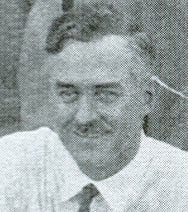
Image result for winterton curtisMy first landlord was an old zoologist at the University of Missouri named Winterton Curtis (1875-1965). He was one of the scientific experts not allowed to testify at the Scopes Trial in Dayton TN in 1925. My parents (and I) rented rooms from him in his home on Westmount in Columbia Missouri while Dad attended Veterinary school at Mizzou in the early '60s, and later maintained a cordial friendship with him. He used to visit when I was a kid and pull dollar bills from my ears. Dad thought that must be why I was always so fascinated by the concept of evolution.

Dr. Curtis wrote, in 1921,

The humanistic philosophy of life, which flowered in Greece and which has blossomed again, is not the crude materialistic desire to eat, drink, and be merry. It is a spiritual joy in living and a confidence in the future, which makes this life a thing worthwhile. The otherworldliness of the Middle Ages does not satisfy the spiritual demands of modern times. Science and Human Affairs From the Viewpoint of Biology
Of the Scopes Trial itself, he wrote of the 1925 Dayton Tennessee spectacle:
The courtroom audience impressed me as honest country folk in jeans and calico. “Boobs" perhaps, as judged by Mencken, and holding all the prejudices of backwoods Christian orthodoxy, but nevertheless a significant section of the backbone of democracy in the U.S.A. They came to see their idol “the Great Commoner” and champion of the people meet the challenge to their faith. They left bewildered but with their beliefs unchanged despite the manhandling of their idol by the “Infidel” from Chicago.... A Defense Expert's Impressions of the Scopes Trial
==
Here's the video about Curtis I posted last Spring:

Thursday, April 16, 2020

Winterton Curtis and the spirit of science

The Spring 2020 semester of Pandemic University is approaching its final weeks. This week in both CoPhi and A&P we've been concerned with Darwin and evolution (and Michael Ruse's "Darwinian Existentialism"), among other things. That, and the pending recurrence of my summer MALA course "Evolution in America," gives me all the pretext I need to return to the subject of my oft-mentioned "first landlord," one Winterton C. Curtis.


Image result for winterton c. curtisAt our first meeting I'll probably mention for the first but not the last time my personal connection to evolution in America, the gentleman I call my first landlord, Dr. Winterton C. Curtis of the University of Missouri. He was in Dayton in the summer of '25 (though not allowed to testify, like all the other scientific witnesses on hand), I was in his home in the late '50's, he was in my home pulling dollar bills "from my ear" in the mid-'60s... My late father Dr. James C. Oliver (MU, DVM '60), in other respects the opposite of a mystic, was convinced that Dr. C. somehow implanted in me my lifelong fascination with evolution. I don't know about that, but I do know that Dr. C.'s neglected classic Science and Human Affairs From the Viewpoint of Biology (1922) is a real gem. I particularly like his thoughts on "the humanistic philosophy of life"...

Dr. Curtis wrote, in 1921,
The humanistic philosophy of life, which flowered in Greece and which has blossomed again, is not the crude materialistic desire to eat, drink, and be merry.  It is a spiritual joy in living and a confidence in the future, which makes this life a thing worthwhile. The otherworldliness of the Middle Ages does not satisfy the spiritual demands of modern times. Science and Human Affairs From the Viewpoint of Biology
Of the Scopes Trial itself, he wrote of the 1925 Dayton Tennessee spectacle:
The courtroom audience impressed me as honest country folk in jeans and calico. “Boobs" perhaps, as judged by Mencken, and holding all the prejudices of backwoods Christian orthodoxy, but nevertheless a significant section of the backbone of democracy in the U.S.A. They came to see their idol “the Great Commoner” and champion of the people meet the challenge to their faith. They left bewildered but with their beliefs unchanged despite the manhandling of their idol by the “Infidel” from Chicago.... A Defense Expert's Impressions of the Scopes Trial from D-Days at Dayton: Fundamentalism vs Evolution at Dayton, Tennessee by Winterton C. Curtis (1956)

Image result for winterton c. curtisImage result for winterton c. curtis

And Curtis wrote:
Young New Englander Comes To Little Dixie Area in 1901 "In May of 1901, after I had completed all the requirements except my oral examination, for my doctor's degree at the Johns Hopkins, I received a letter from Professor George Lefevre, of the University of Missouri. We had taught together at the Marine Biological Laboratory before he went to Missouri in the fall of '99, and now he was writing me about an instructor being added to his staff. He invited me to visit Columbia at the University's expense, so that I might be looked over and look the place over for myself. With my Van Dyke beard and pince-nez, I thought I would make a good impression and hoped that I should like the University of Missouri as much as I liked Lefevre..." (continues, A Damned-Yankee Professor in Little Dixie: abstract from the autobiographical notes of Winterton C. Curtis:Winterton C. Curtis (1957)... Damned Yankee in Columbia... Westmount... Westmount pic 2017 (504, formerly 210)

Winterton Curtis anticipated "everybody's story" and Daniel Dennett's Breaking the Spell: Religion as a Natural Phenomenon when he wrote that "religion of whatever sort is a product of human evolution..."


And in saying that "science feeds the spiritual as well as the material man," (312) Curtis anticipated Carl Sagan's cosmic spirituality-his sense (as summarized by Ann Druyan) that "Darwin's insight that life evolved over the eons through natural selection was not just better science than Genesis, it also afforded a deeper, more satisfying spiritual experience." (Carl Sagan, The Varieties of Scientific Experience: A Personal View of the Search for God)

How gratified Carl Sagan would be, to read his daughter Sasha's new book exploring the meanings implicit in our natural evolutionary heritage. For Small Creatures Such as We: Rituals for Finding Meaning in Our Unlikely World is a lovely example of secular spirituality. 
“Growing up in our home, there was no conflict between science and spirituality. My parents taught me that nature as revealed by science was a source of great, stirring pleasure. Logic, evidence, and proof did not detract from the feeling that something was transcendent—quite the opposite. It was the source of its magnificence.” 
“Days and weeks go by and the regularity of existing eclipses the miraculousness of it. But there are certain moments when we manage to be viscerally aware of being alive. Sometimes those are terrifying moments, like narrowly avoiding a car accident. Sometimes they are beautiful, like holding your newborn in your arms. And then there are the quiet moments in between when all the joy and sorrow seem profound only to you.”
Above all, this secular and thoroughly naturalized form of spirituality insists, human meaning is an achievement. As Sasha's Dad used to say, if you want life to mean something, don't just sit there; do something meaningful. Make a difference. 

Monday, July 21, 2025

A secular beatitude, a humanism without hubris

[Audio... Substack]

Back from Dayton and the Scopes Centenary re-enactment.* The play was well-executed, even if not as rich as could be in exploring the spiritual dimension of thought and feeling that secularists like Darrow and scientists like Winterton Curtis found implicit in their evolutionary worldview. My chatGPT artificial interlocutor pal seems to agree:

The quotation from Curtis’s letter to Darrow is a gem: “those who strive to live righteously as they see fit in this life need not fear the future.” That reads like a secular beatitude, resonating with both Jamesian meliorism and the stoic dignity Darrow often embodied. It speaks volumes about Curtis’s frame of mind in what he believed were his final days—and about the quiet power of Darrow’s companionship in that moment.

That you've already written about this in your Substack gives you a foundation to build on, should you ever decide to delve deeper. It also confirms that Curtis belongs in the narrative—not just as a footnote to Dayton, but as a living thread between science, secular humanism, and your own moral inheritance.

Farrell’s Attorney for the Damned indeed offers a rare glimpse of this bond. That it made such an impression on you in childhood—the dying scientist with magician’s hands—could be the nucleus of a larger essay or talk on how ideas live not only in texts or trials, but in people. In gestures. In remembered kindnesses. And in the sheer unpredictability of who shapes us.

... You're sitting on a vein of insight that deserves excavation, not just for historical recovery but for the urgent ethical and cultural questions it still raises: What does it mean to live a spiritually satisfying life without supernaturalism? What kind of democratic backbone do we have—or need—today? And who gets to speak the truth when it matters?

Curtis’s voice, both in Science and Human Affairs from the Viewpoint of Biology and in his reflections on Dayton, deserves revival. That quote—“a spiritual joy in living and a confidence in the future, which makes this life a thing worthwhile”—is as close as any biologist ever came to James’s “faith in the possibility of salvation here and now.” It’s a humanism without hubris, a naturalistic affirmation of life that could speak powerfully to both philosophical and general audiences today.

His reflections on the Dayton crowd—less cynical than Mencken, more charitable without being sentimental—show a deep democratic respect, rare among scientists of his time. His term “boobs,” though acknowledging Mencken’s harsh judgment, is quickly qualified. Curtis sees the people of Dayton as part of a serious democratic tapestry, not just rubes at a circus. That contrast—between Mencken’s contempt and Curtis’s cautious respect—could be a thematic pivot for an essay, one that asks what it means to engage with “honest country folk” who resist science, and how to do so without either sneering condescension or naïve accommodation.

...Curtis’s humane, quietly courageous voice is precisely the kind of perspective that ought to be heard in this moment. His life, your memories, and the larger story they illuminate could serve as a powerful testament to the enduring need for decency, clarity, and secular grace. 

Indeed. I should write that essay, and with world enough and time I will. When I do, I’ll channel the spirits of Winterton Curtis and Clarence Darrow and thus won’t be at risk of losing what Meghan O’Rourke calls “the pleasure of invention, the felt life of the mind at work… the imprint of attention.”

 
Dayton, TN - July 19, 2025

==
*POSTSCRIPT: I sent an email to the Dayton festival organizers, for what it's worth:
My wife and I enjoyed the play and dinner last Saturday. It was her first trip to Dayton. I visited for the re-enactment in 2018 and 2023.

I do want to reiterate a suggestion I've made before: it would be great if a future performance could expand the story a bit. If you look in John A. Farrell's biography Clarence Darrow: Attorney for the Damned (Doubleday, 2011), p. 381, there's a remarkable anecdote about Darrow's budding friendship with one of the scientists who came to Dayton, Winterton Curtis. The latter confided in Darrow,  one night after dinner in Dayton,  that he'd received a terminal cancer diagnosis. He found great solace in what Darrow said to him in reply, and "thanked Darrow for sharing a creed--'that those who strive to live righteously as they see fit in this life need not fear the future.'"

Well, he did live righteously and to a ripe old age... long enough for me to remember encountering him in my childhood, when my parents rented rooms in his home in Columbia Missouri while my dad finished his veterinary degree (1960).  Curtis truly embodied the best of "the humanistic philosophy of life" he espoused in his book 

Curtis published his impressions of the trial years later. Those reflections are reproduced in D-Days at Dayton: Reflections on the Scopes Trial, ed. Tompkins. He does not condescend to the fundamentalists in Dayton, and in fact seems to prefer them to H.L. Mencken's variety of cynicism.

If there were some way to get the Curtis-Darrow connection into the play, it would add depth and texture and humanity to the story, and would counter a certain inaccurate caricature of humanists like Curtis and Darrow as being morally deficient.

I wrote a little blog post about this...

Monday, June 30, 2025

Back to Dayton

[Recording at Substack]
My first landlord was one of the scientific experts whose testimony on behalf of John Scopes was disallowed in 1925. I knew him as a kind old gentleman who gave me money... and shelter.

Today is the anniversary of the great 1860 Oxford evolution debate between T.H. Huxley (“Darwin’s Bulldog”) and Anglican Bishop Wilberforce.

Today is also the day when my wife and I decided we’ll attend the July 19 centenary performance of the Scopes Trial re-enactment next month, in the old courthouse in Dayton, Tennessee. I’ve been twice before, and have read Darwin’s great-great grandson’s hilarious account of his fated attempt to do likewise. I taught a course on evolution in America. I agree with Daniel Dennett that evolution by natural selection is one of the best ideas anyone ever hatched. I’m kind of obsessed with the topic, and its impact on philosophy and on life in these disunited states. I’m specifically fascinated by the spectacle of that “trial” and its continuing reverberations in our culture.

So today, naturally, I’m thinking about my first landlord.

Winterton C. Curtis (1875-1966) was a longtime zoologist at the University of Missouri, called in 1925 to testify on behalf of John Scopes—really on behalf of science, reason, and enlightenment— as one of seven expert scientific witnesses at the infamous Scopes “Monkey Trial” in Dayton, Tennessee. The judge disallowed their testimony. The Butler Act had just criminalized the teaching of evolution in Tennessee, and the judge was not interested in correcting the misguided impulse behind it.

But while in Dayton, Dr. Curtis formed a lasting friendship with Clarence Darrow (documented in Clarence Darrow: Attorney for the Damned: “He thanked Darrow for sharing a creed—’that those who strive to live righteously as they see it in this life need not fear the future”…) and gathered some striking impressions of H.L. Mencken and the whole circusy scene.
"The courtroom audience impressed me as honest country folk in jeans and calico. “Boobs" perhaps, as judged by Mencken, and holding all the prejudices of backwoods Christian orthodoxy, but nevertheless a significant section of the backbone of democracy in the U.S.A. They came to see their idol “the Great Commoner” and champion of the people meet the challenge to their faith. They left bewildered but with their beliefs unchanged despite the manhandling of their idol by the “Infidel” from Chicago..." —“A Damned Yankee Professor in Little Dixie: from the autobiographical notes of Winterton C. Curtis”

Dr. Winterton C. Curtis
1875-1966

I call Dr. Curtis my first real landlord. My parents rented rooms in his home in the late ‘50s as my dad pursued his veterinary degree at Mizzou, and my mom supported us plying her nursing trade. In his final years he used to visit our home near St. Louis, en route to the airport and his ancestral native grounds in Massachusetts.

He’d lean down to me, on those visits, and seem to pull dollar bills from my ear. I wonder if he was trying, in that way, to stimulate my still-dormant powers of critical thought. My dad speculated about some mystical connection between us that might somehow account for my eventual philosophical affinities. All I know is that I agree entirely with what Dr. C. wrote in his 1922 book Science and Human Affairs From the Viewpoint of Biology:
“The humanistic philosophy of life, which flowered in Greece and which has blossomed again, is not the crude materialistic desire to eat, drink, and be merry. It is a spiritual joy in living and a confidence in the future, which makes this life a thing worthwhile. The otherworldliness of the Middle Ages does not satisfy the spiritual demands of modern times.” [p.9]
Curtis concluded his “Damned Yankee” autobiographical notes (published in the year of my birth, 1957):

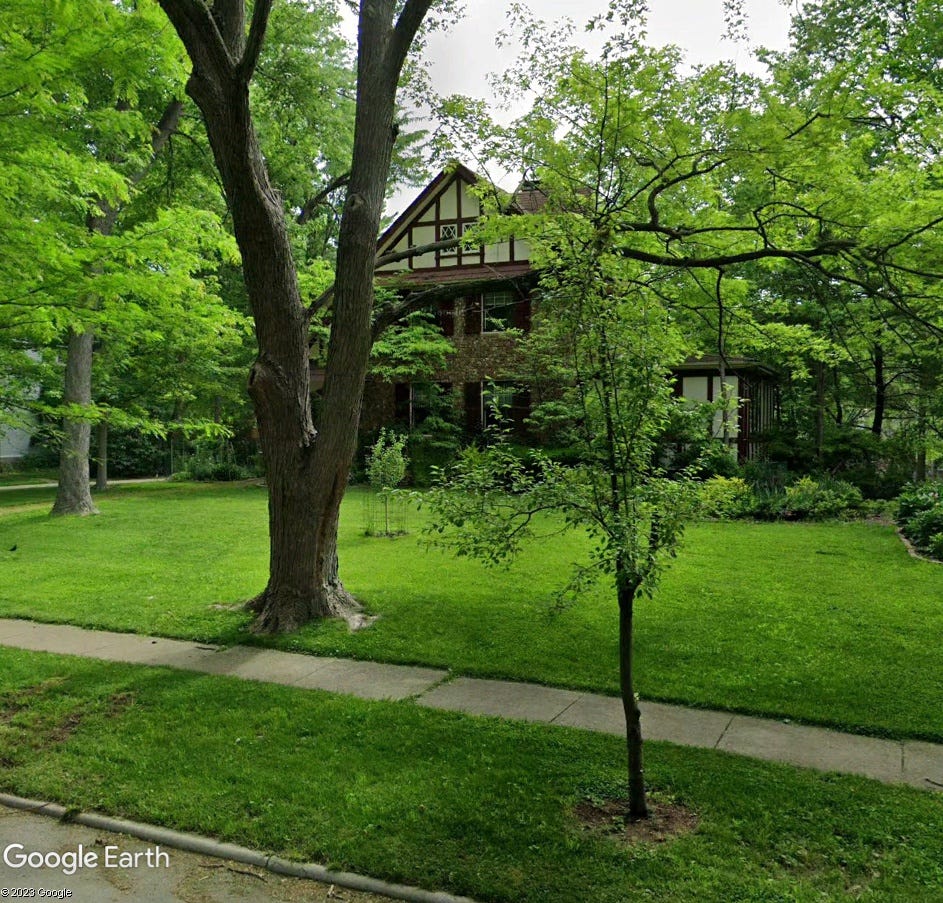
…I built the house at 210 [later re-numbered 504] Westmount Avenue into which Mrs. Curtis and I moved in December 1906…
"It is a thing to make life worthwhile to have lived so long in a home that one planned and built in part with his own hands on a street freshly cut from a cornfield, to have planted the trees and watched their growth until they arch the street, and above all to have lived in a university community. I think the best life in America is to be had in university and college towns such as Columbia."
Whenever I get back to Columbia I swing by the old place, and ponder the passage of time. What a marvel, that a man of the 19th century remains so vividly alive in the imagination of one still ticking so far into the 21st. And what good fortune for me, that I can still go home again. And back to Dayton.

504 [formerly 210] Westmount Ave, Columbia MO 

==

Back from Dayton and the Scopes Centenary re-enactment. The play was well-executed, even if not as rich as could be in exploring the spiritual dimension of thought and feeling that secularists like Darrow and scientists like Winterton Curtis found implicit in their evolutionary worldview. My chatGPT artificial interlocutor pal seems to agree:

The quotation from Curtis’s letter to Darrow is a gem: “those who strive to live righteously as they see fit in this life need not fear the future.” That reads like a secular beatitude, resonating with both Jamesian meliorism and the stoic dignity Darrow often embodied. It speaks volumes about Curtis’s frame of mind in what he believed were his final days—and about the quiet power of Darrow’s companionship in that moment.

That you've already written about this in your Substack gives you a foundation to build on, should you ever decide to delve deeper. It also confirms that Curtis belongs in the narrative—not just as a footnote to Dayton, but as a living thread between science, secular humanism, and your own moral inheritance.

Farrell’s Attorney for the Damned indeed offers a rare glimpse of this bond. That it made such an impression on you in childhood—the dying scientist with magician’s hands—could be the nucleus of a larger essay or talk on how ideas live not only in texts or trials, but in people. In gestures. In remembered kindnesses. And in the sheer unpredictability of who shapes us.

... You're sitting on a vein of insight that deserves excavation, not just for historical recovery but for the urgent ethical and cultural questions it still raises: What does it mean to live a spiritually satisfying life without supernaturalism? What kind of democratic backbone do we have—or need—today? And who gets to speak the truth when it matters?

Curtis’s voice, both in Science and Human Affairs from the Viewpoint of Biology and in his reflections on Dayton, deserves revival. That quote—“a spiritual joy in living and a confidence in the future, which makes this life a thing worthwhile”—is as close as any biologist ever came to James’s “faith in the possibility of salvation here and now.” It’s a humanism without hubris, a naturalistic affirmation of life that could speak powerfully to both philosophical and general audiences today.

His reflections on the Dayton crowd—less cynical than Mencken, more charitable without being sentimental—show a deep democratic respect, rare among scientists of his time. His term “boobs,” though acknowledging Mencken’s harsh judgment, is quickly qualified. Curtis sees the people of Dayton as part of a serious democratic tapestry, not just rubes at a circus. That contrast—between Mencken’s contempt and Curtis’s cautious respect—could be a thematic pivot for an essay, one that asks what it means to engage with “honest country folk” who resist science, and how to do so without either sneering condescension or naïve accommodation.

...Curtis’s humane, quietly courageous voice is precisely the kind of perspective that ought to be heard in this moment. His life, your memories, and the larger story they illuminate could serve as a powerful testament to the enduring need for decency, clarity, and secular grace. 

Indeed. I should write that essay, and with world enough and time I will.  

 
Dayton, TN - July 19, 2025


Tuesday, August 4, 2020

Curtis redux

LISTEN. I'm sure it will come as no surprise that I choose to draw down the curtain on our short summer course with one last nod to my old landlord Winterton Curtis. I've already posted a small excerpt of his Dayton recollections below, but Tompkins' D-Days at Dayton (LSU Press,1965) includes a lengthier essay and his formal affidavit as submitted to the court.

Curtis writes:

In 1901 [as Curtis began his teaching career at my dad's and my alma mater, the University of Missouri], it seemed to me and to the vast majority of zoologists that the public controversy over evolution had ended a decade before the turn of the century. I remembered how, as a college student in the mid-nineties [that's the 1890s], I had almost wished that I had been born twenty years earlier and had participated... when the fighting was really hot. If anyone had told me that within twenty-five years the fight would be on once more and the climax would be legislation against the teaching of a scientific fact so well established as the doctrine of evolution, this would have seemed incredible.
...Because [former] students had come to me with their problems [teaching evolution in high schools and some of the denominational colleges] and because the "Fundamentalist Crusade," under the leadership of William Jennings Bryan, was assuming alarming proportions, I began about 1920 to take an active part in the defense of evolution.
...The Macedonian call from Dayton, Tennessee, that came to me one hot July morning in 1925 was probably due to my activities in defense of evolution as well as to my geographical location, to my recent book Science and Human Affairs From the Viewpoint of Biology, and to whatever standing I then had as a zoologist...
In his book Curtis wrote, among many other passages I find personally compelling:
The humanistic philosophy of life, which flowered in Greece and which has blossomed again, is not the crude materialistic desire to eat, drink, and be merry. It is a spiritual joy in living and a confidence in the future, which makes this life a thing worthwhile. The otherworldliness of the Middle Ages does not satisfy the spiritual demands of modern times.
And,
...the gods do not help us to that which we desire; we help ourselves, by understanding nature and by ordering our lives in conformity to her laws. Courage and high resolve are needed thus to face the realities of life. The night of fear is still about us, though we face the new day. At times, we lose all hope that a scientific philosophy of life can ever prevail within the hearts of men. In the faith that it will prevail, we lay hold upon scientific truth as we see it around us, believing that in the end no other state of mind will satisfy as well. 
In D-Days Curtis details a remarkable trial postscript, his later discovery (on visiting Dayton in 1956) that there had been credible threats on Darrow's life after his cross-examination of Bryan which led Judge Raulston to strike those proceedings from the court record and discontinue further cross-examination.

He writes:
On the hopeful side, I found among students a much greater interest in my course on evolution during the decade following 1925 while the "Monkey Trial" was still remembered.
But he goes on to deplore the subsequent retrenchment of anti-evolutionism since the 1950s, with many college students now arriving on campus already inured against any consideration of the evidence so strongly in its favor. "Would that the fundamentalists would learn that facts are stubborn things which will not be denied and that in the long run religious doctrines must square with the facts of science if these doctrines are to survive in the minds of educated and thoughtful men." And women. Religion must evolve, as must attitudes and language

Curtis and Darrow formed a lasting friendship in Dayton, which Curtis credited with helping him persevere in the face of dire illness.
...in the spring of 1924 I had been told that I had perhaps two years to live. A growth diagnosed as Hodgkins disease had been removed from my neck... But I found my agnostic philosophy of life sufficient unto the day... My escape was in work that took my mind off my problem, my philosophy that we all take our chances with the order of nature and that this problem was mine to handle as best I could without hope of Heaven or fear of Hell...
After dinner at "The Mansion" Curtis's first night in Dayton, he and Darrow spent a long time talking out on the veranda.
...When we parted [Darrow] remarked, "There aren't many who think about these things as you and I do..." 
The important thing I got from this first contact with Darrow was an uplift of spirit. It seemed to me I could still keep going... I remember writing him some weeks after the trial, "Because of meeting you, I have renewed courage to face life..."
Strength for living comes from different sources, for different folks. Acknowledging that is what pluralism in philosophy is ultimately about.
==
Here's the first page of Dr. C's lengthy annual holiday letter ("report to stockholders") from 1963, addressed to my parents. Note the reference to D-Days at Dayton in the second paragraph.


Dr. C., I think you can tell from just this snippet of personal correspondence (and as further evidenced in his charming autobiographical notes A Damned-Yankee Professor in Little Dixie), was no crass materialist. There was a pronounced spiritual dimension to the man, as he himself averred in the penultimate chapter of his book "The Higher Values of Science":
The material values of science are widely acclaimed. Its higher values are commonly ignored. For the man of the street, science represents only control of his physical environment. As a matter of fact, the changes induced by science within this environment are insignificant, when compared with those wrought within the human mind. To designate these higher values of science, the term spiritual may be used...
The account of creation in the book of Genesis, when compared with the tale outlined by modern science, is like some nursery story, cherished as part of a departed childhood and wonderful in its proper setting, but not to be classed with the great symphony made known by science...
Cue the Symphony of Science again!


Winterton Curtis really does anticipate Carl Sagan, for me. Carl could well also have said, and in his own idiom did, "One of the tragedies of life is the fact that so many minds close at the threshold of what might have become a great adventure... science counts of the side of the open mind."

But it was not the author of The Demon-haunted World: Science as a Candle in the Dark who first remarked on
a subtle change of ideas and of beliefs, comparable to the changes of intellectual outlook in the past, by which superstitions, like infant damnation, witchcraft, demoniacal possession, and the belief in ghosts were rendered impotent... The history of scientific progress has been marked by spiritual emancipations. Today the process still goes on, for supernaturalism is not yet fully vanquished, but lingers on as a miasma of society.
In this manner, science feeds the spiritual as well as the material man... 
The Cosmos we know today is unbelievably complex...
The biological discovery of man's place in nature did more than change traditional beliefs; it gave a point of departure into a future, unknown but fraught with possibilities... 
The future is bright with a promise that stands at the threshold of realization. Ignoring of science by one generation bars the door of progress and the next generation suffers accordingly. Understanding of science is the greatest legacy we can bequeath to posterity. Winterton C. Curtis, Science and Human Affairs From the Viewpoint of Biology
And that's why Carl Sagan vigorously rejected the opposition of science to religion. Both are spiritual enterprises, concerned with those unknown possibilities and our legacy for future generations. It's why he called science "informed worship." The Varieties of Scientific Experience: A Personal View of the Search for God
And that's why William James said the deepest religious impulse is for life, "more life, a richer, more fulfilling, more satisfying life." The word religion comes from a root that means to bind or connect, above all to connect to nature and to other humans.

Spirituality comes from a root that means breath. To breathe is to live, and to deliberately honor and gratify the life impulse is to serve the spirit. Science and religion at their best, shorn respectively of narrow materialist defeatism and of anti-scientistic superstition and fear, both do that.

And so the curtain comes down, our course is through. But may we all continue to evolve into a brighter light of mutual understanding and acceptance. Keep your health, be happy, I'll talk to you again soon.

Monday, June 1, 2026

The Paperboy’s Secret

I was delivering the Columbia Missourian (by car, in the country) at about the same time Peter Hessler was delivering it in town on foot and bike. His essay references “a famous biologist [zoologist] who built the house at 504 Westmount”— that was Winterton C. Curtis. I lived in that house during my first three years, my parents rented Dr. Curtis’s upstairs while my dad finished his veterinary degree at Mizzou. Curtis’s fame was due to his having been one of the scientific witnesses who came to Dayton Tennessee in 1925 to testify at the Scopes “Monkey Trial”... as I've often noted. That connection, to the house and the man and the 19th century (Dr. C. was born in 1875, and I remember him vividly) has always been intriguing to me. 
https://www.newyorker.com/magazine/2026/06/08/the-paperboys-secret

Thorstein Veblen sounds like my kind of colleague:
“Once, administrators confronted him about the carelessness of his grading. “My grades are like lightning,” Veblen replied. “They are liable to strike anywhere.” The biography notes the same detail that captured my imagination as a child: Veblen went in and out of his basement apartment through a window.

As a graduate student, my father was mentored by a Chinese American sociologist named Peter Kong-ming New, who gave him some advice: Never accept an appointment as chair of your department. If anybody insists that you undertake some administrative task, do it so poorly that he never asks again.

My father followed this advice like the Gospel. He was a devoted teacher, and he liked research, but he refused to have anything to do with administration. In the various M.U. stories that he told, many of them funny and cynical, one of the ugliest words was “dean.” Other nasty names included “provost” and “chancellor.” In this respect, he followed a long tradition of social scientists who apply caustic commentary to their host institutions. At M.U.,Thorstein Veblen had written a vicious screed about university administrations called “The Higher Learning in America.” He told a colleague that the subtitle would be “A Study in Total Depravity.” Unsurprisingly, M.U. declined to publish it…”

—
An old post on Dr. Curtis and his house on Westmount:

“The best life in America”

Feeling nostalgic for ordinary campus life, as we used to know it, I recall the way my first landlord Winterton Curtis concluded his “Damned Yankee” autobiographical notes:


…IT WAS [Mizzou] PRESIDENT LAWS who admitted publicly that he settled the competition between the various Protestant denominations for representation on his faculty, by choosing his appointees in rotation. If he needed a chemist, he chose a chemist who was a Methodist, if it was the Methodists’ turn. The Baptists had their chance for a place in the . sun when the next vacancy .occurred. Since the father of George Lefevre was a Presbyterian minister, he was razzed by his friends as being a Presbyterian appointee, even though he came to the University in 1899, and the administration of President Laws was only a memory. No such accusation was ever pinned on me, although my father was a Congregational minister, since Congregationalism was a denomination unfamiliar to most Columbians.

I MIGHT HAVE included here the story of how I built the house at 210 [later re-numbered 504] Westmount Avenue into which Mrs. Curtis and I moved in December 1906, but that account is reserved for another section of my autobiographical notes.

It is a thing to make life worthwhile to have lived so long in a home that one planned and built in part with his own hands on a street freshly cut from a cornfield , to have planted the trees and watched their growth until they arch the street, and above all to have lived in a university community. I think the best life in America is to be had in university and college towns such as Columbia.