Delight Springs

Thursday, July 16, 2020

Kurt Wise, Young Earth biologist

LISTEN. In our Evolution in America course last night we discussed the encounter between Darwin descendant Matthew Chapman and Kurt Wise, the Harvard-trained student of Stephen Jay Gould who somehow got his degree and retained his Young Earth Creationist/anti-evolutionist views, and became Bryan College's biology prof. It is, for our purposes, a focal point of the book. I'm particularly interested in what Wise says about his precocious childhood encounter with "deconstructionist philosophy" and his youthful perception of evil.

"I concluded I didn't know that anything in the universe existed for sure. All I really knew was that evil existed..." And then he offers the example of a dog eating baby rabbits.

What strikes me about this is the way it parallels what Darwin had said about the ichneumonidae, and his inability to fathom a divinely-good creation in which organisms are designed specifically to consume other organisms from the inside.
"I cannot persuade myself that a beneficent & omnipotent God would have designedly created the Ichneumonidae with the express intention of their feeding within the living bodies of caterpillars, or that a cat should play with mice."
Darwin "solved" the problem of evil by turning to science and agnosticism, and judging ultimate religious truth as beyond human comprehension.

Wise's solution, evidently, is to embrace fundamentalist biblical literalism and somehow try to square that with his vocation as a professor of biology. (!)

Neither solution can be "proved" exclusively correct, though each offers its proponent a strategy for moving forward in life.

I happen to find Darwin's solution far more appealing, and I find Wise's Young Earth Creationism irreconcilable with biology and science generally. I think his pre-commitment to the Bible and willingness to flatly reject evolution if the former did not literally "hold together" in light of it is dogmatic. And I think Wise's statement that science never proves anything is misleading, since science definitely establishes probable truth much more reliably and testably than any other method we've found for generating knowledge. And as I noted last week, I find belief in Hell ethically problematic (and implausible in the extreme).

And, who ever heard of a nine year old contemplating suicide for philosophical reasons?! (But notice, Chapman tells us he lost his faith in God by age 10. Interesting coincidence. 183)

And, I entirely share Chapman's concern about people and cultures that cultivate a "habit of credulity".. it's of a piece with ant-intellectualism, science denialism, and the "fantasyland" rabbit-hole of alternative facts we've fallen into lately.

But...

I also find Chapman's and Wise's mutual amiability and openness to this conversation refreshing.  Chapman's statement at the end of chapter 14 indicates to me a measure of kindness, decency, and generosity of spirit that I wish more of us could emulate:
"My intellectual views remain the same, but... my feelings have changed. Faith in God... may be absurd, but the need for faith is anything but." 
This is very close to something William James said about religion and its creeds (I think I've mentioned this before), that they may be absurd but the life of religion as a whole is still "mankind's most important function." I wouldn't go that far myself, personally, but I do think the focus on individuals' experience of faith (or its absence), and de-emphasis of "creeds and theories," is right.


Wednesday, July 15, 2020

Frank Bascombe returns

More Richard Ford, from an old post:

Monday, November 10, 2014


Frank Bascombe returns

And I have some more explaining to do.

On the evening of June 27, 1996, I strolled a short distance away from the convalescent facility in Nashville's Green Hills where my wife and I had come to visit her grandmother. The old Davis-Kidd bookstore was hosting one of my favorite writers, who'd recently published the second of his Frank Bascombe novels. John Banville astutely hears Ford's Bascombe as a "relaxed existentialist" who's read his Emerson and kept his sense of humor and style through more than his share of adversity.
His authorial voice from the start has been that of a relaxed existentialist. He recognises the essentially contingent and slippery nature of our being here, and the necessity to manoeuvre our way through the world as best we can. Emerson again, from his great essay “Experience”: “We live amid surfaces, and the true art of life is to skate well on them.” Guardian
That's the voice I heard at Davis-Kidd that night. Ford read, we spoke, I told him how much I admired his work and how inspired I'd been by a particular passage in The Sportswriter, his first Bascombe book. I was then, I thought, permanently done with academia.  The passage in question:
In my view all teachers should be required to stop teaching at age thirty-two and not allowed to resume until they’re sixty-five, so that they can live their lives, not teach them away—live lives full of ambiguity and transience and regret and wonder, be asked to explain nothing in public until very near the end when they can’t do anything else. Explaining is where we all get into trouble. . .
And that's how I acquired this now-ironic inscription:


The irony is that about a month later I decided to crank up the PhD machine one more time. I finally got that degree, thus paving the way for my return to the classroom. I've been there ever since, trying never to forget the value of "ambiguity and transience and regret and wonder," or the trouble awaiting all who explain too much in public. 

Eighteen and a half years later, I'm happy to report, the life and the career have been "real" after all. More real, anyway, than I thought possible back in '96.

Davis-Kidd is gone but Richard Ford will return next month, to Parnassus Books - on the other side of Hillsboro Road - with his latest Bascombe saga Let Me Be Frank. Ford and Bascombe understand about life's funny contingencies and unpredictable twists. I'm sure he'll sign appropriately again. Originally published November 10, 2014

Tuesday, July 14, 2020

Endless forms


"The notion that a majority must have its way, whether in matters of opinion or in matters of personal conduct, is as pestilent and anti-democratic a notion as can possibly be conceived," said Columbia's president in a commencement address calling out the Tennessee General Assembly and Governor for validating an ill-informed majority of Tennesseans who rejected evolutionary science and the modernist movement in theology that sought to accommodate it. Nearly a century later it's hard to see our state legislature as any more astute or less benighted. Mother Jones magazine just a few years ago declared the Tennessee legislature the nation's worst (amidst fierce competition). And the Nashville Tennessean reported in May of this year that
On the final day of the legislative session, the 111th Tennessee General Assembly devolved into chaos Thursday after repeated disagreements between the House and Senate, a physical altercation with a member and a Democratic walkout.
I look forward, btw, to teaching a spring MALA course called Democracy in America, in many ways a natural sequel to this one.

Some other highlights in this week's reading:

Kirkland Hall | Aerial images of Vanderbilt Campus and Kirkl… | FlickrFamed horticulturist Luther Burbank thought the Scopes trial might actually provide the service of "educating the public and reducing the number of bigots" in America. (Vanderbilt's President Kirkland, memorialized in that tower atop the main administration building on the VU campus--which if you've not visited lately you should really check out, with its new over-the-top residential halls and a renovation of Greek row a friend who knows calls lipstick on a Greek pig) also thought it would stimulate serious study of Darwin.)

Needless to say, in 2020, the public still teems with ignorance and bigotry. Public courtroom spectacles don't seem to have been much of an instrument for learning, over the years, though this one--thanks to Edward Larson and Matthew Chapman--is serving us well in that regard. But it's a serious question, how we go about raising the bar of enlightenment in America. I used to think the Internet might help. Is it too soon to despair of that?

Scopes's "army," one reporter said, included "feminists, birth control advocates, agnostics, atheists, free thinkers, free lovers, socialists, communists, syndicalists, biologists, psychoanalysts, educators, preachers, lawyers, professional liberals, and... just talkers." Some of my best friends are canvassed in that impressive list, that in 1925 was meant to scare the bejeebers out of newspaper readers. Especially the talkers, although (as I've said many times before, in previous talks echoing William James and Richard Ford) it really would be an awful universe if everything came down to talk.


Permit me a digression, I've had Richard Ford much on my mind lately. Every July 4 I pull his book Independence Day off the shelf and reacquaint myself with its wit and wisdom. I tweeted about it just this morning:
That's kind of a declaration of independence from old houses. I wonder if any of you have lived in yours as long as I have mine, or if you've ever had to wrestle with an opportunity to move on before you were quite ready (that is, before your heart was quite ready though your head was quite clear as to the rightness of a move)?

But, back to business:

I really like the biting statement from Charles Francis Potter, the Unitarian "New York infidel" who said: "If the Anti-Evolutionists in Tennessee were aware of the existence of any other religions than. their own, they might realize that it is the very genius of religion itself to evolve from primary forms to higher forms." The best religion evolves. The best everything evolves. Or it gets left behind, as "endless forms most beautiful and most wonderful have been, and are being, evolved." That of course is how Darwin concluded his book.
There is grandeur in this view of life, with its several powers, having been originally breathed into a few forms or into one; and that, whilst this planet has gone cycling on according to the fixed law of gravity, from so simple a beginning endless forms most beautiful and most wonderful have been, and are being, evolved.
They still don't have much use for Unitarians in Tennessee. I have a story about that, if anyone wants to hear it...

William James died in 1910, so he wasn't around to enjoy the spectacle of Scopes. But he would have been fascinated and repelled by the intransigence and intolerance on display in Dayton. His work The Varieties of Religious Experience respects the role of faith in anchoring human beings to their lives and projects, but also respects the role of science in liberating us from superstition and fear. He said:
“I believe myself to be (probably) permanently incapable of believing the
Christian scheme of vicarious salvation, and wedded to a more continuously
evolutionary mode of thought.” James considered philosophies “religious" if they
reflect and support a personal style of confronting life and enabling their possessors to act, hope, and dream instead of withdrawing in resignation and despair. SPGS
And he he defended humanism, holding a view pretty close to Clarence Darrow's. “'The religion of humanity' affords a basis for ethics as well as theism does," he writes in The Moral Philosopher and the Moral Life. Let individuals take their consolations and their happiness wherever and however they find them, James says, but the philosopher as philosopher occupies a standpoint outside religion. SPGS

And the same can be said for the science teacher as science teacher. Religion is not science, though both spheres of life have their place. We all still have to keep learning, it seems, to stop stepping out of place. "Hands off," James liked to say. Let people be themselves. Let them believe what they will, but also let educators teach what we've learned about our shared life in the natural world.

Above all: live and let live.

See you in Zoomland, class.

Thursday, July 9, 2020

WJ 13 -- "a mystery of rightness"

LISTEN. “There is a mystery of rightness about the Parthenon that I cannot understand,” James muses in Athens in 1905. Then, serendipitously (or perhaps predictably, philosophers flocking to Athens is not exactly like Pentecostals in Vegas) he runs into George Santayana, “that gifted fish, the oddest spectator of life,” whose rightness is also  hard for a Pragmatist to understand, and yet somehow he is inescapably ours. Maybe it’s the naturalism, the “animal faith,” I don’t know. Good subject for another post.

But James clearly perceives a natural ally in Santayana, against the “dessicating and pedantifying” tendencies of all those “baldheaded and baldhearted” young scholars of erkentnisstheorie being churned out by the new “Ph.D.  Octopus” we noted in the last installment.

For the record: some of my best friends are erkentnisstheorists (we call them epistemologists), a few are bald through no fault of their own, and none are quite heartless.

I do know what James means about the Parthenon, I took classes to our local version when I taught down the street at Vanderbilt… just to sample the atmosphere and soak up the aura. Athena really is something to behold. (A few blocks away, another Alan LeQuire production called “Musica” stops traffic at the head of Music Row. Also a  subject for another post.)

Besides his professional brother Santayana, James had some difficulty understanding his real sibling Henry, “younger and shallower and  vainer” and much less direct in his writing.

(More on this, and other highlights from the present section– including the great 1906 San Francisco earthquake, which was  just about to rumble– as soon as I can regain control of the letter “P” on my keyboard. A liquid mishap, curiously, has disabled only that key and I cannot seem to finish a sentence without it… This is now being pounded out on an alternative machine which, I now discover, cannot handle apostrophes… so I can’t do possessives and contractions, and that proves to be  a much bigger crimp in my style than I’d have guessed. Really, not making this up. Our dependence on the mechanics of symbolic expression, normally ignored, is just too absurdly fragile. How funny.) -- Orig. published 12.11.09
==
WJ 13.1
James loved the Parthenon, aesthetically, architecturally, symbolically. Me too.  It’s one of the great monuments to wisdom,and gilded Athena is cool… WJ 13

But let’s talk now about his response to great San Francisco earthquake of 1906. [USGS] He was there, or close enough in Palo Alto, during a visit to Stanford. His vivid description of the April 18 disaster (as detailed in the preceding link) reveals a predominant attitude of excitement, exuberance, even boyish delight in the unexpected demonstration of nature’s awesome but usually-restrained energies.
Most of Stanford lay in ruins. James went into San Francisco and saw the “whole population in the streets”… his first, instinctual response was to greet the earthquake with a wild Olympian joy…. in his heart of hearts he embraced and welcomed chaos, cataclysm, change, Zerrissenheit (brokenness), impulse, and chance.
His openness to experience, even to disastrous experience, is the key to the temperament that was now driving James’s interest in radical empiricism, panpsychism, pluralism, and pragmatism. We may ignore no experience.
Also of note, at this time: the infamous “bitch-goddess” letter to H.G. Wells decrying our squalid national aping after the lowest-common-denominator variety of “success.” (This link includes Alain de Botton’s TED Talk on the subject. Wouldn’t it have been fun to see WJ’s TED Talk? Wonder what he’d have said about James Randi‘s?)

And in the late Fall of ’06 he commences the lectures that are later published as Pragmatism. He begins with the announcement that the history of philosophy records an ongoing “clash of human temperaments,” loosely ranging under the headings of “Tough-Minded” and “Tender-Minded.”  The former tend to favor empiricism, facts, materialism, pessimism, irreligion, fatalism, pluralism, and skepticism. The latter: rationalism, intellectualism, idealism, optimism, religion, free-will, monism, and dogmatism. But most of us are a composite of both types, and pragmatism (which derives directly from Darwin) promises to mediate between them.

This first lecture (“The Present Dilemma in Philosophy“) is also where James goes after Leibniz’s “superficiality incarnate” and the “airy and shallow optimism of current religious philosophy.”
One of Pragmatism‘s more intriguing analogies:
We stand in much the same relation to the whole of the universe as our canine and feline pets do to the whole of human life. They inhabit our drawing-rooms and libraries. They take part  in scenes of whose significance they have no inkling. They are merely tanget to curves of history the beginnings and ends and forms of which pass wholly beyond their ken. So we are tangents to the wider life of things.

Maybe so. (Our cat “Zeus” is trying to use my keyboard as a pillow, even as I type this.) But the smartest “dogs” in our pound seem to exhibit a greater curiosity and potential for mental expansion than I’ve detected in my own charmingly simple walking & blogging companions. I predict we’ll continue to fruitfully explore the wider life, without any serious risk of disenchanting our drawing rooms.

“The Energies of Men” is one of James’s enduringly-popular essays from this time. Ideas power the world, he writes. “Ideas set free beliefs, and the beliefs set free our wills. The  result is freedom…”

James gave his last Harvard lecture in January 1907, “dying as a Professor” but continuing to think and lecture elsewhere.  And he continues to discover and celebrate other thinkers, including Gustav Fechner… who inspires James to observe  that “when we die, it’s as if an eye of the world were closed.”

But his eyes are still wide open. There’s  so much to experience, so much to see.

Orig. published 4.21.10

Wednesday, July 8, 2020

On first looking into Chapman's Dayton*

We're into Week Two of our July mini-mester study of Evolution in America. Some thoughts, prompted by the class's reaction so far to Edward Larson's Summer for the Gods and Matthew Chapman's Trials of the Monkey...


I'm a bit surprised at the vehemence of some students' negative response to Chapman. His book is 20-plus years old now, which in 2020 definitely dates it in some respects -- especially when it comes to those sensitivities in reference to which lately we talk about being "woke". I really don't think anything I've read in his pages marks him as an inveterate racist, and if he was sexist it was a form of sexism not at all uncommon among men late in the last century. That's no excuse of course, ultimately, but it's still useful to remind ourselves that attitudes many now recoil from were widely and un-circumspectly shared not so long ago. I don't mean to let him off the hook, I just don't think we ought to leave him out to dry as though he were the only one ever (for instance) to call attention to morbidly-obese Greyhound passengers. May we just note his serial insensitivities, class, and turn our attention in a different and potentially more constructive and instructiver  direction?

My hope is that we can release our author from the amateur psychoanalyst's couch, stop speculating about his possible childhood traumas (beyond those he himself reveals), and concede that while his confessions do sometimes place him in an unflattering light they also show him to possess a degree of self-effacing humility and self-critique that I for one find honest and even refreshing. As one of us has commented,
Chapman has not offended me in the way he has some others in the class. His is disrespectful, irreverent and brutally honest but I also find him self-effacing, most often kind to others (at least to their face) and certainly a passionate observer to the people and places he encounters not to mention having a very humorous turn of the phrase. My thoughts keep going back to the fact that he is Hollywood screenwriter and in this role he has learned what arouses an audience, what placates an audience and what entertains an audience. I think he has his well developed "writing tools" on full display in this book. There are time when I wonder what the people he encountered and profiled in the book thought if they ever read the book and if is still welcome in Dayton but I enjoy his writing-crassness, foibles and all. He certainly makes no secret to who and what he is and the elements of his psychological make-up.
Quite so.

In any event, what I'd like to urge is that we view ourselves not as Chapman's character judges and jury but simply as fellow visitors (virtually this semester, alas, in this time of COVID) to a small Tennessee town with a big history of aggressive resistance to Chapman's famous ancestor's evolutionary hypothesis. Let's peer over his shoulder as he encounters people very different from himself culturally, linguistically, ideologically etc., and eavesdrop on his conversations. Let's see if he and they can make any headway in understanding where each other are coming from.

Not to spoil the story, but I've already indicated that I do find Chapman's willingness to reach across those chasms of difference and his progress in coming to understand and even respect his new friends -- all while maintaining a different point of view -- quite rare by comparison to the way people in our day typically regard those of a different party, faith, culture, etc. etc.

So to sum up: to me the point of reading Chapman is not to analyze and it's definitely not to obsess over his personal character flaws. The point is to see how very strange American anti-evolutionism can look from a British pro-evolutionist perspective... and then to see if that gap can be narrowed, if mutual respect can emerge from civil conversation and awakened curiosity about the circumstances, values, aspirations and so forth that created the gap in the first place.

And, we also and simultaneously want to be reading Larson's historical account of the events in Dayton in 1925 with at least as much active engagement. It's a fascinating tale, and it really happened in our Tennessee back yard.
==
* Don't know if you saw what I did there, just a little poetic humor. Very little, perhaps. But let's keep having fun with our subject-matter.

On First Looking Into Chapman's Homer Poem by John Keats - Poem ...

"On First Looking into Chapman's Homer" is a sonnet written by English poet John Keats when he was just 20 years old. Essentially, it is a poem about poetry itself, describing a reading experience so profound that an entire world seems to come to life. The poem talks specifically about a translation of Homer, the Classical Greek poet, by George Chapman, an Elizabethan poet whose translations were more concerned with the reader's experience of the text than loyalty to the original form. The poem was published in the newspaper The Examiner soon after it was written in 1816. LitCharts


John Keats by David Levine | Dessin, Caricatures, Portraits


WJ 12 -- penultimate

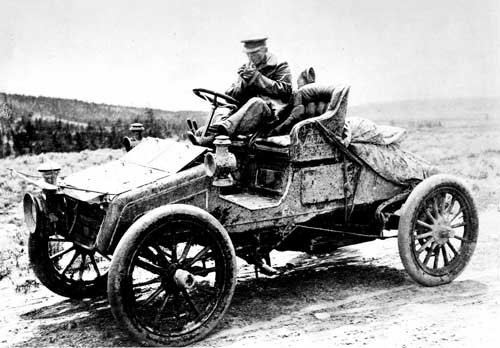
LISTEN. We rejoin James in his early sixties, in 1903: a time of rapid (by the standards of the day) mechanization. “A Packard accomplished the first automobile trip across the United States,” San Francisco to New York, in the astonishing time of just fifty-two days. The Wright Brothers have just gone aerial. And Henry Adams is yearning for the thirteeth century’s cult of the Virgin of Chartres.

To get slightly ahead of our story: James exchanged letters with Adams not long before his death, responding to the latter’s dark musings about the Second Law of Thermodynamics, the inevitable “heat death of the universe” and so on, this way:
“Though the ULTIMATE state of the universe may be its… extinction, there is nothing in physics to interfere with the hypothesis that the PENULTIMATE state might be a happy and virtuous consciousness… In short, the last expiring pulsation of the universe’s life might be, “I am so happy and perfect that I can stand it no longer.”
That’s looking on the bright side.*

James’s great intellectual excitement at this time is his discovery of the “process” philosophy of Henri Bergson, his elan vital and his perception of time’s inexorable forward momentum. “It is like the breath of the morning and the song of birds. And to me it tells of reality itself and not merely of what previous dusty-minded professors have thought about reality.”

(Note that it’s always other professors’ dusty-minded ideas one must shake off.)
This is when James wrestles, somewhat ineffectually, with “the Ph.D. Octopus.” If exclusionary formal credentialing was already out of hand then, how much worse is it now? Short answer: lots.

This is also when he really first appreciates his fundamental consanguinity with John Dewey, who “makes biology and psychology continuous” and whose “favorite word is situation.” (His second-favorite was “reconstruction”).

And this is the time of the Emerson centenary, when James orates in memory of New England’s great Socratic Transcendentalist:
“The deep today which all men scorn” receives thus from Emerson superb revindication. “Other world! there is no other world.” All God’s life opens into the individual particular, and here and now, or nowhere, is reality. “The present hour is the decisive hour, and every day is doomsday.” Such a conviction that Divinity is everywhere may easily make of one an optimist of the sentimental type that refuses to speak ill of anything. Emerson’s drastic perception of differences kept him at the opposite pole from this weakness. After you have seen men a few times, he could say, you find most of them as alike as their barns and pantries, and soon as musty and dreary. Never was such a fastidious lover of significance and distinction, and never an eye so keen for their discovery. His optimism had nothing in common with that indiscriminate hurrahing for the Universe with which Walt Whitman has made us familiar…
1904 brings the nominal birth of  James’s “radical empiricism,” made radical by its refusal to concede the reality of “any element that is not directly experienced nor exclude any element that is directly experienced.” Bertrand Russell, famously disapproving of James’s “Will to Believe“– make-believe, Russell had sneered— said James “was right on this matter, and would on this ground alone deserve a high place among philosophers.” (More Russell quotes)

*Russell also agreed with James’s rejection of cosmic pessimism, even supposing our sun and galaxy and universe must someday expand and collapse and disappear:
I am told that that sort of view is depressing, and people will sometimes tell you that if they believed that, they would not be able to go on living. Do not believe it; it is all nonsense. Nobody really worries about what is going to happen millions of years hence. Even if they think they are worrying much about that, they are really deceiving themselves. They are worried about something much more mundane, or it may merely be a bad digestion; but nobody is really seriously rendered unhappy by the thought of something that is going to happen to this world millions and millions of years hence.
Long-term thinking is good, wondering what life will make of itself is vital… but let’s not get carried away! The end of the universe is (almost) unimaginably remote, much moreso than the potential end of a humanity victimized by its own self-destructiveness. This would have been Russell’s answer to young “Alvy Singer”… it was in fact the essence of what “Dr. Flicker” advised:

Orig.published 12.4.09


Tuesday, July 7, 2020

WJ 11 -- "headfirst"


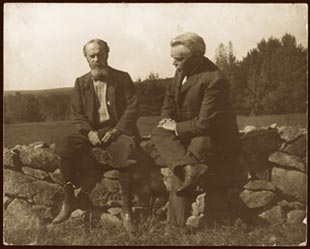
LISTEN. It’s the turn of the (19th to the 20th) century, James is cultivating his friendly philosophical antagonism and personal friendship with Josiah Royce…

who said: “I teach at Harvard that the world and the heavens, and the stars are all real, but not so damned real, you see.”

In this photo James has just goaded Royce with the taunt: “Look out, Royce. Damn the Absolute, I say!” (The Absolute was Royce’s and the other Idealists’ name for, for lack of a better name, God.)
…and he ‘s still hiking too much. He’s working on, and fretting about, the impending Gifford Lectures in Edinburgh, Scotland that will eventually become Varieties of Religious Experience. But a collapse in December ’99 necessitates their postponement.

“The problem I have set myself is a hard one; 1st to defend against all the prejudices of my [profession], ‘experience’ against ‘philosophy’ as being the real backbone of the world’s religious life… and second, to make the hearer or reader believe what I myself invincibly do believe, that although all the special manifestations of religion may have been absurd (I mean its creeds and theories) yet the life of it as a whole is mankind’s most important function.”

We’ve already noted that, for James, the religious impulse is less motivated by questions about God than by the universal urge for better, richer, more meaningful life. Experience, including religious experience, is to be taken seriously whenever it aspires to serve that purpose. Much philosophical discourse about religion is logically and technically correct, but fails to grasp the life-affirming motivation that made James a friend (if not a practitioner) of religious faith.  (And then there’s the Nietzschean critique, according to which religion is intrinsically life-negating. James was more cognizant of religion’s naturalistic roots and fruits.)
James really means what he says.  Religious creeds and theories are absurd, and he has no interest in “your ordinary religious believer, who follows the conventional observances of his country, whether it be  Buddhist, Christian, or Mohammedan. His religion has been made for him by others, communicated to him by tradition…”

James’s interest was more in what we might call ” spirituality,” with a lot of qualification. There remains much confusion about this term, with some assuming that it excludes a naturalistic orientation– it does not– or that it’s simply an alternative, non-sectarian name for “religious”— which it defiantly is not.  “We must make search for the original experiences which were [and are] the pattern-setters,” rather than sinking back into comfortable religious conformism. “Life” demands it.

John Dewey made a similar point, when in A Common Faith he called for the reclamation and emancipation of “religious” as a term of description applicable to generic, non-denominational experience. He didn’t want to surrender the word, but whatever you call it– spiritual, transcendental, “consummatory” etc.– the experience is very much of this world. It’s natural for human beings to seek and find meaningful patterns in life as it is lived, and not to postpone it for an after-life that for all we can possibly know may never arrive.

The so-called religion of healthy-mindedness, or mind-cure, or (more broadly) positive thinking, had James’s strong endorsement. Richardson: “When a person feels better because he thinks he has been given a cure, we call it, with complacent condescension, the placebo effect. For James, however, the same effect is simply a cure.”

Religion never had a more sympathetic defender among philosophers than William James, but as the Edinburgh lectures drew to a close he wrote to a Christian friend: “I believe myself to be (probably) permanently incapable of believing the Christian system of vicarious salvation, and wedded to a more continuously evolutionary mode of thought.” But he’d not have had much sympathy for Richard Dawkins’ atheistic version of evolutionism. He’s too supportive of the life impulse to deny its religious manifestations in just about any form, but he’s also too drawn to the evolutionary hypothesis to exclude religionists from its tent.

Richardson reports a scene that may surprise Jamesians like me who were  aware that he’d rebuffed former student Morris Cohen’s proposal to regard baseball as a “moral equivalent of war,” which James had said “we now need to discover in the social realm… something heroic that will speak to men as universally as war does, and yet will be as compatible with their spiritual selves as war has proved incompatible” :
Friends of son Francis (“Aleck”), who managed the baseball team at his Cambridge school,  “remembered seeing William James sitting by himself in the stands in raw weather, watching his son’s team and taking a lively interest in the new idea of sliding into base headfirst.”

A headfirst slide is a good metaphor for William James’s view of life in general, at age 60. As he said in his last Edinburgh lecture in 1902: “No fact in human nature is more characteristic than its willingness to live on a chance.” And to take serious risk of personal and professional injury doing it, evidently.

Monday, July 6, 2020

WJ 10 -- "the deepest thing in our nature"

wj 1899
LISTEN. Robert Louis Stevenson, James’s favorite author, dies as this week’s installment begins. Stevenson is only 44. And, it so happens, today is Stevenson’s birthday.

It’s the mid-’90s, James is lending financial and moral support to the brilliant but erratic philosopher “Charley” Peirce, who would later bite the hand that fed him by refusing James’s noblesse in crediting him with inventing pragmatism.

He’s also reflecting on the allegedly-false happiness of alcoholic intoxication, which ravaged his brother. Better to “replace the ideal of drinking with the ideal of having a constitution in perfect health,” an example of Spinozistic positive psychology. Stick to the nitrous, when you want to experiment with an expanded yea-saying consciousness.

“Alcoholics Anonymous” makes extensive practical use of Jamesian aids to learning and personal reform. “When AA invokes a ‘higher power,’ it does not mean Jehovah; it means a power higher than oneself.  A small community of two or three will do nicely.” No need to bring in supernatural forces. We’ll all get by with a little help from our friends. [Happy 80th birthday Ringo Starr!]

The naturalistic bent of James’s curiosity is reflected in his slight shift, around this time, away from studies of abnormal psych and the paranormal and towards varieties of religious experience. Richardson makes more of this, though, than he should. Religious experiences may be natural for human beings, but some of the case studies of conversion and “sick souls” James presents in Varieties are as “abnormal” as anything he’d encountered as a student of clinical psychology, and are not prime examples of what Spinoza must have meant when he advised us to re-frame our aversions in terms of positive goods.

James still insists that we not ignore the negative side of life. We must address ourselves to the unpleasant task of hearing what the sick souls, as we may call them in contrast to the healthy-minded, have to say of the secrets of their prison-house, their own peculiar form of consciousness. Let us then resolutely turn our backs on the once-born and their sky-blue optimistic gospel; let us not simply cry out, in spite of all appearances, “Hurrah for the Universe!—God’s in his Heaven, all’s right with the world.” Let us see rather whether pity, pain, and fear, and the sentiment of human helplessness may not open a profounder view…

For himself, though, life is good. “As William James turned fifty-three, in January 1895, his life was rich and full… He was happily, solidly married– though he contracted a mad crush on every other woman he met.” Mid-life can be treacherous. “I have been happy, happy HAPPY!” he wrote Mrs. James, after meeting one of his crushes.

In April ’95 James delivered a talk to the Harvard YMCA called “Is Life Worth Living?” It included this distinctively-Jamesian statement about personal subjectivity:
The deepest thing in our nature in this binnenleben, this dumb region of the heart in which we dwell alone with our willingnesses and unwillingnesses, our faiths and fears. As through the cracks and crannies of subterranean caverns the earth’s bosom exudes its waters, which then form the fountain-heads of springs, so in these crepuscular depths of personality the sources of all our outer deeds and decisions take their rise. Here is our deepest organ of communication with the nature of things.
Another noteworthy publication from this period: “The Gospel of Relaxation,” in which James issues the best pedagogical advice I’ve ever received:  The advice I should give to most teachers would be in the words of one who is herself an admirable teacher. Prepare yourself in the subject so well that it shall be always on tap: then in the class-room trust your spontaneity and fling away all further care.

And there’s good advice here for students, too: If you want really to do your best in an examination, fling away the book the day before, say to yourself, “I won’t waste another minute on this miserable thing, and I don’t care an iota whether I succeed or not.” Say this sincerely, and feel it; and go out and play, or go to bed and sleep, and I am sure the results next day will encourage you to use the method permanently.

“Will to Believe,” maybe James’s most famous essay, comes in 1896. Here he tackles that delicious enfant terrible [William Kingdon] Clifford, who wrote: “Belief is desecrated when given to unproved and unquestioned statements for the solace and private pleasure of the believer…. It is wrong always, everywhere, and for every one, to believe anything upon insufficient evidence.”

James: Our errors are surely not such awfully solemn things. In a world where we are so certain to incur them in spite of all our caution, a certain lightness of heart seems healthier than this excessive nervousness on their behalf. At any rate, it seems the fittest thing for the empiricist philosopher.

And:
No one of us ought to issue vetoes to the other, nor should we bandy words of abuse. We ought, on the contrary, delicately and profoundly to respect one another’s mental freedom: then only shall we bring about the intellectual republic; then only shall we have that spirit of inner tolerance without which all our outer tolerance is soulless, and which is empiricism’s glory; then only shall we live and let live, in speculative as well as in practical things.

“William James at fifty-five seemed a man of unlimited energy.”  But, he wrote a friend, there’s just too much for an academic to read. “One lives on an inclined plane of hopes as regards reading, on which like the snail of mental arithmetic one slips back more in 24 hours than one gains.” Tell me about it.

James finally has an experience of the sort he’d always hungered for, one that  he would characterize as vaguely mystical though not entirely instructive. He called it his Walpurgisnacht, an extraordinary experience of “spiritual alertness” on a magnificent starry night after days of strenuous hiking. Of course it was an experience that, by the very terms of its mystical ineffability, he literally could not speak of in any detail. But, he cryptically said, “I now know what a poet is.”

“On a Certain Blindness in Human Beings” (discussed in last week‘s post) is published in 1898. “The truth is too great for any one actual mind… The facts and worths of life need many cognizers to take them in. There is no point of view absolutely public and universal. The practical consequence of such a philosophy is the well-known democratic respect for the sacredness of individuality.”

Democracy, as we know, does not always evince so great a respect for the individuality of other peoples and nations. The Philippines crisis of 1899 provoked James’s ire. he saw American policy as naked imperialism, “crushing out the sacredest thing in this great human world– the attempt of a people long enslaved to attain to the possession of itself… to be free.” He complains bitterly:  “The stars and stripes are now a lying rag.” Sound familiar?

As the fin de siecle approaches there are troubling signs of health challenges ahead. Ever since his Walpurgisnacht he’s noticed “queer cardiac symptoms,” a “valvular insufficiency”… the sort of thing Daniel Dennett recently had occasion to “thank goodness” for rescuing him from. But James was born too soon to enjoy the opportunity of that particular form of rescue.

Orig. published 11.13.09

Friday, July 3, 2020

WJ 9 -- relax

LISTEN. In WJ 9 we encounter some of James’s most enduring and inspiring work, in the form of essays addressed explicitly to teachers and students concerning applied psychology and “some of life’s ideals.” He was very clear: we all have it in us to stand up and be heroes. Consider, for instance, the so-called Little Rock Nine. Their ideal was simply to get an education in the previously-segregated public schools of Little Rock, Arkansas, and to establish that precedent as the new norm. The personal courage and perseverance they had to summon, to achieve that, was impressive. Human beings have an impressive capacity to rise up and do great, good things. For James, that capacity is what makes a life significant. “The solid meaning of life is always the same eternal thing,— the marriage, namely, of some unhabitual ideal, however special, with some fidelity, courage, and endurance; with some man’s or woman ‘s pains.”

A few new important and telling points about our philosopher and his work:

Jacques Barzun, author of A Stroll With William James, said Principles of Psychology (1890), like Moby Dick, ought to be read from beginning to end at least once by every person professing to be educated.

“Principles” jolted John Dewey out of his neo-Kantian slumber…

Novelist Rebecca West said one of the James brothers grew up to write fiction as though it were philosophy [psychology?] and the other to write philosphy as though it were fiction.

William had a gift for memorable phrases: the bitch-goddess success, stream of consciousness, blooming buzzing confusion, moral equivalent of war, healthy-minded, live option…

“Will you or won’t you have it so?” is the most probing question we are ever asked… We answer by consents or non-consents and not by words…

One of his great enthusiasms arises now: “The Gospel of Relaxation“*… capped by the best practical teaching advice I’ve ever heard: “The advice I should give to most teachers would be to prepare yourself in the subject so well that it shall be always on tap: then in the class-room trust your spontaneity and fling away all further care.”

*”If you never wholly give yourself up to the chair you sit in, but always keep your leg- and body-muscles half contracted for a rise; if you breathe eighteen or nineteen instead of sixteen times a minute, and never quite breathe out at that,—what mental mood can you be in but one of inner panting and expectancy, and how can the future and its worries possibly forsake your mind… The American over-tension and jerkiness and breathlessness and intensity and agony of expression are primarily social, and only secondarily physiological, phenomena. They are bad habits, nothing more or less, bred of custom and example, born of the imitation of bad models and the cultivation of false personal ideals… We, here in America, through following a succession of pattern-setters whom it is now impossible to trace, and through influencing each other in a bad direction, have at last settled down collectively into what, for better or worse, is our own characteristic national type…”

I don’t know if this is still a pervasive problem in America, as apparently it was a century ago. I do notice plenty of tense, constricted, contorted faces on my ambles across campus and in town and behind the wheel. I preach my own gospel of relaxation by urging folks to take a hike or a bike-ride, as I did yesterday on my way to school. My reward: the discovery of a wonderful new bike path from Edwin Warner Park that snakes behind the Ensworth High School campus near the Harpeth River, under Hwy 100, all the way to the playing fields where Younger Daughter played in the Babe Ruth League with her team the Dixie Chicks a few seasons ago. That was relaxing.

Originally published __.__.09