"Film—fiction or documentary—should not concern itself with the facts of ordinary existence, which are the province of the journalist, the bureaucrat and the accountant. 'Facts don't illuminate,' Herzog explained… 'Only truth illuminates. By making a clear distinction between "fact" and "truth", I penetrate a deeper stratum that most films don't even know exists.' "
https://open.substack.com/pub/ksetiya/p/readers-digest-december-9-2023?selection=18515ab1-eec2-4689-852a-566e6ae58a43&r=35ogp&utm_medium=ios
Saturday, December 9, 2023

Friday, December 8, 2023
The Art of Stillness
A good sequel to Burkeman's 4,000 Weeks is the ordinarily-peripatetic Pico Iyer's short paean to "going nowhere"…
"Yet, as ([Leonard!] Cohen talked about the art of sitting still (in other words, clearing the head and stilling the emotions)—and as I observed the sense of attention, kindness, and even delight that seemed to arise out of his life of going nowhere—I began to think about how liberating it might be for any of us to give it a try. One could start just by taking a few minutes out of every day to sit quietly and do nothing, letting what moves one rise to the surface. One could take a few days out of every season to go on retreat or enjoy a long walk in the wilderness, recalling what lies deeper than the moment or the self. One could even, as Cohen was doing, try to find a life in which stage sets and performances disappear and one is reminded, at a level deeper than all words, how making a living and making a life sometimes point in opposite directions.
The idea has been around as long as humans have been, of course; the poets of East Asia, the philosophers of ancient Greece and Rome, regularly made stillness the center of their lives. But has the need for being in one place ever been as vital as it is right now? After a thirty-year study of time diaries, two sociologists found that Americans were actually working fewer hours than we did in the 1960s, but we feel as if we're working more. We have the sense, too often, of running at top speed and never being able to catch up.
With machines coming to seem part of our nervous systems, while increasing their speed every season, we've lost our Sundays, our weekends, our nights off—our holy days, as some would have it; our bosses, junk mailers, our parents can find us wherever we are, at any time of day or night. More and more of us feel like emergency-room physicians, permanently on call, required to heal ourselves but unable to find the prescription for all the clutter on our desk."
— The Art of Stillness: Adventures in Going Nowhere (TED Books) by Pico Iyer
https://a.co/0A14a6Q
"Yet, as ([Leonard!] Cohen talked about the art of sitting still (in other words, clearing the head and stilling the emotions)—and as I observed the sense of attention, kindness, and even delight that seemed to arise out of his life of going nowhere—I began to think about how liberating it might be for any of us to give it a try. One could start just by taking a few minutes out of every day to sit quietly and do nothing, letting what moves one rise to the surface. One could take a few days out of every season to go on retreat or enjoy a long walk in the wilderness, recalling what lies deeper than the moment or the self. One could even, as Cohen was doing, try to find a life in which stage sets and performances disappear and one is reminded, at a level deeper than all words, how making a living and making a life sometimes point in opposite directions.
The idea has been around as long as humans have been, of course; the poets of East Asia, the philosophers of ancient Greece and Rome, regularly made stillness the center of their lives. But has the need for being in one place ever been as vital as it is right now? After a thirty-year study of time diaries, two sociologists found that Americans were actually working fewer hours than we did in the 1960s, but we feel as if we're working more. We have the sense, too often, of running at top speed and never being able to catch up.
With machines coming to seem part of our nervous systems, while increasing their speed every season, we've lost our Sundays, our weekends, our nights off—our holy days, as some would have it; our bosses, junk mailers, our parents can find us wherever we are, at any time of day or night. More and more of us feel like emergency-room physicians, permanently on call, required to heal ourselves but unable to find the prescription for all the clutter on our desk."
— The Art of Stillness: Adventures in Going Nowhere (TED Books) by Pico Iyer
https://a.co/0A14a6Q
Wednesday, December 6, 2023
John Lachs (1934-2023)
http://dlvr.it/SznL3y
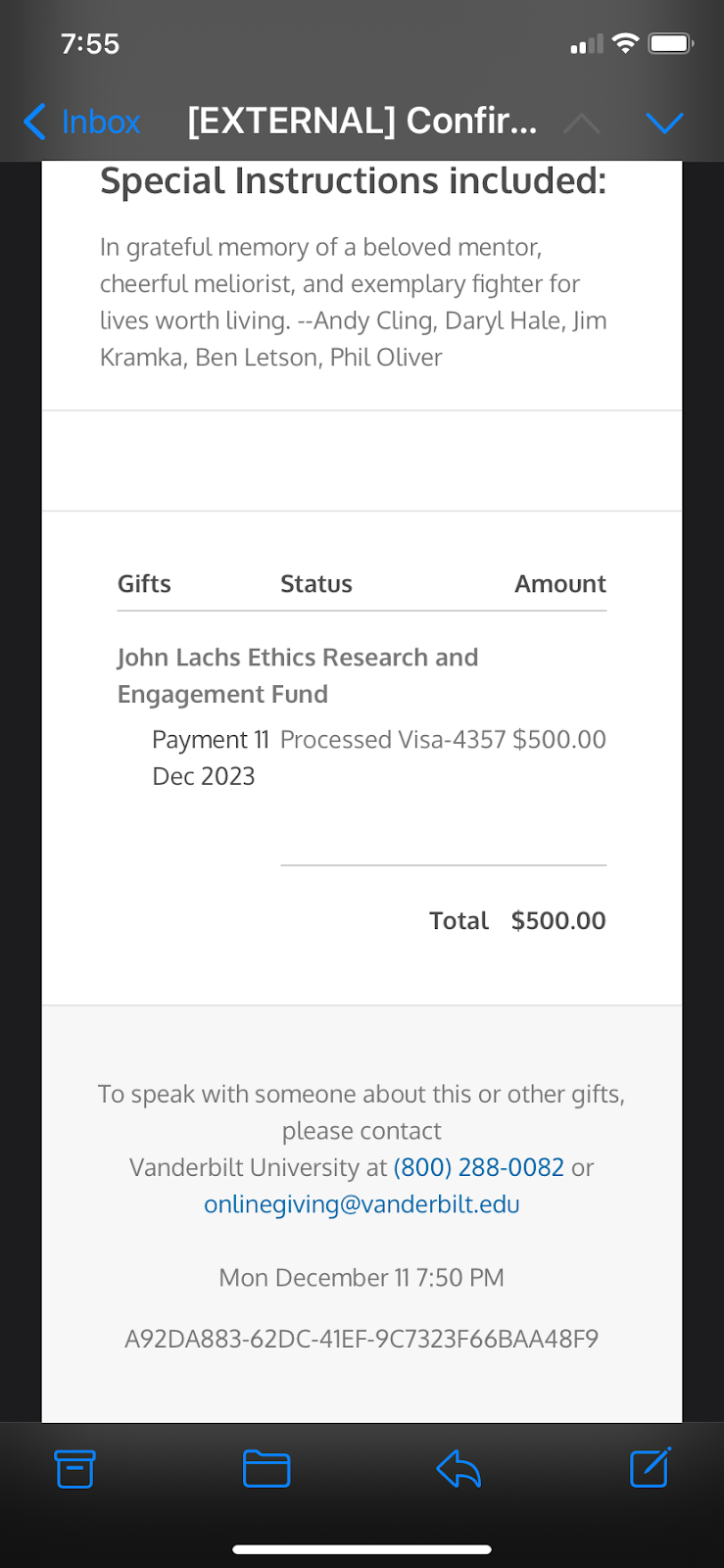
"In grateful memory of a beloved mentor, cheerful meliorist, and exemplary fighter for lives worth living" —
John Lachs, "great and generous friend"
As time goes by, fewer of my colleagues recall John's invaluable support for our department over the years. So I drafted a little note to them yesterday, in anticipation of the memorial service at Vanderbilt's Benton Chapel a week from Saturday (2 pm, 411 21st Ave S, Nashville, TN 37240).
He was our Lyceum speaker in 2001 and then again in 2009, responding on short notice with a specific message--"Education in a Time of Crisis"--that boosted our spirits just when the housing bubble/budget crisis (as perceived by some benighted administrators and politicians) threatened our program.
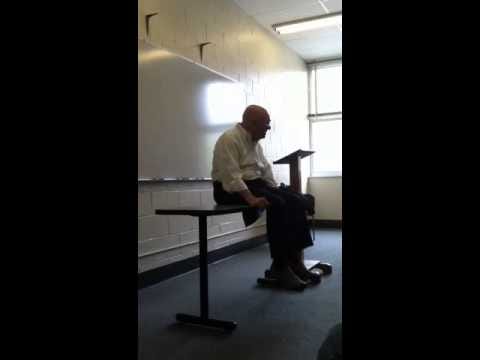
He also came to speak to my classes on another occasion a decade ago. There's a YouTube "short" featuring him perched on the table and fielding student questions in 204. Listen closely and you'll hear him say "One of the greatest joys in my life is to think..." Those of us who had the privilege to study and work with him found that joy infectious.
I've suggested that our donation to the John Lachs Ethics Research and Engagement Fund include this note: In grateful memory of a great and generous friend of our department and our discipline.
Taylor at Harvard
As noted in class last week:
"So the news is out. Harvard will be offering a course on Taylor Swift in the spring. The professor, who is 52, is a Swift fan and describes her interest in Swift — "she's someone who worked to become herself and makes her own decisions in a way that brings people along with her and doesn't alienate people." I suppose you could say the same about Shakespeare, though he did alienate some people who then wound up in engineering or medicine..."
The next paragraph says there won't be a final exam, "they're no fun." Ours was fun yesterday, wasn't it? Not alienating?
https://open.substack.com/pub/garrisonkeillor/p/bringing-people-along-with-me-101?r=35ogp&utm_medium=ios&utm_campaign=post
"So the news is out. Harvard will be offering a course on Taylor Swift in the spring. The professor, who is 52, is a Swift fan and describes her interest in Swift — "she's someone who worked to become herself and makes her own decisions in a way that brings people along with her and doesn't alienate people." I suppose you could say the same about Shakespeare, though he did alienate some people who then wound up in engineering or medicine..."
The next paragraph says there won't be a final exam, "they're no fun." Ours was fun yesterday, wasn't it? Not alienating?
https://open.substack.com/pub/garrisonkeillor/p/bringing-people-along-with-me-101?r=35ogp&utm_medium=ios&utm_campaign=post
Sunday, December 3, 2023
“I Teach the Humanities, and I Still Don’t Know What Their Value Is”
Provocative headline, and a bit disingenuous.
I think Agnes knows the value of a humanistic education lies in the very inquisitiveness she says prevents her from affirming its value.
And, I think she knows a humanities professor is not the same thing as a humanist. In my view, it's the non-humanist humanities teachers— there are more than a few —who create public confusion about the intrinsic value of a humanistic education.
So: challenge accepted. I'm going to continue to defend the humanities, humanistically and non-defensively. In the current hyper-politicized climate that emboldens benighted legislators to chop them, they need and deserve such support from those of us who value the enhanced possibilities for living they sponsor. There may just be a chance of success.
Humanist William James said it best: nothing is more characteristic of human nature than its willingness to live on a chance.
https://www.nytimes.com/2023/12/02/opinion/education-humanities-college-value.html?smid=nytcore-ios-share&referringSource=articleShare
I Teach the Humanities, and I Still Don't Know What Their Value Is
I think Agnes knows the value of a humanistic education lies in the very inquisitiveness she says prevents her from affirming its value.
And, I think she knows a humanities professor is not the same thing as a humanist. In my view, it's the non-humanist humanities teachers— there are more than a few —who create public confusion about the intrinsic value of a humanistic education.
So: challenge accepted. I'm going to continue to defend the humanities, humanistically and non-defensively. In the current hyper-politicized climate that emboldens benighted legislators to chop them, they need and deserve such support from those of us who value the enhanced possibilities for living they sponsor. There may just be a chance of success.
Humanist William James said it best: nothing is more characteristic of human nature than its willingness to live on a chance.
https://www.nytimes.com/2023/12/02/opinion/education-humanities-college-value.html?smid=nytcore-ios-share&referringSource=articleShare
I Teach the Humanities, and I Still Don't Know What Their Value Is
==
LETTERS
Why the Humanities Are Indeed Worth Teaching
Readers respond to a guest essay by a philosophy professor about difficulties defending the humanities.
Dec. 30, 2023, 11:00 a.m. ET
To the Editor:
Re “I Teach the Humanities. I Still Don’t Know What Their Value Is,” by Agnes Callard (Opinion guest essay, Dec. 3):
As a fellow humanist, I understand Dr. Callard’s desire to avoid conventional pieties and, in the spirit of ongoing inquiry, to claim not to know the value of humanities disciplines. But it is still dispiriting to read this essay with the fear that only humanities undergraduates — well schooled in the reading of subtle texts — will understand the irony in hers.
As one who taught in an English department for almost three decades and went on to be the head of a rare book library, I do know the value of the humanities. Right-thinking humanists do not claim to make their students better people or even try to do so. Such a claim smacks of egotism and hubris. But we do claim to make students better critical readers, thinkers and writers — people better equipped as a result of studying complex texts to judge competing claims, to weigh evidence and to make better-informed judgments on a host of issues.
We humanists are the keepers and interpreters of our civilization, defined globally, and we are charged by tradition and consensus to evaluate that civilization in our teaching and scholarship. This is, of course, itself a conventional piety — but like many conventional pieties, it is a true one.
Because we have done so in the face of growing indifference and shrinking support, it is simply not helpful to have an academic colleague proclaim, even ironically, that she does not know the value of the humanities.
Gail Kern Paster
Washington
The writer is director emerita of the Folger Shakespeare Library.
To the Editor:
The debate over the value of humanities courses is really a question of value for money — especially when college costs so much. But it’s worth remembering the skills that humanities courses give us.
First: curiosity. None of us know exactly where we are heading; we can shape the journey if we are curious about the unknown. Humanities courses teach us to be flexible and make us question our assumptions.
Second: the power of example. Works of art and literature link our current concerns to those of others. They show us the frightening power of a secret shared, of misplaced trust, of leadership forged by challenges. History is a lively tale of tough decisions, of choices and their consequences.
Third: communication. Google Translate may make language classes seem unnecessary. But learning another language gives you a deeper understanding of what others value. And the art of debate is a skill we all need.
When I went to university, I saw my humanities courses as a foundation. It turns out they were a staircase. I could find and change careers, thrive in my choice and lead in a crisis.
I use my “useless” knowledge all the time. An elected leader in Germany once asked me about globalization and its consequences in America. I found myself talking about the power of community, the role of local government and the consequences of job loss. I cited work by an American playwright to underscore my point. In German.
Turns out, those humanities courses were useful after all.
Robin Quinville
Arlington, Va.
The writer is a former diplomat.
To the Editor:
As an academic scientist, I eagerly read Agnes Callard’s thought-provoking essay. It is simply not true that “scientists are under a lot less pressure to explain why they exist.” While society understands that science in general is useful, individual researchers are under great pressure to justify the applicability of their work in order to obtain funding to support it.
Moreover, most academics, whether scientists or humanists, work at universities that center teaching rather than research. In teaching universities, the number of students who major, minor or take courses in a given discipline is the primary determinant of a discipline’s value. Since the majority of students do not major in a science discipline, most scientists will need to justify why they exist.
David Snyder
Queens
The writer is a chemistry professor at William Paterson University but is expressing his own views.
To the Editor:
In her guest essay, a humanities professor, Agnes Callard, conceded, “I do not know what the value of the humanities is.”
As a psychologist, I rely daily on the many lessons of my various humanities classes. A psychologist’s only tool to help people remediate their symptoms, reform their lives and stave off suicide is words. My education in the humanities has helped me, more than anything else, to pick the right words to treat my patients’ “dis-ease” as effectively as possible.
The bane of existence for most educators is that they rarely get to harvest the fruits of their labor, and in this way Dr. Callard’s despondence is understandable. However, I hope she and others who teach the humanities can take solace in knowing their efforts contribute, albeit indirectly, to the healing of many — one word at a time.
John G. Cottone
Stony Brook, N.Y.
To the Editor:
I was a high school history teacher for more than 30 years, I taught what used to be called Western Civ, as well as U.S. history, women’s history, African American Voices and geography. The whole gamut. Yes, I loved what I taught. But sharing that love was not my motivation.
My students have become engineers, doctors, moms, software creators and leaders of nonprofits of various sorts. They may well have forgotten that they have read Mary Wollstonecraft, Frederick Douglass or Nietzsche. But they still retained the habits of critical reading, clear writing, thorough research and thoughtful deliberation. Many of them found solace and inspiration in the historical figures they encountered. Some found vocations in the movements they studied.
Like Agnes Callard, I have no need to defend the humanities one author or one discipline at a time. But when schools stop teaching humanities courses, students lose more than just education in social values and cultural literacy. They lose valuable life skills that sustain them regardless of their future paths.
Liz Zucker
Cambridge, Mass.
LETTERS
Why the Humanities Are Indeed Worth Teaching
Readers respond to a guest essay by a philosophy professor about difficulties defending the humanities.
Dec. 30, 2023, 11:00 a.m. ET
To the Editor:
Re “I Teach the Humanities. I Still Don’t Know What Their Value Is,” by Agnes Callard (Opinion guest essay, Dec. 3):
As a fellow humanist, I understand Dr. Callard’s desire to avoid conventional pieties and, in the spirit of ongoing inquiry, to claim not to know the value of humanities disciplines. But it is still dispiriting to read this essay with the fear that only humanities undergraduates — well schooled in the reading of subtle texts — will understand the irony in hers.
As one who taught in an English department for almost three decades and went on to be the head of a rare book library, I do know the value of the humanities. Right-thinking humanists do not claim to make their students better people or even try to do so. Such a claim smacks of egotism and hubris. But we do claim to make students better critical readers, thinkers and writers — people better equipped as a result of studying complex texts to judge competing claims, to weigh evidence and to make better-informed judgments on a host of issues.
We humanists are the keepers and interpreters of our civilization, defined globally, and we are charged by tradition and consensus to evaluate that civilization in our teaching and scholarship. This is, of course, itself a conventional piety — but like many conventional pieties, it is a true one.
Because we have done so in the face of growing indifference and shrinking support, it is simply not helpful to have an academic colleague proclaim, even ironically, that she does not know the value of the humanities.
Gail Kern Paster
Washington
The writer is director emerita of the Folger Shakespeare Library.
To the Editor:
The debate over the value of humanities courses is really a question of value for money — especially when college costs so much. But it’s worth remembering the skills that humanities courses give us.
First: curiosity. None of us know exactly where we are heading; we can shape the journey if we are curious about the unknown. Humanities courses teach us to be flexible and make us question our assumptions.
Second: the power of example. Works of art and literature link our current concerns to those of others. They show us the frightening power of a secret shared, of misplaced trust, of leadership forged by challenges. History is a lively tale of tough decisions, of choices and their consequences.
Third: communication. Google Translate may make language classes seem unnecessary. But learning another language gives you a deeper understanding of what others value. And the art of debate is a skill we all need.
When I went to university, I saw my humanities courses as a foundation. It turns out they were a staircase. I could find and change careers, thrive in my choice and lead in a crisis.
I use my “useless” knowledge all the time. An elected leader in Germany once asked me about globalization and its consequences in America. I found myself talking about the power of community, the role of local government and the consequences of job loss. I cited work by an American playwright to underscore my point. In German.
Turns out, those humanities courses were useful after all.
Robin Quinville
Arlington, Va.
The writer is a former diplomat.
To the Editor:
As an academic scientist, I eagerly read Agnes Callard’s thought-provoking essay. It is simply not true that “scientists are under a lot less pressure to explain why they exist.” While society understands that science in general is useful, individual researchers are under great pressure to justify the applicability of their work in order to obtain funding to support it.
Moreover, most academics, whether scientists or humanists, work at universities that center teaching rather than research. In teaching universities, the number of students who major, minor or take courses in a given discipline is the primary determinant of a discipline’s value. Since the majority of students do not major in a science discipline, most scientists will need to justify why they exist.
David Snyder
Queens
The writer is a chemistry professor at William Paterson University but is expressing his own views.
To the Editor:
In her guest essay, a humanities professor, Agnes Callard, conceded, “I do not know what the value of the humanities is.”
As a psychologist, I rely daily on the many lessons of my various humanities classes. A psychologist’s only tool to help people remediate their symptoms, reform their lives and stave off suicide is words. My education in the humanities has helped me, more than anything else, to pick the right words to treat my patients’ “dis-ease” as effectively as possible.
The bane of existence for most educators is that they rarely get to harvest the fruits of their labor, and in this way Dr. Callard’s despondence is understandable. However, I hope she and others who teach the humanities can take solace in knowing their efforts contribute, albeit indirectly, to the healing of many — one word at a time.
John G. Cottone
Stony Brook, N.Y.
To the Editor:
I was a high school history teacher for more than 30 years, I taught what used to be called Western Civ, as well as U.S. history, women’s history, African American Voices and geography. The whole gamut. Yes, I loved what I taught. But sharing that love was not my motivation.
My students have become engineers, doctors, moms, software creators and leaders of nonprofits of various sorts. They may well have forgotten that they have read Mary Wollstonecraft, Frederick Douglass or Nietzsche. But they still retained the habits of critical reading, clear writing, thorough research and thoughtful deliberation. Many of them found solace and inspiration in the historical figures they encountered. Some found vocations in the movements they studied.
Like Agnes Callard, I have no need to defend the humanities one author or one discipline at a time. But when schools stop teaching humanities courses, students lose more than just education in social values and cultural literacy. They lose valuable life skills that sustain them regardless of their future paths.
Liz Zucker
Cambridge, Mass.
Saturday, December 2, 2023
Mysticism, Peak Experience, and Evil
"The problem is with the ethical content of peak-experience: the sense that nothing truly bad can happen, that the problem of suffering and injustice has, somehow, been solved." Precisely, and particularly from Wm James's perspective: "I cannot bring myself to blink the evil out of sight." Or mystify or peak it out.
"… The study of mystical experience is a respectable enterprise. William James took it seriously, as did later philosophers and psychologists, including W. T Stace, the teacher of John Rawls, who taught Tom Nagel. (Apparently, mysticism skips a generation.) Studies of LSD and psilocybin sometimes use the Mystical Experience Questionnaire, inspired by Stace. A strong predictor of long-term benefits from psychedelic use, statisticians have found, is whether one has something like an experience of God—though it remains unclear whether this is correlation or causation. Perhaps both peak-experience and long-term mood improvement are effects of a common cause: the neural plasticity psychedelic drugs inspire.
Even if they are psychologically real, and psychologically beneficial, though, peak-experiences may not be veridical. My pale approximation wasn't: it represented a force pulling me into space, my legs dangling in the void—but gravity was not, in fact, reversed.
What about the more abstract content of full-fledged peak-experience: reality as an integrated whole, independent of us, and perfectly good? That this experience is, in Maslow's words, "self-validating," that it feels as true as the perception of one's hand in front of one's face, proves nothing. Still, there's reason to be empiricist: to take experience at face value, in the absence of grounds for doubt. This is the attitude James, and perhaps Maslow, brings to peak-experience. Maybe we should think of reality as an integrated whole, independent of us—unless there's reason to think otherwise.
The problem is with the ethical content of peak-experience: the sense that nothing truly bad can happen, that the problem of suffering and injustice has, somehow, been solved. It's not that one could not experience this—perhaps one can—but that the experience has no more weight than my experience of gravity reversed. Which is to say: whatever weight it has is outweighed by evidence to the contrary. Life is hard.
Though perhaps I'm being unfair. After all, I've confessed that I have no first-hand knowledge of peak-experience: I don't really know what it's like. If I did, I might be able see directly how it answers the problem of evil—even if the answer cannot be expressed in words…"
—Kieran Setiya
https://open.substack.com/pub/ksetiya/p/shall-all-manner-of-thing-be-well?r=35ogp&utm_medium=ios&utm_campaign=post
"… The study of mystical experience is a respectable enterprise. William James took it seriously, as did later philosophers and psychologists, including W. T Stace, the teacher of John Rawls, who taught Tom Nagel. (Apparently, mysticism skips a generation.) Studies of LSD and psilocybin sometimes use the Mystical Experience Questionnaire, inspired by Stace. A strong predictor of long-term benefits from psychedelic use, statisticians have found, is whether one has something like an experience of God—though it remains unclear whether this is correlation or causation. Perhaps both peak-experience and long-term mood improvement are effects of a common cause: the neural plasticity psychedelic drugs inspire.
Even if they are psychologically real, and psychologically beneficial, though, peak-experiences may not be veridical. My pale approximation wasn't: it represented a force pulling me into space, my legs dangling in the void—but gravity was not, in fact, reversed.
What about the more abstract content of full-fledged peak-experience: reality as an integrated whole, independent of us, and perfectly good? That this experience is, in Maslow's words, "self-validating," that it feels as true as the perception of one's hand in front of one's face, proves nothing. Still, there's reason to be empiricist: to take experience at face value, in the absence of grounds for doubt. This is the attitude James, and perhaps Maslow, brings to peak-experience. Maybe we should think of reality as an integrated whole, independent of us—unless there's reason to think otherwise.
The problem is with the ethical content of peak-experience: the sense that nothing truly bad can happen, that the problem of suffering and injustice has, somehow, been solved. It's not that one could not experience this—perhaps one can—but that the experience has no more weight than my experience of gravity reversed. Which is to say: whatever weight it has is outweighed by evidence to the contrary. Life is hard.
Though perhaps I'm being unfair. After all, I've confessed that I have no first-hand knowledge of peak-experience: I don't really know what it's like. If I did, I might be able see directly how it answers the problem of evil—even if the answer cannot be expressed in words…"
—Kieran Setiya
https://open.substack.com/pub/ksetiya/p/shall-all-manner-of-thing-be-well?r=35ogp&utm_medium=ios&utm_campaign=post
Friday, December 1, 2023
Mediation transcended
Interesting discussions in our last pre-exam Philosophy of Happiness meeting yesterday afternoon. I mentioned my late mentor John Lachs's discussion of what he called "mediation," relevant to questions about passion burn-out Michael raised in his report.
"...once attention is shifted from the future and we begin to enjoy activities at the time we do them and for what they are, we have transcended the mentality that views life as a process of mediation toward distant ends."
Wednesday, November 29, 2023
“Hope is a precondition of what matters”
Kieran Setiya, like Oliver Burkeman, calls for "acknowledgment and close reading of the lives we have" as the prerequisite of genuine and not merely delusional hope--the sort of hope that, as Rebecca Solnit points out, needs to act and not just lazily wish for a winning lottery ticket. I highly recommend Setiya's Life is Hard: How Philosophy Can Help...
"…It is much easier to say why despair is bad than why hope is good. We despair when things are hopeless, but we remain attached to them. "The relationship is over; she is gone forever," cries the jilted lover. The terminal patient weeps: "There is no cure." What they feel is grief or something like it. The pain of passion for a possibility that has died...
Hope coexists with quiescence. If there's courage in hoping, it's the courage to face the fear of disappointment that hope creates. When things turn out badly, hope is more harrowing than despair.
So Hesiod has a point. Hope can be deceptive, docile, daunting. Why celebrate its role in life? In a book she wrote in the wake of the 2003 invasion of Iraq, the writer and activist Rebecca Solnit rose to hope's defense: "Hope is not like a lottery ticket you can sit on the sofa and clutch, feeling lucky," she wrote. Instead,
— Life Is Hard: How Philosophy Can Help Us Find Our Way by Kieran Setiya

“Life Is Hard” pushes back against many platitudes of contemporary American self-improvement culture. Setiya is no friend to positive thinking — at best, it requires self-deception, and at worst, such glass-half-full optimism can be cruel to those whose pain we refuse to recognize. He describes a situation many of us have experienced: We tell someone about an illness or a fight we had; they try to convince us not to worry so much, or to focus on the bright side. Worse still, they might tell us that “everything happens for a reason.” This grotesque bromide is, explains Setiya, “theodicy,” an attempt to justify suffering as part of God’s plan. The problem is not that it cannot be true — theologians can extend divine providence to anything, even childhood leukemia — but that such thinking can easily serve as an excuse to avoid compassion.
"…It is much easier to say why despair is bad than why hope is good. We despair when things are hopeless, but we remain attached to them. "The relationship is over; she is gone forever," cries the jilted lover. The terminal patient weeps: "There is no cure." What they feel is grief or something like it. The pain of passion for a possibility that has died...
Hope coexists with quiescence. If there's courage in hoping, it's the courage to face the fear of disappointment that hope creates. When things turn out badly, hope is more harrowing than despair.
So Hesiod has a point. Hope can be deceptive, docile, daunting. Why celebrate its role in life? In a book she wrote in the wake of the 2003 invasion of Iraq, the writer and activist Rebecca Solnit rose to hope's defense: "Hope is not like a lottery ticket you can sit on the sofa and clutch, feeling lucky," she wrote. Instead,
hope should shove you out the door, because it will take everything you have to steer the future away from endless war, from the annihilation of the earth's treasures and the grinding down of the poor and marginal. Hope just means another world might be possible, not promised, not guaranteed. Hope calls for action; action is impossible without hope.Solnit may be right that action is impossible without hope: you cannot strive for what you care about, when success is not assured, without hoping to succeed or at least make progress. This is where the myth of hope's value starts. Hope is a precondition of what matters: the pursuit of meaningful change…"
The problem is that hope can be like clutching a lottery ticket and it needn't shove you out the door: as I know too well, you can hope intently as you stretch out on the sofa watching the news. The call for action comes from somewhere else.
...
This is how we should approach life’s hardships, finding possibility where we can: the possibility of flourishing with disability or disease, of finding one’s way through loneliness, failure, grief. The question, then, is not whether to hope but what we should hope for. In the spirit of this book, the answer’s not an ideal life. What we need is acknowledgment and close reading of the lives we have… For who are we? Not just the living but humankind, and there is hope for humanity, and so for us… Other concepts we should leave behind: the concept of the best life as a guideline or a goal, of being happy as the human good, of self-interest divorced from the good of others… Human life is not inevitably absurd; there is room for hope.— Life Is Hard: How Philosophy Can Help Us Find Our Way by Kieran Setiya
“Life Is Hard” pushes back against many platitudes of contemporary American self-improvement culture. Setiya is no friend to positive thinking — at best, it requires self-deception, and at worst, such glass-half-full optimism can be cruel to those whose pain we refuse to recognize. He describes a situation many of us have experienced: We tell someone about an illness or a fight we had; they try to convince us not to worry so much, or to focus on the bright side. Worse still, they might tell us that “everything happens for a reason.” This grotesque bromide is, explains Setiya, “theodicy,” an attempt to justify suffering as part of God’s plan. The problem is not that it cannot be true — theologians can extend divine providence to anything, even childhood leukemia — but that such thinking can easily serve as an excuse to avoid compassion.
Another theory Setiya challenges is the idea that happiness should be life’s primary pursuit. Instead, he argues that we should try to live well within our limits, even if this sometimes means acknowledging difficult truths. Happiness is a matter of definition; Setiya cites Tal Ben-Shahar, the Harvard professor and psychologist who writes about not only happiness but also the importance of accepting reality. Plato, too, he reminds us, held that true happiness lies in recognizing the lies of ordinary life, famously imagined as a cave filled with shadows. If you really consider “happiness” in its everyday sense — a feeling of contentment and pleasure — its desirability is complicated; we can certainly be made to feel good by ignoring injustice, wars, climate change or the hardships of aging. But we cannot live meaningfully that way...
And what does living well mean in practice? To Setiya, it lies in embracing one of the many possible “good-enough lives” instead of aching for a perfect one. Setiya’s liveliest writing is on the subject of infirmity, no doubt because of the chronic pain he has suffered for years...
The golden thread running through “Life Is Hard” is Setiya’s belief in the value of well-directed attention. Pain, as much as we wish to avoid it, forces us to remember that we are indelibly connected to our bodies. Ideally, it also helps us imagine what it is like to inhabit the bodies of others, imbuing us with “presumptive compassion for everyone else.” By cultivating our sensitivity to ourselves and to others, we escape another destructive modern myth: that we are separate from other people, and that we can live well without caring for them...
“Life Is Hard” is a humane consolation for challenging times. Reading it is like speaking with a thoughtful friend who never tells you to cheer up, but, by offering gentle companionship and a change of perspective, makes you feel better anyway. Irina Dumitrescu
Tuesday, November 28, 2023
What’s gloriously possible: Burkeman’s meliorism
What Oliver Burkeman calls "hope," in his Afterword, I would call wishful or delusional thinking. Whatever you call it, he's right: give it up. Giving up delusions of personal infinitude, he concludes,
"kills the fear-driven, control-chasing, ego-dominated version of you—the one who cares intensely about what others think of you, about not disappointing anyone or stepping too far out of line, in case the people in charge find some way to punish you for it later… the "you" that remains is more alive than before. More ready for action, but also more joyful, because it turns out that when you're open enough to confront how things really are, you're open enough to let all the good things in more fully, too, on their own terms, instead of trying to use them to bolster your need to know that everything will turn out fine. You get to appreciate life in the droll spirit of George Orwell, on a stroll through a war-dazed London in early 1946, watching kestrels darting above the grim shadows of the gasworks, and tadpoles dancing in roadside streams, and later writing of the experience: "Spring is here, even in London N1, and they can't stop you enjoying it."
The average human lifespan is absurdly, terrifyingly, insultingly short. But that isn't a reason for unremitting despair, or for living in an anxiety-fueled panic about making the most of your limited time. It's a cause for relief. You get to give up on something that was always impossible—the quest to become the optimized, infinitely capable, emotionally invincible, fully independent person you're officially supposed to be. Then you get to roll up your sleeves and start work on what's gloriously possible instead."
— Four Thousand Weeks: Time Management for Mortals by Oliver Burkeman
https://a.co/aV7pMQz
"kills the fear-driven, control-chasing, ego-dominated version of you—the one who cares intensely about what others think of you, about not disappointing anyone or stepping too far out of line, in case the people in charge find some way to punish you for it later… the "you" that remains is more alive than before. More ready for action, but also more joyful, because it turns out that when you're open enough to confront how things really are, you're open enough to let all the good things in more fully, too, on their own terms, instead of trying to use them to bolster your need to know that everything will turn out fine. You get to appreciate life in the droll spirit of George Orwell, on a stroll through a war-dazed London in early 1946, watching kestrels darting above the grim shadows of the gasworks, and tadpoles dancing in roadside streams, and later writing of the experience: "Spring is here, even in London N1, and they can't stop you enjoying it."
The average human lifespan is absurdly, terrifyingly, insultingly short. But that isn't a reason for unremitting despair, or for living in an anxiety-fueled panic about making the most of your limited time. It's a cause for relief. You get to give up on something that was always impossible—the quest to become the optimized, infinitely capable, emotionally invincible, fully independent person you're officially supposed to be. Then you get to roll up your sleeves and start work on what's gloriously possible instead."
— Four Thousand Weeks: Time Management for Mortals by Oliver Burkeman
https://a.co/aV7pMQz
Monday, November 27, 2023
Not in this epoch
I imagine WJ might write differently, if he met some of the not-so-humble-and-tender fundamentalists of this epoch in America… the ones who think their "deep state" savior is a grifting, lying, pathologically narcissistic real estate mogul. They've clearly been affected by a different sort of modification.
"…in Christians of different epochs it is always one and the same modification by which they are affected: there is veritably a single fundamental and identical spirit of piety and charity, common to those who have received grace; an inner state which before all things is one of love and humility, of infinite confidence in God, and of severity for one's self, accompanied with tenderness for others."
— The Varieties of Religious Experience by William James(Annotated) by william james
https://a.co/1OMg6dz
"…in Christians of different epochs it is always one and the same modification by which they are affected: there is veritably a single fundamental and identical spirit of piety and charity, common to those who have received grace; an inner state which before all things is one of love and humility, of infinite confidence in God, and of severity for one's self, accompanied with tenderness for others."
— The Varieties of Religious Experience by William James(Annotated) by william james
https://a.co/1OMg6dz
“Saintliness,” and Thoreau at home in “the sweet and beneficent society” of nature
I am one of those who finds the word and the doctrinal ideal of saintliness "off-putting," at least when miracles are alleged.
But Robert Richardson is right, it is possible to understand people like HDT as secular or naturalistic "saints" in a non-supernatural sense. Their emotional center is "religious" only in that generous Jamesian big-tent way that admits "whatever they may consider the divine"… even the "higher power" of Henry's gentle rain and Pine needles.
So I'd prefer to leave the likes of Calvin and Jonathan Edwards out of it. But I'm not James.
Richardson:
""Saintliness" is an ill-chosen, off-putting word for many people, and the position of these lectures deep in the Varieties, which is already filled with attractive (and now of course famous) subjects—the religion of healthy-mindedness, the sick soul, conversion, and mysticism—means that the chapters on saintliness are apt to get less attention than the others. But it should be remembered that the five saintliness lectures constitute a full quarter of the entire two-year project, and that what James means by saintliness is how religious experience affects practical everyday life.
From the point of view of James the pragmatist, then, these chapters are the clincher; the whole venture stands or falls here, where James proposes that we judge religious experiences by their fruits, by their value for living. This is, in the old language of Calvinism, the question of sanctification, saintliness, the idea that if you were indeed saved, you would thereby be enabled to lead a good life here and now. It is one more idea James found he shared with Jonathan Edwards. "Old fashioned hell-fire Christianity well knew how to extract from fear its full equivalent in the way of fruits for repentance, and its full conversion value." 6
James dives in by declaring simply that "the best fruits of religious experience are the best things that history has to show." Put in personal, psychological terms, "the man who lives in his religious center of personal energy, and is actuated by spiritual enthusiasm differs from his previous carnal self in perfectly definite ways." The saintly character, then, is "the character for which spiritual emotions are the habitual center of the personal energy," and such a person seems to James to possess, on the whole, four fundamental inner conditions. First is "a feeling of being in a wider life than this world's selfish little interests." Second is "a sense of the friendly continuity of the ideal power with our own life, and a willing self-surrender to its control." Third is "an immense elation and freedom, as the outlines of the confining self-hood melt down." Fourth is "a shifting of the emotional center towards loving and harmonious affections," a shifting toward the yes! yes! of emotional impulses and away from the no! no! of our inhibitions. 7
These inner conditions, taken together, have, says James, "characteristic practical consequences," which are asceticism, strength of soul, purity, and charity. With this rough scheme—just an armature, really, not an argument but something to hold up an argument—James proceeds to flesh it out with examples. His first example of the practical effect of a feeling of the presence of a higher and friendly power is from Henry Thoreau, who recorded the following experience in Walden:
Once, a few weeks after I came to the woods, for an hour, I doubted if the near neighborhood of man was not essential to a serene and healthy life. To be alone was something unpleasant. But in the midst of a gentle rain while these thoughts prevailed, I was suddenly sensible of such sweet and beneficent society in Nature, in the very pattering of the drops, and in every sound and sight around my house, an infinite and unaccountable friendliness all at once like an atmosphere sustaining me, as made the fancied advantages of human neighborhood insignificant, and I have never thought of them since. Every little pine needle expanded and swelled with sympathy and befriended me. I was so distinctly made aware of the presence of something kindred to me, that I thought no place could ever be strange to me again…"
— William James: In the Maelstrom of American Modernism by Robert D. Richardson
https://a.co/injXqCZ
But Robert Richardson is right, it is possible to understand people like HDT as secular or naturalistic "saints" in a non-supernatural sense. Their emotional center is "religious" only in that generous Jamesian big-tent way that admits "whatever they may consider the divine"… even the "higher power" of Henry's gentle rain and Pine needles.
So I'd prefer to leave the likes of Calvin and Jonathan Edwards out of it. But I'm not James.
Richardson:
""Saintliness" is an ill-chosen, off-putting word for many people, and the position of these lectures deep in the Varieties, which is already filled with attractive (and now of course famous) subjects—the religion of healthy-mindedness, the sick soul, conversion, and mysticism—means that the chapters on saintliness are apt to get less attention than the others. But it should be remembered that the five saintliness lectures constitute a full quarter of the entire two-year project, and that what James means by saintliness is how religious experience affects practical everyday life.
From the point of view of James the pragmatist, then, these chapters are the clincher; the whole venture stands or falls here, where James proposes that we judge religious experiences by their fruits, by their value for living. This is, in the old language of Calvinism, the question of sanctification, saintliness, the idea that if you were indeed saved, you would thereby be enabled to lead a good life here and now. It is one more idea James found he shared with Jonathan Edwards. "Old fashioned hell-fire Christianity well knew how to extract from fear its full equivalent in the way of fruits for repentance, and its full conversion value." 6
James dives in by declaring simply that "the best fruits of religious experience are the best things that history has to show." Put in personal, psychological terms, "the man who lives in his religious center of personal energy, and is actuated by spiritual enthusiasm differs from his previous carnal self in perfectly definite ways." The saintly character, then, is "the character for which spiritual emotions are the habitual center of the personal energy," and such a person seems to James to possess, on the whole, four fundamental inner conditions. First is "a feeling of being in a wider life than this world's selfish little interests." Second is "a sense of the friendly continuity of the ideal power with our own life, and a willing self-surrender to its control." Third is "an immense elation and freedom, as the outlines of the confining self-hood melt down." Fourth is "a shifting of the emotional center towards loving and harmonious affections," a shifting toward the yes! yes! of emotional impulses and away from the no! no! of our inhibitions. 7
These inner conditions, taken together, have, says James, "characteristic practical consequences," which are asceticism, strength of soul, purity, and charity. With this rough scheme—just an armature, really, not an argument but something to hold up an argument—James proceeds to flesh it out with examples. His first example of the practical effect of a feeling of the presence of a higher and friendly power is from Henry Thoreau, who recorded the following experience in Walden:
Once, a few weeks after I came to the woods, for an hour, I doubted if the near neighborhood of man was not essential to a serene and healthy life. To be alone was something unpleasant. But in the midst of a gentle rain while these thoughts prevailed, I was suddenly sensible of such sweet and beneficent society in Nature, in the very pattering of the drops, and in every sound and sight around my house, an infinite and unaccountable friendliness all at once like an atmosphere sustaining me, as made the fancied advantages of human neighborhood insignificant, and I have never thought of them since. Every little pine needle expanded and swelled with sympathy and befriended me. I was so distinctly made aware of the presence of something kindred to me, that I thought no place could ever be strange to me again…"
— William James: In the Maelstrom of American Modernism by Robert D. Richardson
https://a.co/injXqCZ
Tuesday, November 21, 2023
A crucial inner shift
Oliver Burkeman says the thought that more of life should feel exceptional and engrossing, rather than routine and boring, indicates a crucial and positive inner shift of attitude towards living in the only time we ever truly possess. "It's deeply unsettling to find yourself doubting the point of what you're doing with your life." But it's good to "face the reality that you can't depend on fulfillment arriving at some distant point in the future... the matter needs addressing now." Four Thousand Weeks ch13 p204
That reminds me of something John Lachs said in his first book, Intermediate Man. "Once attention is shifted from the future and we begin to enjoy activities at the time we do them and for what they are, we have transcended the mentality that views life as a process of mediation toward distant ends." The future is now. Of course we must care about the future, and how our choices in the present will impact it. We must allow our vision of a better future to inform those choices. But experience won't wait. Use it or lose it. Our weeks pass so swiftly by. Now's the time.
Monday, November 20, 2023
The Morality of Having Kids in a Burning, Drowning World
"…Your happy childhood is no guarantee of the same for your kid, especially if they will grow up on a planet that will be warmer by nearly three degrees Fahrenheit. But you can reflect on the contributions that your parents made to that happiness and seek to emulate them. You can feel reasonably confident that the secure attachments you formed and the gentle guidance you received in childhood will be passed on like family heirlooms.
An unhappy childhood provides a trickier data set..."
https://www.newyorker.com/magazine/2023/11/27/the-quickening-elizabeth-rush-book-review-the-parenthood-dilemma-gina-rushtonNotes on Going Home
We can't help ourselves. We are shaped by the landscapes we are born to as inescapably as any other earthly creature born to any other ecosystem…
—Margaret Renkl https://www.nytimes.com/2023/11/20/opinion/home-the-south.html?smid=nytcore-ios-share&referringSource=articleShare
Notes on Going Home
Notes on Going Home
Saturday, November 18, 2023
John Lachs (1934-2023) - Reflections on a Life Well Lived (Daily Nous)
by Michael Brodrick
John Lachs, the Hungarian-born American philosopher, author of In Love with Life, The Relevance of Philosophy to Life, and Intermediate Man, passed away on November 14th, 2023 at his home in Nashville, Tennessee. Born on July 17, 1934 in Budapest, Hungary, Lachs was Professor Emeritus of Philosophy at Vanderbilt University.
Lachs was 10 years old on December 29, 1944, the day the Soviet Red Army encircled Budapest. When the city fell, a years-long occupation ensued. Lachs and his parents passed undetected across two patrolled borders while fleeing Hungary. Those hardships were formative. Lachs later described them as “opportunities” to develop his “latent reflective tendencies.” They called to mind “the evanescence of life and the uncontrollability of fortune,” awakening within him a desire to “know about God, the meaning of life, and the right comportment towards death.”
In his decades-long career as a philosophy professor, Lachs made the case for the relevance of philosophy to life. The rise of the modern university wrought a change in the way philosophy was practiced. Philosophy narrowed its horizons. Its largely abstract and theoretical preoccupations bore little resemblance to the ancient quest for the good life. Lachs’s objective was not merely an effort to theorize about philosophy in a different way. Lachs embodied the philosophical ideas he championed in the classroom, in writing, and in leadership positions across the profession.
Lachs first studied philosophy at McGill University. A senior seminar taught by T. G. Henderson introduced him to the writings of Spanish-born American philosopher George Santayana. Lachs would eventually become one of the foremost authorities on Santayana and a founding member of the Society for Advancement of American Philosophy.
Lachs earned his PhD from Yale where he studied with the legendary Wilfred Sellars, Paul Weiss, and Brand Blanshard. Sellars and Blanshard co-directed his dissertation. Blanshard, Lachs recalled, was “all encouragement and appreciation,” whereas Sellars was “all critical bite.” Lachs took both approaches to heart, deploying them with equal facility in his own teaching.
Lachs began his distinguished career at the College of William and Mary. He later moved to Vanderbilt University, where he remained for more than 50 years. During his time at Vanderbilt, Lachs taught over 10,000 students in his famous ethics course and was first reader on some 72 doctoral dissertations. Lachs’s generosity and respect for individuals and their choices made him a superb mentor of graduate students. “My tendency,” he explained, “is to let them write on what they wish and derive instruction from how I suggest that they trim their luxuriant growths.”
Lachs penned some 21 books and more than 150 articles. Each of these contributes to a sophisticated professional discourse, while at the same time asking a simple question: How can philosophy improve our lives? Lachs recalled learning from Santayana that “the ultimate issue in philosophy and in everyday life is the health of one’s soul.” For Lachs, the professional activities of the professor went hand in glove with the personal quest for meaning, purpose, and fulfillment.
Lachs’s belief in the personal and social value of philosophy prompted him to write one of his most celebrated books, In Love with Life: Reflections on the Joy of Living and Why We Hate to Die. In it, Lachs offers philosophy to the general public, showing in part how reflection can help us cope with life’s challenges, including fear, pain, and suffering. An important caveat is that, for Lachs, philosophy is more than just a consolation for life’s ills: it is an inherently delightful activity by which we learn how to live our best lives.
Observing the overwhelming response to In Love with Life, Lachs wrote that it showed him “the magnitude of the need people experience for philosophical reflections on what they do and what befalls them.” Lachs would continue to advance the project of meeting that need as chair of the American Philosophical Association’s Centennial Committee.
Lachs lived the pragmatism of William James, C.S. Peirce, and John Dewey, embodying the objective of improving the human condition. Whether he was preparing a graduate student for professional success, bringing philosophy to the local community, publishing on the latest problems in biomedical ethics, or listening attentively while a friend confided in him, Lachs’s default posture, as he described it, was “energetic assault upon the world.” His aim was always to make life better.
Everyday life, for Lachs, offered innumerable occasions for joy. There was the pleasure of scratching one’s head, of sitting in the sun, of frolicking in a freshly raked pile of leaves. There was the beauty of the redbud trees when they bloomed in spring. There was Mozart’s music, friendly conversation, and holding hands with your sweetheart. Lachs’s word for moments of that sort was “self-justifying.”
While Lachs considered himself an optimist, he made a point of adding that optimism, for humans, is possible only in the short term. “Pain and eventual loss,” he wrote, “appear to me inevitable elements of the human condition.” In relation to those elements, Lachs lived the philosophy of the Stoics. “At the point where we run out of ameliorative strategies,” he conceded, “graceful acceptance of whatever fate may throw our way makes for inner peace and better life.”
Ralph Waldo Emerson, upon the death of his friend Thoreau, observed that his friend could not be contained within the bounds of any role or profession, for Thoreau “[aimed] at a much more comprehensive calling, the art of living well.” Lachs heard and responded to the same calling. He articulated, taught, and demonstrated the art of living well to the highest degree. His life enriched this world immeasurably. His passing leaves a void equally immeasurable. May our memories of him remind us of the good things life holds and help us rejoice in them.
https://dailynous.com/2023/11/17/john-lachs-1934-2023/
John Lachs, the Hungarian-born American philosopher, author of In Love with Life, The Relevance of Philosophy to Life, and Intermediate Man, passed away on November 14th, 2023 at his home in Nashville, Tennessee. Born on July 17, 1934 in Budapest, Hungary, Lachs was Professor Emeritus of Philosophy at Vanderbilt University.
Lachs was 10 years old on December 29, 1944, the day the Soviet Red Army encircled Budapest. When the city fell, a years-long occupation ensued. Lachs and his parents passed undetected across two patrolled borders while fleeing Hungary. Those hardships were formative. Lachs later described them as “opportunities” to develop his “latent reflective tendencies.” They called to mind “the evanescence of life and the uncontrollability of fortune,” awakening within him a desire to “know about God, the meaning of life, and the right comportment towards death.”
In his decades-long career as a philosophy professor, Lachs made the case for the relevance of philosophy to life. The rise of the modern university wrought a change in the way philosophy was practiced. Philosophy narrowed its horizons. Its largely abstract and theoretical preoccupations bore little resemblance to the ancient quest for the good life. Lachs’s objective was not merely an effort to theorize about philosophy in a different way. Lachs embodied the philosophical ideas he championed in the classroom, in writing, and in leadership positions across the profession.
Lachs first studied philosophy at McGill University. A senior seminar taught by T. G. Henderson introduced him to the writings of Spanish-born American philosopher George Santayana. Lachs would eventually become one of the foremost authorities on Santayana and a founding member of the Society for Advancement of American Philosophy.
Lachs earned his PhD from Yale where he studied with the legendary Wilfred Sellars, Paul Weiss, and Brand Blanshard. Sellars and Blanshard co-directed his dissertation. Blanshard, Lachs recalled, was “all encouragement and appreciation,” whereas Sellars was “all critical bite.” Lachs took both approaches to heart, deploying them with equal facility in his own teaching.
Lachs began his distinguished career at the College of William and Mary. He later moved to Vanderbilt University, where he remained for more than 50 years. During his time at Vanderbilt, Lachs taught over 10,000 students in his famous ethics course and was first reader on some 72 doctoral dissertations. Lachs’s generosity and respect for individuals and their choices made him a superb mentor of graduate students. “My tendency,” he explained, “is to let them write on what they wish and derive instruction from how I suggest that they trim their luxuriant growths.”
Lachs penned some 21 books and more than 150 articles. Each of these contributes to a sophisticated professional discourse, while at the same time asking a simple question: How can philosophy improve our lives? Lachs recalled learning from Santayana that “the ultimate issue in philosophy and in everyday life is the health of one’s soul.” For Lachs, the professional activities of the professor went hand in glove with the personal quest for meaning, purpose, and fulfillment.
Lachs’s belief in the personal and social value of philosophy prompted him to write one of his most celebrated books, In Love with Life: Reflections on the Joy of Living and Why We Hate to Die. In it, Lachs offers philosophy to the general public, showing in part how reflection can help us cope with life’s challenges, including fear, pain, and suffering. An important caveat is that, for Lachs, philosophy is more than just a consolation for life’s ills: it is an inherently delightful activity by which we learn how to live our best lives.
Observing the overwhelming response to In Love with Life, Lachs wrote that it showed him “the magnitude of the need people experience for philosophical reflections on what they do and what befalls them.” Lachs would continue to advance the project of meeting that need as chair of the American Philosophical Association’s Centennial Committee.
Lachs lived the pragmatism of William James, C.S. Peirce, and John Dewey, embodying the objective of improving the human condition. Whether he was preparing a graduate student for professional success, bringing philosophy to the local community, publishing on the latest problems in biomedical ethics, or listening attentively while a friend confided in him, Lachs’s default posture, as he described it, was “energetic assault upon the world.” His aim was always to make life better.
Everyday life, for Lachs, offered innumerable occasions for joy. There was the pleasure of scratching one’s head, of sitting in the sun, of frolicking in a freshly raked pile of leaves. There was the beauty of the redbud trees when they bloomed in spring. There was Mozart’s music, friendly conversation, and holding hands with your sweetheart. Lachs’s word for moments of that sort was “self-justifying.”
While Lachs considered himself an optimist, he made a point of adding that optimism, for humans, is possible only in the short term. “Pain and eventual loss,” he wrote, “appear to me inevitable elements of the human condition.” In relation to those elements, Lachs lived the philosophy of the Stoics. “At the point where we run out of ameliorative strategies,” he conceded, “graceful acceptance of whatever fate may throw our way makes for inner peace and better life.”
Ralph Waldo Emerson, upon the death of his friend Thoreau, observed that his friend could not be contained within the bounds of any role or profession, for Thoreau “[aimed] at a much more comprehensive calling, the art of living well.” Lachs heard and responded to the same calling. He articulated, taught, and demonstrated the art of living well to the highest degree. His life enriched this world immeasurably. His passing leaves a void equally immeasurable. May our memories of him remind us of the good things life holds and help us rejoice in them.
John Lachs Obituary 2023 - Harpeth Hills Memory Garden, Funeral Home, & Cremation Center
John Lachs
July 17, 1934 — November 14, 2023
Nashville
Dr. John Lachs died peacefully at his home in Nashville on November 14, 2023, surrounded by family, friends, caregivers, and his beloved cats. His death was followed by a most spectacular sunset, which was seen from his house across the city to the Vanderbilt University campus. He frequently enjoyed the sunset from his home, and encouraged others to join him in doing so, and those present thought of it as his gift as he departed from a wonderful life.
Over a distinguished career in academia spanning more than 50 years, John was known as a brilliant mind and a generous friend to thousands of students and colleagues. As Centennial Professor of Philosophy at Vanderbilt, he was frequently recognized for his unique ability to engage with his students on challenging topics about human nature, receiving the Madison Sarratt Prize for Excellence in Undergraduate Teaching and the Vanderbilt Alumni Education Award twice, in addition to other honors.
John was a dynamic presence within the Vanderbilt community. His Introduction to Ethics class was the subject of campus legend as one of the most sought-after courses among students of all backgrounds and majors. Over the years, he enthusiastically imparted his inimitable mix of wisdom, critical thinking, and humor to more than 10,000 students – leading him to remark that he taught many of his former students’ grandchildren. He directed more than 70 dissertations over the course of his tenure and helped guide his graduate students toward their careers. He greatly appreciated in his students their questioning nature and always sought to support and encourage their individual pathways.
John was a prolific thinker and writer. His work in philosophy carried on the insights of the American pragmatist tradition, the serious vigor of the philosophy of George Santayana, and the ancient Stoic school’s precepts of dignity and acceptance. His nine books and more than 150 professional articles were devoted to making the case for protecting liberty, valuing individuality, and making room to appreciate the fact that life is finite. In Love With Life, the title of one of his books, is an apt description of his philosophical and personal dispositions.
John Lachs was born in Budapest, Hungary on July 17, 1934. He lived through World War II as a child and emigrated with his parents to Montreal, Canada in 1951. He attended McGill University and graduated with his bachelors degree in 1956 and his masters degree in 1957. He received his Ph.D. in Philosophy from Yale in 1961. He began his teaching career in the Philosophy Department at the College of William and Mary in Williamsburg, Virginia in 1959, and subsequently joined the faculty at Vanderbilt in 1967, where he continued his work until his retirement in 2021.
John’s devotion to his work was only surpassed by his deep love and affection for his family. He married the love of his life, Shirley Mellow, in 1967 and they spent the next 49 years together until her death in 2016. They raised two children, Sheila Marie and James Richard. John and Shirley loved to write, spend time at their beach home in Florida, and travel together, especially to New York City. They enjoyed every meal in each other’s company. They elicited the best in one other and brought a special joy to their friends. The loss of his wife and best friend was extremely difficult for John, and his family is grateful that they are now reunited.
John had an enduring love of life and enthusiasm for living. He enjoyed many things: listening to classical music, observing nature, watching the sunset, eating sweet desserts, feeding anyone and everyone (including the buzzards visiting his yard), and being helpful to others. He loved spending time with and watching the interactions of his cats, Lucy and Socrates. He was generous to all in need.
The family would like to thank Alive Hospice as well as the caregivers who made his life comfortable during his last few months: Dominique Hanserd, Kaland Jones, Malenche Marable, Everette Martin, Martha Morrow, Krystal Nabors, Kate Pearse, Aamore Pryor-Pruitt, and Lena Roach. Special thanks go out to his colleagues, former students, and friends, too many to name, for beautiful visits and times of connection, always and especially during the last three months.
A memorial service will be held on December 16 at 2pm at Benton Chapel at Vanderbilt University, with a reception afterwards. All are welcome. In lieu of flowers, donations may be made to the animal rescue organization of your choice or to Vanderbilt University to the John Lachs Ethics Research and Engagement Fund.
Eric Weber says thanks
He found his Lyceum experience energizing…
https://www.instagram.com/p/CzxdNeONEjs/?igshid=MTc4MmM1YmI2Ng==
https://www.instagram.com/p/CzxdNeONEjs/?igshid=MTc4MmM1YmI2Ng==
Subscribe to:
Posts (Atom)