Delight Springs

Tuesday, April 22, 2014

Earth Week Debate

In Bioethics and A&P we commence final report presentations today, while continuing to read (Blackford on Rawls on enhancement, Powers' Generosity, Hitchens' Mortality).

After class, in celebration of Earth Week, I get to debate my friend the Rabbi (who happens also to be a regular on the interfaith panel circuit, and an adept rhetorician) on God. Oh boy.

I've been assigned the "negative" proposition. I can do that, just barely, if allowed (like my esteemed opponent) to stipulate a non-standard definition. He'll redefine "God," to affirm the resolution. I'll redefine (or maybe just evade) "possible" to deny it, and to affirm what in my opinion is incontestable: our species' urgent need to find common ground in addressing the environmental challenges of our time.

I'll borrow E.O. Wilson's tone and temper in The Creation.
I am a secular humanist. I think existence is what we make of it as individuals. There is no guarantee of life after death, and  heaven and hell are what we create for ourselves, on this planet. There is no other home... For you, the glory of an unseen divinity; for me, the glory of the universe revealed at last. For you, the belief in God made flesh to save mankind; for me, the belief in Promethean fire seized to set men free. You have found your final truth; I am still searching. I may be wrong, you may be wrong. We may both be partly right. Does this difference in worldview separate us in all things? It does not. You and I and every other human being strive for the imperatives of security, freedom of choice, personal dignity, and a cause to believe in that is larger than ourselves. 
Let us see, then, if we can, and you are willing, to meet on the near side of metaphysics in order to deal with the real world we share...
 My brief, though straying from the letter of our forensic charge, is simple: there's no indication that extra-human help is on its way. In fact, every indication suggests we're on our own, without practical recourse to any "final truth." We've got to find it within ourselves to conform our personal behaviors and public policies to ameliorative, sustainable alternatives.

If God-talk (including the sort of God-talk Spinoza and Einstein and maybe Rabbi Rami have sponsored) brings more of us on board with that message, then it's "possible" - which by high redefinition I interpret to mean constructive and pragmatically, experimentally, provisionally vindicated.

But, and it's a big but: in my experience, those who embrace that sort of God and talk that sort of talk tend, in the words of "Miss Generosity," to "decide no more than God." That is, they walk away from a firm commitment to finding human solutions to overwhelming anthropogenic challenges. They render God impossible, in the stipulated sense.

That's what I think I'm going to say. But I don't get to speak first, so I may have to improvise. In the larger sense, we all have to improvise a world our kind can continue to live in.

Happy Earth Week!

Monday, April 21, 2014

From Sartre to Hefner

It's French existentialism and American hedonism today in CoPhi: Sartre (& Mary Warnock on Sartre), de Beauvoir, Camus,  Fussell, and (day after Easter) the Bunny King Hefner. Yup, that Hefner: the Playboy Philosopher

And what a perfect juxtaposition of opposites, class critic Fussell and classy Lady Warnock. (Give her a listen, she sounds straight from Central Casting.)


Jean-Paul Sartre, his companion Simone de Beauvoir, and their cohort Albert Camus were Resistance fighters as well as French intellectuals. "Paris needed a philosophy that would give to individuals a belief in themselves and their own powers," says Lady W., and that's what JPS and his cohort tried to give them. That’s important to remember, when considering the extremity of some of their statements. They were up against the wall, with Nazis in the parlor. And they’re on tap today in CoPhi. 


Warnock seems to find some of Sartre's terms and concepts puzzling: existence precedes essence, "whatever that means!" But I always thought this was one of Sartre's clearer statements: "if God does not exist there is at least one being whose existence comes before its essence, a being which exists before it can be defined by any conception of it." And we are it.

What did Sartre mean by "freedom"? Inquiring minds want to know how any of us can be really free, when we still have payments to make on the fridge. Well, that's the crux of Sartre's "Roads to Freedom." Isn't it, Mrs. P? -"We'll ask him."


"What was Jean-Paul like?"
-"He didn't join in the fun much. Just sat there thinking..."

[Breaking: guess who's getting back together?!]

Some more extreme Gallic/Existential statements:
  • “So this is hell. I’d never have believed it. You remember all we were told about the torture-chambers, the fire and brimstone, the “burning marl.” Old wives’ tales!There’s no need for red-hot pokers. HELL IS–OTHER PEOPLE!”
  • “Man is condemned to be free; because once thrown into the world, he is responsible for everything he does. “Life has no meaning a priori … It is up to you to give it a meaning, and value is nothing but the meaning that you choose.”
  • “Life has no meaning, the moment you lose the illusion of being eternal.”
  • “Words are loaded pistols.”
  • “Life begins on the other side of despair.”
  • “Nothingness lies coiled in the heart of being – like a worm.”
  • “There is no love apart from the deeds of love; no potentiality of love other than that which is manifested in loving; there is no genius other than that which is expressed in works of art.”
  • “An individual chooses and makes himself.”
  • “If I became a philosopher, if I have so keenly sought this fame for which I’m still waiting, it’s all been to seduce women basically.”
  • “It is disgusting — Why must we have bodies?”
  • “I carry the weight of the world by myself alone without help, engaged in a world for which I bear the whole responsibility without being able, whatever I do, to tear myself away from this responsibility for an instant.”
  • “Life is a useless passion.”
  • “There is only one day left, always starting over: It is given to us at dawn and taken away from us at dusk.”
And so it goes. Picture him dropping his verbal cluster-bombs in a dingy Parisian cafe, ringed by his own unfiltered smoke and an adoring cultish audience, all wondering if he and his confreres would live to fight another day. “Useless passion”? Generations of Sartre’s politically (if not metaphysically) free French successors might disagree. But removed from that context, I find these weaponish words hard to love. At least the guy who said hell is other people liked cats.
  • “One is not born, but rather becomes, a woman.”
  • “She was ready to deny the existence of space and time rather than admit that love might not be eternal.”
  • “A man attaches himself to woman — not to enjoy her, but to enjoy himself. ”
  • “If you live long enough, you’ll see that every victory turns into a defeat.”
  • “I am incapable of conceiving infinity and yet I do not accept finity.”
  • “Few tasks are more like the torture of Sisyphus than housework, with its endless repetition: the clean becomes soiled, the soiled is made clean, over and over, day after day.”
  • “I am awfully greedy; I want everything from life. I want to be a woman and to be a man, to have many friends and to have loneliness, to work much and write good books, to travel and enjoy myself, to be selfish and to be unselfish… You see, it is difficult to get all which I want. And then when I do not succeed I get mad with anger.”
  • “Man is defined as a human being and a woman as a female — whenever she behaves as a human being she is said to imitate the male.”
  • “Fathers never have exactly the daughters they want because they invent a notion a them that the daughters have to conform to.”
  • “Why one man rather than another? It was odd. You find yourself involved with a fellow for life just because he was the one that you met when you were nineteen.”
  • “Self-consciousness is not knowledge but a story one tells about oneself.”
Some stories ring truer than others though, no? De Beauvoir rings truer than Sartre, most of the time, for me. And Albert Camus with his Sisyphean view of life offers the starkest challenge when he says the ultimate question in philosophy is that of suicide. “Should I kill myself, or have a cup of coffee?” More coffee! It makes me happy, and it’s the braver choice. But no room for cream, please.
Camus also said
  • “You will never be happy if you continue to search for what happiness consists of. You will never live if you are looking for the meaning of life.”
  • “There are causes worth dying for, but none worth killing for.”
  • “I do not believe in God and I am not an atheist.”
  • “Always go too far, because that’s where you’ll find the truth.”
  • “Real generosity toward the future lies in giving all to the present.”
Albert Camus gave us the Existential version of Sisyphus, and the “fundamental question of philosophy”:
“There is but one truly serious philosophical problem and that is suicide. Judging whether life is or is not worth living amounts to answering the fundamental question of philosophy. All the rest — whether or not the world has three dimensions, whether the mind has nine or twelve categories — comes afterwards. These are games; one must first answer.”
OK, got it. My answer is yes, of course life is worth living. Living’s not always easy, but there’s usually something to show for your hard work. It can be a source of happiness. (And what does Sisyphus do after hours?)


The next question, having consented to live, is how. Politics is supposed to help with that. But in this perpetual season of political discontent, when the polls say all politicians and parties are uniformly scorned by the populace, there have been moments when many of us have wondered if it’s all worth it. Camus felt the same.
“Every time I hear a political speech or I read those of our leaders, I am horrified at having, for years, heard nothing which sounded human. It is always the same words telling the same lies. And the fact that men accept this, that the people’s anger has not destroyed these hollow clowns, strikes me as proof that men attribute no importance to the way they are governed; that they gamble – yes, gamble – with a whole part of their life and their so called ‘vital interests.”

Politics was supposed to be all about freeing the people to pursue happiness, Mr. Jefferson said. If it’s hard to imagine Sisyphus happy, it may be harder to expect that from our politics these days. But we must keep on pushing.

Sisyphus, for such a grim figure, has been a ripe source of amusement for a lot of us.


Paul Fussell (rhymes with Russell) wrote Class: A Guide Through the American Status System to make fun of both the concept of social "class" and the hypocrisy or obtuseness of those who deny that there's any such thing in the American democracy. Tongue lodged semi-firmly in cheek, he named nine classes-including one based on "the place you went to school". 


The only escape from class in America, Fussell allowed, is via "category X." It includes people like Joyce Carol Oates, Albert Einstein,  and Huck Finn, secure and dignified and unconcerned with class. It was a big joke, but it touched a big nerve. Clearly an area of sharp sensitivity, in our less than entirely secure and dignified USA.

And another such area is suggested by his swipe at "pathetic administrators of sad-sack Middle Western teachers' colleges which have been transformed by name only into universities" and "third-rate colleges and 'universities" whose curiosity begins and ends with "money, sports, 'entertainment,' or hobbies." We're not midwestern, in Murfreesboro, but we did begin as a teachers' college 100+ years ago. Some of our True Blue ears should be ringing.

The Playboy Philosopher. Seriously? Sure. Not everyone reads his rag just for the pictures. "Life is too short to be living somebody else's dream," says the Bunny Emperor. And,

My religion and the spiritual side of my life come from a sense of connection to the humankind and nature on this planet and in the universe. I am in overwhelming awe of it all: It is so fantastic, so complex, so beyond comprehension. What does it all mean -- if it has any meaning at all? But how can it all exist if it doesn't have some kind of meaning? I think anyone who suggests that they have the answer is motivated by the need to invent answers, because we have no such answers.
So... let's party? He'd fit right in at the Greek Bacchanal or Medieval Carnival. 


Carlin Romano seems to side with Hef's sympathetic biographer: "Hef had, in regard to sex, consumerism, pop culture, and, yes, women's rights, 'profoundly altered American life and values." 


Before Gloria Steinem was an iconic feminist, she was a bunny. Undercover.

Finally (you'd have to guess) at 86, Hef married a 26-year old. Still living the dream, making meaning. I really don't know what else to say, except: I wish I'd bought shares in Viagra.

Thursday, April 17, 2014

Generosity and The Search

We consider some purported "indirect and intangible harms" of human enhancement today in Bioethics, in Russell Blackford's next Humanity Enhanced chapter; and we begin Richard Powers' Generosity: An Enhancement. It's a novel about a world just slightly off-kilter from ours, and in a way it's also about indirect, intangible, unintended harms we might self-inflict if we continue down the road of genomic self-improvement. So, it's a cautionary tale whose cryptic epigraph may need translating (and not just from Albert Camus' French): 
La vrai generosite envers l'avenir consiste a tout donner au present.
In A&P we wrap up Carl Sagan's Gifford Lectures in The Varieties of Scientific Experience, with "The Search." What are we searching for? Life elsewhere, meaning and happiness here. An answer to what William James called our most "vital question," the future of life. You could say we're searching for an upgrade, dreaming of an enhanced future, taking steps in the present to get there. What would Camus say?

Part One of Generosity begins with a quote from Kay Redfield Jamison that speaks directly to the spirit of "search" and exploration:
Exuberance carries us places we would not otherwise go - across the savannah, to the moon, into the imagination - and if we ourselves are not so exuberant we will, caught up by the contagious joy of those who are, be inclined collectively to go yonder.
 The crucial bioethical choices we'll be making in the near future promise great or terrible consequences for what the Aussie humanist in Generosity (uncannily resembling our man Blackford) calls the future of "human nature." This story has just begun. Powers wants us to understand that we, collectively, will write the sequel. It's not out yet. The future's coming fast but it's not yet fully determined. (That, we noted last class, is part of what Bill McKibben was trying to communicate as well, in Enough.)

“But this is when the story is at its most desperate: when techne and sophia are still kin, when the distant climax is still ambiguous, the outcome a dead heat between salvation and ruin.”

Blackford's prosaic tone is a lot less urgent, but he's still urging: "the burden of proof [is] on those who favor suppression of a practice," and "little warning needs to be given against the creation of beings who would suffer and perhaps be driven to desperation, like the monster depicted in Mary Shelley's Frankenstein."

Well, there are no Frankenstein monsters in Generosity, but Powers is giving warning: slow down, don't rush to embrace enhancements whose consequences may engender unanticipated despair. Try telling Thassadit Amzwar that "little warning needs to be given."

We're reading  Generosity because it raises some of the most profoundly meaningful life issues we face, questions about the possibility of meaningful experience in the human future as we move forward into an increasingly engineered, digitized, hive-minded, televised, entertained (to death?) world of applied biotechnology. These are questions about our own authorship and appropriation of the meanings of our lives, questions about fact and fiction and science fiction becoming fact.

May I suggest that anyone who's challenged by the density or initial indirection of this book consider giving a tandem listen to the excellent audio version available at audible.com.


Meanwhile, back in the Cosmos, Carl Sagan concludes with an emboldening motivational speech.
If we know only one kind of life, we are extremely limited in our understanding even of that kind of life... [The Search] goes with a courageous intent to greet the universe as it really is, not to foist our emotional predispositions on it but to courageously accept what our explorations tell us.
And so may we go, boldly. 

Wednesday, April 16, 2014

Russell & Ayer, Lakoff & Johnson

...and more.  Too many unheralded nonacademics on parade, in AtP, to name in the subject line.  Carlin Romano's implicit invitation, in case you've forgotten: join the parade. 

Oxbridge superstars Bertrand Russell (Cambridge) and A.J. Ayer (Oxford) are the classic 20th century British philosophers at the head of the procession in CoPhi today (Russell was actually born in the 1870s and made it to nearly the century mark). We'll squeeze in another Cambridge don, Frank Ramsey, if time allows.

That's a small philosophy pun, PB's Ramsey expert Hugh Mellor is also an expert on time. And it's in marginally bad taste too, given that poor Ramsey's un-Russellian time was tragically short: he lived only to age 26. But as Mellor says, he accomplished far more than most philosophers manage in that fraction of a lifetime, including the "redundancy" theory of truth that (ironically, paradoxically!) implies the gratuity of theories of truth without disavowing truth's centrality to philosophy. 

Hugh Mellor on time (he says relax, it’s not “tensed”).... Russell @dawn... Russell... Ayer... Logicomix]

Then, another passel of Americans from AtP, including a linguist-philosopher duo on the power of metaphor, a transplanted Anglo-Manhattanite neurologist, and a Unitarian guru. We Yanks win, don't we? -if only by the numbers.  

So much has been said about Russell, and by him. The truth question was pretty cut-and-dried, he thought, like religion and the pragmatic approach in general.

There isn’t a practical reason for believing what isn’t true. If it’s true you should believe it, if it isn’t you shouldn't… it’s dishonesty and intellectual treachery to hold a belief because you think it’s useful and not because you think it’s true. 
The whole problem with the world is that fools and fanatics are always so certain of themselves, but wiser men so full of doubts. 
And if there were a God, I think it very unlikely that He would have such an uneasy vanity as to be offended by those who doubt His existence. 
Fear is the main source of superstition, and one of the main sources of cruelty. To conquer fear is the beginning of wisdom. 
Do you think that, if you were granted omnipotence and omniscience and millions of years in which to perfect your world, you could produce nothing better than the Ku Klux Klan or the Fascists?  [Why I Am Not a Christian... More Russell]

Clearly, "for Russell there was no chance of God stepping in to save humanity." The concept of an Afterlife is, to coin a phrase, "nonsense." We must save ourselves. (As Carl Sagan would later say, there's no sign of help coming from anywhere "out there" to rescue us.)

Russell said family friend and "godfather" J.S. Mill provided a satisfactory answer to his own early childhood query, posed by so many of us: "What caused God?" If anything in the universe can exist without a cause, why can't the universe itself?

Having settled the question of God to his own satisfaction, he turned full attention to the philosophy of logic and mathematics, to paradox, to set theory, and other conceptual conundra. If something is false when it's true ("This sentence is false" etc.), then it's back to the drawing board for the logicians. It's not even a close shave. (Yes, that's another marginal philosophy pun- this time alluding to Russell's paradox of the barber who shaves only those who shave themselves.) As for the extent of my own interest in set theory and its ilk, I think young Ramsey said it best: "Suppose a contradiction were to be found in the axioms of set theory. Do you seriously believe that a bridge would fall down?" No I do not.


"How can we talk meaningfully about non-existent things?" That's never really hung me up, nor anyone who appreciates good literature. Either young Russell was not a big reader of fiction, or maybe he thought he had to justify his reading. I'm glad he cared about "the present king of France," but I frankly could care less.

A.J. (“Freddie”) Ayer, with his Verification Principle, loved to detect and discredit nonsense. Good for him, we're choking on it. But he went too far. "Metaphysics" (not to mention "ethics" and "religion") may have been a dirty word, for him, but there's far more sense on earth (let alone in heaven, if a heaven there be) than was dreamt of in his Logical Positivism

Ayer, by the way, apparently had a Near Death Experience of his own, in his old age. Interesting, in light of his youthful philosophy as exposited in Language, Truth, and Logic, "in every sense" (he admitted while still a relatively young man) "a young man's book," according to which unverifiable statements are meaningless nonsense. 


Old Ayer claimed his premature dalliance with death in no way impinged on his atheism. But an acquaintance reported that “He became so much nicer after he died… not nearly so boastful. He took an interest in other people.” But again, Freddie denied that the experience made him “religious.” [continues here]


…a sentence is factually significant to any given person, if, and only if, he knows how to verify the proposition which it purports to express — that is, if he knows what observations would lead him, under certain conditions, to accept the proposition as being true, or reject it as being false. 
“Stealing money is wrong” has no factual meaning — that is, expresses no proposition which can be either true or false. It is as if I had written “Stealing money!! 
No moral system can rest solely on authority. [Or as Russell said: nothing externally imposed can be of any value.]
There is philosophy, which is about conceptual analysis — about the meaning of what we say — and there is all of this … all of life.

And with that last insight the former Wykeham Professor of Logic may at last have hit on a profound truth far beyond formal language and pedantic logic. Ayer's greatest moment, for my money:
One of the last of the many legendary contests won by the British philosopher A. J. Ayer was his encounter with Mike Tyson in 1987... Ayer -- small, frail, slight as a sparrow and then 77 years old -- was entertaining a group of models at a New York party when a girl ran in screaming that her friend was being assaulted in a bedroom. The parties involved turned out to be Tyson and Naomi Campbell. ''Do you know who [the bleep] I am?'' Tyson asked in disbelief when Ayer urged him to desist: ''I'm the heavyweight champion of the world.'' ''And I am the former Wykeham professor of logic,'' Ayer answered politely. ''We are both pre-eminent in our field. I suggest that we talk about this like rational men.'' nyt 
If George Lakoff and Mark Johnson had been at that party there might have been real fisticuffs. Probably not. But the metaphors would have been flying, for sure. 
For linguist Lakoff and Oregon philosopher Johnson, we live and reason by metaphors. "Philosophy in the flesh" depends on speaking and thinking in ways that mirror our condition as embodied reasoners. The logical categories we project onto our experience directly reflect the most basic facts about our ways of being. We have fronts and backs, so do our cars and tvs. No coincidence. They may overstate the Cartesian  element in traditional philosophizing a bit, but as William James said: "the earth of things, long thrown into shadow by the glories of the upper ether, must resume its rights." Like a prizefighter on the comeback trail, like an underdog who beats the odds, like, well, like a good metaphor.
Mathematician Robert Kaplan makes a whole lot of nothing, and inverts philosophy's great cosmolo- ontological question Why is there something rather than nothing? It gets confusing, but it's still pretty amusing. Just like the encyclopedia entry on "nothingness" that goes on and on and on... And then there's Sartre's le neant. "Nothingness" made him sick. 
Lately this matter has been taken up by physicist Lawrence Krauss in A Universe From Nothing,and journalist Jim Holt in Why Does the World Exist? Thanks for nothing, y'all. (The universe exists to give philosophers something real to think about. Right?)
But seriously, there's an important question lurking beneath all this superficial wordplay. Or else there's important nonsense. If the vacuum of space is not nothing, in even its thinnest manifestations, can we not think the vacuum away and wonder what, if anything, that would leave behind?
Oliver Sacks, the neurologist, deals with more tangible mysteries. Why do some people mistake wives for hats? Must have something to do with personhood. Sacks has an "abiding preference for the organic, the human, the humane." Robin Williams may have been a good casting call, then, since humanity is nothing if not crazy and sometimes manic. 
Like Schopenhauer, he's a musicophiliac and a fount of epigrammatic wisdom. Unlike Schopenhauer, he's a nice man. He'd never push an old lady down the stairs, or inform a patient that the world is without point or purpose.
Music can lift us out of depression or move us to tears - it is a remedy, a tonic, orange juice for the ear. But for many of my neurological patients, music is even more - it can provide access, even when no medication can, to movement, to speech, to life. For them, music is not a luxury, but a necessity.
My religion is nature. That’s what arouses those feelings of wonder and mysticism and gratitude in me.
If a man has lost a leg or an eye, he knows he has lost a leg or an eye; but if he has lost a self—himself—he cannot know it, because he is no longer there to know it.
Language, that most human invention, can enable what, in principle, should not be possible. It can allow all of us, even the congenitally blind, to see with another person’s eyes. [Young Ayer, later visions notwithstanding, couldn't see this.]
In examining disease, we gain wisdom about anatomy and physiology and biology. In examining the person with disease, we gain wisdom about life. 
[Speak, Memory... "Seeing God" (How the brain creates out-of-body experiences and religious epiphanies: Atlantic)... How Hallucinations Happen (npr)... TED '09... Desktop diary (scifri)... ]
Sacks has also inspired one of my favorite novelists, Richard Powers, whose protagonist in The Echo Makers is based on him. But he's no guru.
Anthony Storr (Feet of Clay, Solitude...) said gurus claim to be bringers of light, but more often suffer delusions of grandeur or divinity and propound "absurd theories about the universe." That definition fails to exclude too many accredited academics, but I guess it's clear that Jim Jones and David Koresh were at the far fringe end of the spectrum. Do we really want to include Jesus and Gandhi and Freud and Jung, with the likes of Gurdjieff (blaming the moon for evil?!) and the Bhagwan Shree Rajneesh (check your mind at the door)? Seems like much too broad a brush.
Robert Fulghum is no Davidian whacko, though he was born in Waco. He's a Unitarian Universalist in Seattle, and he was full of occasionally witty (but usually pretty banal) wisdom. Kindergarten does teach important life-lessons, after all. "Play fair, don't hit, share, say you're sorry..."
We don't need gurus, but Van Morrison was wrong about method- we need a better method in philosophy than the search for inarticulate mystical authority- and about teachers. We especially need good kindergarten teachers. Nothing absurd about that.


Tuesday, April 15, 2014

McKibben's end, Sagan's rationality

In Bioethics today we consider "the natural order," and the conservative idea that we must perpetually refrain from altering or upsetting it. Nature is regarded, in such terms, as something wholly separate and apart, something to behold and admire and hold at arms' length from the grubby culture of reconstructive engineering that aims to optimize human interests above any presumption of natural sanctity. 

Russell Blackford has little apparent use for that attitude. Parts of nature merit the preservationist's protection, but we're the part with a stake in self-preservation and, as has been well expressed by Carl Sagan, "we speak for earth." This is fundamentally a pragmatic perspective, and one that I tend to favor. 

But, I have issues. I resist Blackford's sanguine willingness to play dice with the next generations. Resistance may be futile, but we're still a free species. Right? 

In A&P, we get Sagan's personal and cosmic perspective on God and religious experience, and "Acts" in the Good Book. (442-493)


Bill McKibben has been a hero of mine ever since he published The End of Nature and effectively re-launched the modern environmental movement a quarter of a century ago. I'm not sure he's always right, but I know he's always passionately clear-headed and honest about the high ecological stakes we and our fossil fuel Overlords have been gambling with. 


In Blackford's fifth chapter, McKibben's Enough: Staying Human in an Engineered Age is curtly critiqued as needlessly alarmist. His worries over the prospect that our genetic interventions may rob future humans of meaning are dismissed lightly. Blackford spends inordinate attention on "immortals" and not enough on the potential flattening of ordinary life for us mere mortals, in the brave new transhuman world.

True, "we are ill equipped to predict what activities and experiences will be satisfying , joyful, or meaningful for future people who might grow up and interact in environments quite different from our own." That being so, we should err on the side of liberty, for them and for ourselves. 


But that hardly lets us off the hook, when we try to confront the impact of our choices on the predictably-shrunken capacity for choosing of our near (not futuristic and remote) descendants. It hardly supports the breezy and cavalier notion that "if I want my daughter to stand six feet tall, run two-hour marathons, and remember every e-mail address of Yahoo!, how is that any different from deciding I want to dine on Honey Nut Cheerios?"

Isn't it obvious? I don't get to eat for two.

 "These are the most anti-choice technologies anyone's ever thought of," writes McKibben. "In widespread use they will first rob parents of their liberty, and then strip freedom from every generation that follows. In the end, they will destroy forever the very possibility of meaningful choice." (190)

He then goes on to offer an example of the sort of scenario he has in mind, when parents predictably start to panic and think they have to upgrade their kids just to keep up with everyone else who's doing it. "If not, their kids may lose..." 

And then he talks baseball, and steroids. The very first abusers may have had a choice, but subsequent copycats will have felt (rightly or wrongly, but in human terms understandably) compelled to keep up.

Unless I missed it, Blackford does not address or disarm these scenarios. They're serious.

I do want to make effective alliance with the risk-takers and enhancers as against the Luddites and anti-technologists, truly, but I see no evidence that any of them (including Blackford) has grasped or grappled with the profundity of concern expressed in Enough. It's not an idle grumble about the unpredictability of life in the 24th century, it's about the lives our very children and grandchildren will be free (or not) to live.


Carl Sagan, on the other hand, was entirely keyed in to the challenges that will confront our human future. Let's hope he was prophetic: "there is a pervasive human wish to give a rational explanation for the existence of a God or gods." 
Or, a rational explanation for their absence. In all events, though, Sagan remains open to what Einstein (following Spinoza) called a cosmic religious feeling, "something not very different from the sum total of the physical laws of the universe."

Religion on anything less than a cosmic scale tends to conjure gods too small to call divine.


Monday, April 14, 2014

Peirce, James, Nietzsche, Freud, squirrels...

and a cast of thousands. 

Not really. But the docket is suddenly very crowded, must mean we're getting near the end. 


What a fine Lyceum lecture Friday from our Woodbury neighbor David Wood, on Disconcerting Experience, Kierkegaard's earthquake, Nietzsche's eternal return, and much more.

Then on Saturday, a fine night out at the old ballpark in its terminal season. Sunday was hammock heaven, followed by another mind-enlarging and scale-shrinking Cosmos. All this and the return of Mad Men, too!

I'm being selectively inattentive in my appreciations, of course. There was also the usual round of outrages and atrocities and hate-based violence, this weekend. But if you can't take a moral holiday in April it will be (like every other) the cruelest month, by default. So, like William James "I just take my moral holidays." No regrets. What are weekends for, after all? 

It's James and his bumptious friend 
 Peirce (and Vandy's Robert  Robert Talisse on the pragmatists and truth),  Nietzsche (and Aaron Ridley on Nietzsche on art & truth), and Sigmund Freud, and more philosophers/historians/linguists etc. from Carlin Romano. 

Through the years I've written repeatedly and delightedly on PeirceJames, and Nietzsche @dawn, especially WJ.

I’m not especially pleased with Nigel Warburton’s take on James, true enough to the letter but not at all to the spirit of his pragmatic conception of truth. More on that later. At least he gets the squirrel right.


Here's what James actually said, about the squirrel and about pragmatism's conception of truth:
...Mindful of the scholastic adage that whenever you meet a contradiction you must make a distinction, I immediately sought and found one, as follows: "Which party is right," I said, "depends on what you PRACTICALLY MEAN by 'going round' the squirrel. If you mean passing from the north of him to the east, then to the south, then to the west, and then to the north of him again, obviously the man does go round him, for he occupies these successive positions. But if on the contrary you mean being first in front of him, then on the right of him, then behind him, then on his left, and finally in front again, it is quite as obvious that the man fails to go round him, for by the compensating movements the squirrel makes, he keeps his belly turned towards the man all the time, and his back turned away. Make the distinction, and there is no occasion for any farther dispute. You are both right and both wrong according as you conceive the verb 'to go round' in one practical fashion or the other."
Altho one or two of the hotter disputants called my speech a shuffling evasion, saying they wanted no quibbling or scholastic hair-splitting, but meant just plain honest English 'round,' the majority seemed to think that the distinction had assuaged the dispute.
I tell this trivial anecdote because it is a peculiarly simple example of what I wish now to speak of as THE PRAGMATIC METHOD. The pragmatic method is primarily a method of settling metaphysical disputes that otherwise might be interminable. Is the world one or many?—fated or free?—material or spiritual?—here are notions either of which may or may not hold good of the world; and disputes over such notions are unending. The pragmatic method in such cases is to try to interpret each notion by tracing its respective practical consequences. What difference would it practically make to anyone if this notion rather than that notion were true? If no practical difference whatever can be traced, then the alternatives mean practically the same thing, and all dispute is idle. Whenever a dispute is serious, we ought to be able to show some practical difference that must follow from one side or the other's being right... Pragmatism, Lecture II
==
Truth, as any dictionary will tell you, is a property of certain of our ideas. It means their 'agreement,' as falsity means their disagreement, with 'reality.' Pragmatists and intellectualists both accept this definition as a matter of course. They begin to quarrel only after the question is raised as to what may precisely be meant by the term 'agreement,' and what by the term 'reality,' when reality is taken as something for our ideas to agree with...
Pragmatism asks its usual question. "Grant an idea or belief to be true," it says, "what concrete difference will its being true make in anyone's actual life? How will the truth be realized? What experiences will be different from those which would obtain if the belief were false? What, in short, is the truth's cash-value in experiential terms?"
The moment pragmatism asks this question, it sees the answer: TRUE IDEAS ARE THOSE THAT WE CAN ASSIMILATE, VALIDATE, CORROBORATE AND VERIFY. FALSE IDEAS ARE THOSE THAT WE CANNOT. That is the practical difference it makes to us to have true ideas; that, therefore, is the meaning of truth, for it is all that truth is known-as...
...truth is ONE SPECIES OF GOOD, and not, as is usually supposed, a category distinct from good, and co-ordinate with it. THE TRUE IS THE NAME OF WHATEVER PROVES ITSELF TO BE GOOD IN THE WAY OF BELIEF, AND GOOD, TOO, FOR DEFINITE, ASSIGNABLE REASONS... 
Certain ideas are not only agreeable to think about, or agreeable as supporting other ideas that we are fond of, but they are also helpful in life's practical struggles. If there be any life that it is really better we should lead, and if there be any idea which, if believed in, would help us to lead that life, then it would be really BETTER FOR US to believe in that idea, UNLESS, INDEED, BELIEF IN IT INCIDENTALLY CLASHED WITH OTHER GREATER VITAL BENEFITS.
'What would be better for us to believe'! This sounds very like a definition of truth. It comes very near to saying 'what we OUGHT to believe': and in THAT definition none of you would find any oddity. Ought we ever not to believe what it is BETTER FOR US to believe? And can we then keep the notion of what is better for us, and what is true for us, permanently apart?
Pragmatism says no... Pragmatism, Lec. VI
This is a contentious and contestable view, admittedly, but it is not the caricatured reduction to whatever is "expedient" in a situation James's critics (like Bertrand Russell) made it out to be. It's more like Richard Rorty's invitation to an open and ongoing conversation between all comers with something to contribute. It is decidedly not a "Santa Claus" philosophy of truth.

James may have been wrong about truth, but (to paraphrase A.C. Grayling's comment on Descartes) if he was, he was interestingly, constructively, engagingly, entertainingly, provocatively wrong.

Besides, he's the best writer in the James family (sorry, Henry) and possibly the best writer in the entire stable of American philosophers. I call him my favorite because he's the one I'd most like to invite to the Boulevard for a beer. Unfortunately he didn't drink. (Too bad they don't serve nitrous oxide.) Also, unfortunately, he died in 1910. Read his letters and correspondence, they humanize his philosophy and place his "radical" views in the context of their genesis: the context of experience, and of life.

They also counter my friend Talisse's hasty semi-assent to Nigel's outrageous misreading of the pragmatists as missing "a sense of awe and wonder." James had it in spades, and so did Dewey and Peirce in their own ways. Likewise Rorty, who did not like being called a "relativist" and who would not agree that "Nazism and western liberal democracy are the same." Not at all.

But, I do think Talisse does a good job of summarizing James's rejection of "truth-as-correspondence" as an unhelpful formula, once you move past trivial matters like catching the bus. He's also correct in pointing out James's interest in religion as rooted in the lives and experience of individuals, not particularly in God, heaven, the afterlife and so on. He psychologizes and naturalizes religion. It's mostly about life on earth, for Jamesians, not (again) about Santa.

Speaking of dead philosophers...

Our text rightly (if inconsistently) points out the non-literal intent of Nietzsche’s infamous “God is dead” proclamation. More to come on that too. Meanwhile, the theists among us will enjoy imagining that their God has the last word.
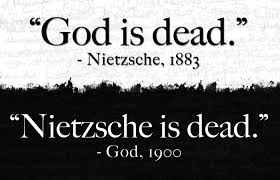
Aaron Ridley points out that Nietzsche split from Schopenhauer (as he eventually split from everyone) over the question of where we should go after god's "funeral." Ultimately Nietzsche thought we should find a way to go back to our lives, and to affirm them. Schopenhauer, he decided, was a nihilist content to wallow in ultimate meaninglessness (or adopt that pose)... except while walking his poodles or visiting the art gallery or attending a concert. But isn't that the very stuff of life? It's the stuff Nietzsche's "eternal recurrence" challenges us to affirm.
What, if some day or night a demon were to steal after you into your loneliest loneliness and say to you: "This life as you now live it and have lived it, you will have to live once more and innumerable times more; and there will be nothing new in it, but every pain and every joy and every thought and sigh and everything unutterably small or great in your life will have to return to you, all in the same succession and sequence—even this spider and this moonlight between the trees, and even this moment and I myself. The eternal hourglass of existence is turned upside down again and again, and you with it, speck of dust!"
Would you not throw yourself down and gnash your teeth and curse the demon who spoke thus? Or have you once experienced a tremendous moment when you would have answered him: "You are a god and never have I heard anything more divine." If this thought gained possession of you, it would change you as you are or perhaps crush you. The question in each and every thing, "Do you desire this once more and innumerable times more?" would lie upon your actions as the greatest weight. Or how well disposed would you have to become to yourself and to life to crave nothing more fervently than this ultimate eternal confirmation and seal? -"The Greatest Weight" (in The Gay Science [When Nietzsche Wept]
Ridley doesn't talk about that, but he's helpful with the Apollonian-Dionysian distinction.

In the final analysis, Nietzsche thought what didn't kill us, what merely made us suffer, made us stronger. That's his blustering pose. It's kind of pathetic. I'd have to agree with James, who pitied "poor Nietzsche's antipathies" and likened Schopenhauer and Nietzsche to a pair of rabid rats in a cage (or think of alienated Dwayne in Little Miss Sunshine, in his room)... largely a cage of their own design.

But what would Freud say?


Freud is darker than Nietzsche… Sheer joy and sheer affirmation of life is pretty hard to find, if you’re being absolutely honest about what reality is.
As long as your ideas of what’s possible are limited by what’s actual, no other idea has a chance. 
If life is a gift, then the more you partake in it, the more you show thanks. Susan Neiman, Moral Clarity: A Guide for Grown-up Idealists


Some wonder what makes Freud a philosopher. In the spirit of Carlin Romano I wouldn't worry about that. He philosophized (albeit reluctantly, says one biographer) about civilization, psychic health, happiness, religion, the material mind, conscience, consciousness, and the scope of philosophy itself.
Philosophy is not opposed to science, it behaves itself as if it were a science, and to a certain extent it makes use of the same methods; but it parts company with science, in that it clings to the illusion that it can produce a complete and coherent picture of the universe. Its methodological error lies in the fact that it over-estimates the epistemological value of our logical operations…
Like Kierkegaard, Freud endlessly mucked around in the morass of anxiety and depression and, like those other great explorers of the mind, was often accused of being of too depressing. Yet, when pressed to provide some positive vision of health, Freud more than once implied that what is fundamental to happiness is the ability to love and work; that is, to be able to invest in something other than yourself. G. Marino, "Freud asPhilosopher"
"Frude had it all figured out." Barney Fife  [Freud...Freud and daydreaming... lucid dreams...BBC]

Also in the spirit of Carlin Romano, some philosophers who aren't dead yet...

Historian Francis Fukuyama jumped the gun when he declared, in nearly-Hegelian tones, The End of History in 1989, as the Berlin Wall and the Soviet Union fell. Those were heady days, prompting many to pronounce the end-times: Bill McKibben's End of  Nature, Daniel Bell'sEnd of Ideology, George Leonard's End of Sex (which really would be the end, as the last Shaker might confirm). Reports of all these ends again invite Twainian drollery: they're all greatly exaggerated. And as The Hitch said, Fukuyama's thesis in particular was touted by neocons in an unseemly and unmerited spirit of self-congratulation. History continues.

But to his great credit, Fukuyama "brought light to an area (anywhere within a thousand miles of Hegel) thought by professional philosophers to produce Absolute Obscurity."

Harvard political scientist Dennis Thompson "argued for as much public discussion as possible," but also "recognized that the polis occasionally resembles a circus." 

Choice, unsurprising example: the Tennessee senate's silliness surrounding the Ten Commandments and the Golden Rule. They actually drafted ethics legislation including a provision that "Thou shalt have no other gods before me..." What would late-night television comics do, without our benighted legislators to kick around? Easy for them, they don't get to live here.

Thompson also said, in the wake of the Lewinsky scandal, that the privacy of public officials "should receive less respect." But their public malfeasance still gets the lion's share of my disrespect.

George Fletcher revived Josiah Royce's interest in the philosophy of loyalty. "America: love it or leave it" is a bad form of loyalty, as was the German people's to Hitler and the motherland. But what about Camus's' mother-love? What about partisan political party loyalty in general? Loyalty to tradition, to church and country? What about loyalty to life itself? What about Carl Sagan's great statement at the end of Cosmos"Our loyalties are to the species and the planet... to the cosmos from which we spring?"

Many have questioned Noam Chomsky's loyalties. Nobody has questioned his impact, in linguistics or in radical politics. Carlin Romano questions his intellectual integrity and "goodwill," his penchant for character assassination and "ad hominem attacks on those who disagreed with him." Chomsky thinks himself "in possession of the Truth." He might benefit from a little more pluralism, and a reading of Pragmatism.