Delight Springs

Wednesday, September 15, 2021

Hobbes

LISTEN. In CoPhi today we take up Niccolo Machiavelli and Thomas Hobbes. 

First, though, we participate in a public reading of the U.S. Constitution, a document that used to compel the reflexive assent of all our representatives in all three branches of the federal government. No more. So I think it's an entirely appropriate ritual demonstration of our commitment to the rule of law that we should line up behind the microphone in front of our building and take turns reading it out. Imagine what it will be like to live in this country when Constitutional law is no longer credible or enforced. Why, it might be something like living in a state of nature, in a war of all against all. It might be nasty, brutish, and short.

And we might find ourselves in that benighted condition sooner, not later, if we don't check the excesses of the Machiavellian "ends justify the means" politicians in our midst. There seem to be a lot more of them lately.

I confess, though, a grudging admiration for Hobbes, and not just because I'm so fond of his feline namesake. 


If I'd lived in (the original) Hobbes's time, in the Elizabethan age of English civil war, I too might also have thought that public civility, even simulated faux-civility, would only ever result from the top-down imposition of a regime of authoritarian intimidation. 

So here's a couple of old posts dedicated to the philosopher who warned us that our worst instincts are our strongest, and that we must "civilize" ourselves through fear not of one another but of a Leviathan state.

Hobbes “walked much and contemplated”

Machiavelli and Hobbes are on tap in CoPhi today. Students often come to them already intrigued with the former but unaware of the latter, though both their names have become adjectival terms of notoriety. Beware Machiavellian politicos and their ends-justify-the-means mentality, we all seem to have been forewarned, and beware Machiaveliian schemers generally. But while the last century spawned chilling examples of totalitarianism and its murderous toll, fewer of us have been alerted to the dangers of the Hobbesian superstate.

The explanation could have something to do with the evident sweetness of temper of “Tommy” Hobbes (as my old poli-sci prof at UMSL called him), who envisioned Leviathan but exemplified something more like the lamb in his personal conduct and bearing. Simon Critchley’s Book of Dead Philosophers offers an endearing glimpse of a true English eccentric. He “avoided excess ‘as to wine and women’ and stopped drinking at age sixty,” he “walked vigorously every day to work up a sweat… and expel any excessive moisture,” he sang “prick-songs” late at night to stimulate his lungs and lengthen his life.

My favorite thing about Hobbes remains, naturally, his peripatetic nature. He walked to work up a sweat but also to stimulate ideas, which he’d interrupt himself long enough to record by disengaging the quill from his walking stick. “He walked much and contemplated,” says Aubrey’s Life, “and he had in the head of his cane a pen and ink-horn, carried always a note-book in his pocket, and as soon as a thought darted, he presently entered it into his book, or otherwise he might perhaps have lost it.”

Another explanation of the failure of “Hobbesian” to convey the menace it might is, of course, a certain sweet-natured cartoonish tiger-cat who resisted his namesake’s “war of all against all.”
Image result for hobbes
“Hobbes was fond of his dram,” sang the Pythons. But he was fonder of his stick. His walking stick. (See below.)

I was amused when my old friend said he’d just spent five weeks in Britain and came away with nothing more philosophical than a visit to a castle where Hobbes had tutored. My colleague answered rightly by noting that an ancient English castle’s more likely to stimulate the philosophical imagination than is a dusty library in Tennessee. But in any event, Hobbes is a fascinating and over-maligned figure whose steps I look forward to tracking. As I wrote for students awhile back,

Thomas Hobbes is one of my favorite “authoritarians”: a walker who kept an inkwell in his walking stick, he lived to 91 in the 17th century and believed humans could be saved from themselves with the right kind of contract. Contrary to a student essay I once graded, he did not say pre-social contract humans were “solitary, poor, nasty, brutish, and short.”

Hobbes did say that’s what it would be like to live in a “state of nature,” without civil authority or police or government to keep the peace and impose order. It would be a “war of all against all.” If you don’t agree, asks Nigel Warburton in his Little History, why do you lock your doors?

Not, surely, because you think everyone’s out to get you. But it only takes a few miscreants, doesn’t it, to create an atmosphere of paranoia and mistrust?

I’d like to think Hobbes might reconsider the extremity of his position, were he transported to our time. On the other hand, we might reconsider the benignity of ours, were we transported to his. Those were tough times: civil war, a king executed, murderous politics, etc. How much freedom would you trade for peace and safety, if there were no other way to secure it? How much have you? How secure do you feel? Still relevant questions in our time, and Hobbes’s answers were extreme indeed. But he was no monster, he was a peace-seeker and a civilizer. Most walkers are.

But, would life in a state of nature really be as bad as Hobbes thought? Most of us find most people less than totally distrustful, hostile, aggressive, and vicious, most of the time. On the other hand, we’re most of us hardly “noble savages” either. Civilization and its discontent-engendering institutions account for a percentage of everyday bad behavior, but surely not all of it.

The Hobbesian threat of insecurity and fear of violent death, in our time, may be great enough for most people to override their desire for personal freedom. Is safety more important than liberty? “Better red (or whatever) than dead?” Better to have government snoops monitoring your calls, emails, etc., than… than what, exactly?

Even if you agree with Hobbes that humans left to themselves would revert to base, aggressive, instinctive behavior, you may still also hesitate to agree that the only corrective for this condition is an all-powerful and authoritative central state. You may prefer not to concede the mechanistic, material model of humans as incapable of changing, of choosing to become more kind and compassionate, less fearful and selfish. You may hold out for a species capable of rewriting its default programming.

Speculations about human nature as inherently good or bad have always slighted the individuality of persons, absorbing it in abstractions about universal nature. We should seek instead to grasp the particularity of our separate natures. Our separate plural natures.

Tuesday, September 14, 2021

Philosophy's contribution to life

LISTEN. In Happiness today we consider  the Epicurean notion that "the alleviation of suffering and especially the suffering produced by fear and anxiety" is "the most important contribution of philosophy to life." That might be right. Surely, philosophies are deficient that fail to address the problem of suffering, that fail to acknowledge the contribution of fear and anxiety to our unhappiness. These are our problems, the gods have other problems of their own. If, that is, they have the problem and opportunity of existing in the first place.  

Or so it seems to us Epicureans. Epicurus said we can only be certain of what appears to us, of how things seem. Maybe philosophy can make still larger contributions. But fear-based suffering seems a good place to start.

"The god... who marks the sparrow's fall" would watch you and me too, presumably, but does the thought of constant survreillance make you happy? Many reformed ex-theists report feeling a tremendous release from judgment, upon abandoning the presumption of an ever-watchful eye in the sky. The Epicurean solution is divine apatheia. Gods should care less about our doings and sufferings. We breathe easier assuming they're not judging and inflicting. 

"Fearfulness promotes vigilance and caution" but may also reflect mistaken beliefs, so we're tasked to distinguish the fears worth heeding from those worth losing. What's on your legit-fear list? 

Mine includes climate change, authoritarian politicians, and mis-/dis-informed citizens. It does not include fear of a punitive afterlife and eternal damnation. I have a hard time imagining what it would be like really to harbor and entertain such fears as an adult human, though I remember clearly enough what it was like to be terrified by them as a child.

"Now I lay me down to sleep/I pray the lord my soul to keep..." My parents, I always thought, were comparatively enlightened, progressive, and humane. But they taught me to recite that prayer. Or at least they didn't un-teach me, didn't insulate me from Southern Baptist hell-mongering Sunday School indoctrination. I'd had enough of it by age fourteen or so, having much earlier been frightened into "going forward" one Sunday morning and "repenting" so I could be "washed in the blood" etc. It all sounds so primitively barbaric. It was,though at the time it was just frightening and confusing. 

Will it ever be possible to discover how and why the structure and activity of atoms in the brain and nervous system give rise to consciousness and the subjective feeling of selfhood? And if we do discover that, will we feel somehow diminished in our humanity? Why should we? I can't think of any good reason. The peculiar configuration of atoms each of us instantiates, and the felt experience of being that particular configuration, is in each instance unique. The perception of self is perhaps the most human thing about us, with all the hazard and possible good fortune that implies. Our challenge is to gain self-possession and the right measure of self-reliance without being seduced by the dark side of too much self-importance. Egoman, as my friend says, must be held at bay.

Epicurus had a materialist view of soul, and if souls there be that's how they must be: parts of the finite organism, not ethereal fly-away free riders. And souls must be renewable in a secular return to life sense, for the duration of their mortal tenure. They must come to understand themselves as the ongoing "renewal of the living world... even in the constant presence of death and dying." They must nurture and prepare their replacements, the ever-aborning new souls, to perform the same function. And enjoy it.

Lucretius: "So the aggregate of all things is constantly refreshed, and mortal creatures live by mutual exchange... at short intervals the generation of living things are replaced, and, like runners, pass on the torch of life from hand to hand." Releasing the torch invites peaceful sleep, but not annihilation. The atoms disperse, new life is configured, and the race continues. 


That's what Robin Ince meant when he said some part of you may once have been, or may yet be, "mountains and apples and pulsars and... Napoleon's knee. That is a good thing. Unlike the occupants of the universe, the universe itself is not wasteful. We are all totally recyclable. And when we die, we don't even have to be placed in different refuse sacs. This is a wonderful thing." Weird and wonderful and unwasteful.

So it's not a perfect world, Plato's Timaeus notwithstanding. But it might just be good enough for the likes of us. Deconstructing the fears and anxieties that would block our embrace and enjoyment of the good-enough world is a worthy contribution. I'd just add a pragmatic/meliorist element: learn also to enjoy the effort of making good-enough better.

Monday, September 13, 2021

Free

LISTEN. A good night's sleep, especially after a bad one, is restorative. Of perspective, and cheer, and gratitude. I got one last night. Thank goodness, or just good fortune.  Either way, acknowledging and expressing gratitude is itself restorative, as I heard A.J. Jacobs saying in the middle of the night Saturday on my smart speaker when (I hypothesize) our Ubered Paneer Masala wasn't sitting quite right. Among the wise insights he shared with TED was the Jamesian psychology he paraphrased: it's easier to act your way into a new way of thinking than the reverse. Maybe that's how Augustine of Hippo finally consummated his conversion and stopped acting licentiously... 

I'm grateful to Younger Daughter, may I say, for the exquisite crab boil she arranged for us this weekend. It was also a pleasure to revisit the charming toy store we used to habituate, and walk the dogs together Sunday morning. And I'm grateful for the mlb wildcard race my team's still in. 

I also heard sage practical "health and wellbeing"advice on BBC 4, urging "small chunks of exercise across your day." Get up and move for five minutes, or ten, now and then. Take the stairs. Circle the building. Or, as I learned to do this summer when observing post-operative restrictions on my mobility, pace your driveway. Or your cell, if you're Boethius. It adds up. Might even set you free. 

On a more somber note, with the 9/11 anniversary just behind us, the self-sacrifice of the FDNY heroes (and those at the Pentagon and in Pennsylvania) twenty years ago is simply astonishing. And inspiring. We should all be grateful.

==

LISTEN (9.20). Today in CoPhi we begin with Augustine and his famous pre-pious "ask" of God, for chastity later. Even Saints must sow their oats. His Manichaean "solution" to the problem of suffering, a less than omnipotent god who needs all the help He can get, still impresses me as more plausible than any standard Christian alternative. An all-hands account of how we can best counter the world's ills makes more sense and greater appeal than the claim that all's already right with the world. Clearly it's not.


The problem of suffering is the toughest nut for any conscientious person of faith to try and crack. Even if "moral evil" and the suffering it produces were entirely a product of human free will, and free will were a divine gift with no strings attached, there's still the sticky matter of natural geo-cataclysms. "Acts of God," in  the insurers' responsibility-ducking argot, are not on us. Victim-blaming is no solution.

Then, Boethius in his prison cell yakking with Lady Philosophy. But where was Lady Theology? And why didn't he write The Consolation of Christianity?

If "God grasps everything in an instant" and "sees past, present and future as one," how does that make us free? How does timeless presence exculpate the all-seeing Omniscient One? People have tried to explain this to me for years, but I think He's still on the hook if He's anywhere or anywhen at all.

Do humans really have a transparently self-validating idea in mind of perfection, an idea so compelling that we have no choice but to acquiesce in its logical necessity? And what would that do to free will, Anselm?

Aquinas's (and Aristotle's) First Cause argument leaves inquiring minds wondering about its unasked and unanswered question, obvious even to a child... or to children like J.S. Mill and Bertrand Russell, at least: what caused the First Cause? Nothing? If the First Cause domino provides its own impulsion , then so can a universe. And anyway, the impulsive force need not be conceived as possessing personal or moral properties. It could just be The Force, neutral with respect to our notions of good and evil.

In Fantasyland  it's time again to marvel at Ronald Reagan's duplicity or credulity (or both) in telling the legend of Thomas Jefferson's Constitutional Convention angel. When Drumpf tells a tale we all know he's bullshitting. Was Reagan?  Or was he an even scarier sort of Confabulator in Chief, one who actually believed his own phantasms?

Cane Ridge, Kentucky, the 19th century Woodstock? A come-to-Jesus fest is not the Garden either Epicurus or CSNY had in mind, I think. It was suggested in class the other day, though, that some people attend Bonnaroo and Burning Man seeking refuge from the commercial and militarized mania of our workaday world. Not my idea of paradise, but to each her own.

I'll never understand why so many Americans believe(d) Joseph Smith, either. Kant and Emerson would have something to say about that, about thinking for oneself and having an "original relation to the universe." To that point, I found my missing questions for last time, on How the World Thinks. One of them is: Should later thinkers consider themselves "mere commentators"? And: Should enlightened thinkers still venerate tradition?

If we can get past those, we'll take up time (one of Augustine's timeless topics) and karma. Both flirt with fatalism, as I see it...

Sep.'20
==
Augustine, Boethius, Anselm, Aquinas, Royce -- 10.7.19

Augustine, free will , and free speech -- 9.17.14

Christians 2, Philosophers 0 (Augustine, Boethius, Hypatia) -- 2.27.12

Thursday, September 9, 2021

Epicurean citizens

LISTEN. Ted Simmons gave quite a nice Hall of Fame induction speech, thanking his friends the (Jon) Hamm family and invoking the Beatles  ("the love you take" etc.). But what a stark illustration of today's poem: “How soon hath Time, the subtle thief of youth/Stol’n on his wing my three and twentieth year!” #23 was eternally young in memory. Time!


In Happiness we turn to the Epicureans, who I generally and favorably distinguish from their Stoic cousins as more assertively pursuant of happiness, less accepting of unhappy fate, more inclined to assign disappointment not to an abstract "nature" with which we've failed to "harmonize" but to a correctable failure to identify and deconstruct our various worries and fears. The Stoics and Epicureans both offer good therapy, but the Stoics sometimes seem too quick to accede to conditions we might have hoped to alter. Acceptance, when all attempts to ameliorate an unwelcome status quo have failed, is admirable. Premature acceptance is unfortunate.

But... are Epicureans good citizens? Have they retreated too deeply into their Garden to engage responsibly in the affairs of the polis? That's one of the questions we first raised when we last took up this topic in this course. It's still open. We may be stardust, and golden, and billion year old carbon (etc.), but aren't we also every bit as much products and stewards of our own time and place? Can we be Epicurean communards and still discharge the duties of properly concerned citizens?

Looking forward to discussing that in Happiness today and MALA tonight.

==

An old post:

LISTEN. It's on to Catherine Wilson's Epicureanism: A Very Short Introduction in Happiness today.

We're catching up, since Tuesday's class was pre-empted by the panel discussion on Suffrage and the Constitution. The Epicureans famously retreated to their Garden commune, in pursuit of life's simpler and less mediated pleasures. Would they have been engaged at all in the sort of civic activism that brought women the vote in 1920, or that is attempting to bring young people out to vote in 2020, or that tomorrow will bring citizens (the younger the better) out to demand action on the climate crisis? Would they have acknowledged any "urgent need of acting now," if that perturbed their garden delights? Where can we find the right balance between personal gratification and public commitment?

Those are some of our questions today. Others include

  • Is it in fact foolish to fear "complete and personal annihilation"? -“To fear death, then, is foolish, since death is the final and complete annihilation of personal identity, the ultimate release from anxiety and pain.” ― Titus Lucretius Carus, On the Nature of Things... Gutenberg etext
  • Do you think Epicurus was on the right track in thinking of atomic "swerve" as a "basis for free will"? 11 If they swerve randomly and unpredictably, how does that refute or challenge determinism? Or is his point that we can try to emulate their example and be random and unpredictable ourselves? Is random unpredictability really another name for freedom? (Remind me to tell my undergrad pub story...)
  • Does Epicurus's analogy of atoms to "dust motes dancing in a sunbeam" remind you, as it does me, of Carl Sagan's Pale Blue Dot ("a mote of dust suspended in a sunbeam" 12)? Do you see any parallels between Sagan's cosmic philosophy and Epicureanism? What about the "multiplicity of worlds" hypothesis vs. the view of Christian salvation as limited to "one small corner of the many world universe" etc. 16
  • Do you think it will ever be possible to discover how and why the structure and activity of atoms in the brain and nervous system give rise to consciousness and the subjective feeling of selfhood?
  • Do you agree that generation and dying are symmetrical processes? 51 In other words, do each of us owe the world a death? Do you find beauty and consolation in that perspective? Is death a peaceful sleep and a dispersal of spirit and soul atoms? 
Talking about these things is indeed an Epicurean delight, or can be. But gathering in the streets to demand social justice and climate sanity can too. A good Epicurean knows when to take a break in the conversation and go pound the pavements.

Wednesday, September 8, 2021

Stoics & Epicureans

LISTEN. It's Star Trek Day AND Hall of Fame Induction Day. 55 Years since I first started following the exploits of Kirk and Spock and Brock and Gibson... And did you see what #55 did in St. Louis last night


Mr. Spock is the best candidate for a segue to today's CoPhi content, I suppose, behind his half-human stoical facade. The enduring epicurean friendship of Pujols and Molina might be another.

Live long and prosper, and seek insight into the conditions of good and happy life. Having and treasuring elective passions of no ultimate consequence is surely one of those. See Bertrand Russell on "impersonal interests" (Conquest of Happiness, ch15)...
==
“Insight,” Josiah Royce’s name for philosophy–“this curious scrutiny of ours into the truth…this game of reflection”–sponsors, he says, the philosopher’s “return to life.”

Return to life – I don’t recall being at all struck by that phrase or even noticing it, on my first reading of The Spirit of Modern Philosophy. It may have registered subliminally, though, because it grabbed me sharply later when I came across William James’s insistence that “the return to life can’t come about by talking.” 

Curious indeed. I wonder if Royce and James talked about that. They must have, they talked incessantly. James was sure that Royce’s talk led to the wrong “insight,” the metaphysical idealism which–from James’s point of view–subsumes individuals under an Absolute scheme of rational order (“intellectualism”) that absorbs their autonomy and co-opts their freedom. Royce, for his part, was convinced that James’s talk led to intellectual anarchy and atomistic isolation. 

Both were sure that life itself, or rather our sense of continuity with all the currents of life, hung in the balance. Both avidly sought the terms of our return. Ours? Or theirs? Most non-philosophers, and perhaps most people generally, are unaware of feeling so entirely detached from life that they must urgently investigate the way home. We all have our bad days, but many fewer of us regularly experience an Oz-like “not in Kansas anymore” sense of ourselves as cut off from the only life we’ve known and loved. Or say so in public, anyway. Alice’s adventures in Wonderland are exceptional and extreme. Most of us escape the rabbit hole. Right? 

Well, James and Royce were exceptional. Both thought it their job to clear the path back from Wonderland, back to Kansas, back to life as they thought they knew it. “I actually dread to die until I have settled the Universe’s hash in one more book,” James mocked himself and his vocation a few short years before he died. The hash remains unsettled, though it must be said that James’s empiricist form of settling has enjoyed more general sympathy in the decades since his and Royce’s departure than the latter’s absolute metaphysical idealist approach. But as we know, popularity is not the last word. Words aren’t even the last word. “I must deafen you to talk, or to the importance of talk…” 

The Stoics and Epicureans, like the Skeptics before them, understood too that “this curious scrutiny of ours into the truth” has to issue in something more tangible than talk if it’s to provide useful therapy. 

An old post:
There are three obstacles to happiness, Epicurus said– fear of death, fear of pain, and fear of the gods– but all can be removed easily enough.
Death is no problem because when we are alive we are not dead and when we are dead we don’t know it… Fear of pain is worse than pain itself. Accept the pain, embrace the sting… and you’ve vanquished your worst foe, the one in your head.” (J.M. Hecht)
Strike one, strike two… and since any gods there may happen to be, out there in the empty spaces between the stars, are quite evidently “totally unconcerned with human affairs,” fear strikes out. Be happy.

Seneca‘s end was not so happy, but it was more or less consistent with his life. He did not strain against the leash of perceived necessity. But does he illustrate the limits the of therapeutic acceptance, and cross the line into defeatist resignation? [text… J-L David painting]

Other Stoics are better role-models. Cicero‘s De Natura Deorum (On the Nature of the Gods) is a neglected classic. Bottom line: “If you want truth, you have to avoid making up anything.”

Marcus Aurelius had a cold unblinking eye for harsh home-truths. He poses a question never more timely than right now, for a celebrity-besotted society like ours:
He who has a vehement desire for posthumous fame does not consider that every one of those who remember him will also die very soon… But suppose that those who will remember are even immortal, and that the remembrance will be immortal, what then is this to thee? And I say not what is it to the dead, but what is it to the living?

Not enough to live for, is what. But the Philosopher-Emperor finds life worth living all the same, for those who cultivate a properly-stoic sensibility. Contented are those who learn to comprehend the universe,

by contemplating the eternity of time, and observing the rapid change of every several thing, how short is the time from birth to dissolution, and the illimitable time before birth as well as the equally boundless time after dissolution.

Our time is brief, but  so then also is our pain. From this perspective, the trite modern phrase about not sweating the small stuff (because it’s all small) can become meaningful and profound.

The skeptic Sextus Empiricus offers an interesting observation on anthropomorphic God-projection, as Jennifer Hecht summarizes: divine virtues are thought to be “fully realized versions of human virtues.” But “that did not make sense unless God had our weaknesses.”

Weaknesses like impotence, fallibility, and ignorance: whose acknowledgement by us is also our greatest strength. So, says Sextus, your God is too small.

But of course, as a skeptic, he must always add: for all we know.

==

And, see Jefferson in Fantasyland p.51: "Question with boldness even the existence of a god..."

Tuesday, September 7, 2021

Perspective, lists, and a good life

LISTEN. In CoPhi today it's bonus content for section H1, so as to keep them in sync with their Monday-Wednesday cohorts. They'll get the quick and abridged version tomorrow of William James's first Pragmatism lecture, Emerson's (and others') appreciation of the peripatetic life, and the philosophical significance of Carl Sagan's "pale blue dot" before we move on to Stoics and Epicureans.


Also, we'll consider what philosophy is for.  Top of my list, in a word (and implied by those images of our little "mote of dust suspended in a sunbeam"): perspective


Making lists has been a theme in Happiness so far, from the things that made life worth living for Manhattan's Alvy Singer to the sources and springs of delight to today's modest and moving final list of life's small and saving graces. It all reminds me of Matt Haig's list in Humans. Lots of good happiness advice there, never mind that it comes from an extraterrestrial and is directed to a particular young human.


The list goes on. #94 is very good: You don't have to be an academic. You don't have to be anything. Don't force it...
==
LISTEN ('19). We finish Daniel Haybron's very fine Very Short Intro to Happiness today.

More important than whether you're happy, says Haybron, is your contribution and legacy. Will you be deservedly well thought-of, for having lived well? So much the better if living well makes you happy, but in the long perspective of history the personal and subjective experience of virtue will barely register. Isn't that all the more reason to make happiness a priority? If you don't, who will?

That's not to endorse "acting badly" in the pursuit, but some will wonder what's to stop any of us from doing so. What compels conscience and compassion, aside from the unpleasant prospect of being poorly thought-of? Decency and virtue might be motivation enough, and their own reward, for the noblest natures. Others rightly care about the judgment of generations to come.

But then there are the deplorables, the philistines, the jerks. They claim the right to be terrible people. Until quite recently I would have said they were marginal to our civilization and not a threat to it. Lately that's less clear. "One should not be an asshole in the pursuit of happiness." You may get yourself in big trouble.

"According to some studies, having kids doesn't make us happier." Having just graduated a couple of them, I've made my own study. I can't imagine the past 20+ years of my life without them. More than that: anticipating them was a source of happiness long before their births. But I know that's not everybody's experience.

"Any life dedicated to worthwhile ends is meaningful," even if the judgment of worth is uncertain or, again, awaits the verdict of history. While we live we have to make that call for ourselves, have to believe we've chosen worthwhile ends, if we're to experience that sort of meaning. Of course, we may never know.

We do know, don't we, that those gawking consumer-touroids on p.104 are draining life of meaning even if they think they're "making memories"? Like selfish and shallow people everywhere, they look more desperate and absurd than happy.

Happiness really is an aspirational ideal, something worth chasing no matter how elusive it may turn out to be.

"Nothing in life is as important as you think it is when you're thinking about it," says Nobelist Daniel Kahneman. Hmm. As a professional thinking person that's disconcerting. But as Michael Lewis points out in The Undoing Project, Kahneman and his pal Amos Tversky have shed needed light on the extent to which we ought to mistrust our own intuitions about everything, including what will make us happy. “Man is a deterministic device thrown into a probabilistic universe." Well no wonder we often get it wrong. Wonder's that we ever get it right. On the other hand, “When you are a pessimist and the bad thing happens, you live it twice."

More uplifting (and poignant) is that heart-grabbing missive from the battlefield that closes Haybron's book. "I am such a lucky person to have the life that I have." That says it.

Tversky said it too, commenting on his own fatal illness. “Life is a book. The fact that it was a short book doesn’t mean it wasn’t a good book. It was a very good book.”

And next we turn to another good short intro, in Happiness, on Epicureanism. 

9.12.19

Thursday, September 2, 2021

Sources and springs, and beyond

LISTEN. Meeting the MALA class to talk about educating good citizens tonight. Is civic virtue a source of happiness, a by-product of it, or both? If by happiness we mean something like Greek arete, virtue, and eudaimonia, it must be both. The good life belongs to individuals whose personal flourishing is inseparable from the health and vitality of the polis and the various communities that compose it. And if we agree with John Dewey that good lives and good societies undergo perpetual reconstruction, never ceasing to learn and grow in response to their environing conditions, it must be both. Looking forward to a good conversation with the good citizens of our MALA community this evening. 9.2.21
==
LISTEN. Today in Happiness we'll ponder the sources of happiness, or as I like to say (following William James) the springs of delight. And then we'll wonder what's beyond happiness: well-being, flourishing, eudaimonia. [First we'll catch up on "Measured Satisfaction" etc.]

Is delight the same as happiness? The floor is open, on that, but I've never been unhappily delighted. When I am delighted, I am well. It's close enough for me. I think it was close enough for James too, whose main point about the "falling dead of the delight" to which we're perpetually liable is that it is recoverable, and that the pursuit of happiness need never be finally abandoned. Delight can be recovered, repeatedly; a lease can be renewed, time and again; the vitality and delight of life at its highest pitch can be returned.

In our bleakest darkness we may and must anticipate the break of a new day... because, the alternative is hopeless resignation. To be delightedly happy is to remain vigilantly attuned to our own peculiar springs of delight. They're peculiarly ours. It's a myth to think that every happy person is happy in the same way, having decoded the same "secret"... and maybe that goes for families too. Sorry, Tolstoy.

[It was on this day (Sep2) in 1901 that Theodore Roosevelt uttered his famous words “Speak softly and carry a big stick.” He was vice president at the time and was giving a speech at the Minnesota State Fair... On another occasion, he said, “If a man continually blusters, if he lacks civility, a big stick will not save him from trouble, and neither will speaking softly avail, if back of the softness there does not lie strength, power.” WA]

Teddy Roosevelt's favorite exclamation, after Bully!, was De-lighted! That capacity and receptivity  wasn't a natural spring for him, it didn't spontaneously flow. He cultivated it, dug it out, tended it... first in overcoming a sickly childhood, then in rebounding from the devastating loss of both wife and mother on the same day in his young adulthood. It's arguable that his robust appetite for the "strenuous" life was an over-the-top overcompensation, his "big stick" diplomacy an imperious excuse for American overreach.

But from TR's own point of view, again, he must have seen no alternative. As the positive psychologists say, he worked hard at eek-ing out as much positivity as his personal set-point allowed. Might he have done otherwise? That's a real and open question, philosophically. But personally and existentially he must have felt the strenuous life as his only salvation. Where, I wonder, does that place him on the spectrum of stoics and epicureans?

And what about this guy?

Image result for robin williams teddy roosevelt

Some of us may be genetically predisposed to experience more delight, but "plenty of things can affect how happy we are" whatever our personal "set point." That can be an excuse for not trying, when the evidence is clear that "human beings are remarkably adaptable and resilient" and thus almost always capable of being happier.

 But beware, "people who place a higher value on money, possessions, and status tend to be less happy." Such extrinsic motivators are inferior, while the enlightened rich whose motivation is intrinsic and interior are often less materialistic than the poor. Go figure.

What else matters, besides intrinsic motivation? An outlook that's positive, accepting, and caring. And besides outlook? Security, autonomy, relationships, something to do that's skilled and meaningful.

But circle back to money, which is too frequently given short shrift in these discussions. It can't buy you love, but if you're pulling less than 75K you're going to notice the happiness-income link.

Aristotelians say its in our nature to pursue happiness and fulfillment as activities in accordance with virtue. So, if you could plug into an Experience Machine that made you feel happy, would you be happy? Wouldn't you like to find out?

"Desire theories assert that what's good for you is getting what you want." You can't always get what you want. What do you need? "People often want things that aren't good for them," so perhaps we should challenge James's contention that "the only possible reason there can be why any phenomenon ought to exist is that such a phenomenon actually is desired. Any desire is imperative to the extent of its amount; it makes itself valid by the fact that it exists at all..." MPML

As for the strivers and enjoyers, I find myself allied with the great E.B. White: “I arise in the morning torn between a desire to improve (or save) the world and a desire to enjoy (or savor) the world. This makes it hard to plan the day.” So, different days for different desires?

Lots more provocative questions for discussion today. My favorites: Is happiness really a choice? Is accepting things as they are really responsible? How would YOU use the Experience Machine?

I'm happy to pass along this Happiness wisdom from cousin Mary, the poet:
Oliver said: “I’ve always wanted to write poems and nothing else. There were times over the years when life was not easy, but if you’re working a few hours a day and you’ve got a good book to read, and you can go outside to the beach and dig for clams, you’re okay.” http://writersalmanac.org/
(If you're landlocked, you're going to have to substitute for the clams.)

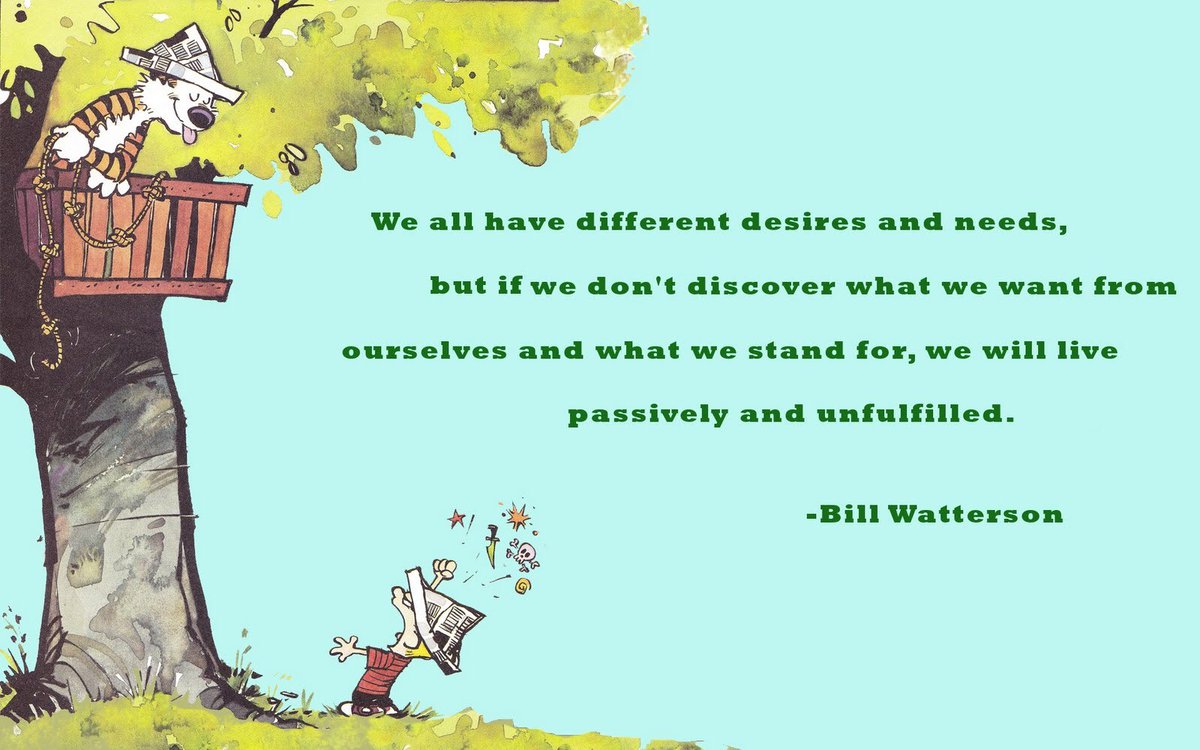
And as for Desire Theory, it's hard to dispute Calvin & Hobbes:


9.10.19

Tuesday, August 31, 2021

Satisfaction

LISTEN. Today in Happiness we consider "life satisfaction" and Daniel Haybron's assertion that To be satisfied does not mean you think your life is going well for you...

If you've spent the bulk of your life imprisoned, and declare upon eventual release that you were and are happy, does that bode ill for happiness as a worthy object for a life's quest? Or does it just speak well of the temperament of the ex-con who persevered so heroically?

Plato's cave-dwellers in Book VII of the Republic must have thought themselves happily ensconced in their subterranean prison, else they'd not so have resented their enlightened peer's attempt to shine a light on their situation. Happiness surely does not supersede delusion. 


Wittgenstein's dying words, "Tell them I had a wonderful life," belie his morose reputation. So did old Schopenhauer's Scrooge-like visage. But maybe happiness can take the form, for some, of delight in adversity and mental anguish and deep pessimism, after all. 

Or maybe they need to join Philosophers Anonymous, and acknowledge their impotence to alter a power larger than themselves. But what would that power be? Temperament? Genetics? Fate?

Or maybe not. Maybe Wittgenstein and Schopenhauer and the cavers and the ex-con knew satisfaction, but not happiness.  I'd like to think so, and I think a lot of us would. We'd like to think our respective pursuits of happiness won't just satisfy but ultimately will uplift, transport, and redeem us. 

Ultimately. For now, though, day by day, how do we measure our satisfaction and judge its contribution to our ultimate happiness? After all, we're "just born, and there you are. So it's hard to know where to set the bar for a 'good enough' life." 

I say set the aspirational bar high, but be prepared to appreciate and celebrate close to the ground.  A low and mean life would have to be pretty low and mean to be flatly unsatisfactory. It can still be lacking, disappointing, wounding, depleting, whatever, but still satisfy in ways oblivion obviously cannot. "It sure beats being dead."

It does, doesn't it? Sophocles in Oedipus Rex -- “...count no man happy till he dies, free of pain at last” -- was chronically unhappy, no fit role model for us. Right?

If you don't know you're pain-free, you might as well not be. If you're happy and you know it, that deserves some applause. But if you think, with Schopenhauer, that the hunt for happiness gives rise to deluded hope and dissatisfaction, well, good luck. And don't worry, the end is always near.

Monday, August 30, 2021

Better ancestors

LISTEN. We turn to Aristotle today in CoPhi, I'm also thinking a lot this morning about my upcoming MALA classes on educating good citizens. The Stagirite has things to say about that. He 

disparages oligarchs, who suppose that justice requires preferential claims for the rich, but also democrats, who contend that the state must boost liberty across all citizens irrespective of merit. The best polis has neither function: its goal is to enhance human flourishing, an end to which liberty is at best instrumental, and not something to be pursued for its own sake. (SEP)

My MALA focus will be first on John Dewey, whose commitment to democracy also sought an equilibrium between personal liberty and communal well-being. Like Aristotle, Dewey also thought we are political animals. We are social beings with an inherent civic duty to respect and collaborate effectively with our peers in addressing matters of common concern.  

And like Aristotle, Dewey placed great emphasis on human flourishing as something far more profound and lasting than fleeting pleasures, more than a feeling. It's a state of being, the ongoing project of a lifetime coordinate with the lives of our fellow citizens, an effort to live virtuously in a community dedicated to virtue. Being a good citizen, in these terms, involves the pursuit of personal liberty and well-being no more or less urgently than that of the entire polis.

Being a good citizen also, maybe especially, involves being a good ancestor. "The most important question we must ask ourselves is, 'Are we being good ancestors?'" So said the great humanist and medical researcher Jonas Salk, without whose vaccine countless lives would have been lost and countless others would never have begun. 

In our time, life is threatened by disease, ignorance, dishonesty, and consumerist disregard for the long-term environmental consequences of our "lifestyles." It's threatened, at bottom, by a failure to see ourselves as individuals inseparable from not only our immediate community but from the larger historical human community. 

“In an incredibly short period of time we have endangered a world that took billions of years to evolve. We are just a tiny link in the great chain of living organisms, so who are we to put it all in jeopardy with our ecological blindness and deadly technologies? Don’t we have an obligation, a responsibility, to our planetary future and the generations of humans and other species to come?” ― Roman Krznaric, The Good Ancestor: How to Think Long-Term in a Short-Term World

Dewey put it this way: 

“The things in civilization we most prize are not of ourselves. They exist by grace of the doings and sufferings of the continuous human community in which we are a link. Ours is the responsibility of conserving, transmitting, rectifying and expanding the heritage of values we have received, that those who come after us may receive it more solid and secure, more widely accessible and more generously shared than we have received it.” A Common Faith

That notion of community as continuous, prior and larger and posterior to our personal selves, is crucial to good ancestry. Our "heritage of values" is a sacred trust, and potentially our greatest gift to the next generations. If we neglect it, the next generations will curse our dereliction as bad citizens and bad ancestors. If we neglect it too long and too selfishly, the long-term flourishing--if not the very existence--of the next generations will be imperiled. If we treasure it, our lives and theirs may flourish. 

Aristotle had the germ of that notion of community, but it took his followers millennia finally to appreciate our Deweyan responsibility to expand it to include all citizens and all persons. So to be good and virtuous citizens, concerned not only to flourish in our own right but to ensure all others the same opportunity, it's not enough to be good ancestors. We have to be better ones.

Thursday, August 26, 2021

"Life is good"

LISTEN. So said the Amazonian Piraha people, according to Daniel Everett, before it became a popular marketing slogan.
Happiness (the class) begins for real today with Daniel Haybron's Very Short Introduction, which includes that epigramatic reference to the Pirahas and then tells us that Socrates - so often exalted as a paradigmatically happy man, right up until the hemlock kicked in, in his 70th year - "didn't miss out on a thing." Well, he missed out on his 71st. Life might have been better, certainly longer.

Was Socrates happier than the average college student? "You might think the typical college student lives in a state of bliss," with minimal obligations and maximal opportunities to ruminate, socialize, and party, but apparently that would be wrong. How many of them are living the examined life? Ignorance is perhaps not bliss, after all? But what about enlightened Socratic ignorance? Either way, American students are apparently less happy than we thought.

Panama is most blissful, evidently. Or was. More recent results point elsewhere. Denmark? Iceland? (I think I recall Eric Weiner's Geography of Bliss giving them high marks.)

One way to chart our happiness index is to ask what's on your bucket list. Another: what's not on your deathbed list of things you just have to do one more time. Maybe not "another peck at the mobile phone, or one more trip to the mall." Maybe you won't wish you'd bought more crap.

"What sort of life ultimately benefits a person," wondered Aristotle. What, not shopping or iPhoning? How many of us can even imagine how bizarre those activities would seem to an old Greek philosopher?

A young Intro student yesterday told me it was his impression that philosophy was mostly about pondering and pontificating on our feelings. But Haybron quickly withdraws feeling theories from the field, in favor of "life satisfaction." But don't confuse that with "subjective well-being," a catch-all of psychologism he says we must confuse with our real quarry.

Has there really never been a better time to be alive? I wouldn't have said the first decade of this millennium was the best ever, but it depends on the yardstick. Steven Pinker's Better Angels makes the case for our good luck.

Many indigenous peoples say the only thing they envy about the western industrial lifestyle is healthcare (and we know how fraught that is). William James told his friend Schiller to "keep your health, your splendid health - it's worth all the truths in the firmament." Hard not to agree, especially after a bout with serious illness. If you've not experienced that, by the time you reach "a certain age," you're even luckier than most.

Haybron says "we need a theory - a definition - of happiness." Do we? What do you mean, we? We philosophers? We authors? We moderns? We shoppers and social media fanatics? Why can't we be happily undefined and atheoretical? Presumably because the absence of a good theoretical framework leaves us in the wrong "state of mind."

Happiness is a state of mind, for sure, but it's even more a state of experience and expectation. No?

8.31.17

"I'll be hanging in a classroom one day..."

On Opening Day in Happiness class Tuesday I referenced Opening Day in 2019, and Woody Allen's film Manhattan. Here's what I posted the next day, back then. Other side of COVID seems like more than just two years ago, doesn't it?

Originally published Aug. 30, 2019:

LISTEN. A  student introduced himself yesterday, in Philosophy of Happiness, as "the oldest guy in the room." Sometimes, when people say that, they mean they're 3d year students, twenty or so. This guy really was of my generation, even a little older. A "me generation" product of the 1970s, he called himself, before going on to credit Woody Allen with drawing him to philosophy.

I can't count how many times, over the years, I've referenced scenes and lines from Annie Hall, Manhattan, Sleeper, Crimes and Misdemeanors, Midnight in Paris, et al,  to blank stares of non-recognition. Those who've heard of Woody at all know him simply as one more old guy accused of sexual misconduct, with a sordid intra-family twist.

I can't defend Woody's morals, and of the worst accusations fervently hope he's not guilty as charged. I do know that, like our "non-traditional" classmate, Woody's film work was a big positive influence in my life.

The Woody scenes from Manhattan we referenced in class:


An idea for a short story about, um, people in Manhattan who are constantly creating these real, unnecessary, neurotic problems for themselves cos it keeps them from dealing with more unsolvable, terrifying problems about... the universe. Let's... Well, it has to be optimistic. Well, all right, why is life worth living? That's a very good question. Well, there are certain things, I guess, that make it worthwhile. Like what?
OK... for me... 
Ooh, I would say Groucho Marx, to name one thing. And Willie Mays. And... the second movement of the Jupiter Symphony. And... Louis Armstrong's recording of Potato Head BluesSwedish movies, naturally. Sentimental Education by Flaubert. Marlon Brando, Frank Sinatra. Those incredible apples and pears by Cezanne. The crabs at Sam Wo's. Tracy's face...

You know, someday we're gonna be like him. And he was probably one of the beautiful people, dancing and playing tennis. And now look. This is what happens to us. You know, it's important to have some kind of personal integrity. I'll be hanging in a classroom one day and I wanna make sure when I thin out that I'm... well thought of...

Wednesday, August 25, 2021

Plato's Socrates

LISTEN. I was saying in class yesterday that my preferred approach to class prep these days is to rise early and try to come up with something fresh and novel to say about the philosopher(s) du jour.  So, what's new with Socrates and Plato?

Well, according to Xenephon, Plato's Socrates is "pure rationality" whereas the real Socrates was a dispenser of practical "how to live" advice.

Those who know Socrates mainly through the writings of Plato – Xenophon’s near-exact contemporary – will find Xenophon’s Socrates something of a surprise. Plato’s Socrates claims to know nothing, and flamboyantly refutes the knowledge claims of others. In the pages of Xenophon’s Memorabilia, however, Socrates actually answers philosophical questions, dispenses practical life advice, provides arguments proving the existence of benevolent gods, converses as if peer-to-peer with a courtesan, and even proposes a domestic economy scheme whereby indigent female relatives can become productive through the establishment of a textile business at home. Socrates’ conversation, according to Xenophon, ‘was ever of human things’. This engaged, intensely practical, human Socrates can be refreshing to encounter. Anyone who has felt discomfort at how the opponents of Plato’s Socrates suffer relentless public refutations and reductions to absurdity can take some comfort in Xenophon’s Socrates who ‘tries to cure the perplexities of his friends’.

Trying to cure the perplexities of your friends, forever conversing "of human things," and generally just trying to ameliorate the human condition through an antiquarian version of talk therapy sounds exactly like what we should expect of a philosopher who claims to know nothing of things in the heavens and under the ground. 

Humility and humanity go together well. The real mystery is why a Platonically hyper-rationalized Socrates ever had any credibility among scholars at all. We're accustomed to saying that Plato's our only credible source on Socrates, and to dismissing Xenophon without a hearing. Bertrand Russell called him stupid. But we're more likely to inch closer to the historical Socrates by triangulating our vision and consulting other sources. It would be stupid not to.

Tuesday, August 24, 2021

Happiness

LISTEN. It's the first day of class in the latest iteration of Philosophy of Happiness

Last time this course convened was Fall 2019, pre-COVID. Our emphasis that semester was on Stoics and Epicureans, and "graceful life" philosophies generally. Good thing, with lockdown looming unseen just over our horizon we would all soon come to need more stoic perseverance and epicurean delight in the simple/domestic goods of life than we could then have easily imagined.

Before the month was out we'd all been introduced to "the oldest guy in the room," my future collaborator, who for once wasn't me. He declared an appreciation of the ouvre of Woody Allen, which -- in spite of everything -- I continue to share. Isaac in Manhattan makes a list of the things that make life worth living. We could also call it a Happy List. We should all make our lists, and then actively pursue and celebrate their various items.

This semester, we'll look again at stoics and epicureans. I will again profess a preference for the latter, though I find much to admire in the former. We'll also notice the convergence of attitude and approach the stoics share with Buddhists, when we read More Than Happiness: Buddhist and Stoic Wisdom for a Sceptical Age. But "on the question of speaking" we'll challenge the call for silence. We're here to have a series of conversations, though not on "vulgar topics"...

“On the question of speaking, Stoics and Buddhists are at one. In Epictetus’ words: ‘Be mostly silent, or speak merely when necessary, and in few words. We may enter sparingly into conversation sometimes, when the occasion calls for it; but not about any of the common subjects, such as gladiators, or horse races, or athletic champions, or food, or drink – the vulgar topics of conversation; and especially not about individuals, either to blame, or praise, or make comparisons.”

We're also going to spend time with the great seminal essayist Montaigne, through the instructive mediation of his biographer Sarah Bakewell in How to Live: A Life of Montaigne in one question and twenty attempts at an answer. He knew a trick or two.


“The trick is to maintain a kind of naïve amazement at each instant of experience - but, as Montaigne learned, one of the best techniques for doing this is to write about everything. Simply describing an object on your table, or the view from your window opens your eyes to how marvelous such ordinary things are. To look inside yourself is to open up an even more fantastical realm.”
And, at the enlightened suggestion of my collaborator, we're going to spend more time than has been customary in this course with my favorite philosopher William James. We'll look at John Kaag's Sick Souls, Healthy Minds: How William James Can Save Your Life, and we'll pair his chapters with essays by his subject. My own interest in happiness as a philosophical subject is coevally rooted with my longstanding fascination with James, who said
"If we were to ask the question: “What is human life's chief concern?” one of the answers we should receive would be: “It is happiness.” How to gain, how to keep, how to recover happiness, is in fact for most men at all times the secret motive of all they do, and of all they are willing to endure."

He also knew that endurance is often liable to interruption and derailment. But his good news is that the music of life can always recommence, even for "melacholy metaphysicians" like (on occasion) himself.

And, in a moment of transcendently happy defiance of life's inexorable  finitude, he wrote to the pessimistic historian Henry Adams:

Though the ULTIMATE state of the universe may be its extinction, there is nothing in physics to interfere with the hypothesis that the PENULTIMATE state might be a happy and virtuous consciousness... In short, the last expiring pulsation of the universe's life might be, "I am so happy and perfect that I can stand it no longer."

And then, within just a few weeks, James was gone. But he still inspires many of us to make the most of our penultimate opportunities. One of those is PHIL 3160. See you this afternoon.

Monday, August 23, 2021

Opening Day

LISTEN. Here we go, our first proper Opening Day since January 2020 and first class in an actual classroom in almost eighteen months. 

Not quite proper, since we'll be masked and worried about variant strains. Hope we're not setting ourselves up for another round of lock-down. For today at least, let's assume not. But let's not be reckless.

So the commute is back. Can't say I'm thrilled about that, but the road trip to Alabama to meet my old pals and take in a minor league baseball game Saturday night was a good road test and a nice transition. (A Trash Panda, btw, is an angel-in-training.)

I have two sections of Honors Intro ("CoPhi") today, and another tomorrow. Happiness too. Live and in person. Hope it's like riding a bike (which I'm not yet supposed to do, per surgeons' instructions--that'll make traversing campus expeditiously between consecutive classes a bit of a challenge, but with ambulatory competence now restored by said surgeons I'm ready).

To study philosophy is to learn to die, said Montaigne (following Socrates and the Stoics and others) in one of his gloomier-sounding essays. But of course that's just the flip-side of learning to live. The passing of one of our great musicians, Tom T. Hall, reminds us that the end of a good life is always occasion to celebrate  the privilege and opportunity of living. “We are going to die, and that makes us the lucky ones. Most people are never going to die because they are never going to be born," as Richard Dawkins so aptly said.

I always look for some light way of conveying a serious philosophical point or two on opening day. This time I think I'll bring Data and his daughter into our opening conversation. Philosophy begins in wonder, whether you're a carbon-based biological life form or a reflective positronic AI trying to puzzle out your purpose.

I'll also wonder aloud with them what our purpose is: what's the point of human school?

A smartly written recent essay proclaims that "universities are not for producing better citizens…they are not for producing happier human beings.” But I say we can try. We certainly need better and happier citizens.

Our main mission though, surely, remains the purveying of that old Enlightenment ideal we talked about this summer: Sapere aude, as Kant put it. Learn to think (not just opine, not just feel) for yourself, as I prefer to put it.

The best way to learn that lesson, since thinking for yourself is not the same as thinking by yourself, is through amicable collaboration. CoPhilosophizing is my shorthand for that. And William James's. "The pluralistic form takes for me a stronger hold on reality than any other philosophy I know of, being essentially a social philosophy, a philosophy of 'co'..."

I think we'll find it much easier to be a collaborative plurality in the classroom than we did in those little Zoom rectangles.