Delight Springs

Showing posts sorted by relevance for query aristotle. Sort by date Show all posts

Monday, September 8, 2014

Aristotle & God

We have Aristotle on two tracks (the Little History and Philosophy Bites) today in CoPhi. God's on 3d (pinch-hitting for Lucius Outlaw and last year's America the Philosophical* discussion of the historical role of African-Americans in philosophy, if you're interested).

Aristotle‘s in the Pythons' philosopher's song too, though he's even more sober than his Ionian predecessors. He rejected his teacher Plato’s metaphysics, returned to the cave of the phenomenal world to take a closer look, avoided universalizing abstractions and CAPS (preferring forms in things to transcendent and remote FORMS "above"), and inspired the name of our annual Spring speaker series in the philosophy department at MTSU, the Lyceum. 


(We actually now also have a *Fall Lyceum at MTSU, inaugurated last year by Carlin Romano.)


The best quick & graphic way of illustrating the difference between Plato and his student Aristotle, I’ve found, is by pondering Raphael’s famous painting School of Athens [annotated]. Pay close attention to the hands. 

A new history of western philosophy takes that painting to heart. The Cave and the Light: Plato Versus Aristotle, and the Struggle for the Soul of Western Civilization, by Arthur Herman,  traces its implications for centuries of philosophers who lined up to squeeze into the School behind either Plato or Aristotle.
They began as student and master. They ended as rivals. Plato is supposed to have said, “Aristotle kicked me,as foals do their mothers when they are born.”All the evidence, however, suggests the crucial break between them came after Plato's death. Aristotle entered Plato's Academy in Athens at age seventeen, probably in 367 BCE. When he left, he was in his forties...
Why they broke is a fascinating story reflected in centuries of divergent influence. If I were going to have to line up in that painting I'd have to pick Aristotle's side.

"How Aristotle Invented Science"

Aristotle said one swallow doesn't make a summer, and a few moments of pleasure don't add up to a happy life. Nor does a "happy childhood." We must be in it for the long haul, and must see our good as coordinate with that of others including those who'll succeed us after we're gone. It's all about eudaimonia ("you die" is a helpful mnemonic, aggressive and hostile though it sounds, and though it really means you live.)

It's probably for his ethics that Aristotle is most widely renowned, but Bertrand Russell for one was unimpressed. "There is in Aristotle an almost complete absence of what may be called benevolence or philanthropy. The sufferings of mankind, in so far as he is aware of them, do not move him emotionally." (Hold that thought, when we talk about the problem of evil.)

Aristotle was a naturalist, noticing our continuity with the rest of nature. Like trees and plants we flourish when well-nurtured. Unlike them, we must take charge of our own nurture in order to reach our potential and achieve The Good Life in tandem with our peers.

It's so ironic that the middle ages made Aristotle "The Philosopher," i.e. the unquestioned Authority. That was indeed "against the spirit of philosophy."

Terence Irwin's podcast interview is compelling listening, for those unaccustomed to a Yorkshire accent (or whatever it is). He makes the same point I just did about coordinating the personal and the public good, and "identifying one's own interest with other people's interest" etc. 

He also helpfully corrects overly-simple reductions of Aristotle's ethics to a dogged middle-of-the-roadism. Avoiding extremes doesn't mean choosing the blandest, milk-toastiest possibility. No, his Golden Mean means doing the right thing at the right time for the right reason etc., and that could very well turn out to be something exciting. Or scary. (Like going after ISIS? What would Aristotle say?)

Aristotle's version of God, on the other hand, may just be too bland for your taste. It's not a he or she, or really even an it as we typically understand things. 
To Aristotle, God is the first of all substances, the necessary first source of movement who is himself unmoved. God is a being with everlasting life, and perfect blessedness, engaged in never-ending contemplation. IEP
This is a remote and impersonal God, who won't intervene in our affairs and could really care less about them. 

The God implied in the Hebrew Bible book of Ecclesiastes seems fairly indifferent to human suffering & flourishing too, and unpromising with respect to the old dream of Sunday School heaven and immortality. Jennifer Hecht glosses it smartly in Doubt:
Koheleth brushed aside the dream of an afterlife with a simple appeal to reason--Who knows this?--and the conclusion that humans have nothing above the beasts in this regard...
But it doesn't follow that simple happiness is unavailable in this life. The recipe's pretty simple too.
Love your spouse. Get some work to do, do it with all your might; enjoy the simple pleasures of food, drink, and love. Everything else is vanity. 
But, it's a form of vanity we can live with. The search for true love, solid friendship, good work, and daily delight might just be enough. Enjoy your life. A person could do worse. The search for happiness on this orb is anything but a "dismal" undertaking, as someone sadly suggested. You could ask Aristotle. It's the end and aim of life.

Not everyone agrees with Aristotle about that, of course. For some, the end and aim is to serve and glorify God (and maybe reap the reward of that elusive afterlife after all). Their god knows and cares about human striving, and presumably abhors gratuitous suffering.

But there's the rub that's rubbed raw in our Philosophy: The Basics reading today: the perennial problem of evil or suffering, or the worry that our world is too full of woe to lay at the figurative feet of an omni-being. And even if we think we can disarm some of the problem by deploying the timeworn Free Will Defense, we leave "natural" evil (killer storms, quakes, disease) unaccounted for.

We also read today of David Hume's posthumous objections to weakly-analogical Paley-ish Design Arguments. Human artifacts are one thing, the products of complex time-borne natural phenomena seem to be something very different. 

But natural selection, the "blind" and unpremeditated evolutionary process whereby organisms thrive when they develop adaptations suitable to the conditions of their environment, can be considered a form of Design without a Designer. We should ask and try to answer: Is there an important difference between intelligent design and natural complexity?

Must there have been a universal First Cause? But what caused the cause? That question is neck-and-neck with the problem of evil, in turning out many a young non-theist. J.S. Mill and Bertrand Russell, for instance.
[T]the argument that there must be a First Cause is one that cannot have any validity. I may say that when I was a young man and was debating these questions very seriously in my mind, I for a long time accepted the argument of the First Cause, until one day, at the age of eighteen, I read John Stuart Mill's Autobiography, and I there found this sentence: "My father taught me that the question 'Who made me?' cannot be answered, since it immediately suggests the further question `Who made god?'" That very simple sentence showed me, as I still think, the fallacy in the argument of the First Cause. If everything must have a cause, then God must have a cause. If there can be anything without a cause, it may just as well be the world as God, so that there cannot be any validity in that argument. Bertrand Russell, Why I Am Not A Christian

I think I've heard just about every imaginable response to this question, through the years in my classrooms, but I'll ask it again: 

If you believe in God, how do you attempt to reconcile or understand the full extent of human suffering? (Think of particular instances such as the "agony of a young child dying of an incurable disease," or an innocent gunshot or terror victim, or someone killed in a storm and their survivors.) Do you see it as part of a divine plan we just have to trust, or a deep mystery we shouldn't think too much about? Or do you believe in a God who is less than omnipotent and is just doing the best He/She/It can to bring about a harmonious and just Creation?

If you don't believe in God, is that in whole or in part because of the Problem of Evil? Or something else?

Or maybe you're like Charlie Brown's antagonist Lucy, who once responded to his Socratic query about the meaning of it all that "I just don't think about things I don't think about." Didn't seem to make her any happier, not thinking. Did it?

Tuesday, February 3, 2015

Aristotle & God

We have Aristotle on two tracks (the Little History and Philosophy Bites) today in CoPhi. God's* on 3d (pinch-hitting for Lucius Outlaw and last year's America the Philosophical* discussion of the historical role of African-Americans in philosophy, if you're interested).

(*The God, or a god? An important distinction, as Bill Murray noted in Groundhog Day: scroll down...)

Aristotle‘s in the Pythons' philosopher's song too, though he's even more sober than his Ionian predecessors. He rejected his teacher Plato’s metaphysics, returned to the cave of the phenomenal world to take a closer look, avoided universalizing abstractions and CAPS (preferring forms in things to transcendent and remote FORMS "above"), and inspired the name of our annual Spring speaker series in the philosophy department at MTSU, the Lyceum. 


(We actually now also have a *Fall Lyceum at MTSU, inaugurated last year by Carlin Romano.)


The best quick & graphic way of illustrating the difference between Plato and his student Aristotle, I’ve found, is by pondering Raphael’s famous painting School of Athens [annotated]. Pay close attention to the hands. 

A new history of western philosophy takes that painting to heart. The Cave and the Light: Plato Versus Aristotle, and the Struggle for the Soul of Western Civilization, by Arthur Herman,  traces its implications for centuries of philosophers who lined up to squeeze into the School behind either Plato or Aristotle.
They began as student and master. They ended as rivals. Plato is supposed to have said, “Aristotle kicked me,as foals do their mothers when they are born.”All the evidence, however, suggests the crucial break between them came after Plato's death. Aristotle entered Plato's Academy in Athens at age seventeen, probably in 367 BCE. When he left, he was in his forties...
Why they broke is a fascinating story reflected in centuries of divergent influence. If I were going to have to line up in that painting I'd have to pick Aristotle's side.

"How Aristotle Invented Science"-a slight overstatement, but not compared to Plato the armchair philosopher. 

Aristotle was more eloquently poetic than scientific, though, when he said one swallow doesn't make a summer, and a few moments of pleasure don't add up to a happy life. Nor does a "happy childhood." We must be in it for the long haul, and must see our good as coordinate with that of others including those who'll succeed us after we're gone. It's all about eudaimonia ("you die" is a helpful mnemonic, aggressive and hostile though it sounds, and though it really means you live.)

It's probably for his ethics that Aristotle is most widely renowned, but Bertrand Russell for one was unimpressed. "There is in Aristotle an almost complete absence of what may be called benevolence or philanthropy. The sufferings of mankind, in so far as he is aware of them, do not move him emotionally." (Hold that thought, when we talk about the problem of evil.)


(Yesterday was the anniversary of Russell's death, btw. Strange occasion to mark, I suppose, but any excuse to check out Maria Popova's brainpickings is worthwhile.)

Aristotle was a naturalist, noticing our continuity with the rest of nature. Like trees and plants we flourish when well-nurtured. Unlike them, we must take charge of our own nurture in order to reach our potential and achieve The Good Life in tandem with our peers.

It's so ironic that the middle ages made Aristotle "The Philosopher," i.e. the unquestioned Authority. That was indeed "against the spirit of philosophy."

Terence Irwin's podcast interview is compelling listening, for those unaccustomed to a Yorkshire accent (or whatever it is). He makes the same point I just did about coordinating the personal and the public good, and "identifying one's own interest with other people's interest" etc. 

He also helpfully corrects overly-simple reductions of Aristotle's ethics to a dogged middle-of-the-roadism. Avoiding extremes doesn't mean choosing the blandest, milk-toastiest possibility. No, his Golden Mean means doing the right thing at the right time for the right reason etc., and that could very well turn out to be something exciting. Or scary. (Like going after ISIS? What would Aristotle say?)

Aristotle's version of God, on the other hand, may just be too bland for your taste. It's not a he or she, or really even an it as we typically understand things. 
To Aristotle, God is the first of all substances, the necessary first source of movement who is himself unmoved. God is a being with everlasting life, and perfect blessedness, engaged in never-ending contemplation. IEP
This is a remote and impersonal God, who won't intervene in our affairs and could really care less about them. 

The God implied in the Hebrew Bible book of Ecclesiastes seems fairly indifferent to human suffering & flourishing too, and unpromising with respect to the old dream of Sunday School heaven and immortality. Jennifer Hecht glosses it smartly in Doubt:

Koheleth brushed aside the dream of an afterlife with a simple appeal to reason--Who knows this?--and the conclusion that humans have nothing above the beasts in this regard...
But it doesn't follow that simple happiness is unavailable in this life. The recipe's pretty simple too.
Love your spouse. Get some work to do, do it with all your might; enjoy the simple pleasures of food, drink, and love. Everything else is vanity. 
But, it's a form of vanity we can live with. The search for true love, solid friendship, good work, and daily delight might just be enough. Enjoy your life. A person could do worse. The search for happiness on this orb is anything but a "dismal" undertaking, as someone sadly suggested. You could ask Aristotle. It's the end and aim of life.

Not everyone agrees with Aristotle about that, of course. For some, the end and aim is to serve and glorify God (and maybe reap the reward of that elusive afterlife after all). Their god knows and cares about human striving, and presumably abhors gratuitous suffering.

But there's the rub that's rubbed raw in our Philosophy: The Basics reading today: the perennial problem of evil or suffering, or the worry that our world is too full of woe to lay at the figurative feet of an omni-being. And even if we think we can disarm some of the problem by deploying the timeworn Free Will Defense, we leave "natural" evil (killer storms, quakes, disease) unaccounted for.

We also read today of David Hume's posthumous objections to weakly-analogical Paley-ish Design Arguments. Human artifacts are one thing, the products of complex time-borne natural phenomena seem to be something very different. 

But natural selection, the "blind" and unpremeditated evolutionary process whereby organisms thrive when they develop adaptations suitable to the conditions of their environment, can be considered a form of Design without a Designer. We should ask and try to answer: Is there an important difference between intelligent design and natural complexity?

Must there have been a universal First Cause? But what caused the cause? That question is neck-and-neck with the problem of evil, in turning out many a young non-theist. J.S. Mill and Bertrand Russell, for instance.

[T]the argument that there must be a First Cause is one that cannot have any validity. I may say that when I was a young man and was debating these questions very seriously in my mind, I for a long time accepted the argument of the First Cause, until one day, at the age of eighteen, I read John Stuart Mill's Autobiography, and I there found this sentence: "My father taught me that the question 'Who made me?' cannot be answered, since it immediately suggests the further question `Who made god?'" That very simple sentence showed me, as I still think, the fallacy in the argument of the First Cause. If everything must have a cause, then God must have a cause. If there can be anything without a cause, it may just as well be the world as God, so that there cannot be any validity in that argument. Bertrand Russell, Why I Am Not A Christian

I think I've heard just about every imaginable response to this question, through the years in my classrooms, but I'll ask it again: 

If you believe in God, how do you attempt to reconcile or understand the full extent of human suffering? (Think of particular instances such as the "agony of a young child dying of an incurable disease," or an innocent gunshot or terror victim, or someone killed in a storm and their survivors.) Do you see it as part of a divine plan we just have to trust, or a deep mystery we shouldn't think too much about? Or do you believe in a God who is less than omnipotent and is just doing the best He/She/It can to bring about a harmonious and just Creation?

If you don't believe in God, is that in whole or in part because of the Problem of Evil? Or something else?

Or maybe you're like Charlie Brown's antagonist Lucy, who once responded to his Socratic query about the meaning of it all that "I just don't think about things I don't think about." Didn't seem to make her any happier, not thinking. Did it?

Tuesday, February 2, 2021

Aristotle

Today in CoPhi it's our first pass at Aristotle. "One swallow doesn't make a summer" (or a spring-were the Greeks really so vague about the seasons as these alternative translations suggest?) was his most poetic observation by far.
If then the work of Man is a working of the soul in accordance with reason, or at least not independently of reason... and we assume the work of Man to be life of a certain kind, that is to say a working of the soul, and actions with reason, and of a good man to do these things well and nobly, and in fact everything is finished off well in the way of the excellence which peculiarly belongs to it: if all this is so, then the Good of Man comes to be "a working of the Soul in the way of Excellence," or, if Excellence admits of degrees, in the way of the best and most perfect Excellence.
And we must add, in a complete life; for as it is not one swallow or one fine day that makes a spring, so it is not one day or a short time that makes a man blessed and happy.

Happiness is far more than the sum of its parts, it's a quality of soul steeped in a lifetime of habitual virtue. Or so we say, when interchanging "happiness" with "eudaimonia." Flourishing or well-being are better substitutes. By whatever name, though, Aristotle's saying the good life takes time, possibly more time than a lifetime affords. If your child suffers a tragic and premature end, even after you've gone, your life has suffered diminution. In some non-trivial sense your well-being has taken a hit, your flourishing has foundered.


Russell: From 335 B.C. to 323 B.C. (in which latter year Alexander died), Aristotle lived at Athens. It was during these twelve years that he founded his school and wrote most of his books. At the death of Alexander, the Athenians rebelled, and turned on his friends, including Aristotle, who was indicted for impiety, but, unlike Socrates, fled to avoid punishment. In the next year ( 322) he died. Aristotle, as a philosopher, is in many ways very different from all his predecessors. He is the first to write like a professor: his treatises are systematic, his discussions are divided into heads, he is a professional teacher, not an inspired prophet. His work is critical, careful, pedestrian, without any trace of Bacchic enthusiasm. Russell didn't much like Aristotle's perennial quest for the "mean" between extremes, particularly when applied to truth and other intellectual virtues. But splitting the difference between excess and deficiency is often the right strategy in life.

...with respect to acting in the face of danger, courage {Gk. ανδρεια [andreia]} is a mean between the excess of rashness and the deficiency of cowardice; with respect to the enjoyment of pleasures, temperance {Gk. σωφρσυνη [sophrosúnê]} is a mean between the excess of intemperance and the deficiency of insensibility; with respect to spending money, generosity is a mean between the excess of wastefulness and the deficiency of stinginess; with respect to relations with strangers, being friendly is a mean between the excess of being ingratiating and the deficiency of being surly; and with respect to self-esteem, magnanimity {Gk. μεγαλοψυχι&alpha [megalopsychia]} is a mean between the excess of vanity and the deficiency of pusillanimity.So many of the circumstances of life are beyond our control, on either side of the grave. Can we increase our chance of eudaimonia, or must we just learn to accept our fate and let happiness happen or not? Aristotle says we can take steps to develop our character, form strong habits, and live the good life. This is only partly subject to our control, since much depends on the quality of our early nurture. Some overcome adverse beginnings, others are derailed. Life and luck are unfair.

And that's why Aristotle was so concerned to create a just society, a polis capable of nurturing and supporting all its citizens (except slaves and women-in this regard Plato scores over his pupil). "We live together, and need to find our happiness by interacting well with those around us in a well-ordered state." If you choose to go it alone, you may or may not be pleased with your life but you definitely won't flourish in Aristotle's terms.

The middle ages enshrined Aristotle as The Philosopher, the great authority not to be challenged. He would have hated that, inimical as it is to the spirit of free and open debate governed by reason alone.

Only hedonists conflate pleasure and happiness, but that doesn't mean the relation between them is easy to pin down. Wouldn't Aristotle admit that it might be possible to indulge the right pleasures at the right time for the right reasons etc., thus acknowledging that the time and place for pleasure is always a matter of judicious discretion? Bertrand Russell seemed to think he would not, and for that reason found the Nichomachean Ethics less than wholly appealing. "The book appeals to the respectable middle-aged, and has been used by them, especially since the seveteenth century, to repress the ardours and enthusiasms of the young. But to a man with any depth of feeling it cannot but be repulsive." Repulsive!

I would have said tepid, not repulsive, but Russell has a bit of a point. I'll still line up on Aristotle's side of the School of Athens, though. Which side are you on? (2.20.18)

Other old Aristotle posts..older still

Wednesday, September 25, 2019

Aristotle

LISTEN. The latest New Yorker cover raises a specter, one which we touched on in Happiness class out on the James Union Building stoa late yesterday afternoon.


Some "transhumanists" and futurists think it's our destiny to merge with our machines and become a hybrid species. Is that already happening? If so, I recommend getting outside ASAP and going for a long walk. Unplugged. Step away from the console, Ray Kurzweil. ("...within several decades information-based technologies will encompass all human knowledge and proficiency, ultimately including the pattern-recognition powers, problem-solving skills, and emotional and moral intelligence of the human brain itself.” The Singularity is Near: When Humans Transcend Biology)

Can we know, reliably forecast, or even roughly anticipate the future? How many of us, for instance, saw the Internet coming even as late as (say) 1989, when we were already well into the Microsoft era of personal computing? I recall one morning in 1992, during my one-year stint at East Tennessee State, when my colleague excitedly told us about his new discovery of an exotic thing called a "search engine." 

Humans have been trying to peer into crystal balls for as long as they've been peering at anything, but our prognosticating track record is pretty spotty.  The future is an open and undiscovered country, as today's CoPhi subject Aristotle explained back when we were his far future.
Aristotle formulated the openness of the future in the language of logic. Living in Athens at a time when invasion from the sea was always a possibility, he made his argument using the following sentence: ‘There will be a sea-battle tomorrow.’ One of the classical laws of logic is the ‘law of the excluded middle’ which states that every sentence is either true or false: either the sentence is true or its negation is true. But Aristotle argued that neither ‘There will be a sea-battle tomorrow’ nor ‘There will not be a sea-battle tomorrow’ is definitely true, for both possibilities lead to fatalism; if the first statement is true, for example, there would be nothing anybody could do to avert the sea-battle. Therefore, these statements belong to a third logical category, neither true nor false. In modern times, this conclusion has been realised in the development of many-valued logic. Anthony Sudbery, Aeon
As Montaigne said, Que sais-je?

As Doris Day said, Que sera sera.

As George Santayana said (sort of), there's no cure for death but to enjoy its prelude.

And as Richard Dawkins said, we're going to die and that makes us the lucky ones. [YouT]

An old post:
Today in CoPhi it's our first pass at Aristotle. "One swallow doesn't make a summer" (or a spring-were the Greeks really so vague about the seasons as these alternative translations suggest?) was his most poetic observation by far.
 If then the work of Man is a working of the soul in accordance with reason, or at least not independently of reason... and we assume the work of Man to be life of a certain kind, that is to say a working of the soul, and actions with reason, and of a good man to do these things well and nobly, and in fact everything is finished off well in the way of the excellence which peculiarly belongs to it: if all this is so, then the Good of Man comes to be "a working of the Soul in the way of Excellence," or, if Excellence admits of degrees, in the way of the best and most perfect Excellence.
And we must add, in a complete life; for as it is not one swallow or one fine day that makes a spring, so it is not one day or a short time that makes a man blessed and happy.
Happiness is far more than the sum of its parts, it's a quality of soul steeped in a lifetime of habitual virtue. Or so we say, when interchanging "happiness" with "eudaimonia." Flourishing or well-being are better substitutes. By whatever name, though, Aristotle's saying the good life takes time, possibly more time than a lifetime affords. If your child suffers a tragic and premature end, even after you've gone, your life has suffered diminution. In some non-trivial sense your well-being has taken a hit, your flourishing has foundered.

From 335 B.C. to 323 B.C. (in which latter year Alexander died), Aristotle lived at Athens. It was during these twelve years that he founded his school and wrote most of his books. At the death of Alexander, the Athenians rebelled, and turned on his friends, including Aristotle, who was indicted for impiety, but, unlike Socrates, fled to avoid punishment. In the next year ( 322) he died. Aristotle, as a philosopher, is in many ways very different from all his predecessors. He is the first to write like a professor: his treatises are systematic, his discussions are divided into heads, he is a professional teacher, not an inspired prophet. His work is critical, careful, pedestrian, without any trace of Bacchic enthusiasm. 
Russell didn't much like Aristotle's perennial quest for the "mean" between extremes, particularly when applied to truth and other intellectual virtues. But splitting the difference between excess and deficiency is often the right strategy in life.
...with respect to acting in the face of danger, courage {Gk. ανδρεια [andreia]} is a mean between the excess of rashness and the deficiency of cowardice; with respect to the enjoyment of pleasures, temperance {Gk. σωφρσυνη [sophrosúnê]} is a mean between the excess of intemperance and the deficiency of insensibility; with respect to spending money, generosity is a mean between the excess of wastefulness and the deficiency of stinginess; with respect to relations with strangers, being friendly is a mean between the excess of being ingratiating and the deficiency of being surly; and with respect to self-esteem, magnanimity {Gk. μεγαλοψυχι&alpha [megalopsychia]} is a mean between the excess of vanity and the deficiency of pusillanimity.
So many of the circumstances of life are beyond our control, on either side of the grave. Can we increase our chance of eudaimonia, or must we just learn to accept our fate and let happiness happen or not? Aristotle says we can take steps to develop our character, form strong habits, and live the good life. This is only partly subject to our control, since much depends on the quality of our early nurture. Some overcome adverse beginnings, others are derailed. Life and luck are unfair.

And that's why Aristotle was so concerned to create a just society, a polis capable of nurturing and supporting all its citizens (except slaves and women-in this regard Plato scores over his pupil). "We live together, and need to find our happiness by interacting well with those around us in a well-ordered state." If you choose to go it alone, you may or may not be pleased with your life but you definitely won't flourish in Aristotle's terms. 

The middle ages enshrined Aristotle as The Philosopher, the great authority not to be challenged. He would have hated that, inimical as it is to the spirit of free and open debate governed by reason alone.

Only hedonists conflate pleasure and happiness, but that doesn't mean the relation between them is easy to pin down. Wouldn't Aristotle admit that it might be possible to indulge the right pleasures at the right time for the right reasons etc., thus acknowledging that the time and place for pleasure is always a matter of judicious discretion? Bertrand Russell seemed to think he would not, and for that reason found the Nichomachean Ethics less than wholly appealing.  "The book appeals to the respectable middle-aged, and has been used by them, especially since the seveteenth century, to repress the ardours and enthusiasms of the young. But to a man with any depth of feeling it cannot but be repulsive." Repulsive!

I would have said tepid, not repulsive, but Russell has a bit of a point. I'll still line up on Aristotle's side of the School of Athens, though. Which side are you on?

Today in Fantasyland, speaking of theme parks... "Black America" opened in Brooklyn at the turn of the 20th century. "Black Panther" it wasn't, staffed as it was with "actual field hands from the cotton belt" and designed to show the slaves' "happy, careless life." Right.

Then we learn of a former Tennessee governor and senator who makes Bill Haslam and Bob Corker look pretty good by low-bar comparison who traveled the country with the same fantastic "treacly" message, before Hollywood got in on the whitewash with Birth of a Nation's "shameless" celebration of the KKK. In this light it might seem unfair to pick on the south, while the whole country was losing its mind to illusion and delusion. The Mind of the South contended that southerners had a particular "incapacity for the real, a Brobdingnagian talent for the fantastic."

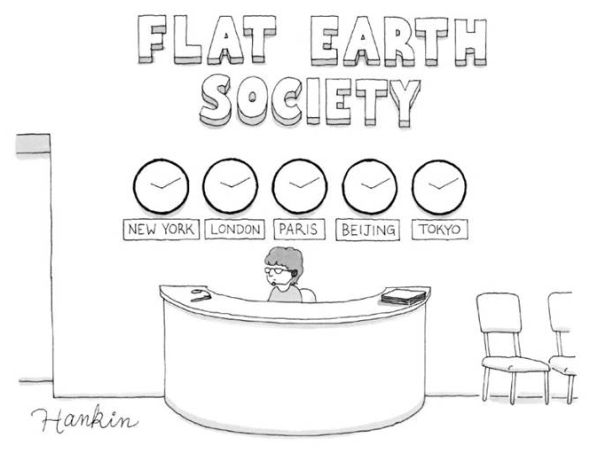
The modernist New Theology is old by now, still foolishly stoking a simplistic God/Satan struggle for our souls. Other modernists realized Christianity must adapt to the times or be winnowed like every other struggler, bending to the theistic evolutionary hypothesis that evolution was "a new name for 'creation' rather than its denial. But Billy Sunday's old-time religion ("I don't believe your own bastard theory of evolution") captured a greater share of the credulity market and set the stage for Dayton, Tennessee, 1925.  What a circus. "It was absurd that 'the book of Genesis, written when everybody thought the world was flat,' should refute science." Was and is. But some people evidently just don't mind living a contradiction, or in defiance of their time.

Image result for flat earth cartoon new yorker

(Carl Sagan & Neil deGrasse Tyson set them straight...)

Monday, September 12, 2016

Progress, Plato, Aristotle

More Platonic reflections from Rebecca Newberger Goldstein in CoPhi today, and Russell on Aristotle.

Goldstein continues her reply to the philosophy jeerers and their slight that philosophy bakes no bread and gets us nowhere. She might have recalled William James's opening salvo in Pragmatism acknowledging the former but entirely repudiating the latter.
Believing in philosophy myself devoutly, and believing also that a kind of new dawn is breaking upon us philosophers, I feel impelled, per fas aut nefas, to try to impart to you some news of the situation.
Philosophy is at once the most sublime and the most trivial of human pursuits. It works in the minutest crannies and it opens out the widest vistas. It 'bakes no bread,' as has been said, but it can inspire our souls with courage; and repugnant as its manners, its doubting and challenging, its quibbling and dialectics, often are to common people, no one of us can get along without the far-flashing beams of light it sends over the world's perspectives. These illuminations at least, and the contrast-effects of darkness and mystery that accompany them, give to what it says an interest that is much more than professional.
In fact, philosophy constantly progresses in this way, by illuminating the "covert presumptions" that lie buried beneath our awareness. Facing, discussing, and sometimes revising or rejecting our various unexamined convictions can be the epitome, and always is the requisite condition, of progress at the level of reflective thought. What is truth, beauty, or goodness? You may think you know, but we need to talk about it.

The path of progress for Plato is dialogic, argumentative, and collaborative, like much scientific discourse; but unlike most scientific results, those of philosophy register most powerfully in personal terms, and are revealed in the progressive personal transformations of individuals rather than in "paradigm shifts"  impacting whole disciplines and epochs.

What is Platonism? It's an unfamiliar idea about ideas, that when they embody truth they do so by subsisting in an abstract realm beyond the reach of everyday sense (and common sense). "A Platonist asserts that the abstract is as real as the concrete, the general as realized as the particular." Or moreso. A Platonist is the diametric opposite of a Pragmatist.

And, a Platonist asserts the eternal intertwining of goodness, beauty, and truth: a Sublime Braid that cashes out for Plato's Socrates as humility and piety of a secular sort, a "strengthened kinship with the cosmos" through an uplifted infatuation with wisdom and "love for that which isn't oneself."

Aristotle's student Alexander, "arrogrant, drunken, cruel, vindictive, and grossly superstitious," was evidently not a good philosopher. Russell doubts he learned much from his tutor, but he did us the service of keeping Hellenic civilization alive long enough to produce a big chunk of our curriculum.

Aristotle was optimistic and teleological (or purpose-driven), convinced that "the universe and everything in it is developing towards something continually better." Coulda fooled us, or most of us. (But Goldstein's husband Steve Pinker, with his Better Angels, might offer qualified agreement.)

Aristotle's "good," unlike Plato's remote and abstract Form, is immanent and practically universal. It's that activity of the virtuous soul called eudaimonia, flourishing, or happiness. Everybody wants some, for its own sake. Aristotle's god is another story.

And what is virtue? It's any action that tends to produce happiness (but don't confuse happiness with fleeting pleasure. One swallow does not make a summer.

Some more possible points for discussion today: If Aristotle's metaphysics is Plato diluted by common sense, what's so common about it? Does each of us have an "essence"? What do you think of Aristotle's airy and impersonal God? Is happiness the only thing in the world that's intrinsically good, for its own sake? Is Aristotle's golden mean really golden, or is it vapid, formulaidc, and equivocal? Is it true what Fish said to Boghossian, that philosophical conclusions "do not travel"? What can that possibly mean, from a peripatetic or pragmatic point of view? 

Today is the anniversary of the Battle of Marathon, "regarded as the kicking-off point for the rise of Classical Greece and the birth of Western civilization" (if you want to call it that). We're debating, at this late date, the deplorability of racists and other haters? People who casually fling the ugly word that rhymes with stitch, and worse, are offended by that perfectly apt and descriptive word?  That's deplorable.

Why is it so hard to live in the present? Past and future do seem more safe, sane, and secure. But here and now is where it's always happening, and here and now is where we store our past and hatch our possible futures. Here's where the progress has to happen.
==
Weekend update. Highlights: the veggie chimichanga at Guac, Meryl Streep as a really good bad singer, one last Sounds game, honey (etc.) from the Green Door csa, wonderful songs at summer's end (loving the new WMOT roots music!), and Sunday brunch at home. Especially that. No time for Titans. Life is good. 

5:45/6:29, 57/88, 6:57

Tuesday, January 24, 2023

Aristotle, friendship, happiness, Wendell Berry

In CoPhi it's time again for Aristotle. This time last semester, on August 30, that serendipitously coincided with the lead-off slot I'd been asked to fill in the Honors Fall Lecture Series. It also coincided with the kickoff of our Environmental Ethics course's discussion of the Kentucky sage Wendell Berry, so I found myself looking for points of intersection between Aristotle and Wendell--specifically on the subjects of friendship and happiness. Having already noticed some affinity between Aristotle and Socrates, I then also detected an Aristotelian strain in the farmer-poet from Port Royal. That again leaves Plato the odd man out. 

In particular, I noticed the echo in Wendell of Aristotle's insistence on creating strong communal lives wherein individuals have learned to trust and thus mutually support one another. That's the collective form of friendship, or at least its cousin. Good friends, good neighbors, and good citizens share a great deal of common ground. "We need better government, no doubt about it," writes Wendell in his 1970 essay Think Little. "But we also need better minds, better friendships, better marriages, better communities."

Aristotle's great theme, in the broadly-ethical sphere that asks what it means to live a good human life and thus to flourish and attain happiness, is ευδαιμονια [eudaimonia]. Nigel Warburton's mnemonic is worth remembering, even if a native Greek speaker might say it mangles the proper pronunciation: a flourishingly happy human is one who has succeeded in replacing you die with a virtuous life of αρετη [aretê], and thus has begun really to live. That's excellent.

Wendell's great theme, bound up with love of one's homeplace and a willingness to work joyously to sustain it, live from it, try to improve it, and ultimately pass it along to its next generation of caretakers, is also (I submit) something like Aristotle's version of happiness. Both aim at the great Graceful Life prize, αταραξια [ataraxia], serenity, tranquility, peace of mind, freedom from pain and fear. And happiness. "Be joyful, though you've considered all the facts."

But Wendell disagrees with Aristotle and Solon (“Count no man happy until he is dead"), we must take our happiness where and when we find it.

I made a few slides for the Honors lecture, probably too many and still in poor order. But they got us talking. That too is something Wendell shares with the sage of Stagira, an uncommon ability to provoke constructive conversation. And so the Socratic gadfly from Kentucky is also an Aristotelian provocateur. 

Monday, September 9, 2013

Aristotle to Outlaw

We have Aristotle on two tracks (the Little History and Philosophy Bites) today in CoPhi, and on the third a "Woody Allen-ish" philosopher from New York (Canada originally), Lou Marinoff. He's featured in today's reading from America the Philosophical, as is local star Lucius Outlaw. 

Aristotle‘s in the Pythons' philosopher's song too, though he's even more sober than his Ionian predecessors. He rejected his teacher Plato’s metaphysics, returned to the cave of the phenomenal world to take a closer look, avoided universalizing abstractions and CAPS (preferring forms in things to transcendent and remote FORMS "above"), and inspired the name of our annual Spring speaker series in the philosophy department at MTSU, the Lyceum. 

Our first-ever Fall Lyceum is coming up on November 8, with Carlin Romano coming to explain why America really is a vibrantly philosophical civilization if you look in the right places. Watch for details.)

The best quick & graphic way of illustrating the difference between Plato and his student Aristotle, I’ve found, is by pondering Raphael’s famous painting School of Athens [annotated]. Pay close attention to the hands.

Aristotle said one swallow doesn't make a summer, and a few moments of pleasure don't add up to a happy life. Nor does a "happy childhood." We must be in it for the long haul, and must see our good as coordinate with that of others including those who'll succeed us after we're gone. It's all about eudaimonia ("you die" is a helpful mnemonic, aggressive and hostile though it sounds, and though it really means you live.)

Aristotle was a naturalist, noticing our continuity with the rest of nature. Like trees and plants we flourish when well-nurtured. Unlike them, we must take charge of our own nurture in order to reach our potential.

It's so ironic that the middle ages made Aristotle "The Philosopher," i.e. the unquestioned Authority. That was indeed "against the spirit of philosophy."

Terence Irwin's podcast interview is compelling listening, for those unaccustomed to a Yorkshire accent (or whatever it is). He makes the same point I just did about coordinating the personal and the public good, and "identifying one's own interest with other people's interest" etc. 

He also helpfully corrects overly-simple reductions of Aristotle's ethics to a dogged middle-of-the-roadism. Avoiding extremes doesn't mean choosing the blandest, milk-toastiest possibility. It means doing the right thing at the right time for the right reason etc., and that could very well turn out to be something exciting. Or scary. (Like bombing Syria? What would Aristotle say?)

I used Lou Marinoff's Plato, Not Prozac in Intro (before it was CoPhi) some years ago. Was a bit tempted to experiment with hanging out a shingle and seeing whether the market could bear my therapeutic presence. One of these days, maybe.

Best intro to him might be this Times feature from awhile back.
...philosophical counselors disagree on everything from the best name -- philosophical practice? public philosophy? -- to whether they should be trying to cure people, empower them or guide them to self-understanding...
Marinoff and other practitioners hold that we all have a philosophy of life, whether we know it or not, and that we can benefit from identifying that philosophy, making sure it helps us rather than hinders us -- defining success, say, in a way we might actually achieve it -- and then strengthening it through dialogue with the great thinkers. 
Sounds reasonable enough, doesn't it? But when professions and income levels collide, controversy ensues.

Lucius Outlaw was a pioneering African-American philosopher who studied at Fisk. He's at Vanderbilt now (where he's said some terrific things about teaching, learning, and love). I'm not quite sure why Carlin Romano's chosen to shine such a spotlight on him (I'll put it on my list of questions for Carlin when he comes, in November.)

The most prominent African-American philosopher in America is Cornel West, "in a league of his own" in Outlaw's own words. Here he is in London last year with our first podcast interviewee, MM McCabe (Socrates), and then in the public sphere of NYC, in a taxi, in and on "the examined life."


Kwame Anthony Appiah, London-born Ghanaian-raised, Cambridge-educated, and Princeton-based, is another African-heritage philosopher in America we should all know. His Cosmopolitanism, discussed here, would be required reading in every school, if I were philospher-king. He too was featured in The Examined Life, articulating why it's not only okay for people to be different but actually imperative. And healthy.


See also his wonderful talk on "Ethics in a World of Strangers."

There have been important African-American philosophers all along, including (notably) W.E.B. DuBois and (arguably) Booker T. Washington. And then there's Hubert Harrison.
Hubert Harrison, the “Black Socrates,” defies the stereotype of unblinking theism among African-Americans. He also admired Paine, noted errors in the Bible, and embraced Agnosticism (“such an agnostic as Huxley was”).  He said he had no intention of bowing down to a lily-white god or worshipping a Jim Crow Jesus. He was more than a little literal when he also embraced Nietzsche’s repudiation of “slave ethics.” Admitting that reason alone did not meet his every need, he still preferred “to go to the grave with my eyes open.” That’s a really good personal credo, “eyes open.” Mind too. JMH
One more thing. The Bible book of Ecclesiastes came up in discussion on the CoPhi site, over the weekend. I broke my vow of staying entirely off the Internet during the Sabbath to post my own two cents. Seems crucial, from an Aristotelian or Marinoffian or just plain life perspective, to try and get clear on just what the author was trying to say. Surely not that you have to die and be one of the proud, the few, the "elect," to be happy. I prefer Jennifer Hecht's gloss:
Koheleth brushed aside the dream of an afterlife with a simple appeal to reason--Who knows this?--and the conclusion that humans have nothing above the beasts in this regard...
But it doesn't follow that simple happiness is unavailable in this life. The recipe's pretty simple.
Love your spouse. Get some work to do, do it with all your might; enjoy the simple pleasures of food, drink, and love. Everything else is vanity. 
But, it's a form of vanity we can live with. The search for true love, solid friendship, good work, and daily delight might just be enough. Enjoy your life. A person could do worse. The search for happiness on this orb is anything but a "dismal" undertaking, as someone sadly suggested. You could ask Aristotle. It's the end and aim of life.


Wednesday, February 5, 2014

Aristotle to Outlaw

We have Aristotle on two tracks (the Little History and Philosophy Bites) today in CoPhi, and on the third a "Woody Allen-ish" philosopher from New York (Canada originally), Lou Marinoff. He's featured in today's reading from America the Philosophical, as is local star Lucius Outlaw. 

We're still waiting for Woody's real apology, not that it'd ever be enough to rectify the harm for which he stands accused. Sounds like he needs to see a battery of counselors, of all kinds: philosophical, psychiatric, legal...

Aristotle‘s in the Pythons' philosopher's song too, though he's even more sober than his Ionian predecessors. He rejected his teacher Plato’s metaphysics, returned to the cave of the phenomenal world to take a closer look, avoided universalizing abstractions and CAPS (preferring forms in things to transcendent and remote FORMS "above"), and inspired the name of our annual Spring speaker series in the philosophy department at MTSU, the Lyceum. 

Our first-ever Fall Lyceum was in November. Carlin Romano came and explained why America, contrary to popular prejudice, really is a vibrantly philosophical civilization. You just have to look in the right places. His book will show us where.

The best quick & graphic way of illustrating the difference between Plato and his student Aristotle, I’ve found, is by pondering Raphael’s famous painting School of Athens [annotated]. Pay close attention to the hands.

Aristotle said one swallow doesn't make a summer, and a few moments of pleasure don't add up to a happy life. Nor does a "happy childhood." We must be in it for the long haul, and must see our good as coordinate with that of others including those who'll succeed us after we're gone. It's all about eudaimonia ("you die" is a helpful mnemonic, aggressive and hostile though it sounds, and though it really means you live.)

Aristotle was a naturalist, noticing our continuity with the rest of nature. Like trees and plants we flourish when well-nurtured. Unlike them, we must take charge of our own nurture in order to reach our potential.

It's so ironic that the middle ages made Aristotle "The Philosopher," i.e. the unquestioned Authority. That was indeed "against the spirit of philosophy."

Terence Irwin's podcast interview is compelling listening, for those unaccustomed to a Yorkshire accent (or whatever it is). He makes the same point I just did about coordinating the personal and the public good, and "identifying one's own interest with other people's interest" etc. 

He also helpfully corrects overly-simple reductions of Aristotle's ethics to a dogged middle-of-the-roadism. Avoiding extremes doesn't mean choosing the blandest, milk-toastiest possibility. It means doing the right thing at the right time for the right reason etc., and that could very well turn out to be something exciting. Or scary. (Like bombing Syria? What would Aristotle say?)

I used Lou Marinoff's Plato, Not Prozac in Intro (before it was CoPhi) some years ago. Was a bit tempted to experiment with hanging out a shingle and seeing whether the market could bear my therapeutic presence. One of these days, maybe.

Best intro to him might be this Times feature from awhile back.
...philosophical counselors disagree on everything from the best name -- philosophical practice? public philosophy? -- to whether they should be trying to cure people, empower them or guide them to self-understanding...
Marinoff and other practitioners hold that we all have a philosophy of life, whether we know it or not, and that we can benefit from identifying that philosophy, making sure it helps us rather than hinders us -- defining success, say, in a way we might actually achieve it -- and then strengthening it through dialogue with the great thinkers. 
Sounds reasonable enough, doesn't it? But when professions and income levels collide, controversy ensues.

Lucius Outlaw was a pioneering African-American philosopher who studied at Fisk. He's at Vanderbilt now (where he's said some terrific things about teaching, learning, and love). I'm not quite sure why Carlin Romano's chosen to shine such a spotlight on him. Possibly just because most of us hadn't heard of him, and he doesn't deserve such obscurity. 

The most prominent African-American philosopher in America is Cornel West, "in a league of his own" in Outlaw's own words. Here he is in London last year with our first podcast interviewee, MM McCabe (Socrates), and then in the public sphere of NYC, in a taxi, in and on "the examined life."


Kwame Anthony Appiah, London-born Ghanaian-raised, Cambridge-educated, and Princeton-based, is another African-heritage philosopher in America we should all know. HisCosmopolitanism, discussed here, would be required reading in every school, if I were philospher-king. He too was featured in The Examined Life, articulating why it's not only okay for people to be different but actually imperative. And healthy.
See also his wonderful talk on "Ethics in a World of Strangers."

There have been important African-American philosophers all along, including (notably) W.E.B. DuBois and (arguably) Booker T. Washington. And then there's Hubert Harrison.


Hubert Harrison, the “Black Socrates,” defies the stereotype of unblinking theism among African-Americans. He also admired Paine, noted errors in the Bible, and embraced Agnosticism (“such an agnostic as Huxley was”).  He said he had no intention of bowing down to a lily-white god or worshipping a Jim Crow Jesus. He was more than a little literal when he also embraced Nietzsche’s repudiation of “slave ethics.” Admitting that reason alone did not meet his every need, he still preferred “to go to the grave with my eyes open.” That’s a really good personal credo, “eyes open.” Mind too. Jennifer Michael Hecht, Doubt: A History
One more thing. The Bible book of Ecclesiastes came up in class yesterday (it seems to be in Grayling's Good Book) as we pondered a humanist's "lamentations." Seems crucial, from an Aristotelian or Marinoffian or just plain life perspective, to try and get clear on just what the author was trying to say. Surely not that you have to die and be one of the proud, the few, the "elect," to be happy. I prefer Jennifer Hecht's gloss:
Koheleth brushed aside the dream of an afterlife with a simple appeal to reason--Who knows this?--and the conclusion that humans have nothing above the beasts in this regard...
But it doesn't follow that simple happiness is unavailable in this life. The recipe's pretty simple.
Love your spouse. Get some work to do, do it with all your might; enjoy the simple pleasures of food, drink, and love. Everything else is vanity. 
But, it's a form of vanity we can live with. The search for true love, solid friendship, good work, and daily delight might just be enough. Enjoy your life. A person could do worse. The search for happiness on this orb is anything but a "dismal" undertaking, as someone sadly suggested. You could ask Aristotle. It's the end and aim of life.