Delight Springs

Thursday, July 14, 2022

John Post

Talking in Rationality the other evening about my earliest explicit classroom experience with logic, having been thrown in without a figurative lifejacket as a first-year grad student and told not to sink as John Post's TA, has me in a reminiscent mood this morning. 

John was the first Vandy professor I spent social time with, literally on my first evening in town. My roommate and fellow Mizzou alum already knew him, having preceded me by a year. We joined the Posts at their West Meade home at around sundown, out on the patio, not far (it turned out) from where my own future family would establish residence a decade and a half later.  

I don't recall a lot of conversational details from that evening long ago, but I do remember John saying I  reminded him of a recent Vandy grad who was then teaching at MTSU. (His name sounded a lot like grey fox, if I recall correctly.) I think it was probably just because we sported similar facial hair at that time, in an era when beards of any sort were still relatively rare. But it was, in retrospect, an interestingly-coincidental foreshadowing. 

Fast-forward a few months to John's Metaphysics seminar, when I said something probably quite banal and John interpreted it so generously that it wound up in a footnote in his Faces of Existence.

A bit later I repaid his generosity poorly, joining a pair of fellow classmates in going to his office one afternoon and complaining that the course was a little too heavily focused on his own work. He listened and responded graciously and reasonably. I'm glad we continued to discuss non-reductive physicalism that semester, and sorry we bothered him about it. 

A bit after that he invited us logic TAs to his home on a Sunday morning to finalize and report grades. Bloody Marys and Mimosas made it a memorably festive experience.

Fast-forward more years than I'd care to admit, and there's John pressing me during my PhD oral defense over my objections to the way Daniel Dennett deployed Richard Dawkins's (pre-Internet) notion of memes. I never did persuade him, but I still got his vote and his congratulations (along with those of John Lachs, Michael Hodges, John Compton, and Paul Dokecki).

A few years later my wife and I were in his living room, part of a surprise party to commemorate a milestone birthday. Or anniversary?

And then, blink of an eye, he was gone. 

John attributed a strong and nurturing family, fulfilling work as a writer and teacher of philosophy, and vigorous engagement with the natural world as a climber and lover of wilderness as fundamental to his growth and wellbeing. "Wise parents gave me the support, freedom, and inspiration to follow my own interests from an early age. A happy marriage to the same woman for [53] years, two fine sons with whom I bonded deeply, and a close, lifelong relationship with my brother and only sibling provided emotional sustenance and personal stability." obit

John's death came during the pandemic, and so his memorial would be later and on Zoom. It was there that I learned from his brother of John's close association at Berkeley with Mario Savio and the Free Speech Movement. John housed Mario for a time, in those heady days of student-led activism, offering him sustenance and (apparently) a much-needed shower. He was on the right side of that history.

John said in a mid-90s interview that "we need to be careful that we do not buy too quickly into a strand of Western thought according to which none of the grammatical or logical features of language are there because of 'the way the world is'--the world in which we evolved." I agree. That strand can lead to a devaluing of experience, or an uncoupling of experience from rationality and a reduction of philosophy to something platitudinous and incapable of illuminating not only how the world is but how it ought to be. That would be excessively reductive, and as John said: 

"It is a good thing I am a non-reductivist."


So glad I got to study and work with and know John, all those years ago. I often cycle past his place, and always think fondly of my introduction to logic. 

Wednesday, July 13, 2022

Running with the stars

 Did someone say Carl Sagan?

Predictably, when Dan chose the Baloney Detection Kit as his report topic in Rationality I seized the moment: yet another occasion to speak gratefully of the formative model Sagan's cosmic perspective  has been for me. I discovered his Cosmic Connection late in High School and, in retrospect, credit the Sagan connection with lighting the candle that would eventually lead me to Philosophy. 

Carl's daughter Sasha insists (pace NASA administrator Nelson at the conclusion of yesterday's big Webb telescope reveal party) he never said “somewhere, something incredible is waiting to be known” (that was somebody else, quoted in Newsweek) but he surely believed it. “Man is a transitional animal. He is not the climax of creation.” 

In the transition we've learned to think critically (or try) and use the logical toolkit to detect and call bullshit on at least some of the baloney. Logic is indeed a great tool, in service of rationality conceived as life on the grandest scale of possibility for our species and loyalty to our cosmos. We've been invited to see ourselves as transient riders on a pale blue dot, "a lonely speck in the great enveloping cosmic dark." We should by now have come to accept "our responsibility to deal more kindly with one another, and to preserve and cherish the pale blue dot, the only home we've ever known."

Nobody else in class had ever seen, read, or heard the PBD before, or the Contact opening, which together convey that most rational perspective that transcends personal, tribal, sectarian, merely instrumental parochialism. Rationality in the expansive Jamesian sense involves just such a broadened big-picture perspective that doesn’t diminish us and reduce everything to narrow self-regarding means-ends efficiencies.

I noted that, by contrast to this generation's most renowned astro-popularizer Neil deGrasseTyson (who has recounted receiving the Cosmos baton from Carl directly), Sagan was instinctively a friend of philosophy. He knew what the old Roman emperor meant: "Dwell on the beauty of life. Watch the stars, and see yourself running with them."


“The cosmos is within us. We are made of star-stuff. 
We are a way for the universe to know itself.”

Tuesday, July 12, 2022

Rationality, not so easy as it looks

LISTEN. Tonight in Rationality we focus on logic and critical thinking (Pinker's chapter 3) and probability and randomness (4), with our first report presentation on what Carl Sagan (or his editor) in The Demon-Haunted World: Science as a Candle in the Dark with euphemistic gentility called Baloney. But let's call it a spade. Let's call in Harry Frankfurt.

“One of the most salient features of our culture is that there is so much bullshit. Everyone knows this. Each of us contributes his share... It is impossible for someone to lie unless he thinks he knows the truth. Producing bullshit requires no such conviction... Bullshit is unavoidable whenever circumstances require someone to talk without knowing what he is talking about.” "On Bullshit"


I didn't much know what I was talking about back in my first year of grad school, when I was pressed into service as a Teaching Assistant in the late John Post's logic and critical thinking course at Vandy. One of my TA colleagues knew quite a lot about biochemistry, she already had a PhD in the subject and would go on to tack one on in philosophy... and then to make a significant research contribution in the urgent quest to develop a COVID vaccine in 2020.

Another of my peers would go on to distinguish himself as a premier contemporary epistemologist, working out of Chicago. I had and have great regard for his logical acuity, notwithstanding my Jamesian disdain for "the gray-plaster temperament of our bald-headed young Ph.D.'s, boring each other at seminaries, writing those direful reports of literature in the Philosophical Review and elsewhere, fed on 'books of reference,' and never confounding 'Æsthetik' with 'Erkentnisstheorie.' Faugh!" 

Faugh indeed. That would be my absolute favorite imprecation, if only it wouldn't confuse people who thought James and I were referencing Asian cuisine and not hair-splitting logic-chopping self-exalting anal analytics. I'm sure Santayana caught his drift, though, in that 1905 letter.

We taught a text called Reasoning that year, 1980. When I got a chance to teach my own critical thinking course--they're all critical thinking courses, of course--I used the 1st edition of How to Think About Weird Things: Critical Thinking for a New Age (Schick & Vaughn), inspired by Michael Shermer's Why People Believe Weird Things: Pseudoscience, Superstition, and Other Confusions of Our Time

A subsequent edition of Shermer included a chapter on why smart people believe weird things. Don't they know better than to accept ghosts and aliens and conspiracies (etc.) without rational evidence? At some level maybe, but we all know how to rationalize our hearts' desires and smart people are good at rationalizing. "Smart people believe weird things because they are skilled at defending beliefs they arrived at for non-smart reasons."

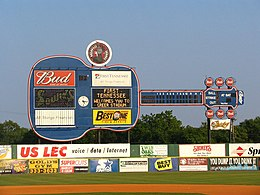
That's why it's tricky, to walk that Jamesian tightrope whereby the subjective mark of rationality is as much a feeling or sentiment as an evidenced bit of cognition. But life is a tightrope, and it's whole people with all their biases and blindnesses and passions and prejudices who get to try to walk it.* Keeping our rational balance (like catching fly balls, noted Skeeter Barnes after lending me his glove one fine Herschel Greer Stadium pre-game Sunday a few decades back) is thus not so easy as it looks. (I caught one of three fly ball chances. And I fell on my ass doing it.)

Even trained professionals sometimes drop the ball and fall on their asses. Or make asses of themselves, smartly defending the indefensible propositions they've embraced non-smartly. 

Fortunately we have teammates who'll pick us up, if we'll let them. The non-sporting metaphorical equivalent of that is, of course, the collaborative approach to thinking James and I call Co-Philosophy.


Pretend what we may, the whole man within us is at work when we form our philosophical opinions. Intellect, will, taste, and passion co-operate just as they do in practical affairs..." SOR


Monday, July 11, 2022

Improve AND enjoy

LISTEN. It's E.B. White's birthday (1899). I'm always quoting him, mock-seriously but in total sympathy: "I arise in the morning torn between a desire to improve the world and a desire to enjoy the world. This makes it hard to plan the day.”

It's a funny way of saying something serious and true. Our time is short, even at the outside.* We don't need to waste it, whether in frivolity or undue solemnity. We should want to ameliorate the world but also to luxuriate in the precious privilege of getting to exist at all. Just consider the immense improbability that any one of us would ever even have been born. We will do just that in class tomorrow, when we take up Steven Pinker's chapter on probability. I'll probably mention Alan Lightman's Probable Impossibilities, Richard Dawkins' meditation on our good luck ("We are going to die...")  and Maria Popova's complementary appreciation of White's humanism.

I've never quoted the line just preceding White's morning conundrum, but it sharpens and deepens the point: “If the world were merely seductive, that would be easy. If it were merely challenging, that would be no problem." But it's both, so we must be hedonists of a sort as well as meliorists.

Hedonists of the sort, I mean, who understand that the experience of pleasure and delight is a universal birthright not to be hoarded but expanded. The good and happy times we want for ourselves we must rationally want for all. That was John Dewey's rationale for insisting on what the "best and wisest parent" wants for all children in the sphere of education. Learning is not preparation for life, he said, but life itself. Let us not squander it. Improve AND enjoy. That's what you do, if you love life. 

“All that I hope to say in books, all that I ever hope to say, is that I love the world.”

White also said:

“After all, what's a life, anyway? We're born, we live a little while, we die.”

While we're here we should try to do some good, have some fun, and “always be on the lookout for the presence of wonder.” 

E.B. White was *Roger Angell's stepdad. Some family.

Reading recommendation: My old friend and '80s co-worker Michael Sims wrote a great book about Mr. White... Other books by Michael...


Thursday, July 7, 2022

Clearness, simplicity, and "the whole man"

LISTEN. The resonant and lingering issue for me, after our first Rationality class, is the enduring confusion around David Hume's famous and notorious statement about reason being rightly the slave of the passions. Steven Pinker rightly notes that Hume was decidedly not praising licentious hedonism or inviting the excessive indulgence of un-reason. He was just alerting us to the goal-oriented sources in our experience that give reason something to think about. Fine. 

But does that really entail the hyper-instrumental view that reason and feeling must be segregated, kept in separate chambers, and not mutually engaged except when we're puzzling about the most efficient means to our passionally prescribed ends? I think not. I think reason, understood in an appropriately-broadened conception, is anything but "inert" and non-impulsive. 
"Passions are the engine for all our deeds: without passions we would lack all motivation, all impulse or drive to act, or even to reason (practically or theoretically). This gives at least one sense in which “reason is, and ought only to be the slave of the passions... So, reason has only an instrumental use. But whatever its other virtues, this model does little to explain why reason “ought to be” the slave of the passions. It also seems inappropriate to reduce passions to desires: passions have a great deal more structure than their attractive or aversive directions, important though those may be. What seems central to Hume’s view is the inertness of reason, its inability to generate impulses for the mind."  SEP
I think, with James, that reason and sentiment are inter-penetrative.
A man's philosophic attitude is determined by the balance in him of these two cravings [for clearness and simplicity]. No system of philosophy can hope to be universally accepted among men which grossly violates either need, or entirely subordinates the one to the other. The fate of Spinosa, with his barren union of all things in one substance, on the one hand; that of Hume, with his equally barren 'looseness and separateness' of everything, on the other,—neither philosopher owning any strict and systematic disciples to-day, each being to posterity a warning as well as a stimulus,—show us that the only possible philosophy must be a compromise between an abstract monotony and a concrete heterogeneity... Pretend what we may, the whole man within us is at work when we form our philosophical opinions. Intellect, will, taste, and passion co-operate just as they do in practical affairs..." SOR
Is it the case that rationality is only good for devising efficient means to our chosen ends (desires, goals etc.), and cannot help us think about what those ends should be... and thus is entirely neutral with respect to value, virtue, character, goodness, kindness...? James would say that's too narrow a concept of reason and rationality. And if Kurt Vonnegut was right about the indispensability of the "rule" to ("God damn it, babies") be kind, what's the status of the rule? Is it a rational rule? A sentimental rule? Both? Neither?

For my part, I do want my rational deliberations to be informed by a kind of emotional intelligence. I don't want my thinking and feeling segregated in separate boxes. That of course raises the great challenge of getting the balance right between heart and head, intellect and our "passional" natures. Call it Spock's (or the Stoic's) dilemma. He's half-human. We're all human. If Aristotle's right, we're rational animals. We must, therefore, integrate and honor the parts of us that think and the parts that feel. We must overcome the violent and uncivilized passions, or re-channel ("sublimate") them. We can't just suppress or dis-integrate them. Only the purest Vulcans can do that. And remember, they're a fiction.

So let's drop the pretense that we are passionally-neutral calculators whose passions are just a given to be dealt with or dealt out. Let's think about them. That's what reason is really good for. Isn't it? Thinking about what it means to be a whole person?

Looking forward to continuing that conversation in class.


Tuesday, July 5, 2022

Rational possibilities

LISTEN. The Independence Holiday was simple and right, in my household. Just quality time together appreciating what's good about our lives in this land of possibility, acknowledging what's bad and what must be made better. Nourishing food and nurturing conversation, no rah-rah nationalistic bombast. Like John Fogerty I and mine were not born to wave the flag. It ain't us.

But we  do still salute this country's unfulfilled creed of freedom and justice for all. Baseball, hot dogs, & apple pie too. (The cliche came alive for me, on my bikride yesterday morning, when I happened upon a parade of my neighbors on bikes and in strollers over by the Richland branch library.) And we salute our independence from conformist bluster. 

To all those gifts we quietly re-pledged our allegiance. When the temperature rose to oppressive levels we hit the multiplex to see Baz Luhrmann's take on Elvis. Glad we didn't let the New Yorker review deter us, it's an all-American story of rags to riches to heartbreak to legend. The boy from Tupelo and Memphis flew, before he crashed at just 42 in '77. But in the process, in many positive ways, he made things better. Thank you, thank you very much. I think I have to go to Graceland now. Gotta find that old Paul Simon disc.

So now summer school begins, with my MALA course Rationality (sequel to last summer's Enlightenment, prequel to next spring's Experience). 

We only have a few weeks, really just time to dive in to Steven Pinker's book and BBC podcast. But I want to begin by setting up a contrast between Pinker's emphasis on the rules of rational thinking and William James's in "The Sentiment of Rationality" on feeling. We need to honor both, in order to begin realizing our potential for lives at least intermittently salved by "ease, peace, rest"--James's subjective "marks" of rationality.

And why, ultimately, should we want to be rational? Because the unrealized possibilities we treasure, like those Fourth of July ideals, and a mutual commitment to sustainable non-violent peace, depend on it. Reading this morning an interview with the public radio star Krista Tippett, she says of her new project that it will attempt to ameliorate some of the irrational "disarray, damage, and pain" of our country and world in this time by "stitching together relationships and quiet conversations at a very human, granular level. We’re going to work on quiet conversations that will not be publicized.

That sounds like a good description of what we might possibly accomplish, on a much smaller scale, in our course. It's possible. There's a chance. And as James said, nothing is more characteristic of human nature than its willingness to take a chance on possibility. Seems rational to me.

Thursday, June 30, 2022

Walking, listening, evolving

Walking to Listen is good, titularly combining two of my favorite things--the peripatetic and the auditory.

Subtitled 4,000 Miles Across America, One Story at a Time, Andrew Forsthoefel's account of his post-graduate transcontinental "slog" after finishing at Middlebury in 2011 is our freshman read. Most of our incoming class probably won't pick it up because it's, you know, a book. That's a shame. It's an education in itself and a good preamble to philosophy, in whose standard discourse so much is so often said and so little really heard. It is, as the Washington Post reviewer said, an "ideal antidote for even the strongest bout of national doubt." And that's what a lot of us have got right now, on this 4th of July holiday weekend eve, isn't it? National doubt? Global doubt? Maybe even a bit of species self-loathing?

There's an Enlightenment/Rationality theme here: Andrew wanted to know what it could mean to come of age, grow up, “be a man,” throw off his self-imposed non-age and immaturity. Having as yet had little firsthand experience of an edifying sort himself, he decided to hit the road and go get some. He would open himself to others' experience, as revealed by the stories he resolved to listen to, while gathering his own.

There's a related Jamesian/pluralist theme: we can all teach each other, it takes every voice to make a chorus etc. "Each attitude being a syllable in human nature's total message, it takes the whole of us to spell the meaning out completely." VRE

There's a message about slowing down and waking up, focusing the attention and being appropriately wonder-struck by the astonishment of existence. “Life is fast, and I’ve found it’s easy to confuse the miraculous for the mundane, so I’m slowing down, way down, in order to give my full presence to the extraordinary that infuses each moment and resides in every one of us.”

And there's hopefulness in Forsthoefel's humanistic anticipation of a species-level Great Leap Forward that may just be possible for us yet. “Evolution takes its sweet time in its work on our collective consciousness; the lasting leap from fear to love in the human mind will be its masterpiece.” 

So, fresh-persons, please put down the game-controller for a bit and pick up this book. It's worth a listen.


Wednesday, June 29, 2022

A "community of reasoners"

In the preface of Rationality: What It Is, Why It Seems Scarce, Why It Matters Steven Pinker declares an inter-subjective aspiration which, as I was saying, distinguishes genuine rationality from personal self-indulgent bias. A "community of reasoners" can still get things wrong, but isolated individuals almost always do. And they almost never correct themselves.
"Many act as if rationality is obsolete—as if the point of argumentation is to discredit one’s adversaries rather than collectively reason our way to the most defensible beliefs. In an era in which rationality seems both more threatened and more essential than ever, Rationality [the book, the course, the ideal] is, above all, an affirmation of rationality. A major theme of this book [course] is that none of us, thinking alone, is rational enough to consistently come to sound conclusions: rationality emerges from a community of reasoners who spot each other’s fallacies."
And that's what our course on Rationality, commencing just after the fireworks, will be: a self-correcting little conversational community of rational inquiries and sharers of experience. Listeners, then, as well as spotters.

First, though, it will be rational to enjoy the celebration of independence that I choose to regard not as a patriotic/nationalistic holiday but rather as an occasion to rally around Immanuel Kant's clarion call for enlightenment. Sapere aude! Use your capacity for reasoned understanding, think for yourself. But do it in a reality-based community.

It's also my annual occasion to dust off and revisit Richard Ford's Independence Day and "consider in what ways we're independent or might be..."


Tuesday, June 28, 2022

Ziggy Stardust, meliorist

I'm looking past the sordid and depressing news this morning, to some of the deeper sources of life and light. Listened on our dogwalk to a terrific BBC documentary on the semicentennial of Ziggy Stardust, and read the best thing on page one--clinical psychologist Mary Pipher's essay on "finding light in darkness." 

She writes of the skills she's acquired for having good days in troubled times, and especially in summertime. Yes, there's skill involved in slowing down, setting aside pool and hammock time, acknowledging and appreciating the half-full glass, above all in realizing the value of attentiveness to one's own immediately present experience. "As Thich Nhat Hanh would say: 'Present moment. Beautiful moment.'" 

Pipher ends her essay with a rhetorical question that echoes Keat's negative capability: "Life is so terrible and beautiful at the same time. Do I have the capacity to hold it all in my heart?"

Not all at once, perhaps. Some moments just have to be allowed to occupy the entire stage, for the moment. We must gather enough fully-attended moments to strengthen our hearts for the fights of our lives. Life does feel like a fight, as James said in "Is Life Worth Living?

But it feels beautiful too. That's the feeling the Ziggy show leaves me with. We can't in any given moment fix what's wrong with the world, but we can attend and create and appreciate and enjoy. Fifty years from now, I'm betting, the names of the hard-hearted Supreme Court injustices will be forgotten. Ziggy Stardust will live.

Monday, June 27, 2022

The sentiment of rationality

 Summer school begins next week, I'm teaching Rationality--a sequel to last summer's Enlightenment and a prequel to next spring's Experience (to be previewed in the tag-team interdisciplinary course I'll get a two-week block of, in fall). 

The binding thread and shared premise of all three Master of Liberal Arts courses is that humanity is equipped with an underdeveloped capacity for reasoned and intelligent action. Reason, perpetually guiding and correctively guided by experience in turn, is potentially our greatest tool for amelioration and progress. Our history and trajectory may seem to belie the premise, but a complementary premise is that it's still not too late to vindicate our nobler hopes and dreams. The doomsday clock has not struck the terminal hour. Yet. 

Steven Pinker wrote our main text last summer (Enlightenment Now: The Case for Reason, Science, Humanism, and Progress) and this (Rationality: What It Is, Why It Seems Scarce, Why It Matters). He's a great writer and wit, and lately a provocateur whose critics consider him un-progressive and scientistic (in a bad way). One rationale for reading him is to assess such criticism. The greater rationale is to see if his analysis can help steer our increasingly irrational culture and politics back from the abyss of unreason, fear, supersitition, and incivility. Tall order.

We're reading Pinker, but I read him against an un-Pinkerish backdrop: William James's pragmatic framing of what rationality is and why it matters. Perhaps Pinker, James, and all of us can agree in broad strokes that (as James's abstract indicates) "rationality means fluent thinking"; but what such fluency is (in a characteristic Jamesian locution) "known as," how it is actually expressed and experienced by individuals and communities, may be a point of some dispute. We'll see. One of my own goals for the course is to decide if I still like James's framing of the issue in these terms:

When enjoying plenary freedom either in the way of motion or of thought, we are in a sort of anaesthetic state in which we might say with Walt Whitman, if we cared to say anything about ourselves at such times, "I am sufficient as I am." This feeling of the sufficiency of the present moment, of its absoluteness,—this absence of all need to explain it, account for it, or justify it,—is what I call the Sentiment of Rationality. As soon, in short, as we are enabled from any cause whatever to think with perfect fluency, the thing we think of seems to us pro tanto rational.

Whatever modes of conceiving the cosmos facilitate this fluency, produce the sentiment of rationality. Conceived in such modes, being vouches for itself and needs no further philosophic formulation. --"The Sentiment of Rationality," in The Will to Believe and other essays

A sentiment is a feeling, a subjective state of satisfaction. The better, more rational feelings and satisfactions are those we can reconcile with the various and alternate feelings and satisfactions of the greatest number of our peers. The better sentiments are thus inter-subjective. 

A Jamesian is always inclined to respect subjectivity but to esteem and exalt  inter-subjectivity even more. We live in a time of subjective over-indulgence. Rational pragmatists must draw some boundaries, must exclude some subjectivities. Specifically they must repudiate those pushing faux conspiracies and factual fabrications. I'm sure James wouldn't deny that. I'm not sure he was clear or emphatic or explicit enough as to why. We'll see.

Friday, June 24, 2022

Strange but true

 As people like to say on the internet, I don't know who needs to hear this... Actually, I do. 

The latest Strange New Worlds episode was exceeding strange indeed, but I'm glad we stuck with it when in the early going it just seemed frivolous and goofy. 


Turned out to be more serious than silly with its Kahlil Gibran-esque parental message: your children are not your children. If you love them let them go. If you can’t “cure” or fix or change them for the better, or for your particular notion of what's better for them, then give someone or something else a chance. Give them a chance.

Either way, don’t try to hold them in the “pattern buffer,” the stasis of childhood innocence. They've got to author their own story. 

Like Emerson said (I'll track the precise quote down later... but he also said to stop quoting others and just tell us what you know): you shouldn't try to replicate yourself in them, and you shouldn't be disappointed or feel rejected when they turn out not to be your replicant. 

"For life goes not backward nor tarries with yesterday." (Never mind that SNW is a prequel.)


Thursday, June 23, 2022

Seaside afterglow

"I hate the beach. My skin burns and blisters as soon as the sun touches it, I dislike sweating without exercising, and sand makes no sense at all to me—it's just hot and gritty dirt that other people apparently enjoy rolling around in... Plus, the ocean itself, while aesthetically pleasing, is terrifyingly untrustworthy, with its riptides and hurricanes and tsunamis and sharks and microplastics and slithering monsters of the deep. It has just too many sneaky ways to kill you."

Good points all, Lauren Groff, and the larger environmental message of your essay/review of Sarah Stodola's The Last Resort: A Chronicle of Paradise, Profit, and Peril at the Beach is of profound ethical/existential import for our progeny and our species. 

But I still love the beach and haven't yet lost the afterglow of our week at Tybee. I've already (almost) forgotten the unpleasantness of being stung by a ray on first setting foot in the water last Monday, and the peeling skin on my right shoulder doesn't bother me. The elemental experience of walking and pedaling up and down an uncluttered early-morning seashore always restores my spirit and awakens a palpable perception of deep time. Mother Ocean nurtures my naturalist sensibility and reinforces my concern for the fate of the earth as a hospitable human abode.

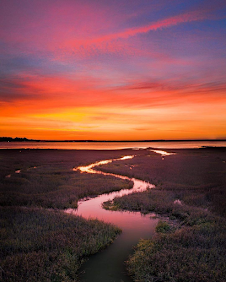
And oh how I love the palate-memory of those wonderful grouper sandwiches and shrimp tacos, and the visual memory of those gorgeous island sunrises and sunsets.

If we're to conserve and preserve the places we love we must allow ourselves to delight in the small experiences that bring us into vital connection with the only home we've ever known. If sun, surf, and sand are not your thing, that's cool. I like mountain hikes too, and country rambles, and occasional urban immersions in the Whitmanesque crowd. All the varieties of human experience are potentially to the good, if they remind us of our obligation to sustain the possibility, for ourselves and our successors, of continuing to indulge them. 

In other words: find your springs and tap them. Don't tap them out. Embrace "conscientious stewardship" at the seashore and everywhere else. 


Wednesday, June 22, 2022

Salty friends

Next would seem properly to follow a dissertation on Friendship,* begins Aristotle in Book VIII of his Nicomachean Ethics

I've been invited to participate in the Fall Honors lecture series, whose theme is precisely that. I'm setting myself the initial goal of understanding what to make of the old proverb Aristotle endorses that "men cannot know one another 'till they have eaten the requisite quantity of salt together'..." 

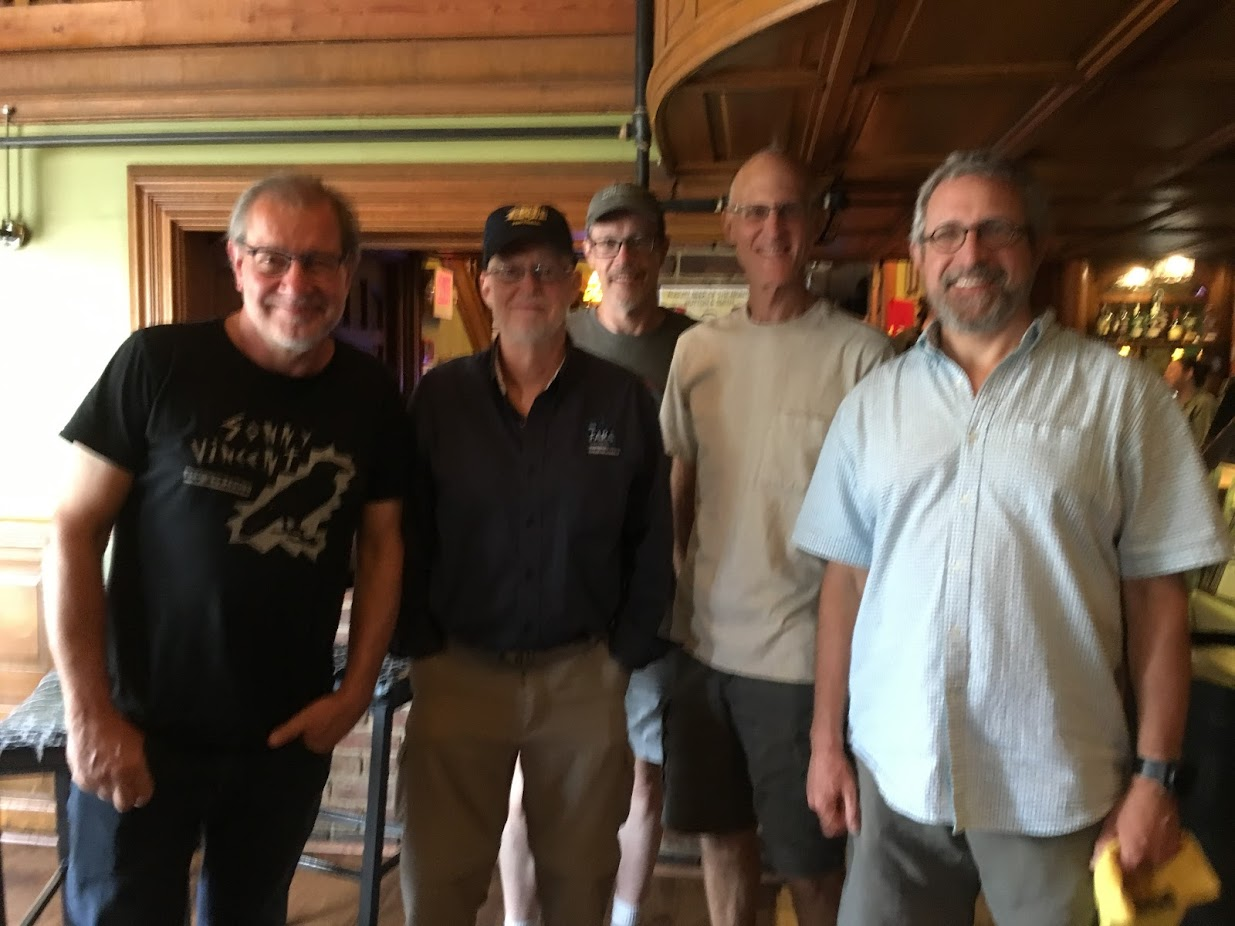
My friends and I have a tradition of gathering every August and consuming mass quantities of pub and ballpark food (and drink) at minor league venues in places like Chattanooga, Asheville, Nashville, Huntsville... This year it'll be Lexington KY, on the Bourbon Trail. Salt and bourbon pair well, in my experience. Would Aristotle approve? Maybe I'll ask him.


* because, in the first place, it is either itself a virtue or connected with virtue; and next it is a thing most necessary for life, since no one would choose to live without friends though he should have all the other good things in the world...

Right. The nachos and onion rings just aren't the same without friends to make them worth their salt.

NOTE: That last image is at the late great Nashville institution Rotier's... we were there not long before it closed forever, recapitulating our old '80s grad school Friday night tradition. One last cheeseburger on french breach with a side of rings. Sigh. 

Monday, June 20, 2022

The paternal condition

LISTEN. Back from our beach holiday, but that June mood persists. Long hot days when those who don't rise at dawn are to be pitied for missing the literal and figurative cool of aurora. The triple-digit forecast has been downgraded to 99, but sitting here with the pups in 59 degrees with windows open anticipating a pleasant walk... that's the glory of summer. 


And Father's Day is part of the glory of summer. Younger Daughter plied me with thoughtful presents (not least of which was a sumptuous breakfast), but none could exceed the simple gift of her presence. I'm not taking it for granted, Older Daughter has been two time-zones away for years. The strongest parental bonds stretch and won't break, but there's a lot to be said for geographical proximity.

And despite the sacrifices and losses and occasional disappointments there's a lot to be said for the experience of parenthood. Fathers Day is a good time to reflect on that, on the expectations we bring to it and the reality that confounds some of them. But my expectation was always that it would be a privilege and a pleasure to spend quality time with growing minds, and to anticipate the ways in which they'd add value to a world in dire need of amelioration. That expectation hasn't been confounded, it's been rewarded. Being Dad to two smart, funny, creative young adults who are making the world better than it would or could have been is a profound joy. 

So that's my answer to the anti-natalists and other parental skeptics. I'm with Ezra Klein on this, and with Hannah Arendt. Natality is the hopeful flipside of mortality, the "miracle" that just might redeem this mysterious unfinished project we call humanity. 

“The miracle that saves the world, the realm of human affairs, from its normal, ‘natural’ ruin is ultimately the fact of natality, in which the faculty of action is ontologically rooted. It is, in other words, the birth of new [people] and the new beginning, the action they are capable of by virtue of being born. Only the full experience of this capacity can bestow upon human affairs faith and hope.” The Human Condition

I'm also with those who say that, contra Elon, we may already have enough people. What we need more of is happy people, engaged in the noble melioristic struggle to save the world. That's the point, for me, of Fathers Day. And Mothers Day. And Teacher Appreciation Day, if that's ever a thing.


James P. Oliver, 1957-
James C. Oliver, 1928-2008


Monday, June 13, 2022

On the beach


I’m relaxed enough that I’ve stopped thinking about the drive here, 
but not so relaxed that I’m not thinking about the drive back.”

Postscript. Day 3, not thinking about the drive this morning... Day 4...


Friday, June 10, 2022

Ad astra

LISTEN. Watched the first depressing but necessary (except apparently on Fox) Jan 6 Committee hearing last night. I really need to get away.


Additions to the vacation leisure-reading list, which is already too long and (with still more New England Transcendentalism) possibly not leisurely enough: The Human Cosmos by Jo Marchant, Two Wheels Good by Jody Rosen, "The Poet" and "Experience" in Emerson’s Essays.

I think the ulterior question  motivating every item on my list, beyond mere diversion and the vacating of everyday routine, is simply: What is experience? So Emerson's coming to the beach too.

Whatever the philosophers say, I say experience is just whatever it is we do when we follow Aurelius's advice and recognize the precious privilege of being alive. It's breathing, thinking (which in this context emphatically includes feeling, not denigrating it as some philosophers do), enjoying, loving etc. It's not necessarily authoritative or authoritarian in a moral or a Rortian sense. (Interesting discussion on that point, though, in this Moral Maze podcast debate.) It's simply what James says we all do, implicitly and often unconsciously, all the time. 

“For the philosophy which is so important in each of us is not a technical matter; it is our more or less dumb sense of what life honestly and deeply means. It is only partly got from books; it is our individual way of just seeing and feeling the total push and pressure of the cosmos.” Prag I

That's also what Jo Marchant seems to think (and feel) in The Human Cosmos: Civilization and the Stars.

"The scientific account of the universe is a pinnacle of our modern civilization, a vision so powerful that its rivals have been all but obliterated. Cosmology—the study of the cosmos—once described the broad philosophical and spiritual endeavor to make sense of existence, to ask who we are, where we are, and why we're here. It is now a branch of mathematical astronomy. So what happened to those bigger questions? Is there nothing else about the universe we need to know? Instead of detailing the latest astronomical developments, this is a guide to the long history of knowledge that people have gleaned from the stars. It's about what their view of the cosmos told them of the nature of reality and the meaning of life; about the gods and souls, myths and magical beasts, palaces and celestial spheres that we've discarded; about how the scientific view came to dominate; and how in turn that journey still shapes who we are today. It's a tale about people—of priests, explorers, revolutionaries and kings—and it starts not with the Big Bang, nor even with the birth of science, but with the very first humans who looked to the stars, and the answers they found in the sky."

There's a cosmic connection in Two Wheels Good: The History and Mystery of the Bicycle too.

In the 1890s, advertising posters depicted bicycles in outer space. These are some of the most famous images of the bicycle ever created: they show bikes pressed against the firmament, bikes streaking past comets and planets, bikes coasting down the slopes of sickle moons. The riders of these bicycles are often women—or, rather, goddesses. They have bare breasts and rippling Grecian garments and long hair that trails behind them like a jet stream. In one advertisement, for the French bicycle company Cycles Sirius, a nearly nude cyclist rides sidesaddle across a starry sky, her eyes closed, her smiling face thrust upward in ecstasy. The image says that a bicycle is a conduit of otherworldly pleasure. A bike ride can shoot you to the stars; a bike ride could give Aphrodite an orgasm. A poster designed in 1900 for another French firm, Cycles Brillant, pictures two barely clad female figures adrift in the Milky Way. One of them, with fairy wings on her back and an olive bough in her left hand, is reaching up toward the front wheel of a bicycle that hovers overhead like an orbiting sun. The bike is spotlit and radiant, reflecting the glow cast by a diamond that floats nearby. In this surreal vision, the bicycle itself is a deity, a heavenly body beaming light down to Earth."
Before we hit the beach, I'm planning to rent a fat-tire bike. Shoot me to the stars, Cycles Brillant. Or Raleigh. Or whatever they've got. If they're out (since their website says they don't take reservations), I'll still reach the stars my usual way. Solvitur ambulando.


Thursday, June 9, 2022

The experience of Home

LISTEN. The theme of next year’s tag-team MALA liberal arts course at our school, I'm gratified to learn (having proposed it), will be Experience. So, I'll get to do a two-week trailer in the Fall for my semester-long Spring '23 course of the same name. 

We'll do William James's 1901-02 Gifford LecturesVarieties of Religious Experience, the first week;  then Carl Sagan's from 1985, that thanks to Ann Druyan's perspicacity became the posthumous Varieties of Scientific Experience.

The juxtaposition will be apposite, and true to the pluralistic hearts and minds of James and Sagan. Both Gifford fellows, in their strikingly distinctive ways, made the point that assimilating our personal experience, valuing it, respecting it, defending it, is precisely how we make ourselves feel (and be) at home in the world and in our own skins. 

And James explicitly, Sagan implicitly, defend that state of being and feeling as the epitome of rationality. 

Hence the rationale for melding my impending summer MALA course, Rationality (commencing shortly in July), with Experience. They do belong together. As Jennifer Michael Hecht once wrote of the Hellenic "graceful-life philosophies" (Epicureanism, Stoicism et al), the great task of a reasonable life is to stop searching manically for a way out of the "forest" (the natural universe). "Hang a sign that says HOME on a tree and you’re done..." *

I did that once, or got Younger Daughter to do it back when she was in her arts-and-crafts phase. The sign eventually faded but the message has stuck. 


* "Where the Hellenistic philosophies excelled was the production of what could be called secular religions. They were based on self-help–oriented doctrines often borrowed from the earlier philosophers but interpreted and presented in a way that made more direct sense to a lot of people. I’m calling them graceful-life philosophies to distinguish them from other philosophy. Their goals were practical happiness, and they were not merely theoretical about it: they provided community, mediations, and events. In this they were more like religions, but they did not identify themselves as religions and they had remarkably little use for God or gods. The Hellenistic graceful-life philosophies had a lot in common. The experience of doubt in a heterogeneous, cosmopolitan world is a bit like being lost in a forest, unendingly beckoned by a thousand possible routes. At every juncture, with every step, one is confronted with alternative paths, so that the second-guessing becomes more infuriating even than the fact of being lost. After a direction is chosen, one is constantly met with another tree in one’s path. What do you do if you come from a culture that had a powerful sense of home and local value, and now you are lost in something vast and sprawling, meaningless and strange? The stronger your belief in that half-remembered home, the more likely you are to panic, to grow claustrophobic among the trees and beneath their skyless canopy. Hellenistic men and women felt a desperate desire to get out of the seemingly endless, friendless woods. The graceful-life philosophies of this period were able to achieve an amazing rescue mission for the human being lost in the woods and bone-tired of searching for home. They did this by noticing that we could stop being lost if we were to just stop trying to get out of the forest. Instead, we could pick some blueberries, sit beneath a tree, and start describing how the sun-dappled forest floor shimmers in the breeze. The initial horror of being lost utterly disappears when you come to believe fully that there is no town out there, beyond the forest, to which you are headed. If there is no release, no going home, then this must be home, this shimmering instant replete with blueberries. Hang a sign that says HOME on a tree and you’re done; just try to have a good time. Thus the cosmopolitan doubter looks back on earlier generations with bemused sympathy—they were mistaken—and looks upon believing contemporaries with real pity, as creatures scurrying through the forest, idiotically searching for a way out of the human condition. After all, it isn’t so bad if you just settle in and accept a few difficult ideas from the get-go."

Doubt: A History: The Great Doubters and Their Legacy of Innovation from Socrates and Jesus to Thomas Jefferson and Emily Dickinson 

==

Been thinking about this for a while... Hecht @home, 2.4.10

Wednesday, June 8, 2022

Frank Bruni, Stoic Pragmatist

LISTEN. With our first beach vacation since well before COVID looming, I'm giving serious thought to my leisure-reading list. Currently on it: The 1619 Project, because it so annoys the right; Walking to Listen, because it's our freshman summer read; James Patterson’s eponymous memoir, because I've never read him --everyone else has, apparently-- and want to see if I should; and Ben Shattuck’s Six Walks in the Footsteps of Thoreau, because of course.

Frank Bruni's books were on my list. I didn't wait for the beach. 

Born Round: The Secret History of a Full-Time Eater is about obsession, excess, and delight, and his lifelong struggles to enjoy life responsibly and in appropriate moderation. It's not just about food, though it was an interesting and challenging career twist for him when he became the Times's food critic. 

I share Bruni's concern about the decline of reading for pleasure, especially among younger people who've grown up with so many electronic distractions and don't have a personal memory of ever falling into a printed story and being transformed by the experience. “Books are personal, passionate. They stir emotions and spark thoughts in a manner all their own, and I'm convinced that the shattered world has less hope for repair if reading becomes an ever smaller part of it.”

Where You Go Is Not Who You'll Be: An Antidote to the College Admissions Mania ought to be our freshman read one of these years. “College is a singular opportunity to rummage through and luxuriate in ideas, to give your brain a vigorous workout and your soul a thorough investigation, to realize how very large the world is and to contemplate your desired place in it.” Right. For too many students college is just another hurdle on the road to "the real world" and a job. That's largely true of the Ivy-obsessed, Bruni says, but it's also true of too many in public institutions like mine. Who you'll be, if you do it right, is only negligibly determined by where you go or what work you end up doing. Will you be curious, engaged, open to possibility, eager to learn, excited to discover new things? Or will you settle for less, far less, and then die?

The Beauty of Dusk: On Vision Lost and Found also confronts the choices we make in the shadow of mortality and loss. Bruni recounts the harrowing experience of waking one morning with badly-compromised vision that turned out not to be merely the residue of too much wine the night before. He had "non-arteritic anterior optic neuropathy," effectively blind in one eye and at serious risk of total blindness. There's no cure except ownership of one's agency.

“Of course, some people, confronting hardship, don’t have that agency: The circumstances are so overwhelming or their internal coping mechanisms so compromised that their lots hinge on the interventions or generosity of those around them. But…more people have sway over the direction they turn in… there’s a crucial period, a discrete phase, when they summon the will to steer toward a sunny horizon or they don’t.”

But “People who flourish make a decision to flourish. They point themselves toward joy... While we have minimal control over the events that befall us, we have the final say over how we regard and react to them.”

Flourishing, joy, and stoicism belong together, Bruni is saying. I agree. We can't know we have "the final say," but isn't it better to believe so? The Beauty of Dusk makes that case pretty effectively, and that makes Frank a pragmatist too. A Stoic Pragmatist. 


Monday, June 6, 2022

Dwelling places

LISTEN. Another summer weekend, another leisurely drive down the Natchez Trace Parkway on Saturday with Brother-in-law (with his newly-installed heart hardware) , another lovely streaming Sunday from Yankee Stadium to Dodger Stadium to Wrigley Field (Cards win, in ten). Keep your silly Bananas, Savannah. The grand old pastime is already "fun," the fact that it's usually slower and more meditative than TikTok is a feature-- not a bug. It's plenty fast and fun, if you pay attention.


Meditative doesn't necessarily mean cogitative, though it doesn't necessarily not mean that. But this is the portion of summer when serious thinking is easily shunned in favor of sun and sand. The day-dreamy days. Summer reading days. Days defending experience simply by having and enjoying it.

We're soon heading beachward, with a stop in Atlanta to see real baseball before pulling up on the island they used to call Savannah Beach. I see there's been recent acrimony there, over the troubled but whitewashed racial history of the place and new racially-tinged objections to the perennial presence of HBC spring-breakers. We don't want to ignore any of that, but neither do we want to dwell on it. We want, as the old Stoic said, to dwell on the beauty of life

Saturday, June 4, 2022

Philosophy as Poetry

LISTEN. Thinking this morning about philosophy and poetry, Emerson and James and Shelley and Rorty. (And a bit about baseball and the beach, each of which figure prominently in the poetry of life as I've experienced it.)

"Mankind does nothing save through initiatives on the part of inventors, great or small, and imitations by the rest of us—these are the sole factors active in human progress. Individuals of genius show the way, and set the patterns, which common people then adopt and follow. The rivalry of the patterns is the history of the world." In that passage, James is echoing Emerson, whose essay "Circles" is perhaps the best expression of the romantic view of the nature of progress. "The life of man," Emerson writes there, is a self-evolving circle, which, from a ring imperceptibly small, rushes on all sides outwards to new and larger circles, and that without end. The extent to which this generation of circles, wheel without wheel, will go, depends on the force or truth of the individual soul. . . . Every ultimate fact is only the first of a new series. . . .There is no outside, no inclosing wall, no circumference to us. The man finishes his story—how good! how final! how it puts a new face on all things! He fills the sky. Lo! on the other side rises also a man, and draws a circle around the circle we had just pronounced the outline of the sphere. Then already is our first speaker not man, but only a first speaker. His only redress is forthwith to draw a circle outside of his antagonist. . . . In the thought of to-morrow there is a power to upheave all thy creed, all the creeds, all the literatures of the nations. . . . Men walk as prophecies of the next age. The most important claim Emerson makes in this essay is that there is no "inclosing wall" called "the Real." There is nothing outside language to which language attempts to become adequate. Every human achievement is simply a launching pad for a greater achievement. We shall never find descriptions so perfect that imaginative redescription will become pointless. There is no destined terminus to inquiry. There are only larger human lives to be lived. As James echoed Emerson, so Emerson was echoing the romantic poets. They too urged that men should walk as prophecies of the next age rather than in the fear of God or in the light of Reason. Shelley, in his 'Defence of Poetry,' deliberately and explicitly enlarged the meaning of the term 'poetry' [as] 'the expression of the Imagination'..." — Philosophy as Poetry (Page-Barbour Lectures) by Richard Rorty

Well, I have to admit that while my Purist instincts recoil at the artificial "ballet" the Savannah Bananas have imposed on our beautiful (former) national pastime, which always already embodied the real ballet of athleticism combined with collaboration and commitment to a shared cause, they nonetheless represent an impressive display of expressive Imagination. Philosophy could do that too; not all philosophy, perhaps, but surely that part of the wisdom quest concerned with ameliorating our condition and "prophesying the next age" of human achievement.

I'm still resisting the Rortian "nothing outside language" locution, though. I imagine there's much outside language, and that great poets are doing their best to imagine it. Maybe the big point, however, is that poetry and imagination are adequately expressive whether they mirror what's "outside" or not. We'd never know if they did. But we can know if they gratify our prophetic wills, and our collective will to truth and reality as we can hope to know it. Truth and reality are different but mutually implicated aspects of a singular referent: facts are real, truth is what we say about the facts and reality when our talk succeeds in moving us forward towards something better.

Wisdom, then, is to recognize and promote what gratifies that impulse. Thus will we live larger lives. That, James reminds us, was always the point. Life, more life. Richer experience. Not mere verbal abstraction. 


Friday, June 3, 2022

Sometimes you win, sometimes you lose...

And sometimes you're rained out.

 I'm sorry to report the postponement of the 26th annual conference meeting on Baseball in Literature and Culture, scheduled for July 7-9 on the campus of Ottawa University in Ottawa KS. We finally got to meet again on ground last July, after the COVID interruption of 2020. We're now tentatively scheduled to meet next at the end of March 2023, when I'll happily present "Character(s) of the game: virtue, integrity, and eccentricity in our pastime” (new working title). The slideshow is under construction...


 I notice that the annual Cooperstown Symposium, in which I participated back in 2000, is meeting right now. Sometimes you have to send up a pinch-hitter.

Thursday, June 2, 2022

"Coffee Drinking Linked to Lower Risk of Dying"

LISTEN (includes previous posts).

The research found that those who drank moderate amounts of coffee, even with a little sugar, were up to 30 percent less likely to die than those who didn't drink coffee.

That morning cup of coffee may be linked to a lower risk of dying, researchers from a study published Monday in The Annals of Internal Medicine concluded. Those who drank 1.5 to 3.5 cups of coffee per day, even with a teaspoon of sugar, were up to 30 percent less likely to die than those who didn't drink coffee. Those who drank unsweetened coffee were 16 to 21 percent less likely to die during the study period, with those drinking about three cups per day having the lowest risk of death when compared with noncoffee drinkers...

"It's huge. There are very few things that reduce your mortality by 30 percent," said Dr. Christina Wee... nyt

That is huge. By this reckoning, or by this unguarded locution, I could be an immortal. I have a lower risk of dying!

All the same, I still think I'd better not bank on that. Time goes by, the road may go on but we've each still got to find our right exit. It's out there somewhere up ahead. That's why we celebrate the milestones, as we did for Younger Daughter yesterday. Brunch at IHOP, dinner at Bella Napoli, cake on the patio. With coffee. Life is good. 

And so I shall continue to recite Marc's morning mantra until the mug runs dry and the carafe is empty. When you arise in the morning, think of what a precious privilege it is to be alive-- to breathe, to think, to enjoy, to love... To press and pour and perk up and run with the stars.

 
Morning is when I am awake and there is a dawn in me... HDT

Wednesday, June 1, 2022

"Get excited about a lot of little things"

That's what I was just saying. 

Anticipating some "small, delightful experiences" to celebrate Younger Daughter's twenty-three years today, starting with brunch at IHOP-at her request. Daddy-Daughter Days are one of our more delightfully recurring experiences. 1999, when so many were so weird about the impending millennium, was for our family the beginning of a wonderful era... the beginning, that is, of phase two of the wonderful era that began with Older Daughter in 1995. 

To Enjoy Life More, Embrace Anticipation
Looking forward to something can be almost as good as experiencing it..
...Anticipating a smattering of small, delightful experiences can be as enjoyable as looking forward to one big event, said Carrie L. Wyland, a social psychologist at Tulane University in New Orleans.

"At the end of every day, write down one thing you're excited for tomorrow," she said. "Maybe it's a new book or getting doughnuts or a package you're expecting."

The accumulation of these mini-thrills means you'll still reap the benefits of looking forward to something, even if it's not a big-ticket reward, said Christian E. Waugh, a psychology professor at Wake Forest University who studies anticipation.

"Plus, with the nearer stuff, there's more of a sense it's going to happen for sure," he said. "You've got more control over a small gathering this evening than a vacation in six months."
...
Holly Burns, nyt

 Right. The springs of delight can flow at will. Oh to be twenty-three, with a lifetime of small, delightful experiences ahead. Henry at Walden was just a little older when he said he "left the woods for as good a reason as I went there," having "several more lives to live." More delight means more lives. More life. 

We used to get excited anticipating our next small encounter with Henry, too.