Delight Springs

Tuesday, October 22, 2019

Stoic Buddhism, and so it goes

LISTEN. We're due for a report on eastern happiness today, in Happiness, as we continue with Epicurus's Art of Happiness and its elucidation of "the highest Epicurean ideals--serenity, detachment, unadulterated happiness, all summed up in the one word ataraxia." The Epicurean quest for happiness is also an imitatio Dei, and so a kind of religious quest too - but one that does not look to transcendent gods for guidance or deliverance. In that, it has something in common with Buddhism. And so of course has Stoicism.

It's noteworthy that the Dalai Lama also (co-) wrote a book called The Art of Happiness. The similarities between aspects of eastern philosophy and stoicism are striking. Marcus Aurelius had his daily pre-meditation -- “Begin each day by telling yourself: Today I shall be meeting with interference, ingratitude, insolence, disloyalty, ill-will, and selfishness..." etc. -- and so has the DL:
“Every day, think as you wake up, today I am fortunate to be alive, I have a precious human life, I am not going to waste it. I am going to use all my energies to develop myself, to expand my heart out to others; to achieve enlightenment for the benefit of all beings. I am going to have kind thoughts towards others, I am not going to get angry or think badly about others. I am going to benefit others as much as I can.”
The laws of nature and the path of enlightenment both counsel humane restraint and kindness in the face of hostility, and a recognition of the suffering that infuses every life. "For our life to be of value, I think we must develop basic good human qualities—warmth, kindness, compassion. Then our life becomes meaningful and more peaceful—happier.”

And, “Although you may not always be able to avoid difficult situations,you can modify the extent to which you can suffer by how you choose to respond to the situation.”

And His Holiness seems to be cribbing straight from Epictetus here: “We need to learn how to want what we have, NOT to have what we want, in order to get steady and stable Happiness.”

And above all, to be happy we've got to stop wasting *time. “Sometimes when I meet old friends, it reminds me how quickly time passes. And it makes me wonder if we've utilized our time properly or not. Proper utilization of time is so important. While we have this body, and especially this amazing human brain, I think every minute is something precious."

He may also have read Kurt Vonnegut's God Bless You, Mr. Rosewater:
Image result for vonnegut hello babies"Hello, babies. Welcome to Earth. It's hot in the summer and cold in the winter. It's round and wet and crowded. At the outside, babies, you've got about a hundred years here. There's only one rule that I know of, babies—God damn it, you've got to be kind."
I don't think Kurt was either a Buddhist or a Stoic, though he suffered more than his share of mental anguish and would doubtless have benefited from both. What he was, was a Humanist. We who read him have benefited from his having been that.

“We Humanists behave as well as we can, without any expectation of rewards or punishments in an Afterlife. We serve as best we can the only abstraction with which we have any real familiarity, which is our community.”

And we know, with Kurt: "Love may fail, but courtesy will prevail."

Andrei Codrescu told us he collects old typewriters. Kurt's had its own Twitter account, I saw it at his museum in Indianapolis.
Image

* No time like now, indeed. So it goes. Slow down and enjoy it.

Monday, October 21, 2019

At the Royce Conference

LISTEN. Since today's CoPhi classes last met, I've hosted celebrity guest Andrei Codrescu, taken a Ghost Tour of our campus (at superstitious biology major Younger Daughter's insistence), participated in the Josiah Royce conference at Vanderbilt (see previous post below), enjoyed a perfectly-gorgeous Sunday afternoon biking and then basking in the sun on the patio at True Foods Kitchen in Green Hills (best Kale Cobb I've ever had, albeit the first), and (recalling Lincoln's warning that "where there is no vision the people perish") purchased new spectacles. Plus, all the usual dogwalks to which I attribute my general health and (what I call my) sanity. Good weekend!

And how gratifying, at the conference, to get to acknowledge the positive impact on my life of my old Vandy grad school teachers with two of them (Lachs and Hodges) in the room, and a third (Compton) there in spirit. (I should also note John Post's flattering footnote citation as a major early validation and encouragement.)  Slide #13:

And this happened: a man introducing himself as Evan said he'd taken my Meaning of Life course at Vandy a decade and a half ago, changed his major to Philosophy in consequence, and was now in town from New York just to enjoy the show. That's doubly gratifying. We're more likely to hear from the complainers, most of the time.

And, I got to share one of my old Best Man's best lines. He used to work in a factory, where a cohort would sometimes say something like "Hey Asshole, hand me that hammer!" On the day my friend was awarded his PhD (for his work on Kant, btw), he announced that from now on the appropriate response would be: "That's Dr. Asshole to you!"

That got the laugh it deserved, and broke the lingering tension after Scott Aikin opened the session with a thrown gauntlet retrieved during Q-&-A by Randy Auxier: "Call me an analytic asshole, I'm a big boy, I can take it." Randy and Scott reconciled eventually, with Randy's passive-aggressive concession: "best irrelevant analysis of William James's will to believe I've ever heard."

I for one do not enjoy the pugilistic style of winner-take-all confrontational discourse still favored by too many philosophers, redolent of the trash-talking polarized politics we sadly seem to be coming to accept as the new norm. John Lachs long ago took a public stand against that style of philosophizing, when he founded the Society for the Advancement of American Philosophy (SAAP) as a deliberate alternative to the cutthroat aggressions then common at meetings of the American Philosophical Association (APA).

But, some of my best friends are analytic assholes. ("Royce. Woo hoo!" texted one of them yesterday). They have their redeeming qualities and saving aspects. Mostly they don't take or intend the pugilism personally, it's just sport for them... in service of the pursuit of truth. There's more than one way to be a good philosopher. I don't disagree with Scott's assertion that good philosophers study logic, I'd just add that really good philosophers leaven their logic with humane charity and what Lachs in the Q-&-A called a sense of "pity" which, if it is indeed something like empathy and compassion, the world could sure use a lot more of.)

Scott's partner in style and substance Robert Talisse, our recent Lyceum guest, has had more than his share of verbal bouts in the philosophy ring, in print and lecture halls and online. And now he's written a whole book urging a more civil style of public intercourse. It's a good prescription, a solid analysis.

An old post. Anthony Trollope said “A small daily task, if it be really daily, will beat the labours of a spasmodic Hercules.” Here we go.

Today's small task in CoPhi is to introduce three gallic wits of half a millennium ago whose preoccupations have barely aged: Rene Descartes, Michel Montaigne (the anti-Descartes who preceded him), and Blaise Pascal. Of the three, Montaigne the peripatetic skeptic essayist, is most to my taste. I so envy his book-lined tower, and his pluck in inventing the personal essay.
From the windows on the top floor he had a commanding view of the estate and could give orders and instructions to the estate workers. As he walked around the Tower he could see above him painted on the beams favorite quotes (mainly in Latin, but some in Greek) from his favorite Classical writers; Also as he walked, thought and dictated he would stop and consult his books to check a quote or story... Reading the world – visiting Montaigne’s Tower
The quotable essayist:
  • “On the highest throne in the world, we still sit only on our own bottom.” 
  • “I quote others only in order the better to express myself.” 
  • “When I am attacked by gloomy thoughts, nothing helps me so much as running to my books. They quickly absorb me and banish the clouds from my mind.” 
  • “Nothing is so firmly believed as that which we least know.” 
  • “To begin depriving death of its greatest advantage over us, let us adopt a way clean contrary to that common one; let us deprive death of its strangeness, let us frequent it, let us get used to it; let us have nothing more often in mind than death... We do not know where death awaits us: so let us wait for it everywhere." 
  • "To practice death is to practice freedom. A man who has learned how to die has unlearned how to be a slave.” 
  • “There were many terrible things in my life and most of them never happened.” 
  • “When I dance, I dance; when I sleep, I sleep; yes, and when I walk alone in a beautiful orchard, if my thoughts drift to far-off matters for some part of the time for some other part I lead them back again to the walk, the orchard, to the sweetness of this solitude, to myself.” 
  • “He who establishes his argument by noise and command, shows that his reason is weak.”
  • “Not being able to govern events, I govern myself” 
  • “The thing I fear most is fear.” 
  • “Saying is one thing and doing is another” 
  • “There is no knowledge so hard to acquire as the knowledge of how to live this life well and naturally.” 
  • “Que sçais-je?" (What do I know?)” 

Sunday, October 20, 2019

Royce

Good times at the Royce conference at Vandy this morning...
LISTEN

Royce from Osopher


Royce from Osopher

Thursday, October 17, 2019

CRISPR, STEAM, and science for the sake of happiness

LISTEN. "Socrates is CRISPR," said the old NPR commentator and homme de lettres Andrei Codrescu last night, in the Science Building at our school (participating in something called a "STEAM Festival"-that's STEM plus A for the Arts, an attempt to bridge the historic two-cultures divide). The question mark, he said, has always been our greatest gene-editing tool. So it will remain, so long as we value and practice philosophical curiosity.

Not sure how the scientists in the audience all felt about that. The man in front of me who prefaced his own question to Codrescu with "I'm a scientist and when I have a question I go into the lab and design an experiment..." seemed puzzled and possibly a bit irritated by the notion that non-scientists like Socrates are playing the same game as he.

But Codrescu at one point defined science simply as the quest for truth. Philosophers, then, are scientists too. But do they really alter genes? Do they engage with, modify, or otherwise have anything at all to do with "clustered regularly interspaced short palindromic repeats"? Well... not literally. [CRISPR explained-video]

Codrescu is a poet, he has a license to say such things. Plato's Socrates, he also reminded us, wanted to ban poets from his utopian republic. Fortunately for us all, utopia still means "no place." The science of poetry survives. It still edits thoughts and feelings, if not genes straight-on. It still communicates truths and exemplifies one of the ways we may seek them.

Codrescu didn't mention Bertrand Russell's "The Value of Philosophy," but he might have.
Philosophy is to be studied, not for the sake of any definite answers to its questions since no definite answers can, as a rule, be known to be true, but rather for the sake of the questions themselves; because these questions enlarge our conception of what is possible, enrich our intellectual imagination and diminish the dogmatic assurance which closes the mind against speculation; but above all because, through the greatness of the universe which philosophy contemplates, the mind also is rendered great, and becomes capable of that union with the universe which constitutes its highest good.
He might also have mentioned Royce's Spirit. "You philosophize when you reflect critically upon what you are actually doing in your world. What you are doing is of course, in the first place, living. And life involves passions, faiths, doubt, and courage. The critical inquiry into what all these things mean and imply is philosophy." And, as his biographer summarizes,

"We live like those who stand on the shore of a limitless ocean of appreciation; we describe a pebble and a wave or two, but know that vast depths, solitudes, and storms remain beyond unexplored. The meaning is seen only as waves breaking on the beach, as evidences of a restless life. We call these waves evolution, but to the extent that we are in touch with our own depths, we know also that much remains undescribed."

Front CoverIn Happiness today we take up the small collection of Epicurus's extant writings on seeking the truth of how to live a good human life. In the foreword of The Art of Happiness, speaking of bridging cultures, we're reminded that Epicurean happiness parallels Buddhism. (The Dalai Lama has also published The Art of Happiness, btw.)  "Happiness is tranquility, and tranquility comes principally from putting aside worldly “hankerings”— ambitions for power, status, involvement in government, the pursuit of voluptuous sensory experiences, and the accumulation of material
goods. Two of Epicurus's most quoted maxims distill this idea: 'Not what we have, but what we enjoy, constitutes our abundance' and... 'Nothing is enough for the man to whom enough is too little.'"

In other words, we've got to get ourselves back to the Garden. Epicurean happiness, ataraxia, is an absence of pain. We've got to shuck the pain of life in the fast lane, if we want to reach "the summit of human experience sometimes known as 'being here now.'"

In other other words, Thoreau's: Simplify, simplify.

And here's a thought for the CRISPR crowd. "The Epicurean savior today would be the humanitarian scientist, who would tell us that cancer is not divinely sent but naturally caused, even though he does not yet know its precise cause. With the Epicureans it was never science for the sake of science but always science for the sake of human happiness." If that's what gene editing is for, I'm all for it.

POSTSCRIPT: It was great to welcome Andrei Codrescu to both my afternoon classes on Thursday. He read poems, answered questions, urged us not to take our democratic freedoms for granted, and generally impressed with his graciousness and insight. Thanks, Andrei!

Wednesday, October 16, 2019

Full circle

LISTEN. Back from Fall Break, to Hobbes and Machiavelli, Descartes, Montaigne, Pascal, and more reports. And the Vandy Royce conference is coming up quickly, this weekend. Busy time.

But I'll not be busy watching my team in postseason baseball. What a funny game. The Cards scored ten runs in the first inning of their division series winner against the Braves, but could barely muster a hit against the Nats. Good pitching stops good hitting, and embarrasses bad.

More importantly, it was great to see my old best man and his wife on their trip through town back from Indiana to Carolina yesterday. We met at our old greasy spoon on Elliston Place, enjoyed the classic cheeseburger on french bread, and wondered where the time went. We used to dine there just about every Friday night after "Sherry Hour" across the way, back in the day. Good times.

In those bygone days I was just discovering William James's pragmatism, learning to "damn the Absolute" as defended by James's friend Royce.

As an undergrad at Mizzou I'd been encouraged to think well of post-Kantian metaphysical idealism, and to think not at all of classic American philosophy. I didn't know there was any such thing. I wrote a sympathetic paper on Schelling (mostly) for the undergrad philosophy contest, c. 1979. Improbably, it won. Professor von Schoenborn told me I wrote like T.S. Eliot. I didn't know what he meant, but I guessed it was a good thing. The next year I came to Vandy.

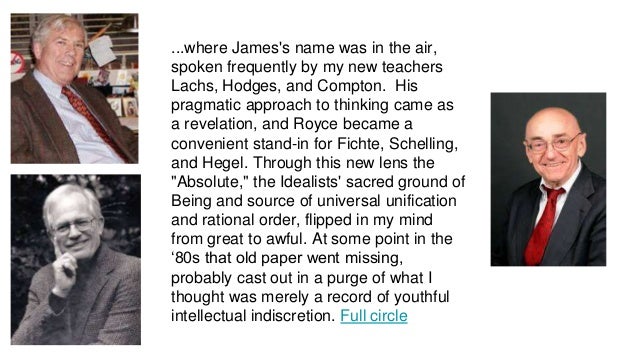
James's name was in the air, spoken frequently by my new teachers Lachs, Hodges, and Compton.  His pragmatic approach to thinking came as a revelation, and Royce became a convenient stand-in for Fichte, Schelling, and Hegel. Through this new lens the "Absolute," the Idealists' sacred ground of Being and source of universal unification and rational order, flipped in my mind from great to awful.

And flipped it's been, pretty much ever since. I've been quite sure that James was right to wag his finger in Royce's face and say "damn the Absolute!" I accepted James's confident conviction that metaphysical idealists must renounce the ameliorative fight for right that James said life felt like to him. “If this life is not a real fight, in which something is eternally gained for the universe by success, it is no better than a game of private theatricals from which one may withdraw at will. But it feels like a real fight.”

At some point in my grad school years, now considering myself a committed Jamesian, I decided one day on a whim to purge my old files. I threw out that winning essay, sure it no longer contained anything I'd care to claim. I forgot it.

And now, with the Royce conference impending, I'm recalling it. I recall specifically that whatever I thought I understood of Schelling and the idealists was largely due to Royce's 1892 book The Spirit of Modern Philosophy. Royce's name then meant nothing to me, I'd not yet found James or encountered the James-Royce friendly feud.

So I kinda wish I could lay hands on that old essay again. I don't suppose it's sitting in a dusty file in the philosophy department in Columbia, Mo. Maybe I'll ask.

Or maybe I'd rather not. It's been fun, trying to reconstruct without a map the long intellectual journey that's brought me back around to the place I began. Royce's book is the more elaborate map I've been trying to navigate by. Perhaps I will, as the poet said, finally come full circle - he also started in Missouri, and measured out his life with coffee spoons -  and know the place for the first time.
“We shall not cease from exploration
And the end of all our exploring
Will be to arrive where we started
And know the place for the first time."
Perhaps, at least, I'll come to know the wisdom of Royce's statement that alternative positions in philosophy need not be mutually exclusive or mutually destructive. Just as he says there's a place for both the metaphysical optimism of a Hegel and the cosmic pessimism of a Schopenhauer, so is there not just room in philosophy for the insights of both James and Royce, there's an urgent need for them. Both. Together. Thesis-antithesis, point-counterpoint, ying-yang... I thought I knew it. I'm beginning to really feel it too.


Thursday, October 10, 2019

Trust

LISTEN. "It's a long season, you gotta trust it," said Crash Davis. Cards and Nats fans are feeling that this morning, after their teams upended the two NL teams with better season records to take their respective division series'.  Braves and Dodgers fans are probably not.

The situation is a bit (but only a bit) like the sinking boat scenario we were discussing out on the JUB stoa yesterday afternoon in CoPhi. The boat sinks, all aboard are lost, but one would-be passenger who didn't board thinks it must have been his destiny, his "fate" to survive. But what about the actual passengers? Their trust was not rewarded, Crash.

Oh well, says the trusting believer. Life's a mystery. Why do bad things happen to good and innocent people? Why must the innocent die young? Why must the team with 106 regular-season wins now go home to watch its inferiors contend for glory? God only knows.

Or the gods, as the interlocutors in Cicero's On the Nature of the Gods would say.

Cotta the Skeptic, Velleius the Epicurean, and Balbus the Stoic talk it out in an conversation that's still fresh and relevant. All score points at various moments in the discussion. We're giving it a glance today in Happiness.

Early in the dialogue, Velleius mocks the idea of a Master Planner god who's got the whole world in his hands. (NOTE, class: this is a different translation than we're reading, cited by J.M. Hecht in Doubt: A History.) "So you have smuggled into our minds the idea of some eternal overlord, whom we must fear by day and night. Who  would not fear a god who foresees everything, ponders everything, notices everything? A god who makes everything his own concern, a curious god, a universal busybody? ...Epicurus has saved us from all such fears and set us free."

I recall being afraid, as a small child, that the god we sang about in Sunday School was snooping on my every indiscretion. "His eye is on the sparrow, I know he's watching me." Yikes! (And, "if I should die before I wake" etc.-double yikes!!)  If trust is purchased with fear and thus (for an Epicurean) any prospect of true happiness, it's not worth it. Better to picture the god(s) as indifferent to our fate, uninterested in either protecting, rewarding, or punishing us.

Cotta the Skeptic takes it a step further. "Divine Providence was supposed to be able 'to accomplish anything it pleases' and yet it lets people die." 

And: 

"It follows from this theory of yours that this Divine Providence is either unaware of its own powers or is indifferent to human life. Or else it is unable to judge what is best. 'Providence is not concerned with individuals,' you say. I can well believe it."

Fate? You really can't trust it. Or the gods, or the God, fate's reputed Master Planner and divine engineer. We cannot count on a cosmic ally or savior to secure our happiness. We're on our own. We must cultivate our Garden.

Image result for epicurus garden

Wednesday, October 9, 2019

Hobbes

LISTEN. I noted in class yesterday that one of my baseball heroes provides a strong riposte to Thomas Hobbes's implicitly unflattering portrayal of human nature. Pre-civilized life in a state of nature, Hobbes said, would be a war of all against all. Without the brake and censure of lawful civic authority, he was sure, we'd be mutually hostile and viciously competitive in the struggle for survival.

Well, Hobbes never met Buck O'Neil. “It’s much easier to love than it is to hate! Hate eats you up on the inside!”

An old post.

"Hobbes (the English social contract philosopher, not the tiger) was fond of his dram," sang the Pythons. But he was fonder of his stick-his walking stick. He used it not only to perambulate but also to record his thoughts as they came to him, on his daily rambles. Like an iPhone recorder, without need of a battery.

He was also a Royalist, a materialist, a determinist, and a pessimist about human nature. He was "difficult to classify" (Russell). I had an undergrad prof at UMSL, back in the day, who spoke weirdly of "mainlining on utopia with Tommy Hobbes." The Hobbesian utopia is no place I want to live.

But still I like much of what I know about him, particularly his daily morning ramble habit.

I was amused when my old friend said he'd just spent five weeks in Britain and came away with nothing more philosophical than a visit to a castle where Hobbes had tutored. My colleague answered rightly by noting that an ancient English castle's more likely to stimulate the philosophical imagination than is a dusty library in Tennessee. But in any event, Hobbes is a fascinating and over-maligned figure whose steps I look forward to tracking with our Study Abroad course in Britain.

Thomas Hobbes is one of my favorite “authoritarians”: a walker who kept an inkwell in his walking stick, he lived to 91 in the 17th century and believed humans could be saved from themselves with the right kind of contract. Contrary to a student essay I once graded, he did not say pre-social contract humans were “solitary, poor, nasty, brutish, and short.” Just that their lives would've been.

Hobbes did say that’s what it would be like to live in a “state of nature,” without civil authority or police or government to keep the peace and impose order. It would be a “war of all against all.” If you don’t agree, asks Nigel Warburton in his Little History, why do you lock your doors?

Not, surely, because you think everyone’s out to get you. But it only takes a few miscreants, doesn’t it, to create an atmosphere of paranoia and mistrust?

I’d like to think Hobbes might reconsider the extremity of his position, were he transported to our time. On the other hand, we might reconsider the benignity of ours, were we transported to his. Those were tough times: civil war, a king executed, murderous politics, etc. How much freedom would you trade for peace and safety, if there were no other way to secure it? How much have you? How secure do you feel? Still relevant questions in our time, and Hobbes's answers were extreme indeed. But he was no monster, he was a peace-seeker and a civilizer. Most walkers are.

But, would life in a state of nature really be as bad as Hobbes thought? Most of us find most people less than totally distrustful, hostile, aggressive, and vicious, most of the time. On the other hand, we're most of us hardly "noble savages" either. Civilization and its discontent-engendering institutions account for a percentage of everyday bad behavior, but surely not all of it. So Hobbes may have been onto something, with his claim that we're wired for trouble and must be subdued by something bigger than us all, something leviathan-like.

The Hobbesian threat of insecurity and fear of violent death, in our time, may be great enough to override everyone's desire for personal freedom. Is safety more important than liberty? "Better red (or whatever) than dead?" Better to have government snoops monitoring your calls, emails, etc., than... than what, exactly?

Even if you agree with Hobbes that humans left to themselves would revert to base, aggressive, instinctive behavior, you may yet hesitate to agree that the only corrective for this condition is an all-powerful and authoritative central state. You may prefer not to concede the mechanistic, physicalistic, materialist model of humans as incapable of changing, of choosing to become more kind and compassionate, less fearful and selfish. You may hold out for a species capable of rewriting its default programming.

Speculations about human nature as inherently good or bad have always slighted the individuality of persons, absorbing them in abstractions about universal nature. We should seek instead to grasp the particularity of our separate natures. Our separate plural natures. Our plurality, subjectivity, uniqueness.

"Common sense" gets things wrong often enough and egregiously enough, doesn't it? - the flatness of earth, the rectitude of slavery, etc. - to give serious pause. Uncommon sense is in shorter supply, and greater demand. Just like decency, honesty, and humility. We need the Buck O'Neils of the world, now more than ever.

Tuesday, October 8, 2019

A new Stoicism

LISTEN. We conclude our short intro to Stoicism today in Happiness. For the Stoics, humans are endowed by nature with "innate inclinations which we are programmed to follow and which we must follow and perfect if we are ever to be fully successful versions of ourselves (that is, to achieve our goal, happiness)."

In what sense should we construe our "program"? Is it a solecism, or even an anachronism, to think of it by way of analogy to computing? If so, may or can we defy the program? Is it deviancy, perversity, or creativity to want to defy those innate inclinations? Is it freedom? Is happiness our proper primary goal? And is it ours? Are we in fact programmed for virtue, social solidarity, rationality, and truth, with respect to all of which these truly are times that try our souls... or, if you will, that challenge the integrity of our program.

The Stoics thought of the world and (therefore) ourselves as rationally ordered and infused with divine purpose. Let's grant the order of nature, but admit the central concern of our times: we humans have too frequently been monkey wrenches in the Nature machine, a source of unreason and deranged disorder. "Great and unmatched wisdom" is on occasional but rare display. More frequent is arrogance, hubris, and megalomaniacal insanity. Real wisdom eludes us, some more than others.

And yet... the Stoic call to hone our reason, harmonize with Nature, "proceed on to something higher than just opinion" and thus attain our personal and species perfection, our arete, is seductive. The promise of an equanimity in the face of natural necessity (as we noted in connection with Spinoza's pantheistic version of stoic fatalism), that we need "never be upset," is powerful.

But, the old concern with this philosophy: is it sternly suppresive of the best and most humane part of us, our capacity to care and feel and  love? Does it threaten to turn us cold, distant,  and indifferent? Is it a Vulcan philosophy, but not so appealing as IDIC? Would it make us Spocks? Or would it simply mask an underlying but undemonstrative "constant joy and tranquility," the ethos of "completely rational people"?

And so, the penultimate chapter is devoted to Stoic logic. "Illogical, Captain"-if he said it once he said it a thousand times. "Defensive wall," indeed. He meant irrational, but even at age ten we knew what he meant. "The ability to give or withhold assent" based on reason and evidence, not arbitrary preference or whim, is what makes rational animals potentially logical. Exclusive devotion to logic, though, can seem to deny our humanity. All of us, like Spock, are at least half human. (But some humans ain't human, says John Prine.) We must cultivate our emotional intelligence too. As young Josiah Royce learned, "emotion cannot be deleted from life, even the coldest opinions are motivated by feelings... the life of reason is partly emotional."

Is now the time for a new Stoicism? (Do some of us want to read and report on Lawrence Becker's book, class? g'r) A "grand, integrative vision of a good human life" that honored the entirety of our thinking-and-feeling natures would be welcome. If "following nature means following the facts," the time is overripe. Might just be our salvation. Live long and prosper.

Image result for live long and prosper

Monday, October 7, 2019

Augustine, Boethius, Anselm, Aquinas, Royce

LISTEN. Friday's Lyceum with Robert Talisse, on Overdoing Democracy, was timely, entertaining, instructive, and fundamentally right: democracy is supposed to enable us to pursue good lives in multiple dimensions, not just obsess all the time over politics and the shortcomings, imbecilities,  and crimes of our foes; and, it's supposed to enable peaceable, mutually respectful coexistence with our fellow citizens whether we voted for the same candidates or not. Instead, we've allowed our civic life to be invaded by a branding mentality (Target vs. Walmart, Starbucks vs. Dunkin' etc.) that villifies the very humanity of partisans for the other party. (I actually defy the branding stereotypes myself, you'll find me in all the good coffee-and-donut emporia.)

There was a tense moment during the Q-&-A that threatened to subvert the larger message, but the moment passed. It did for me, anyway. Talisse is indeed, as our chair told him at the reception later, a star performer. Glad he could shine in front of his mom at our show.

Another weekend highlight: on the first rainy Sunday in a month of Sundays we went to see Downton Abbey. As an Anglophile and hereditary Anglo on my father's side (descended from Olivers who resided in Bristol U.K. before landing in Kentucky and eventually relocating to mid-Missouri, if the genealogy my dad passed along can be believed), I revel in representations of the Old Country and its upstairs-downstairs social strata... even while sympathizing with formerly-firebrand Irish Republican resisters like Tom Branson.

He would understand Talisse's message: people for whose politics he "wouldn't give a tuppence" are, nonetheless, sometimes, decent at their core. And in his case they're also family. They love his daughter, giving her (and him) a place to call home. Remembering such things puts politics in its place.

 What a lovely film, sentimentally nodding to both the charm and the contradictions of a bygone era that seems much more distant in time than it really is. Carson and the Dowager were so sure that Crawleys would still inhabit Downton in our day. Some heirs of the ancient estates do in fact still haunt those old mansions, mostly for the tourist trade. The class rigidity of that world is well lost, not to mention its various, racist, homophobic, xenophobic (etc.) intolerances and snooty superiorities. But they did know how to entertain royalty.

I had a hard time buying Arthur Dent as King George V, though.

Image result for arthur dent king george simon jones Image result for king george v

Also this weekend: Monty Python turned 50, Naomi Klein was on BookTV, the Cards lost twice to the Braves... and Augustine, Boethius, Anselm, and Aquinas remained long dead, though not forgotten.

Not quite so long dead, but largely forgotten until a recent small revival of interest got him a shout-out from David Brooks in the Times, is Josiah Royce. "Royce is the philosopher we need today. In an age of division, fragmentation and isolation, Royce is the philosopher we don’t know we have. He is the philosopher of binding and connection." Loyalty to a worthy cause makes life meaningful and satisfying, if not exactly happy in the conventional and superficial sense. "How does the individual fit into the community and how does each community fit into the whole? He offered a shift in perspective. When evaluating your life, don’t ask, 'How happy am I?' Ask, 'How loyal am I, and to what?'"

William James, left, and Josiah Royce, circa 1910.Contrarily, self-centered individualism in pursuit of “fleeting, capricious and insatiable” desires makes for hollow, unhappy, antagonized and antagonistic lives of lonely isolation. Royce showed us, and could show us again if we wanted to be shown, an alternative way to live good lives that's rooted as much in western philosophical traditions as individualism. You don't have to embrace Buddha, he said, to find nirvana. Or at least to find peace, love, and understanding. Was he right? That's what he and his friend James talked about on that wall.

Even if he is right, are we receptive to that news? A piece in yesterday's Times suggests many are not. They cling to a self-defeating "go-it-alone" self-reliance that's not working for them, but they're stubbornly "determined to get rid of the last institutions trying to help them, to keep people with educations out, and to retreat from community life and concentrate on taking care of themselves and their own families. It’s an attitude that is against taxes, immigrants and government, but also against helping your neighbor." They don't read, or support the local library. They won't read Royce.

An old post. In late antiquity and the middle ages the big questions tended to be more about life's rumored sequel and how to achieve it. Augustine first thought you had to make alliance with the forces of good, in their death struggle with the forces of darkness. He was on the right track, I tend to think, before his big conversion. He was right to suppose that our side needs all good hands on deck, to resist and overcome evil. He put that conversion off as long as he could, praying for purity but only in due course. For the record, though: I don't think he was right to think of our carnal condition as an entombment. Incorporeal souls sow no wild oats, ascetics enjoy few existential delights.

So, buoyed by Platonism, he "put all forms of materialism firmly behind him" and "turned back the clock of intellectual history." The old Greek commitment to reason was not finally comforting enough to him. "He returned to a version of the comforting supernatural stories which most of the first philosophers sought to dispense with, or at least to rationalize."

Boethius's Consolation of Philosophy dialogue found its own form of comfort, not in Augustine's Christianity but in Lady Philosophy's timeless stoicism. God (or Good?) sees all in a single atemporal sweep, "at a go," and thus somehow leaves the hapless victim of tortured persecution and execution as free as it found him. He can still choose to be "philosophical" about every misfortune, even to his dying breath on the rack. His freedom's a lot like Kris Kristofferson's and Janis Joplin's, "just another word for nothing left to lose."

Anselm's God, "than which nothing greater can be conceived," and his famous "proof" thereof, is another of those notorious sleights of hand made to do heavy philosophical lifting with nothing more muscular than verbiage. It's still shocking to me, how many bright people (including young Russell, briefly) it's seduced.

Speaking of great misfortune, poor Abelard's is painful to ponder. Gottlieb blames "his scholarly prowess and his passionate involvement with logic" for emboldening him to undertake his own fateful seduction. How ironic, that he would go on to make his mark as "the first serious moral philosopher of medieval times" and "to apply rational analysis to the nature of moral goodness." Too little, too late.

Moses Maimonides did not address Abelard's peculiar form of perplexity but did try to bring philosophy, science, and religion together. “Truth does not become more true by virtue of the fact that the entire world agrees with it, nor less so even if the whole world disagrees with it.” But try telling that to the world. He was right, though. “You must accept the truth from whatever source it comes.” But, “Do not consider it proof just because it is written in books, for a liar who will deceive with his tongue will not hesitate to do the same with his pen.”

He was onto confirmation bias early. “We naturally like what we have been accustomed to, and are attracted towards it. [...] The same is the case with those opinions of man to which he has been accustomed from his youth; he likes them, defends them, and shuns the opposite views.”

Was he really the first to say this?: “Give a man a fish and you feed him for a day; teach a man to fish and you feed him for a lifetime.” Did he anticipate James's Will to Believe notion that "our errors are not such awfully solemn things"? “The risk of a wrong decision is preferable to the terror of indecision.”

He was sort of a bioethicist before his time: “The physician should not treat the disease but the patient who is suffering from it.” And, “No disease that can be treated by diet should be treated with any other means.” Actually that might have helped Abelard, with a little timely saltpeter in his diet.

William of Ockham's famous "razor" said we should keep our theories simple, our ontology thin. "It is pointless to do with more what can be done with less." Remember Goober's beard?

Remember Buridan's Ass? Apparently "no such animal appears in his writings." Too bad, he's been such a workhorse for logicians.

Giordano Bruno was a mystic friar, but he also had a vivd scifi imagination. He said there must be other worlds and "countless suns" out there in the Void, "innumerable globes like this on which we live and grow." We've only confirmed that in the past twenty years or so. It (and other heresies) got him torched in 1600. Carl Sagan and Neil Tyson tell his story.

Finally today, Aquinas. His First Cause Argument, echoing Aristotle, said a never-ending series of causes and effects would lead to an unacceptable regress. The first term in any explanatory sequence, he thought, has to be self-evident. But is that itself self-evident? Russell says, of "the supposed impossibility of a series having no first term: Every mathematician knows that there is no such impossibility; the series of negative integers ending with minus one is an instance to the contrary. But here again no Catholic is likely to abandon belief in God even if he becomes convinced that Saint Thomas's arguments are bad; he will invent other arguments, or take refuge in revelation." It's not just Catholics. Remember confirmation bias?

March 2017