Delight Springs

Wednesday, February 23, 2022

The earth of things

An old post from the Happiness blog, featuring a long-married pair of preeminent poets now both passed, reminding us why it's so vital that we humans keep moving forward and thinking about a better tomorrow. 

That's meliorism, which "treats salvation as neither inevitable nor impossible. It treats it as a possibility, which becomes more and more of a probability the more numerous the actual conditions of salvation become."

"It is clear that pragmatism must incline towards meliorism." Isn't it? Meliorists move forward, ideal by realized ideal, to see what may be made of our brief and flitting lives and of those still to come.

The poets remind us as well that we mustn't squander what James called the sufficiency of the present moment. It's in such moments of presence that the "earth of things" speaks most eloquently of the continuity of all time and the remembrance of things past.

I don't think happiness really comes to rocks and rainfall and wineglasses, but the poet is entitled to her license. I think her point is that it's here amidst the stuff of life, or for us it's nowhere. 

There’s just no accounting for happiness,
or the way it turns up like a prodigal
who comes back to the dust at your feet
having squandered a fortune far away
...
It even comes to the boulder
in the perpetual shade of pine barrens,
to rain falling on the open sea,
to the wineglass, weary of holding wine.
--Happiness by Jane Kenyon 

Likewise, her husband the Sox fan. She's gone, and his attention has turned to his things.


William James, a poet among philosophers and an excellent philosopher of happiness, would have approved.
The really vital question for us all is, What is this world going to be? What is life eventually to make of itself? The center of gravity of philosophy must therefore alter its place. The earth of things, long thrown into shadow by the glories of the upper ether, must resume its rights. Pragmatism
Happiness on earth must be found on earth. Even those who invest themselves in dreams of heaven still do their dreaming here.

Such a simple point, but so elusive for so many.

Tuesday, February 22, 2022

Meliorism, humanism, hope, and happiness

 For those of us whose melioristic sympathies are rooted in William James's Pragmatism, the enlistment of Bertrand Russell as an ally in the moral equivalent of war may sound odd. James called him an ass ("Bertie Russell trying to excogitate what true knowledge means, in the absence of any concrete universe surrounding the knower and the known. Ass!"), he took nasty swipes at WJ and said the "logical outcome" of the Will to Believe when applied to religion and politics would be carnage. "What is wanted is not the will to believe but the wish to find out, which is its exact opposite."

Nonetheless, I am struck more by the affinities of James and Russell and Richard Rorty as hopeful meliorists and humanists, and (though Rorty's general public demeanor was glum and Eeyore-ish) philosophers united in their pursuit of happiness. Those affinities far outweigh any differences as to the best interpretation of the relation between belief and knowledge. 

Meliorism, humanism, hope, and happiness are centered in forward-looking action, not armchair or seminar room contemplation. Rorty, Russell, and James (and let's add Dewey) share in the former's "protest against the idea that human beings must humble themselves before something non-human, whether the Will of God or the Intrinsic Nature of Reality." Pragmatism as Anti-Authoritarianism

James, it's true, defended the right of believers to humble themselves before "whatever they may call the divine." But his more characteristic disposition was to exalt the ways in which beliefs of all sorts could get persons formerly humbled and crippled by the challenges of living off their knees, up and moving forward.

It's always, for happy hopeful melioristic humanists, a question of what value for life our respective commitments and projects may deliver. It's always our really vital question: "What is this world going to be? What is life eventually to make of itself?" 

Happy the philosopher whose center of gravity has shifted to this earth of things and finite humans questing to do their bit to make things just a little better. Going forward.

Monday, February 21, 2022

Bertie Russell, meliorist

 Yesterday's gorgeous sunny harbinger of spring, a sleeveless bikeride, two dogwalk 60s sort of day that we get randomly and delightfully in winter here in the mid-south, has yielded to clouds and a forecast of rain. Not complaining. Take delight where it comes, and anticipate more. 

Of course, weather finds other ways to try and kill us down here. So do our politicians. Pick your poison. I sometimes imagine what life would be like in New England. Would I have learned to love cross-country skiing and snowmobiling and seven or eight months of what we call winter? It sure looks great on screen, on Trout and Coffee and Ally Marie.

Imagination is one of our best tools, it enables us to describe and re-describe our lives and dreams. To dream, perchance to live. If you can think it you can maybe make it, or not. Either way, a flexible imagination is insurance against the possibility-denying platonic temptation to lock ourselves into an upper-case Reality without the prospect of amelioration. And we desperately need amelioration.

While I was out walking and riding in the sunshine yesterday I took Lord Russell with me. The BBC just brought out his inaugural Reith lectures of 1948, "Authority and the Individual." Younger Bertie was a platonist--"brief and powerless is Man's life; on him and all his race the slow, sure doom falls pitiless and dark"--, but he got over it. He became a meliorist. He grew up, into the understanding that our hopes, “though as yet they are largely frustrated by our folly,” remain “within our reach.” A better politics, a stronger democracy, a heritage of values still worthy to transmit to our heirs, remains a possibility.

Keep hope alive.

And that's how I think I'll conclude my remarks in Chicago next weekend at the APA, where it will probably not be sunny and sixty-something. It wasn't the last time I was there this time of year, right before everything locked down. But it'll be a nice place to visit again.


Thursday, February 17, 2022

“We American college teachers”

This is quite a remarkable passage In Rorty's Universality and Truth lecture. Understand it, and you better understand his total weltanschauung.

"The fundamentalist parents of our fundamentalist students think that the entire 'liberal Establishment' is engaged in a conspiracy…These parents have a point. Their point is that we liberal teachers no more feel in a symmetrical communication situation when we talk with our fundamentalist students than do kindergarten teachers with their students…When we American college teachers encounter religious fundamentalists, we do not consider the possibility of reformulating our own practices of justification so as to give more weight to the authority of the Christian Scriptures. Instead, we do our best to convince these students of the benefits of secularization. We assign first-person accounts of growing up homosexual to our homophobic students for the same reasons that German schoolteachers in the postwar period assigned The Diary of Anne Frank…The racist or fundamentalist parents of our students say that in a truly democratic society the students should not be forced to read books by such people—black people, Jewish people, homosexual people. They will protest that these books are being jammed down their children's throats. I cannot see how to reply to this charge without saying something like 'There are credentials for admission to our democratic society, credentials which we liberals have been making steadily more stringent by doing our best to excommunicate racists, male chauvinists, homophobes, and the like. You have to be educated in order to be a citizen of our society, a participant in our conversation, someone with whom we can envisage merging our horizons. So we are going to go right on trying to discredit you in the eyes of your children, trying to strip your fundamentalist religious community of dignity, trying to make your views seem silly rather than discussable. We are not so inclusivist as to tolerate intolerance such as yours.' I have no trouble offering this reply, since I do not claim to make the distinction between education and conversation on the basis of anything except my loyalty to a particular community, a community whose interests required re-educating the Hitler Youth in 1945 and require re-educating the children of southwestern Virginia in 1993..."

— Pragmatism as Anti-Authoritarianism by Richard Rorty
https://a.co/3psrY57

Wednesday, February 16, 2022

A good day

 Yesterday was excellent. First day of the rest of my life. 

Got it off on the right foot by walking away from my building, when I first arrived on campus at 8 am, rather than heading in. Just felt an insistent need for an immediate walkabout, without distraction or delay. 

That used to be my default, in every weather: walk to work (like Henry), right after the long benumbing auto commute. Lately I've gotten soft, in winter, preferring the instant comfort of central heating. 

But it wasn't that cold yesterday morning, 40-something, so I parked and pivoted in the direction of the Tom Jackson Building rather than the James Union. Then on past Murphy Center, the stadium, the baseball field, the KUC, the library, the science building, the Naked Eye observatory, through the Peck Hall courtyard, hard left at Kirksey Old Main... 


A brisk forty-minute ramble around our lyceum grounds and now I'm vivified, revitalized, and ready to work. I feel great.

And what do I find waiting for me at my office door?


Well, the day just kept getting better. Had our first midterm report presentation in CoPhi #6, on the Buddhist notion of anatta. Great job, Kloey. And thanks for bringing little chocolate chip cupcakes, Eden.

Then in #9 more of us finally found our tongues, eager to comment on Julian Baggini's observation that kids these days seem less interested in asserting fixed and essential identities with respect to gender and sexuality.

Then in A&P we voted to go outside and bask in the sunshine of the Peck Hall stoa as we continued our discussion of Richard Rorty's anti-authoritarianism. Just as we concluded, our resident Methodist minister noted with some amusement Rorty's cheeky statement about how "we American college teachers encounter religious fundamentalists..." 

And finally, in Bioethics we shared Claire's sweet treats and were treated as well to outstanding presentations from Patricia (on pandemics of yore) and Curtis on food insecurity, nutritional illiteracy and related issues. I was reminded to tout Cousin Jamie's spirited "ministry" and Michael Pollan's clever (and now brilliantly illustrated) Food Rules.

And I got to bring home the rest of the goodies. And reaffirmation, yet again, that it (just about any it) is solved by walking. Solvitur Ambulando. That might make a decent tattoo.


Tuesday, February 15, 2022

After all these years

 Well that was a lovely V/b-day, fed (Radish's falafel and Edleys' catfish and Younger Daughter's donuts-Krispy Kreme and Donut Den-and cake) and feted and collegially well-wished. My old pal in Alabama, who bought me a drink on my 21st birthday the day after his own, sent me a photo of his Medicare card. A club that'll have even us.

I was gifted with a green light, symbolizing hope and possibility. Hope mine shines steadier than Scott's and Gatsby's. "And one fine morning..."


The day began with a nice message from S "celebrating another trip around the sun, now you've caught up with me," and ended with Older Daughter's "hope you've enjoyed another rotation around the sun as much as possible during this confusing time." But of course the sun's but a morning star. Why shouldn't I enjoy going round and round it?

And as I told her, the old stoic's morning mantra helps keep the confusion at bay.

"When you arise in the morning, think of what a precious privilege it is to be alive - to breathe, to think, to enjoy, to love… Dwell on the beauty of life. Watch the stars, and see yourself running with them."

I do in fact begin each day with those very thoughts. I don't know what it exactly meant to Marcus Aurelius to run wth the stars, but to me it means being endlessly wonderstruck by the sheer scale and improbability of a cosmos that needn't have included me and those I love but nonetheless, "in our ordinariness" as Professor Dawkins effused in one of his humbler moments, did. Does.

Yesterday I thought also, inevitably, of the inexorable passage of time. Did you see Chevy Chase on Sunday Morning?

That must be why I took Oliver Burkeman with us on our dogwalk yesterday. Four Thousand Weeks aren't so many, when the bulk of them are behind you.

“The world is bursting with wonder, and yet it’s the rare productivity guru who seems to have considered the possibility that the ultimate point of all our frenetic doing might be to experience more of that wonder.”

We're never going to "master time," the feeling of "total authority" is a crutch and a delusion (as Richard Rorty also keeps saying, long after his string of days ended), so we may as well "stop erring on the side of caution." Choose "curiosity over worry." Our errors are surely not such awfully solemn things most days, after all. 

So stop worrying and enjoy your life. Breathe. Run with the stars.


Thursday, February 10, 2022

Acceptance

The local electric utility sent its contractor over yesterday, without warning, to “trim” along the fence and power line. For some inexplicable reason they trimmed to the ground, tore up the backyard, took out a section of fence in Dogland and did not replace it, and left. 


Then AT&T came to install a fiber upgrade they said would disrupt service for no more than a few minutes. So naturally we’ve been without internet ever since, and I’m pecking out this post on the phone.


Also, a mysterious pain in my right hand again disrupted my slumber.


Good time for a carafe of Seattle’s Best, and Mark’s morning meditation (the one I’ve installed atop my digital diary as a daily reminder):


"When you arise in the morning, think of what a precious privilege it is to be alive - to breathe, to think, to enjoy, to love… Dwell on the beauty of life. Watch the stars, and see yourself running with them." --Marcus Aurelius


Thanks, Emperor. Maybe things aren’t as bad as I thought.


But my reflections on RR’s pragmatic anti-authoritarianism have been squeezed, boiled down to just this: the chaos of our ludicrous fake-facts discourse and hyper-polarized politics just shows how unavailable anything resolutely authoritative is to us. 


Of course the facts are what they are, reality is what it is, but confirming the truth about facts and reality is a matter of messy “conversation”-not dispositive platonic imposition. 


Life is lived in lower-case, like it or not. I accept the lower-case universe. And I accept the moral of Carlyle’s quippy response to Fuller. Gad, we’d better.


Wednesday, February 9, 2022

The human abode

Interesting discussion in A&P yesterday of the Varieties of [Religious/Scientific] Experience, and their point of convergence in Carl Sagan's appreciation of WJ's longing to get back home. "Carl admired James's definition of religion as a feeling of being at home in the universe." What else is experience finally for, if not to acclimate us to our abode? 

The human abode, Dewey called it. Wherever we go, there we are. Wherever we are, there we go. Here we are. This is us, this natural world, this secular universe. The religious dimension of life here, on his view, embodies a "common faith" embracing nature and culture, anchoring us to the universe and to one another. Supernature can be dispensed with.

The way I'd put that point: supernatural yearnings are natural for some of us. Not for me, but for many. We can thus understand religion as the natural expression of that yearning to connect with something large and meaningful. We don't have to exit our universe to make that connection, it is implicit in the "natural piety" which is our inheritance and our birthright. 

Natural piety is not of necessity either a fatalistic acquiescence in natural happenings or a romantic idealization of the world. It may rest upon a just sense of nature as the whole of which we are parts, while it also recognizes that we are parts that are marked by intelligence and purpose, having the capacity to strive by their aid to bring conditions into greater consonance with what is humanly desirable. Such piety is an inherent constituent of a just perspective in life.

Natural piety plugs us into the "continuous human community in which we are a link" and, Dewey concludes, furnishes "all the elements for a religious faith that shall not be confined to sect, class, or race."  We need to make it "explicit and militant"--but don't call it atheism, which in Dewey's analysis too frequently spurns association with religion and piety and that universal human linkage some of us call humanism.

So we turn next in A&P to Richard Rorty, who was more partial to Dewey than James. One of our questions, in which you may detect a Saganesque echo: Who speaks for pragmatism?

A bigger question: What practical difference does it make? 

What significant value for life hinges on whether we're Jamesians, Deweyans, Rortians, Humanists, Natural Pietists, Methodists, Genesis Creationists...? 

(I'm still puzzling over Gary's charge that Carl Sagan "misunderstood" Genesis, that it was never meant to be taken literally. That's enlightened Methodism for sure. But I think I understand from long experience that literal interpretations of Genesis are more nearly the rule than the exception, at least around these parts.)

But anyway, and most important of all: Can't we just all just get along? Those who come after us will have been counting on it.


Tuesday, February 8, 2022

A clean well-lighted corridor

First thing catching my eye, on parting the curtain this pitch-dark morn, is Venus blazing bright in the southeast. Good omen, for a semi-Thoreauvian who wears a tatted "morning star" under his sleeve. 

Or it would be, if omens were real. And maybe they are, in the natural non-mystical way that light prepares sight. Mercury and Mars are right there in Skyview's frame too, less nakedly visible but no less real. 

That's also the view from the pragmatic corridor, where I still find myself these days. Haven't made it to Rorty's bazaar yet, but I'll check it out soon. Like the star, the corridor invites expectation of hopeful hours ahead, hours of peaceable productivity and social amity. Expectation is not a promise, a guarantee, a specification of conditions, or a definition. But it is an inducement to get up and move, to risk a statement or two, to essay a thought and even dart to an aim.

The morning star for a corridor-roaming pragmatic mediator, just trying to keep all the tenants in Hotel Pragmatismo happy, is a symbol of civility. That's something sometimes hard to summon, when negotiating with adamantly insistent and demanding parties across the hall. But that's the mission, when you've taken the job of mediator. Pragmatism in that respect stands for no definite results save sustainable co-residency.  

So what are we talking about? We could be talking about definitions. Richard Rorty wonders about the best pragmatist definition of religion, and finds James deficient by comparison to the surprisingly militant Dewey who (he says) more adamantly forswears non-human undemocratic incursions from outside the natural and social bounds of the establishment (the "hotel"). 

Maybe. But from a mediator's circumscribed unpedantic perspective the best definition is probably none at all. "Most books on the philosophy of religion try to begin with a precise definition of what its essence consists of. Some of these would-be definitions may possibly come before us in later portions of this course, and I shall not be pedantic enough to enumerate any of them to you now." VRE II

Second-best would be the least disruptive of peace all along the corridor. It would be maximally inclusive, and would not presuppose contentious metaphysical supernatural entities or powers. 
Religion, therefore, as I now ask you arbitrarily to take it, shall mean for us the feelings, acts, and experiences of individual men in their solitude, so far as they apprehend themselves to stand in relation to whatever they may consider the divine...the immediate personal experiences will amply fill our time, and we shall hardly consider theology or ecclesiasticism at all.

There is nothing in the known universe more natural than immediate personal experiences, nor anything more promising of happiness. So that's what a good pragmatic hotelier will fill the time with. Definitions aren't really so crucial, but experience is. Experience of the divine, whatever you may consider it and however you define it, is (for a radical empiricist) a natural phenomenon. "Any total reaction upon life is a religion,"  a tie that binds an individual to life. There's no need to get militant about that. Is there? Except, at least, when individuals become imperious and authoritarian in their "reaction"?

The corridor is long, tidy, and lit. We should enjoy our stay.


Monday, February 7, 2022

Our 19th century

It's Dickens' birthday. He was just 58 when he died, after penning and performing all those marvelous tales of 19th century travail. What a legacy of great expectations, as I stare down the barrel of another milestone birthday just a week away. What else might he have left us, if he'd had another seven healthy years!

Speaking of the 19th century...

I'd been getting a bit disappointed at the failure of so many of our department's interviewees' for the position of Assistant Prof to acknowledge, let alone enthuse about, a place in the curriculum for 19th century British and American philosophers. But that changed in our most recent bracket of zoom calls. One candidate loves William James, another wants to learn more about Peirce, another wants to do Darwin and the Brits, and another even mentioned Rorty. 

And that's my cue to burrow deeper into Pragmatism as Anti-Authoritarianism. Today's meditation is on a couple of arresting assertions in "Pragmatism as Romantic Polytheism":

  • "If atheism is interpreted as anti-monotheism, then Dewey was as aggressive an atheist as has ever lived."
  • "Dewey is the better exponent of a properly pragmatist philosophy of religion" than James.
The first is questionable because atheism need not be defined primarily as anti-anything. Let's keep it positive, I say. Also, "aggressive" is not a word I generally associate with the Dewey of A Common Faith. But he does speak of becoming more "militant"...
We who now live are parts of a humanity that extends into the remote past, a humanity that has interacted with nature. The things in civilization we most prize are not of ourselves. They exist by grace of the doings and sufferings of the continuous human community in which we are a link. Ours is the responsibility of conserving, transmitting, rectifying and expanding the heritage of values we have received, that those who come after us may receive it more solid and secure, more widely accessible and more generously shared than we have received it. Here are all the elements for a religious faith that shall not be confined to sect, class, or race. Such a faith has always been implicitly the common faith of mankind. It remains to make it explicit and militant.
 So we'll see.

The second is surprising, in light of James's eagerness to embrace the radical pluralism of Varieties. But Dewey's common faith is all about uniting our ideals and with an ameliorated reality in the future, and one could make a case for James's position being more retrospective, more about conserving past pieties that seem to have had a value for life according to their votaries. So again, we'll see. 

Dewey wrote The Influence of Darwin on Philosophy, James dedicated Pragmatism to J.S. Mill. This is an Anglo-American meditation, and a conversation absolutely central to the 19th century philosophical legacy. 

So whatever the upshot of my morning meditation, I'm just buoyed to see young scholars on the horizon who are themselves engaged with these thinkers and their ideas. 


Thursday, February 3, 2022

Pragmatism and Religion

 In CoPhi today it's a bunch of churchmen invoking supernatural nonhuman authority. Pragmatic humanists don't share their enthusiasm for Divine incursion and spiritual/apologetic coercion, but pragmatic pluralists (who turn out to be the same pragmatists, tilting their hats just a bit aslant) are bound to "respect" whatever value for life the likes of Augustine, Boethius, Anselm, and Aquinas and their devotees credibly attest from that remote and august quarter. "Value for life" is deliberately vague, but it definitely excludes any over-narrow construction cast in strictly self-serving short-sighted terms. Value must be for life as a whole and in the long run. The question for a good pragmatist is never What's in it (just) for me?

That's the view we're examining in A&P, as we skip ahead in Pragmatism to the final pair of lectures. The penultimate Pragmatism and Humanism defends WJ's friend FCSS's (Ferdinand Canning Scott Schiller of Oxford) "butt-end foremost statement of the humanist position," his avowal that the world possesses enough  plasticity to actually accommodate some and other of our various moral and existential desires. (Schiller was a parodist and later eugenicist whose acerbic sense of humor sometimes annoyed and perplexed James, but whose bout with illness prompted him to urge the life-advice I've always tried to honor: "Keep your health, your splendid health; it's worth all the truths in the firmament.)

To mix the metaphorical soup, the world is our block of marble; we carve it up according to our needs, wants, and impulses as expressed through actionable ideas. Thought engages reality, as the sculptor engages the marble. The marble is real and resistant to our chisel but not wholly resistant. It yields, to a greater extent than some Authoritarian Rationalist types would like us to know. For them, "reality is ready-made and complete from all eternity, while for pragmatism it is still in the making, and awaits part of its complexion from the future... still pursuing its adventures."

But, but, butt foremost: the pragmatic adventurer remains committed to the process of mediation between tough-and-tender thinking and living, and to accommodating even the Authoritarian Rationalist (Absolutist) type of mind when its perspective delivers sufficient value to those whose temperaments find it congenial. 

Finally, Pragmatism and Religion ends WJ's lectures just where Richard Rorty's begin in Pragmatism as Anti-Authoritarianism (HUP 2021, posthumous).

"Between the two extremes of crude naturalism on the one hand and transcendental absolutism on the other," concludes WJ, "you may find that what I take the liberty of calling the pragmatistic or melioristic type of theism is exactly what you require." 

Rorty's lecture entitled Pragmatism and Religion commences with a declaration that pragmatism is "a protest against the idea that human beings must humble themselves before something non-human, whether the Will of God or the Intrinsic Nature of Reality."

Can those of us who think of ourselves as "pragmatistic or melioristic" (but decidedly not theistic) respect WJ's and RR's respective varieties of humanism alike? Can Jamesians and Rortians all just get along? Can they meet in Rorty's bazaar, if not in James's corridor? 

Still just asking questions here.


Wednesday, February 2, 2022

Explore Engage etc.

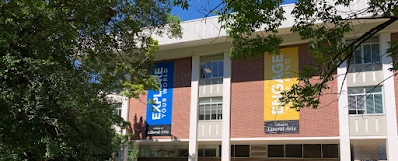
 What a lovely springy day we had to usher in February, yesterday. I biked across campus and got to class with time to spare, then biked back to find everybody in A&P (almost) itching to go out. So we ambled over to the stoa of Peck Hall, where the "painted porch" encourages us to Explore our world and Engage our minds.

 We explored William James's first Pragmatism lecture, The Present Dilemma in Philosophy, in anticipation of next week's encounter with neo-Pragmatist Richard Rorty. We wondered how "tough" or "tender" we might be, as we sort through all our different 'isms.

...tender-minded and tough-minded people, characterized as I have written them down, do both exist. Each of you probably knows some well-marked example of each type, and you know what each example thinks of the example on the other side of the line. They have a low opinion of each other... The tough think of the tender as sentimentalists and soft-heads. The tender feel the tough to be unrefined, callous, or brutal. Their mutual reaction is very much like that that takes place when Bostonian tourists mingle with a population like that of Cripple Creek. Each type believes the other to be inferior to itself; but disdain in the one case is mingled with amusement, in the other it has a dash of fear.

Now, as I have already insisted, few of us are tender-foot Bostonians pure and simple, and few are typical Rocky Mountain toughs, in philosophy. Most of us have a hankering for the good things on both sides of the line. Facts are good, of course—give us lots of facts. Principles are good—give us plenty of principles. The world is indubitably one if you look at it in one way, but as indubitably is it many, if you look at it in another. It is both one and many—let us adopt a sort of pluralistic monism. Everything of course is necessarily determined, and yet of course our wills are free: a sort of free-will determinism is the true philosophy... practical pessimism may be combined with metaphysical optimism. And so forth—your ordinary philosophic layman never being a radical, never straightening out his system, but living vaguely in one plausible compartment of it or another to suit the temptations of successive hours... (continues)

Living vaguely in this or that compartment sounds something like the pragmatic corridor, introduced in the next lecture (What Pragmatism Means).

Innumerable chambers open out of it. In one you may find a man writing an atheistic volume; in the next someone on his knees praying for faith and strength; in a third a chemist investigating a body's properties. In a fourth a system of idealistic metaphysics is being excogitated; in a fifth the impossibility of metaphysics is being shown. But they all own the corridor, and all must pass through it if they want a practicable way of getting into or out of their respective rooms.

I want us specifically to explore whether Rorty sings from the same hymnal when he derides the appeal to non-human and supernatural authorities as "authoritarianism." James says any room on the pragmatic corridor whatsoever, when it is shown to have a value for the lives of those who occupy it, must be respected. Not inhabited, not endorsed, just respected. On its face that sounds a lot more accommodating and pluralistic than Rorty's position. We'll see.

And we'll also engage the ultimate pragmatists' question: what practical difference does it make to you or me, if there is or isn't some discernible difference between two old dead pragmatists? Why should we care?

Further down the stoa we're encouraged to enrich our lives and earn a living. Clarity with respect to those questions might contribute to the sort of enrichment we were talking about in CoPhi, the Epicurean gratification of a simpler and less stressful life spent doing the things that deliver peace of mind and a tranquil spirit. They might make a living worth earning.


Happy Groundhog Day! It's not so "cold out there," here--47 in middle Tennessee (Alexa says it's 30 in Punxsutawney), but it's wet and fecund. Spring is in the air. Respect must be paid.


Tuesday, February 1, 2022

Leaving the garden

 As we turn to the Epicureans and Stoics today in CoPhi, to WJ's Dilemma in A&P, and continue to ponder the ethics of "unstoppable" pandemic in Bioethics, a little more cosmic philosophy seems to the point. "How much more satisfying had we been placed in a garden custom-made for us," indeed... but we were always too restless, curious, and hungry for the garden. To become who we really are, we had to get out. We have to explore. We have to question, to converse, to try and know. We have to reject the non-human authorities who would impose a placid and passive existence. 


Monday, January 31, 2022

Cosmic philosophy as anti-authoritarianism

 We are it, the vast and awesome universe. We are small creatures with capacious imagination and growing intellect and, unfortunately, residual primitive fears and hostilities we have to overcome before we can truly claim our largest cosmopolitan heritage as citizens of a cosmos. The brain may be wider than the sky but the heart of too many of us remains a few sizes too small. 

So I should clarify the cosmic/humanist philosophy I was celebrating in that last post. We're not insignificantly minuscule by birth, but neither are we vested with importance by pedigree. We bear tremendous potential. That means we have it in us to do something on a cosmic scale. Or not. 

”We are the custodians of life's meaning," so far as we can tell. That's quite a responsibility. It's not yet an achievement. "If we crave some cosmic purpose then let us find ourselves a worthy goal,” was Carl's anti-authoritarian instruction at the end of "A Universe Not Made For Us."

Do something, humanity, don't just (as WJ always said) "lie back." Don't rest on some falsely-imagined lineage of inherent essential grandiosity conferred by divine descent. "This is the famous way of quietism, of indifferentism. Its enemies compare it to a spiritual opium. Yet pragmatism must respect this way, for it has massive historic vindication." (Pragmatism VIII) Respect. Don't emulate.

In A&P we're surveying 'isms tangential to atheism, some on my view salutary--humanism, naturalism, pragmatism--and others decidedly not--parochialism, racism, sexism, nationalism, geo-centrism, chauvinism. 

The docile passivity of waiting for meaning and purpose and importance to rain down from heaven or some more proximal potentate is beneath us. That reeks of authoritarianism. We can do better. Or so we'll see.


Friday, January 28, 2022

This is us

 The conversation in A&P took a pleasantly unexpected turn yesterday when I was asked what had led me to my view that humanity is not so insignificantly minuscule after all, in the ever-expanding vastness of space-time. "Look again at that dot. That's here.That's home. That's us..."


The question was pleasant to me because I never get asked it, though I've endlessly shared the observation every semester when speaking of "cosmic philosophy" and recalling my adolescent delight in first discovering Carl Sagan's Cosmic Connection back in the day. 

We are a "transitional animal," I read, and that makes us part of something so much larger and potentially better than we've yet imagined. That's when I really began pondering the evolutionary epic that is everybody's story, and that led me eventually to philosophy.

"The universe is vast and awesome, and for the first time we are becoming part of it.” Right, I thought. We are it.

But that's not what I said in class yesterday. I surprised myself, pleasantly again, by citing a later moment of clarity when I first encountered the Belle of Amherst's poem.

The Brain—is wider than the Sky—
For—put them side by side—
The one the other will contain
With ease—and You—beside—


I might also have mentioned Eric Idle's Mrs. Brown, who I discovered at about the same time in the '70s and who also helped clarify my peculiarly hybridized brand of humanism. Just remember that you're standing on a planet that's evolving and revolving at 900 miles an hour... 

And hang on tight.


Thursday, January 27, 2022

Believing-muscles

We're wrapping up Julian Baggini's Atheism: A Very Short Introduction today in A&P. 

It emerged last class that I'm using the 2d edition, just out, while others have the 1st. Not a big deal, but since it dates all the way back to 2003 they're missing a few emendations. There's a fresh discussion of the New Atheists, for instance, who of course are not so novel anymore. 

And I'm missing the old autobiographical start to chapter 1, in which the author charitably described his own childhood exposure to Roman Catholicism in "a gentle, benign religious environment" by non-"Bible-thumper" parents and teachers who were not "anything other than kind." He says he later "moved over to Methodism" before eventually landing in atheism. He believes there is no God. But he bears no grudge against those who believe otherwise. It's a nice beginning. I wonder why they removed it.  

Maybe this line from Charles Lutwidge Dodgson, aka Lewis Carroll (who would be 190 today) is pertinent to that editorial decision. It's definitely pertinent to our impending CoPhi discussion of ancient skepticism. 

“If you set to work to believe everything, you will tire out the believing-muscles of your mind, and then you’ll be so weak you won’t be able to believe the simplest true things.”

But you've got to believe something, and even the most skeptical atheists do. They believe, affirmatively, that there are no gods. That's something, right Pyrrho? Well, he's not saying. He's like Douglas Adams's hyper-skeptic in the Hitchhiker's Guide (Restaurant at the End of the Universe), the Ruler of the Universe, whose cat he calls the Lord...

Wednesday, January 26, 2022

Lessons Learned

 In Bioethics we're reading, in Michael Lewis's The Premonition, of the pandemic planning task force hastily assembled in 2005 by Rajeev Venkayya, a young White House staffer tabbed by George W. Bush to head the "Biodefense Directorate" of the Department of Homeland Security. (What odd names for agencies of the U.S. government, they somehow sound more suited to the old U.S.S.R.)

Bush, it may surprise some of us to learn, had read a book. Or at least had read the portions of a book that staffers had highlighted for him, pointing out the country's state of utter unpreparedness should anything like the influenza pandemic of 1918 ever be repeated. If it happened on his watch his presidential legacy would suffer. On the heels of 9/11, Hurricane Katrina, WMDs in Iraq (not), et al, that got Dubya's attention.

Venkayya's first hire was a Vandy grad named Richard Hatchett, who left a promising path towards a career in poetry for med school. "Writing is too hard." He gave us "social distance" as we've come to know it today, not knowing its anthropological significance as a kinship marker or its track record from 1918. "I just didn't know any better." Pandemic planning turns out to be hard, too.

Then came Dr. Carter Mecher, a Chicagoland native whose father encouraged his medical path: "If some other dumb fuck can do it, so can you." Thanks, Dad.

"Very few medical students shared his enthusiasm for human beings on the brink of death." He sounds like a soulmate for the Santa Barbara public health director Charity Dean, who we read in the previous chapter used to soothe herself in childhood reading and thinking about the Bubonic Plague.

Dr. Mecher is quite right, it's good to learn from our mistakes but "best to learn from other people's mistakes."

And what great lesson has he learned about how people do and do not learn hard lessons? "The gist of it was that people don't learn what is imposed upon them but rather what they freely seek..."

Right! And since it's time for us to begin thinking about midterm report presentation topics I urge you all, classes, not to wait for me to impose on you. Take a glance at the syllabus for February and freely seek the subject you can't wait to share. If some other !@#$%! can do it, so can you.

Tuesday, January 25, 2022

The polls are open

 Today in CoPhi, inspired by all those philosophers (especially Agnes in Chicago) who love to ask their questions on Twitter, I'm running a poll. Hoping we'll discover interesting differences amongst ourselves, as regards our respective understandings of "Socratic," to discuss in class. 

If it goes well, we'll do it again. Maybe we'll do it in Atheism and Bioethics too. In fact, classes, I'm open to your suggestions: what relevant queries would you like to pose for your classmates in an informal and non-binding plebiscite? 

Monday, January 24, 2022

Breathe and pay attention

“Don’t pass it by — the immediate, the real, the only, the yours.” 

Henry was telling his friend Edith Wharton to write what she knew, to attend to and describe what she most directly encountered. Great advice, which I've also heard from another Henry and from the late great Buddhist sage Thich Nhat Hanh. 

Unlike his brother the radical empiricist,  Master of prolix fiction probably wouldn't concede that sometimes, oftentimes, words are superfluous. It's odd how often we must remind ourselves: just breathe, just behold. 


Thursday, January 20, 2022

The Premonition

We commence reading our Bioethics texts today with Campbell's Basics and Lewis's Premonition: A Pandemic Story. Michael Lewis says "Trump was a comorbidity" of the pandemic. That's one of the nicer words I can think of, for him. But Lewis is right, the previous occupant's mismanagement, dishonesty, and lunacy are only a part of the COVID story.  

The story begins with Laura Glass, a prescient middle schooler in Albuquerque whose scientist dad taught her that "science was this tool for finding cool new questions to ask, and answer" and who came to understand what so many of our nation's nominal leaders did not: that there's "no difference between giving a person a vaccine and removing him or her from the social network," the result in each case being a halt the the spread of infection.

The story continues with Charity Dean, the young chief public health officer for Santa Barbara County in California with a passion for communicable disease and crisis who persisted in doing her job despite stiff resistance from misogynists, sexists, male chauvinists, and other health obstructionists. In childhood, "when she was feeling low, she had cheered herself up by reading books on bubonic plague." When she learns that the fine print of her job description empowers her to take whatever measures she deems necessary to block the spread of disease, the drama begins

Our stage is set for a compelling story, made all the more so by the fact that it's true. I foresee another Lewis-inspired film.


Wednesday, January 19, 2022

Speaking and listening

 It felt good to get back in the classroom yesterday, though I was feeling talked out and a bit sore-throated by the end of the day. Obvious remedy: talk less, listen more. 

And so I responded affirmatively to the student who emailed later to ask if I was familiar with the work of Ram Dass, aka Baba Ram Dass, aka Richie Alpert, who said “The quieter you become, the more you can hear.” True. And that was indeed a message I tried to convey on Opening Day, that the collaborative form of philosophy I hope to foster in our classes involves just that willingness to listen as well as speak. I need to practice what I preach.

Richie's obit describes him as a "peripatetic lecturer on New Age possibilities," but I don't think he was quite my style of peripatetic. Or Aristotle's. That doesn't mean I shouldn't try to hear what he might have to say. "Be here now" is a wonderfully pithy piece of wisdom. If we do that in class and really attend to one another's contributions, not leap to dismiss what sounds unfamiliar or uncongenial, we might learn something. 

Richie eventually learned something his pal Tim Leary, who turned on, tuned in, dropped out, orbited the planet for  a few years and then literally crashed and burned, apparently did not: "He said he realized that his 400 LSD trips had not been nearly as enlightening as his drugless spiritual epiphanies..."

I hope we have some of those this semester too, in and out of class. Listening respectfully will help. But as William James knew, philosophers also must speak. They must fire their volleys of vocables from their conceptual shotguns, and the honest among them also know that only a few of those volleys will approach their targets. 

Truth and fact do well up into our lives in ways that exceed verbal formulation. But words are our medium and currency, so another of my Opening Day messages was that we've got to speak up if we're going to be any decent kind of CoPhilosophers. And pay attention to our peers.

Words are also, said the poet, a powerful and amazing drug when judiciously dispensed. Getting the dosage right is a challenge, but a worthy one. Let's drop in, and let's converse.

Tuesday, January 18, 2022

Opening Day!

LISTEN. Another semester's Opening Day is upon us. Deja Vu all over again. It's cold out there, as they say day after day in Punxsutawney PA. After so many of them, I (like Phil Connors) should be able to get it right. 

Getting it right is pretty easy, on Opening Day in CoPhi, Atheism, and Bioethics. We just talk about who we are and why we're here, and we prepare to ask and address lots and lots of other questions. 

Questions like: What is philosophy? What is wisdom? What is the status and importance of truth (and facts, and reality) in our country and our world? How does the world think? Why do so many of us think it's okay to believe whatever we feel like believing? Why do so many have so cavalier a disregard for the health and well-being of our peers? Why do so many choose to live in Fantasyland?

And is it true, as an old prof of mine liked to quote Martin Heidegger, that "only a god can save us now?" 

Or was Carl Sagan right: there's no sign that help is coming from any external quarter to save us from ourselves?

I choose, as a humanist and meliorist, to look on the bright side. Let's co-philosophize and see if we can't improve our situation. Or at least do no harm.

I'll leave it there, for now. I don't want to presume that any of us has all the time in the world.

Monday, January 17, 2022

Don't panic

 Well here we go again, the start of another pandemic-shadowed semester in a state whose legislators insist on our absolute persona freedom from responsible and prudent action in service of the public health and general well-being. 

A story in the Times yesterday quoted the old Vanderbilt Chancellor Gordon Gee, now at the helm of the University of West Virginia.

“I think there is a rush to do something immediate, and that kind of is a panic push, which I don’t like,” he said. “We’ll never go back to where we were, those days are done. This is what life is about. We have the Omicron, we have the Delta, next year when you and I take a flu shot, we’re going to take it with a dose of Covid vaccine.” Some Colleges Loosen Rules for a Virus That Won’t Go Away

I'm triple-vaxed myself, but I've never had a flu shot. Does that have to change now? Whatever. Just don't panic. (And don't address students, as one arrogant, profane, and benighted history prof in Michigan did, as "vectors of disease"-!)

Our Provost sent around our marching orders, reminding us that in Tennessee we cannot require masks in our classrooms or send anyone out for exhibiting alarming symptoms. But, "run your classrooms as you see fit within the boundaries set by good sense and the rules of the University." Ha ha ha.

The Covid affliction is one health crisis we're still having to deal with, another--which it has doubtless had much to do with exacerbating--is the emotional strain and angst so many students say they're suffering these days. Eric Idle, the Python, offers this sound philosophical counsel to all who find themselves feeling blue (not to be confused with True Blue).
@bodonadam: i'm a sick guy (long term) and i've been feeling rather melancholy lately, ive just turned 30. any words of wisdom/advice, if you have time, @EricIdle? maybe a reading or music suggestion? I usually love making and listening to music.
Yes. You’re alive. You’re going to die. Don’t waste any time. That’s what George would say. Be alive! Live each day to the best of your ability. With love and kindness. I have a Reading Blog if you want reading advice. All music is better than none. Good luck.

 Couple this with what he once sang to Mrs. Brown, and you should be fine.


Just remember that you're standing on a planet that's evolving... all evidence to the contrary. And good luck.


Saturday, January 15, 2022

Militant meliorsts: to the barricades!

 Nice resumption, after a holiday hiatus, of my weekly Meliorist Movement Meetup on Zoom yesterday afternoon. We're a small but motivated advocacy group, and thanks to my comrade we have a logo, a line of apparel, combat gear, and a reserved domain name. Aux barricades ! 


Meliorists of the world, unite! We have nothing to lose but our fatalistic indifference to a world in steep decline. What do we want? Gradual but persistent improvement. When do we want it? ASAP. 

"If this life be not a real fight, in which something is eternally gained for the universe by success, it is no better than a game of private theatricals from which one may withdraw at will. But it feels like a real fight... Be not afraid of life," faithful fighters... William James, Is Life Worth Living?

Friday, January 14, 2022

In the mud with the earth of things

 One of the things Rorty's critics in the ranks of academic philosophy seem to find most galling about his stance is what they perceive as his disrespect for their discipline, the suggestion that philosophers are no more or less capable of addressing our big questions about god, freedom, mortality, truth etc. than (say) literary critics. His last appointment at Stanford, after all, was in comparative literature.

I have no problem with Rorty's literary affinity, and unlike some of my colleagues I find nothing deflating about the link to literature. A sympathetic peer yesterday referred approvingly to the Rortian notion that philosophy is "in the mud" with literary (and other) studies, reminding me of a recent exchange in which we agreed that fiction often exceeds formal philosophy in its relevance and probity. Richard Powers's Bewilderment is a good example. (Thanks for the Shakespeare & Co. link, AC, I'll listen as soon as I can tear myself away from Five Questions... Still trying to answer #5. What am I afraid of?) 

So I reminded my sympathetic peer:
As noted here recently, being "in the mud" with literature is not a bad place for a pragmatic philosopher to be. Better to describe it, though, as WJ did, as being in touch with "the earth of things" rather than enchanted by "the glories of the upper ether."

But to be clear, a Jamesian pragmatic pluralist has no quarrel with those who entertain enchanted ethereal dreams and fantasies. Each room on the pragmatic corridor has its own claim to occupancy. Those who refuse to maintain contact with the earth of things, though, are neglecting our most vital question* concerning the future of life. The increasingly near, increasingly imperiled future of this world.


*The really vital question for us all is, What is this world going to be? What is life eventually to make of itself? The centre of gravity of philosophy must therefore alter its place. The earth of things, long thrown into shadow by the glories of the upper ether, must resume its rights. To shift the emphasis in this way means that philosophic questions will fall to be treated by minds of a less abstractionist type than heretofore, minds more scientific and individualistic in their tone yet not irreligious either. It will be an alteration in 'the seat of authority' that reminds one almost of the protestant reformation. And as, to papal minds, protestantism has often seemed a mere mess of anarchy and confusion, such, no doubt, will pragmatism often seem to ultra-rationalist minds in philosophy. It will seem so much sheer trash, philosophically. But life wags on, all the same, and compasses its ends, in protestant countries. I venture to think that philosophic protestantism will compass a not dissimilar prosperity. Pragmatism, Lec. III

Thursday, January 13, 2022

Truth's authority

…Authoritarians don't just want to control the government, the economy and the military. They want to control the truth. Truth has its own authority, an authority a strongman must defeat, at least in the minds of his followers, persuading them to abandon fact, the standards of verification, critical thinking and all the rest. Such people become a standing army awaiting their next command. —Rebecca Solnit
A question for Rortians: does truth have its own authority? 

Jamesians think it has, but they too think you cannot divine it by appeal to something eternal. Truth's authority, for a Jamesian pragmatic pluralist, flows from its affinity to the facts and reality as discerned to apply in the case at hand. The truth about January 6, or climate change, or the pandemic, or whatever, requires honest attention to what happened, is happening, and is reasonably projected to be likely to happen. "Truth HAPPENS to an idea. It BECOMES true, is MADE true by events."

Do Rortians understand this in the same way Jamesians do? 

I used to be sure they did not. I'm not quite so sure, now.  I'm going to see if I can get clear on that between now and Chicago in February...

Wednesday, January 12, 2022

Stand and shout

LISTEN. Celebrated those birthdays (a collective 245) with sushi and cake last night. And now the holiday season is really over, for a few weeks. And for a few weeks I again get to be the numerically-younger spouse. She really doesn't want to hear that, but as Senator Baker used to say: truth will out.

It was a nice commemoration of WJ on twitter yesterday, at Jeffrey Howard's instigation. 

I appreciate his retweet of what I finally decided is my favorite WJ quote, wherein he derides his own "childish idiocy" for dreading to die before "settling the universe's hash" in one more book. This may be the most binding thread between James's pragmatism and Rorty's successor neo-version: a resolute refusal to take the philosophical enterprise any more or less seriously than any finite and fallible human project deserves. It is, after all, the most sublime and the most trivial of pursuits, this compulsive impulse to formulate truths. 

The philosopher's version of Keats's negative capability is surely the ability to hold the sublimity and the triviality steadily in mind together, and to be ready at all times to call oneself out for thinking the cosmic hash can ever really be disturbed. And yet we must create a disturbance. That's what pragmatists think thinking's for. We sit in uncertainty, and stand up to make a stab at progress. Not to stand before we sit down to write, as Thoreau said, is vanity. It's right up there with childish idiocy.

WJ's next paragraph, after the sublime-and-trivial observation, declares "the history of philosophy is to a great extent that of a certain clash of human temperaments." And that brings me to my latest podcast obsession, Kieran Setiya's Five Questions. 

I hope there will be another season, every episode I've binged so far has been excellent. [UPDATE: just learned there will be, at @KieranSetiya.] Each is a conversation with a contemporary academic philosopher, each begins with the question of how the  philosophers perceive the connection between their temperament and philosophical commitments. Kieran attributes the question to Iris Murdoch, who also thought it important to ask philosophers what they're afraid of. 

Philosophers who don't know their own temperament, or who don't think temperament relevant, seem to me to betray a shocking absence of fundamental Socratic self-knowledge. 

I really like Cheryl Misak's answer to the fear question. She's afraid of the same things we all should be afraid of, things like the anti-democracy surge we've witnessed in recent years around the globe and especially in the U.S., and the climate crisis, and injustice, etc. 

But of course the point of fear, for a pragmatist, is to invigorate a propitious response. Don't just sit there. Stand. Face the fear, fix what you can. You may not settle the universe's hash but at least you will have engaged with it, in a way Misak says philosophers generally haven't for twenty years or so. She notes that WJ used to "shout" at his peers for their disengagement from the public sphere. Childish idiots.

Tuesday, January 11, 2022

WJ at 180

 Happy 180th birthday, WJ. Happy 65th, SCR. 

The dance of common sense is more supple than most commentators, in and out of academia, trying to grasp what James meant when he said truth is what it is better for us to believe. But I've come to think it best to overlook the flat-footedness of some neo-pragmatists' glibness on this topic. There's far more depth and import in WJ's philosophy than is dreamt in most interpretations of his delineation of what it means for a philosophical view to "work" and successfully guide our experience. 

Some of my favorite WJ quotes: 

"Keep your health, your splendid health. It's worth all the truths in the firmament."--Letter to Schiller 

"Our errors are surely not such awfully solemn things. In a world where we are so certain to incur them in spite of all our caution, a certain lightness of heart seems healthier than this excessive nervousness on their behalf." --Will to Believe

"The really vital question for us all is, What is this world going to be? What is life eventually to make of itself? The centre of gravity of philosophy must therefore alter its place. The earth of things, long thrown into shadow by the glories of the upper ether, must resume its rights." Pragmatism III

Monday, January 10, 2022

Truth-ism?

LISTEN. Time to get back in the saddle. All holidays, moral and otherwise, must end.

For the record, I have been up at dawn every day through this winter-break interregnum, faithfully reporting to a journal whose circulation, unlike Henry's, shall in all likelihood remain exclusive to its author. 

For a long time I was reporter to a journal, of no very wide circulation, whose editor has never yet seen fit to print the bulk of my contributions, and, as is too common with writers, I got only my labor for my pains. However, in this case my pains were their own reward.

There was something pleasantly liberating about not pushing Publish every time the sun hit my eyes, these past weeks. 

But there's also something usefully motivating about intending to do so. That's why I first started pushing these partially baked ruminations into the vast void of what we used to call the blogosphere, when I started the earlier version of Up@dawn almost thirteen years ago. I've come to regard blogging as more archival than reportorial: I post stuff so I can find it, somehow the internet is more accessible than my personal filing system. But useful motivation is also still a good thing. Whatever works, as we say.

School resumes next week, and the Chicago conference where I'm to present thoughts about pragmatism, authoritarianism, and truth is coming. I have questions. 

It's tempting to indulge the pattern-seeking impulse and add an 'ism to truth too, but my concern is really more with that form of post- or anti-truthism Colbert called truthiness. 

The big question: is Richard Rorty's posthumously-published Pragmatism as Anti-Authoritarianism the right text for our anti-democractic time? 

Or, has the fantasyland environment that’s emerged since his death in ‘07--the conspiracy-fueling I believe it because I want to dereliction of fealty to facts, reality, and truth Kurt Andersen named--so altered the philosophical landscape that we who value intellectual integrity and "the relevance of philosophy to life" must rededicate ourselves to a more robust (still a fine word, academic overuse notwithstanding) realism about facts/reality/truth than Rorty has been perceived to support? 

If the facts are the facts but the truth is what we make and say of them, is that a sufficiently robustious realism in either Rorty's terms or James's? And are those two terms, or the same?

Does the Rortian story about stories (the “truths” we make of the facts) enable the fabulists and conspiracy nuts? OR, is the anti-authoritarian emphasis EXACTLY what we need to combat them? 

And in general: is the philosophical/meta-philosophical debate relevant to the challenge of the historical moment? Should we be more focused on the neo-pragmatists' metaverse, or on Zuck’s?

Lots to chew on. Happy New Year.