Delight Springs

Showing posts sorted by relevance for query nozick. Sort by date Show all posts

Wednesday, February 19, 2014

Anselm to Rawls

It's more Saints today in CoPhi, and more Harvards: Anselm & Aquinas (with commentary on the latter from Anthony Kenny), Robert Nozick, and John Rawls.


Anselm stumped for the divine moral perfection (and omnipotence and omniscience) of a being “than which none greater could be conceived.” His Ontological Argument is either ingenious or ridiculous, depending on who you ask. But it rarely persuades those who do not come at it armed with antecedent faith. "Faith seeking understanding," or maybe just the appearance of rational cover.

Aquinas was sure there had to be an uncaused cause in back of everything, or else we’d never get to an end of explaining. Well, we probably won’t. Not ’til the would-be explainers themselves are gone. But is an uncaused cause really a step forward, explanatorily speaking?

Both of those guys were committed, of course, to belief in a heavenly afterlife. Samuel Scheffler, in the Stone recently, wrote of the afterlife here. Here, of course, is where people live the lives their beliefs inform. Life, not god or supernaturalism, is the natural impulse behind religion. Dewey's continuous human community is another way of naming nature's afterlife.

But what if you learned that the species would expire within a month of your own passing? That's Scheffler's thought experiment. He thinks he and we would be profoundly unsettled, that life would suffer an instant meaning collapse, and that this shows how invested we all are in a natural afterlife for humans (though not each of us in particular) on earth. He thinks "the continuing existence of other people after our deaths -- even that of complete strangers -- matters more to us than does our own survival and that of our loved ones." That's what he means when he begins his essay: "I believe in life after death."

He also explained his view on Philosophy Bites.

Our old dead Italian Saints said nothing about this, so far as I'm aware. Anthony Kenny does say Aquinas still agreed with Aristotle about "the best way to spend your lifetime down here on Earth," that happiness is ultimately an activity rather than a feeling, and that "the supreme happiness for rational beings was an intellectual activity." To Aristotle's standard "pagan virtues" he added faith (in Christian revelation), hope (for heavenly ascent), and charity (toward god and neighbor).

But the charity he seems to admire most in Aquinas is of the intellectual variety, "always trying to balance arguments from both sides" and treat those whose conclusions he disputes with civility.


Neither of today's 20th century Harvard philosophers was a Saint, but both were civil.
Robert Nozick began his academic career as a narrow analyst and wunderkind libertarian, but evolved well beyond his starting place. He came to realize that astringent libertarianism neglects "the reality of our social solidarity and humane concern for others." He came also to the view that "thinking about life is more like mulling it over" than like pinning it with a syllogism. "It feels like growing up more." He kept growing, 'til stomach cancer took him at age 63.
Nozick's chapter on dying in The Examined Life begins,
THEY SAY NO ONE is able to take seriously the possibility of his or her own death, but this does not get it exactly right. (Does everyone take seriously the possibility of his or her own life?) A person's own death does become real to him after the death of both parents.
He's right about that.
Before his death (as Yogi Berra might have said) Nozick gave us the good old Experience Machine. We just talked about this the other day in HAP 101.

John Rawls, says Carlin Romano, wrote "the most important book of English-language political theory since Mill's On Liberty. His goal was a coherent theory of "justice as fairness" whose appeal would span the spectrum, after emerging from behind a "Veil of Ignorance." Not everyone buys it, but we all talk about it. Michael Sandel does too, to a much bigger class than ours, albeit mostly virtual & MOOCy.
And now there's a musical stage show. How many political philosophers can say that?!  Rawls@dawn

Monday, September 23, 2013

Anselm to Rawls

It's more Saints today in CoPhi, and more Harvards: Anselm & Aquinas (with commentary on the latter from Anthony Kenny), Robert Nozick, and John Rawls.

Anselm stumped for the divine moral perfection (and omnipotence and omniscience) of a being “than which none greater could be conceived.” His Ontological Argument is either ingenious or ridiculous, depending on who you ask. But it rarely persuades those who do not come at it armed with antecedent faith. "Faith seeking understanding," or maybe just the appearance of rational cover.

Aquinas was sure there had to be an uncaused cause in back of everything, or else we’d never get to an end of explaining. Well, we probably won’t. Not ’til the would-be explainers themselves are gone. But is an uncaused cause really a step forward, explanatorily speaking?

Both of those guys were committed, of course, to belief in a heavenly afterlife. Samuel Scheffler, in the Stone yesterday, wrote of the afterlife here. Here, of course, is where people live the lives their beliefs inform. Life, not god or supernaturalism, is the natural impulse behind religion. Dewey's continuous human community is another way of naming nature's afterlife. 

But what if you learned that the species would expire within a month of your own passing? That's Scheffler's thought experiment. He thinks he and we would be profoundly unsettled, that life would suffer an instant meaning collapse, and that this shows how invested we all are in a natural afterlife for humans (though not each of us in particular) on earth. He thinks "the continuing existence of other people after our deaths -- even that of complete strangers -- matters more to us than does our own survival and that of our loved ones." That's what he means when he begins his essay: "I believe in life after death." 

He also explained his view on Philosophy Bites.

Our old dead Italian Saints said nothing about this, so far as I'm aware. Anthony Kenny does say Aquinas still agreed with Aristotle about "the best way to spend your lifetime down here on Earth," that happiness is ultimately an activity rather than a feeling, and that "the supreme happiness for rational beings was an intellectual activity." To Aristotle's standard "pagan virtues" he added faith (in Christian revelation), hope (for heavenly ascent), and charity (toward god and neighbor).

But the charity he seems to admire most in Aquinas is of the intellectual variety, "always trying to balance arguments from both sides" and treat those whose conclusions he disputes with civility.


Neither of today's 20th century Harvard philosophers was a Saint, but both were civil.
Robert Nozick began his academic career as a narrow analyst and wunderkind libertarian, but evolved well beyond his starting place. He came to realize that astringent libertarianism neglects "the reality of our social solidarity and humane concern for others." He came also to the view that "thinking about life is more like mulling it over" than like pinning it with a syllogism. "It feels like growing up more." He kept growing, 'til stomach cancer took him at age 63.
Nozick's chapter on dying in The Examined Life begins,
THEY SAY NO ONE is able to take seriously the possibility of his or her own death, but this does not get it exactly right. (Does everyone take seriously the possibility of his or her own life?) A person's own death does become real to him after the death of both parents.
He's right about that.
Before his death (as Yogi Berra might have said) Nozick gave us the good old Experience Machine. We just talked about this the other day in HAP 101.

John Rawls, says Carlin Romano, wrote "the most important book of English-language political theory since Mill's On Liberty. His goal was a coherent theory of "justice as fairness" whose appeal would span the spectrum, after emerging from behind a "Veil of Ignorance." Not everyone buys it, but we all talk about it. Michael Sandel does too, to a much bigger class than ours, albeit mostly virtual & MOOCy.
And now there's a musical stage show. How many political philosophers can say that?!  Rawls@dawn


Wednesday, September 24, 2014

Anselm, Aquinas, & politics

It's more Saints today in CoPhi, and more Harvards: Anselm & Aquinas (with commentary on the latter from Anthony Kenny), Robert Nozick and political philosophy. Inexplicably, our politics chapter omits discussion of the most important political philosopher of the 20th century, John Rawls. We'll rectify that in class.


Anselm stumped for the divine moral perfection (and omnipotence and omniscience) of a being “than which none greater could be conceived.” His Ontological Argument is either ingenious or ridiculous, depending on who you ask. But it rarely persuades those who do not come at it armed with antecedent faith. "Faith seeking understanding," or maybe just the appearance of rational cover.


Anselm considers reason subordinate to faith. 'I believe in order to understand,' he says; following Augustine, he holds that without belief it is impossible to understand. God, he says, is not just... St Anselm, like his predecessors in Christian philosophy, is in the Platonic rather than the Aristotelian tradition. For this reason, he has not the distinctive characteristics of the philosophy which is called "scholastic," which culminated in Thomas Aquinas. Russell
In the time of Aquinas, the battle for Aristotle, as against Plato, still had to be fought. The influence of Aquinas secured the victory [for Aristotle] until the Renaissance; then Plato, who became better known than in the Middle Ages, again aquired supremacy... Russell
 Indeed, "Aquinas fully endorsed Aristotle..." (Cave & Light)

 Aquinas was sure there had to be an uncaused cause in back of everything, or else we’d never get to an end of explaining. Well, we probably won’t. Not ’til the would-be explainers themselves are gone. But is an uncaused cause really a step forward, explanatorily speaking?
Both of those guys were committed, of course, to belief in a heavenly afterlife. Samuel Scheffler, in the Stone recently, wrote of the afterlife here. Here, of course, is where people live the lives their beliefs inform. Life, not god or supernaturalism, is the natural impulse behind religion. Dewey's continuous human community is another way of naming nature's afterlife.
But what if you learned that the species would expire within a month of your own passing? That's Scheffler's thought experiment. He thinks he and we would be profoundly unsettled, that life would suffer an instant meaning collapse, and that this shows how invested we all are in a natural afterlife for humans (though not each of us in particular) on earth. He thinks "the continuing existence of other people after our deaths -- even that of complete strangers -- matters more to us than does our own survival and that of our loved ones." That's what he means when he begins his essay: "I believe in life after death."
He also explained his view on Philosophy Bites.
Our old dead Italian Saints said nothing about this, so far as I'm aware. Anthony Kenny does say Aquinas still agreed with Aristotle about "the best way to spend your lifetime down here on Earth," that happiness is ultimately an activity rather than a feeling, and that "the supreme happiness for rational beings was an intellectual activity." To Aristotle's standard "pagan virtues" he added faith (in Christian revelation), hope (for heavenly ascent), and charity (toward god and neighbor).

But the charity he seems to admire most in Aquinas is of the intellectual variety, "always trying to balance arguments from both sides" and treat those whose conclusions he disputes with civility.


Neither of today's 20th century Harvard philosophers was a Saint, but both were civil.
Robert Nozick began his academic career as a narrow analyst and wunderkind libertarian, but evolved well beyond his starting place. He came to realize that astringent libertarianism neglects "the reality of our social solidarity and humane concern for others." He came also to the view that "thinking about life is more like mulling it over" than like pinning it with a syllogism. "It feels like growing up more." He kept growing, 'til stomach cancer took him at age 63.

Nozick's chapter on dying in The Examined Life begins,
THEY SAY NO ONE is able to take seriously the possibility of his or her own death, but this does not get it exactly right. (Does everyone take seriously the possibility of his or her own life?) A person's own death does become real to him after the death of both parents.
He's right about that, in my experience.

Before his death (as Yogi Berra might have said) Nozick gave us the good old Experience Machine. We just talked about this the other day. Here's a Yalie to talk about it too.


John Rawls, says Carlin Romano, wrote "the most important book of English-language political theory since Mill's On Liberty. His goal was a coherent theory of "justice as fairness" whose appeal would span the spectrum, after emerging from behind a "Veil of Ignorance." Not everyone buys it, but we all talk about it. Michael Sandel does too, to a much bigger class than ours, albeit mostly virtual & MOOCy.


And now there's a musical stage show. How many political philosophers can say that?! Rawls@dawn


Also a propos of politics, happily included in our chapter today: historicity, Kantian respect, egalitarianism, libertarianism, affirmative action ("reverse discrimination"), the Marxist critique of sham democracy, and paradoxes of conscience. Plenty, as usual, on our plates.

Thursday, February 19, 2015

Anselm, Aquinas, & politics

It's more Saints today in CoPhi, and more Harvards: Anselm & Aquinas (with commentary on the latter from Anthony Kenny), Robert Nozick and political philosophy. Inexplicably, our politics chapter omits discussion of the most important political philosopher of the 20th century, John Rawls. We'll rectify that in class.


Anselm stumped for the divine moral perfection (and omnipotence and omniscience) of a being “than which none greater could be conceived.” His Ontological Argumentis either ingenious or ridiculous, depending on who you ask. But it rarely persuades those who do not come at it armed with antecedent faith. "Faith seeking understanding," or maybe just the appearance of rational cover.


Anselm considers reason subordinate to faith. 'I believe in order to understand,' he says; following Augustine, he holds that without belief it is impossible to understand. God, he says, is not just... St Anselm, like his predecessors in Christian philosophy, is in the Platonic rather than the Aristotelian tradition. For this reason, he has not the distinctive characteristics of the philosophy which is called "scholastic," which culminated in Thomas Aquinas. Russell
In the time of Aquinas, the battle for Aristotle, as against Plato, still had to be fought. The influence of Aquinas secured the victory [for Aristotle] until the Renaissance; then Plato, who became better known than in the Middle Ages, again aquired supremacy... Russell
 Indeed, "Aquinas fully endorsed Aristotle..." (Cave & Light)

 Aquinas was sure there had to be an uncaused cause in back of everything, or else we’d never get to an end of explaining. Well, we probably won’t. Not ’til the would-be explainers themselves are gone. But is an uncaused cause really a step forward, explanatorily speaking?
Both of those guys were committed, of course, to belief in a heavenly afterlife. Samuel Scheffler, in the Stone recently, wrote of the afterlife here. Here, of course, is where people live the lives their beliefs inform. Life, not god or supernaturalism, is the natural impulse behind religion. Dewey's continuous human community is another way of naming nature's afterlife.
But what if you learned that the species would expire within a month of your own passing? That's Scheffler's thought experiment. He thinks he and we would be profoundly unsettled, that life would suffer an instant meaning collapse, and that this shows how invested we all are in a natural afterlife for humans (though not each of us in particular) on earth. He thinks "the continuing existence of other people after our deaths -- even that of complete strangers -- matters more to us than does our own survival and that of our loved ones." That's what he means when he begins his essay: "I believe in life after death."
He also explained his view on Philosophy Bites.
Our old dead Italian Saints said nothing about this, so far as I'm aware. Anthony Kenny does say Aquinas still agreed with Aristotle about "the best way to spend your lifetime down here on Earth," that happiness is ultimately an activity rather than a feeling, and that "the supreme happiness for rational beings was an intellectual activity." To Aristotle's standard "pagan virtues" he added faith (in Christian revelation), hope (for heavenly ascent), and charity (toward god and neighbor).

But the charity he seems to admire most in Aquinas is of the intellectual variety, "always trying to balance arguments from both sides" and treat those whose conclusions he disputes with civility.


Neither of today's 20th century Harvard philosophers was a Saint, but both were civil.
Robert Nozick began his academic career as a narrow analyst and wunderkind libertarian, but evolved well beyond his starting place. He came to realize that astringent libertarianism neglects "the reality of our social solidarity and humane concern for others." He came also to the view that "thinking about life is more like mulling it over" than like pinning it with a syllogism. "It feels like growing up more." He kept growing, 'til stomach cancer took him at age 63.

Nozick's chapter on dying in The Examined Life begins,
THEY SAY NO ONE is able to take seriously the possibility of his or her own death, but this does not get it exactly right. (Does everyone take seriously the possibility of his or her own life?) A person's own death does become real to him after the death of both parents.
He's right about that, in my experience.

Before his death (as Yogi Berra might have said) Nozick gave us the good oldExperience Machine. We just talked about this the other day. Here's a Yalie to talk about it too.


John Rawls, says Carlin Romano, wrote "the most important book of English-language political theory since Mill's On Liberty. His goal was a coherent theory of "justice as fairness" whose appeal would span the spectrum, after emerging from behind a "Veil of Ignorance." Not everyone buys it, but we all talk about it. Michael Sandel does too, to a much bigger class than ours, albeit mostly virtual & MOOCy.


And now there's a musical stage show. How many political philosophers can say that?! Rawls@dawn


Also a propos of politics, happily included in our chapter today: historicity, Kantian respect, egalitarianism, libertarianism, affirmative action ("reverse discrimination"), the Marxist critique of sham democracy, and paradoxes of conscience. Plenty, as usual, on our plates.

Saturday, February 8, 2025

Experience Pill

Still sounds pretty "invasive" and unreal to me…

"In 2018, researchers restaged Robert Nozick's Experience Machine thought experiment… to see if, forty years later, Nozick's findings—that people would reject the Experience Machine because it offered pleasurable experiences that were not "in contact with reality"—still held. 

They discovered that if you replaced Nozick's invasive machine with an Experience Pill that promised a lifetime of pleasurable experiences with no side-effects, people were more likely to say they would take it. The researchers hypothesized (correctly, as it turned out) that "the less invasive an intervention is—the less it severs contact with reality—the more people will be prepared to accept it.""

— The Extinction of Experience: Being Human in a Disembodied World by Christine Rosen
https://a.co/hWJSWYB

Phil.Oliver@mtsu.edu
👣Solvitur ambulando
💭Sapere aude

Monday, December 2, 2013

Foot, Thomson, Rawls, Moyers, Campbell

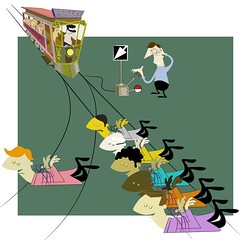
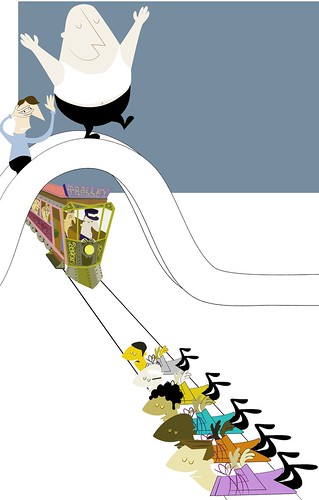
It’s Thought Experiment day in CoPhi (TX-Phi?) with Philippa Foot’s infamous runaway trolleyJudith Thomson‘s unwanted violinist (always a hot topic in Bioethics), and John Rawls‘ Veil of Ignorance in LH (& Jonathan Wolff on Rawls in PB); and in AtP, Bill Moyers and Joseph Campbell. [And for #H1 on Tuesday, a peek forward at Peter Singer.]


And here's a PB bonus on the Trolley Problem... more trolley problems... plus, Sarah Bakewell's recent Times "trolley-ology" review.... (What would Montaigne say about the Fat Man? Maybe “I just don’t do trolleys.” )

For those who do trolleys, two scenarios seem to pull in different directions: either pull  a switch to divert the runaway trolley, or push a person fatally into its path. Same result, different intuitions about our moral culpability.
In numerical terms, the two situations are identical. A strict utilitarian, concerned only with the greatest happiness of the greatest number, would see no difference: In each case, one person dies to save five. Yet people seem to feel differently about the “Fat Man” case. The thought of seizing a random bystander, ignoring his screams, wrestling him to the railing and tumbling him over is too much. Surveys suggest that up to 90 percent of us would throw the lever in “Spur,” while a similar percentage think the Fat Man should not be thrown off the bridge. Yet, if asked, people find it hard to give logical reasons for this choice. Assaulting the Fat Man just feels wrong; our instincts cry out against it.
I find it hard to take trolleys seriously. But there is a point to thinking about cartoonishly-exaggerated ethical scenarios...
basic trolley scenariobridge situation


What is the point of thought experiments? (What is the point of armchairs?) To “trigger our awareness of conflicts between judgments that we previously held in combination” and “open up new conversations.” And give us a relaxed venue for mulling stressful situations, so we'll be prepared for the them if and when they come. Mostly thought experiments are just fun.


One result of trolley experiments is the valuable reminder that concrete choices, in even the most contrived, improbable situations, are messy and complicated. A normally-endowed and emotionally healthy human being will never find it easy to pull a switch that kills, no matter what she tells you. 
A cool utilitarian calculus has its place, and so do our subrational instinctive juices. If either were missing, we would make some truly terrible choices. Yet there is also still room for that quaint seated figure, thinking through the principles and working out a kind of pragmatic yet justifiable wisdom. An armchair is also a useful place for reading books [about thought experiments]. With all this help, then perhaps when the trolley comes rattling around the corner, and with a half-second to decide, you might just do the right thing. Whatever that may be. Bakewell


John Rawls’ veil. Rawls was committed to the idea of selfless mutual self-interest as the precondition of justice and fairness. Justice is fairness, he said.

What principles of social justice would be chosen by parties thoroughly knowledgeable about human affairs in general but wholly deprived—by the “veil of ignorance”—of information about the particular person or persons they represent? Rawls thought they’d pick these two: (1) fundamental  individual equality, allowing (2) only those inequalities that can be presumed to work out to everyone’s advantage.

An amusing (if not especially animated) rendition of Rawls:


Last time we talked Rawls somebody suggested a sporting example: a Rawlsian social contract won’t entirely level our playing fields, won’t be purely egalitarian. Behind the veil we’d probably want to design a society in which those who excel at a game others  might enjoy watching, for instance, will have sufficient incentive to actually play. The basketball fan does not begrudge Michael Jordan’s fortune, if he thinks it contributes to his own delight at courtside. It’s to his “advantage,” too, for Michael to have more money and notoriety.

But whatever the deliberators decide, behind that veil, Rawls wanted to give them a procedural opportunity to agree on the basis of relevant considerations. We’ve instead been auctioning public office and social influence to the highest, loudest bidders, not the coolest reasoners.  There’s nothing fair or just about that. The “law of peoples” can do better.

Michael Sandel is a semi-Rawlsian, with his talk of restoring respectful forms of democratic argument. He's also, as Wolff notes, "a communitarian who thinks Rawls is biased towards liberal individualistic conceptions of the good."


And he likes to think about trolleys too.


The late Robert Remini, biographer of Jackson and Claywas by my reckoning a Rawlsian in spirit. He bemoaned the lost art of political compromise. (“Clay,” btw, is a family namesake: my Dad was James Clay, his Dad was Clay, and back it went deep into the 19th century. A rooted source of my pragmatic attraction to anti-ideology, perhaps?) [Remini on NPR]

An important question: "who's doing the imagining in the Original Position?" A bunch of philosophers will presumably think and deliberate differently from a bunch of fascists, or monks. But if it's a polyglot mix drawn from a diverse society, and none of them knows their race, sex, earning power, or basic preferences, maybe they won't think exclusively like (narrow or partisan) philosophers, fascists, and monks. Maybe they'll think like pluralists and cosmopolitans. Maybe they won't be prepared to gamble with their liberty. Maybe they'll want to be just and fair, and be more inclined to take care of the least well-off. Maybe so. 

Carlin Romano fills out Rawls's position with the important, astonishing, neglected biographical Rawls back-story. It's useful and illuminating to know who he is, in assessing his theory of justice. He was a lucky child, recovering from diptheria and pneumonia, then a lucky soldier. His siblings and army brothers were not so lucky. He felt bad about his good luck, and angry about the theodicies offered to account for it. 
A Lutheran pastor... said that God aimed our bullets at the Japanese while God protected us from theirs. I don't know why this made me so angry, but it certainly did. I upbraided the Pastor (who was a First Lieutenant) for saying what I assumed he knew perfectly well... were simple falsehoods about divine providence... Christian doctrine ought not to be used for that...
To interpret history as expressing God's will, God's will must accord with the most basic ideas of justice... I soon came to reject the idea of the supremacy of the divine will as also hideous and evil. 
Did Rawls "fail" to justify his theory of justice? Wolff doesn't think so. Nor, apparently, do the theatrical producers behind this:


Bill Moyers has been the most philosophically-curious face on television for a long time, producing programs and companion books like A World of Ideas, Healing and the Mind, and Language of Life. Just watched his late-'80s interview with Isaac Asimov, it's riveting. And Moyers' series with the late Joseph Campbell, The Power of Myth, was a surprise smash hit. It's all about discovery and creation of meaning. "To find your own way is to follow your bliss..."

Or, as we trolley philosophers say: "Your own track, kid, and not what your guru tells you."


Monday, April 28, 2014

Foot, Thomson, Rawls, Moyers, Campbell

Final report presentations continue, on Thought Experiment day in CoPhi (TX-Phi?) with Philippa Foot’s infamous runaway trolleyJudith Thomson‘s unwanted violinist (always a hot topic in Bioethics), and John Rawls‘ Veil of Ignorance in LH (& Jonathan Wolff on Rawls in PB); and in AtPBill Moyers and Joseph Campbell


And here's a PB bonus on the Trolley Problem... more trolley problems... plus, Sarah Bakewell's recent Times "trolley-ology" review.... (What would Montaigne say about the Fat Man? Maybe “I just don’t do trolleys.” )

For those who do trolleys, two scenarios seem to pull in different directions: either pull  a switch to divert the runaway trolley, or push a person fatally into its path. Same result, different intuitions about our moral culpability.
In numerical terms, the two situations are identical. A strict utilitarian, concerned only with the greatest happiness of the greatest number, would see no difference: In each case, one person dies to save five. Yet people seem to feel differently about the “Fat Man” case. The thought of seizing a random bystander, ignoring his screams, wrestling him to the railing and tumbling him over is too much. Surveys suggest that up to 90 percent of us would throw the lever in “Spur,” while a similar percentage think the Fat Man should not be thrown off the bridge. Yet, if asked, people find it hard to give logical reasons for this choice. Assaulting the Fat Man just feels wrong; our instincts cry out against it.
I find it hard to take trolleys seriously. But there is a point to thinking about cartoonishly-exaggerated ethical scenarios...
basic trolley scenariobridge situation


What is the point of thought experiments? (What is the point of armchairs?) To “trigger our awareness of conflicts between judgments that we previously held in combination” and “open up new conversations.” And give us a relaxed venue for mulling stressful situations, so we'll be prepared for the them if and when they come. Mostly thought experiments are just fun.

One result of trolley experiments is the valuable reminder that concrete choices, in even the most contrived, improbable situations, are messy and complicated. A normally-endowed and emotionally healthy human being will never find it easy to pull a switch that kills, no matter what she tells you. 
A cool utilitarian calculus has its place, and so do our subrational instinctive juices. If either were missing, we would make some truly terrible choices. Yet there is also still room for that quaint seated figure, thinking through the principles and working out a kind of pragmatic yet justifiable wisdom. An armchair is also a useful place for reading books [about thought experiments]. With all this help, then perhaps when the trolley comes rattling around the corner, and with a half-second to decide, you might just do the right thing. Whatever that may be.Bakewell


John Rawls’ veil. Rawls was committed to the idea of selfless mutual self-interest as the precondition of justice and fairness. Justice is fairness, he said.

What principles of social justice would be chosen by parties thoroughly knowledgeable about human affairs in general but wholly deprived—by the “veil of ignorance”—of information about the particular person or persons they represent? Rawls thought they’d pick these two: (1) fundamental  individual equality, allowing (2) only those inequalities that can be presumed to work out to everyone’s advantage.

An amusing (if not especially animated) rendition of Rawls:


Last time we talked Rawls somebody suggested a sporting example: a Rawlsian social contract won’t entirely level our playing fields, won’t be purely egalitarian. Behind the veil we’d probably want to design a society in which those who excel at a game others  might enjoy watching, for instance, will have sufficient incentive to actually play. The basketball fan does not begrudge Michael Jordan’s fortune, if he thinks it contributes to his own delight at courtside. It’s to his “advantage,” too, for Michael to have more money and notoriety.

But whatever the deliberators decide, behind that veil, Rawls wanted to give them a procedural opportunity to agree on the basis of relevant considerations. We’ve instead been auctioning public office and social influence to the highest, loudest bidders, not the coolest reasoners.  There’s nothing fair or just about that. The “law of peoples” can do better.

Michael Sandel is a semi-Rawlsian, with his talk of restoring respectful forms of democratic argument. He's also, as Wolff notes, "a communitarian who thinks Rawls is biased towards liberal individualistic conceptions of the good."


And he likes to think about trolleys too.


The late Robert Remini, biographer of Jackson and Claywas by my reckoning a Rawlsian in spirit. He bemoaned the lost art of political compromise. (“Clay,” btw, is a family namesake: my Dad was James Clay, his Dad was Clay, and back it went deep into the 19th century. A rooted source of my pragmatic attraction to anti-ideology, perhaps?) [Remini on NPR]

An important question: "who's doing the imagining in the Original Position?" A bunch of philosophers will presumably think and deliberate differently from a bunch of fascists, or monks. But if it's a polyglot mix drawn from a diverse society, and none of them knows their race, sex, earning power, or basic preferences, maybe they won't think exclusively like (narrow or partisan) philosophers, fascists, and monks. Maybe they'll think like pluralists and cosmopolitans. Maybe they won't be prepared to gamble with their liberty. Maybe they'll want to be just and fair, and be more inclined to take care of the least well-off. Maybe so. 

Carlin Romano fills out Rawls's position with the important, astonishing, neglected biographical Rawls back-story. It's useful and illuminating to know who he is, in assessing his theory of justice. He was a lucky child, recovering from diptheria and pneumonia, then a lucky soldier. His siblings and army brothers were not so lucky. He felt bad about his good luck, and angry about the theodicies offered to account for it. 
A Lutheran pastor... said that God aimed our bullets at the Japanese while God protected us from theirs. I don't know why this made me so angry, but it certainly did. I upbraided the Pastor (who was a First Lieutenant) for saying what I assumed he knew perfectly well... were simple falsehoods about divine providence... Christian doctrine ought not to be used for that...
To interpret history as expressing God's will, God's will must accord with the most basic ideas of justice... I soon came to reject the idea of the supremacy of the divine will as also hideous and evil. 
Did Rawls "fail" to justify his theory of justice? Wolff doesn't think so. Nor, apparently, do the theatrical producers behind this:


Bill Moyers has been the most philosophically-curious face on television for a long time, producing programs and companion books like A World of Ideas, Healing and the Mind, and Language of Life. His late-'80s interview with Isaac Asimov is riveting. So is the Neil deGrasse Tyson Cosmos II preview. Here he is recently with Bill McKibben:


Moyers' series with the late Joseph Campbell, The Power of Myth, was a surprise smash hit. It's all about discovery and creation of meaning. "To find your own way is to follow your bliss..."

Or, as we trolley philosophers say: "Your own track, kid, and not what your guru tells you."