Delight Springs

Showing posts sorted by relevance for query ricard. Sort by date Show all posts

Friday, October 11, 2013

Happily we flow along

"Knowing truth and facing reality is essential to a happy life."

Last insight you'd ever have expected from a Dursley, but Shannon and her fellow Wanderers in CoPhi let Mrs. D have it yesterday. What a dramatically impressive Potter report they did, complete with Blooper Reel and authentic Hogwarts comestibles! They need to share it with the world.

I later shared the last remnant of the Butter Beer with students in HAP 101, one of whom-- obviously not a fan-- unhappily discovered its essence as cream soda. No magic. Face reality, James.

(Daniel Radcliffe was on the radio right before the Wanderers' report, btw. Heard him during my eerily solitary bikeride through shutdown-shuddered Stones River.)

In HAP 101 we learned of Matthieu Ricard's habits of happiness, meditation, mindfulness, freedom from negative emotions etc., and Mihaly Csikszentmihalyi on Flow ("the secret to happiness"). Does it make you happy to achieve an optimally balanced engagement of your particular skills and interests with challenges that elicit them? Some of us seemed to think that sounds like too much work, but Csik.'s point is that it feels effortless and liberating.

I recalled The Monk and the Philosopher, an insightful text in my old Vandy "Meaning of Life" course. Ricard's dad is the philosopher, Jean Francois Revel.


We professional western philosophers are congenitally, occupationally suspicious of "doctrinal" solutions to the problem of the meaning of life (whatever we think that means). We're especially leery of talk about "direct contemplation of absolute truth, beyond all concepts," etc. Ricard and the Buddhists insist, though, that a profound non-doctrinal "inner transformation" of the sort they seek is available to all.

We'll have our little Fall Break and then, guided by Owen Flanagan and Bodhisattva's Brain, we'll talk about it. But we must not just talk, that would miss their point entirely.


Wednesday, September 11, 2019

East and west and yin and yang

Where were you on 9.11.01? What do you remember of that day? The current cohort of new students may not have an answer...

In CoPhi today, our attention turns to the dichotomy noted last time between eastern and western approaches to philosophy. That split is well exemplified by The Monk and the Philosopher, the monk being Matthieu Ricard ("the happiest man in the world"), the philosopher his late father Jean-Francois Revel (1924-2006). If anyone is in a position to bridge the difference it must be Ricard, who walked away from a promising scientific career in molecular biology to go and study Buddhism with the Dalai Lama in Tibet. Ricard on happiness...

And if anyone nailed it, in observing the crowd-mind of our increasingly benighted time, it was his Dad. Revel said:

“A human group transforms itself into a crowd when it suddenly responds to a suggestion rather than to reasoning, to an image rather than an idea, to an affirmation rather than to proof, to the repetition of a phrase rather than to arguments, to prestige rather than to competence.”

Too many of the most "responsive" among us, in fact, don't even require "prestige" in any but the most literal sense, in our phrase-mongering tweeters and instagrammers and snapchatters. That's precisely why Stephen Batchelor's advocacy of a secularized Buddhism strikes many as right for our time.

Interesting thought from Elon Musk, echoing the late John McDermott (and others of course) about the "journey":

If heat death will be inevitable end of Universe, it actually *is* all about journey 🤔

An old post:
So much to talk about in CoPhi today, spanning east to west. My hook this morning is the ever-elusive Tao, the way of natural harmony and balance and reconciliation of mutual opposition. It’s hard to talk about (“The Tao that can be named is not the true Tao” etc.) but maybe that’s why we ought to try.
M 30/T 31 PW 18-39. Buddhism & JainismConfucius & Taoism, Early Greek philosophy (pre-Socratics), SocratesPlato. RECOMMENDED: JMH ch3 & p11-24
Two of the Tao’s better trans-cultural emissaries are Fritjof Capra and Benjamin Hoff, authors respectively of The Tao of Physics and The Tao of Pooh.
I’m a follower of Pooh from way back, he was Older Daughter’s favorite bear. (There have been a few, eh Boo-Boo?)
Capra, though, I’m really just finally beginning to explore, through the back door: David Kaiser’s How the Hippies Saved Physics . Maybe it’s a load of quantum flapdoodle, as skeptic Michael Shermer & others say [review of What the #$*! Do We Know?], but it’s challenging (or at least provocative) flapdoodle.
Our tendency to divide the perceived world into individual and separate things  and to experience ourselves as isolated egos in this world,” Capra contended, had long been understood in Eastern traditions as a mere illusion which comes from our measuring and categorizing mentality. Western observers’ impressions of the physical world as pointillist and fundamentally cleaved off from human consciousness arose not from the nature of reality per se, but from the mental filters and habits we happened to have imposed…  three centuries after Newton and Descartes, quantum physicists had only just learned that “we can never speak about nature without, at the same time, speaking about ourselves”—a deep insight that Capra considered comparable to age-old Hindu, Buddhist, and Taoist teachings.
JMH as usual has helpful things to say about all our topics today.  Consider her remarks on the Buddha’s conception of karma, for instance, and how questions like whether there’s a God or an afterlife or an immortal immaterial soul are unhelpful.
He said worrying about these things would be like a man pierced by an arrow asking questions about the family origins of the man that made the weapon… He said that to ask where the soul goes after death is like extinguishing a campfire and then asking whether the fire went east or west when it left. “The question is not put rightly.” Was there a God? Were there gods? The Buddha said these are questions “which do not edify.”
And here we can note an east-west meeting of the minds. Buddha, Confucius, and Socrates in particular were always more interested in the practical business of how to live well, than in speculative and metaphysical  questions about ultimate truth.
And this brings us to Socrates and Plato. The former “taught” the latter, who in turn taught Aristotle.  Each student disagreed with his mentor in big ways, without abandoning attention or respect. (Good role models for us all, we co-philosophers and listeners.)  But there’s a real question about whether Plato the metaphysician didn’t exaggerate Socrates’ interest in the hypothetical world of essences, Ideas, and Forms and understate his preoccupation with ethics. It’s the primarily-ethical bearing of Socrates’ inquiries, after all, that gets Solomon to label him a Sophist (and to intend by that a compliment).
Socrates was not opposed to the Sophists; he was the best of them…
Socrates believed that virtue is the most valuable of possessions, that the truth lies beyond the “shadows” of our everyday experience, and that it is the proper business of the philosopher to show us how little we really know. PW
Socrates “knew nothing and yet was wiser than most, since at least he knew that he knew nothing.” JMH continues:
Socrates counts among those great minds who actually cultivated doubt in the name of truth. The Socratic method is an eternal questioning. This is not relativism; there is truth to be found, but human beings may best approach it through doubt than conviction.
Plato’s allegory of the Cave, in Republic  Book VII, is a thinly-veiled homage to his teacher Socrates (whose “last days” he witnessed and was deeply affected by), though his own philosophy went considerably further than Socrates’ in asserting metaphysical knowledge of another world.

Wednesday, October 7, 2015

Matthieu Ricard

Took advantage of Indian Summer yesterday with a long lunch-hour walkabout at the old civil war fortress. How do other academics, granted the glorious freedom to get away from their desks at mid-day, allow themselves not to, on days like these? 

And, how do they allow themselves and their classes not to spill out into any of our many seductive campus courtyards? We did that in my classes yesterday again, in the morning for a CoPhi report on The Simpsons & Philosophy (Sophia was right, it's much easier to think out there) and then late in the day in Happiness to learn why Matthieu Ricard is such a happy guy. Damon, Caroline, and Jessica assumed appropriate meditative postures on the ground and gave us a great introduction to the "happiest man in the world."

Ricard repeatedly writes that happiness takes work, but promises that it's work we're all fitted for if we're willing. We don't have to toss our western careers and lifestyles and move to Tibet, we can detach from the toxins of our culture, from our habitual acquisitiveness and busy-ness, at will.

This is an eastern message whose "astonishing" western echo Frederic Lenoir finds finds in Stoicism and Montaigne's skepticism. 
This wisdom can be summed up in a few words: nothing is more precious than life, and in order to be happy we just need to learn to love life and enjoy it in the proper, adaptable way, in accordance with our own natures.
And also like Chuang Tzu, and the current Dalai Lama, Montaigne has a happy sense of humor. He laughs at himself and invites us all to lighten up in a spirit of gentle self-mockery: On the highest thrones we're still seated on our asses, etc. What fun he would have had with TV's viagra and cialis spots.

But, just learn to love life really seems more promissory than practical - kind of like the Pythons' "How to Do It."
Here's Jackie to tell you how to rid the world of all known diseases... Well, first of all become a doctor and discover a marvelous cure for something, and then, when the medical world really starts to take notice of you, you can jolly well tell them what to do and make sure they get everything right so there'll never be diseases any more.
Tune in next time, sure, but don't expect anyone to teach you how to love life. That's the self-help each of us has to manage for ourselves if we can. The happy example of a radiant French-Tibetan scientist/monk, and a TED Talk or two (or two dozen) is more than encouraging, but ultimately the pursuit of happiness is personal.

Podcast
6:49/6:49, 59/86

Monday, May 9, 2016

Commencement

Commencement on Saturday afternoon was long and hot, as usual, under the medieval robes in Murphy Center. Our speaker Kary Antholis, a filmmaker & HBO exec, gave the grads a short and worthy sendoff.
Explaining that his Oscar-winning documentary on Holocaust survivor Gerda Weissmann Klein, “One Survivor Remembers,” had its impetus in his own mother’s family’s horror in Greece at the hands of the Nazis, Antholis recalled Mrs. Klein’s beautiful, gracious words that night and their impact since. (You can see Mrs. Klein’s speech here.)
“You do earn success with hard work and self-reliance, but you also will be served by remaining mindful of the people who’ve helped you along the way,” Antholis said.
“As you go forward and build your lives, enjoy success and endure setbacks, please know that you will always be well-served by honoring the voices, values and love of those who have supported you and made sacrifices for you.”
Over the speaker's right shoulder, nodding attentively (in response to something cynical my colleague Jack, off-camera, whispered as he looked up briefly from his book), there I am, at about the 3'46" mark.


Fortunately my face doesn't betray the discomfort of those tiny rock-hard plastic seats on my aching joints. I never sit still for two and a half hours, except at Commencement.

What really matters, though, is how happy it made all those kids - some not so young anymore - to walk off that stage with those credentials. 


If I ever give a commencement speech I'll quote Kary Antholis on always being mindful of the others whose support and sacrifice enables our personal flourishing. I'll mention Buddhist altruism, compassion, and kindness too. "Our own happiness is intimately linked to that of others," writes Matthieu Ricard. The Dalai Lama backs him up on that. The souvenir Older Daughter brought back from Bonnaroo two years ago, now on display in a corner of my office, nearly says it all:


“We are visitors on this planet. We are here for one hundred years at the very most. During that period we must try to do something good, something useful, with our lives. if you contribute to other people's happiness, you will find the true meaning of life.”
5:30/5:47, 70/81/62


Thursday, September 21, 2017

Voltaire, Socrates, Jesus, Kant

Interesting quartet, in Happiness today.

Voltaire's response to my question the other day, as to whether any of us ever regret the examined life and would occasionally prefer to swap places with Forrest Gump or Winnie the Pooh, is as acerbic as you'd expect. "I should be happy if I were as brainless as my neighbor, and yet I do not desire such happiness." Maybe he'd have been happy to live in a better neighborhood. For my part, as I was saying in class, I try to spend a bit of relatively brainless time in the neighborhood every morning with the dogs. It's a happy time of day. Knowledge and lucidity aren't obstacles to happiness, but too much thinking can be.

Our author Monsieur Lenoir is still pushing us to the "Max": last time he urged maximum pleasure and reason, this time he invokes Andre Comte-Sponville for "maximum happiness in maximum lucidity." Is it always really so wise to push the pedal to the metal? Let up on the lucidity accelerator occasionally, I'd say. It better suits the rambling narrative of this Philosopher's Guide.

"Happiness is the awareness of an overall and enduring state of satisfaction in a meaningful existence founded on truth." I guess. Sometimes it's just a warm puppy, though. Awareness can be implicit and pre-verbal.

Satisfaction is a happy word, when coupled with the love of life. Matthieu Ricard's wish for wisdom, flourishing, and peace in every moment is lofty. But as we were saying last time, wasted moments are gone forever. Make a wish. A smart and willful wish, leading to well-chosen goals. Nietzsche's formula was for "a yes, a no, as straight line, a goal." He wasn't that happy, though, do you imagine?

Nor was Kant, I imagine.  "Full and complete happiness" may not exist on earth, but the promise of their attainment after death rings hollow to Epicureans, humanists, and others who think the "earth of things must resume its rights."
The really vital question for us all is, What is this world going to be? What is life eventually to make of itself? The centre of gravity of philosophy must therefore alter its place. The earth of things, long thrown into shadow by the glories of the upper ether, must resume its rights. Pragmatism
Deferred gratification is often a necessary condition of our happiness, but is deferred happiness ever a good idea?

Some more questions: Does illusory happiness interest you? Can you be happy in the absence of meaning and truth? Do you share Matthieu Ricard's "primary aspiration"? Does it set the bar too high? Do you know people who "lose themselves in a permanent hyperactivity, artificially filling the emptiness of their lives"? Is that a fair characterization, or an external view from an unsympathetic perspective? Is it your duty to make yourself worthy of happiness, to be as happy as possible, both, neither... or is talk of "duty" irrelevant to the question of happiness? Were Socrates and Jesus happy? Are martyrs happy, generally? Do you wish for a cause to die for?
==
It's the birthday of H.G. Wells (books by this author), born Herbert George in London (1866). He is the sci-fi writer most known for The Time Machine, The Invisible Man, and War of the Worlds. Wells wasn't the first to write about time travel or alien invasions, but his brand of sci-fi was uniquely realistic. He wanted to make the made-up science as believable as possible. Wells called this his "system of ideas" — today we would call it suspension of disbelief... and here's a nice Happiness poem for today, by Cousin Mary:
“If you suddenly and unexpectedly feel joy, don’t hesitate. Give in to it. There are plenty of lives and whole towns destroyed or about to be. We are not wise, and not very often kind. And much can never be redeemed. Still life has some possibility left. Perhaps this is its way of fighting back, that sometimes something happened better than all the riches or power in the world. It could be anything, but very likely you notice it in the instant when love begins. Anyway, that’s often the case. Anyway, whatever it is, don’t be afraid of its plenty. Joy is not made to be a crumb. (Don't Hesitate)”
 WA

Wednesday, May 4, 2016

Presence, past and future

Thinking more this morning of life-changes, and dipping into Matthieu Ricard's 2004 "Habits of Happiness" TED Talk, where he says some of us believe only in "remembering the past, imagining the future, never the present." I don't know anyone who really says that, but many of us act as though we believe it most of the time. That was Kierkegaard's point, when he complained of the mania of busy-ness. We don't stop to smell the roses often enough, to slow down, to forget the clock and the to-do list and just inhabit the moment attentively.

Others, though, "say happiness is right now; it's the quality of the freshness of the present moment."

They're missing out, too. But on what?

Ricard quotes Henri Bergson, "All the great thinkers of humanity have left happiness vague so that each of them could define their own terms." Smart. When I find a way to articulate what's wrong with pure presence, to the exclusion of past and future - especially future - I'll finally have defined happiness my way and identified my happiness project - which, btw, Gretchen Rubin rightly said we all should undertake. There is no single Project, just so many projects. Most of them have been allowed to gather dust.

We noted in Bioethics, contrary to the conventional wisdom, that many older people are also happier than at any earlier stage of life. Slower, sure. But steadier too, those who've kept themselves mentally engaged, active, and curious. There are genes for that of course, but you don't have to have won the genetic lottery to develop your happiness skills. 

Among them: a capacity for attentive presence, a reminiscent fondness for the past of pleasant memory, and an active interest in what William James called our most vital question. "What is this world going to be? What is life eventually to make of itself?" Happy people take delight in imagining the future, caring about it, building it - or at least not impeding or derailing it. 

My current cosmic leisure-reading looks forward and back, while pondering life in all its dimensions. The big picture is not an enemy of meaningful presence, and may even be one of its conditions.

Image result for how it all began impey  Image result for five billion years of solitude the search for life among the stars

"On this day in 1675, England’s King Charles II commissioned the Royal Greenwich Observatory, the center of time and space on Earth..." And its the birthday of Horace Mann, who said we should all “be ashamed to die until you have won some victory for humanity.”

6 am/5:52, 47/68


Wednesday, September 12, 2018

The monk and the philosopher in the Anthropocene

LISTEN...
In CoPhi today, our attention turns to the dichotomy noted last time between eastern and western approaches to philosophy. That split is well exemplified by The Monk and the Philosopher, the monk being Matthieu Ricard ("the happiest man in the world"), the philosopher his father Jean-Francois Revel. If anyone is in a position to bridge the difference it must be Ricard, who walked away from a promising scientific career in molecular biology to go and study Buddhism with the Dalai Lama in Tibet.

In  Environmental Ethics, we wrap up our consideration of Erle Ellis's Anthropocene: A Very Short Introduction.

Some worry that recognizing the Anthropocene might be to issue a blank "anything goes" check, while others - and I'm with them - think that failing to do so is to deny the reality of climate change. Others still think it all a distractive labeling debate, a re-arranging of deck chairs as the ship slowly (or not so slowly) sinks.

In any event, it seems undeniable that humans have become a force of nature, geophysical agents at whose hands society and nature have merged. Our story is Big History, and so far it's the story of wealthy nations (the USA, with China lately playing catch-up but still lagging far behind, per capita) and individuals emitting carbon pollutants at a rate wildly out of proportion with their numbers. Our story has largely been that of capitalism ascendant, remunerating short-term, self-interested thinking and in the process transforming the Earth by producing massive social inequalities.

So what we may really need, at this stage, is no single account but "many different Anthropocene narratives, to engage with the broadest range of human needs." Hence, the rationale for our course project of crowd-sourcing a variety of "cli-fi" narratives to furnish alternative visions of our future. "The visions we offer our children shape the future," said Carl Sagan. Our vision quest is no idle daydream, it's the preparation our survival demands.

Donna Haraway, inspired by sci-fi writer H.P. Lovecraft, has offered her imaginative vision of an alternative story, that of the Chthulucene. Her message: individuality is an illusion, all of life is connected, is "kin."

"The Anthropocene demands action,"beginning with an act of acknowledgement that we face serious challenges of our own design, that will require some serious noospheric thought to overcome.

Are we the Promethean technology masters who must and will save ourselves, or are we hubristic Icarus, about to get singed by our own overconfidence? Too soon to say, but "the prospect of a better planetary future" is not beyond the pale. After all, we've banned DDT, protected endangered wildlife, created parks and preserves, invested in carbon-neutral energy systems, developed solar technology and electric cars, issued LEED certification... But past is prologue. We're now called to think large and long. Can we do it? Set the clock, for 10,000 years. There's no time like the Long Now.


Tuesday, November 21, 2017

How to Live an Experiment

More Jamesian happiness today. We've briefly considered On a Certain Blindness (1899), which sounds a fundamentally altruistic note. It's as interested in (though necessarily less comprehending of) others' "springs of delight" as in one's own. (We'll take a closer look at Blindness next time.)

I've just finished Matthieu Ricard's Altruism, and am struck by the consanguinity of Ricard's Buddhism with James's pragmatic pluralism. The latter celebrates individuality, subjectivity, and selfhood, sure; but it equally extols empathy and compassion.

Those virtues were on impressive display when young William James advised a friend - and himself - to counter what we'd nowadays call SAD (seasonal affective disorder) with a fictive inner shift of attention:
Image result for skimming gullsRemember when old December's darkness is everywhere about you, that the world is really in every minutest point as full of life as in the most joyous morning you ever lived through; that the sun is whanging down, and the waves dancing, and the gulls skimming down at the mouth of the Amazon, for instance, as freshly as in the first morning of creation; and the hour is just as fit as any hour that ever was for a new gospel of cheer to be preached. I am sure that one can, by merely thinking of these matters of fact, limit the power of one's evil moods over one's way of looking at the cosmos. (Letters vol.1)
Today, we turn back to two of his earlier essays: The Sentiment of Rationality (1879) and The Dilemma of Determinism (1884).

They convey the themes most central to James's perpetual interest in personal flourishing: enthusiastic acceptance of one's own and others' distinctive individuality as the pre-eminent condition of feeling oneself "at home" in the world, at peace and at liberty to enjoy "the sufficiency of the present moment"; and, a sense of one's own free agency as pragmatically vindicated by those who act on it ("my first act of free will shall be to believe in free will"). For James, to be happy is fully to inhabit the present and confidently anticipate your fitness to meet the future freely. It's to reject the tired notion that the "juice has been pressed out of the free-will controversy," that free will is an illusion without a future. To the contrary, for those whose willing natures require a canvas of real possibility the future must be a free and open country awaiting the brushstrokes of our attention, belief, and action.

Why do we philosophize? James says we seek a more rational "frame of things," marked by "a strong feeling of ease, peace, & rest" affording transition from confusion and perplexity to pleasure in rational comprehension. That's a subjective definition of rationality, concerned not simply with the degree of objective fit between our ideas and the world but with the palpable and personal perception therof.
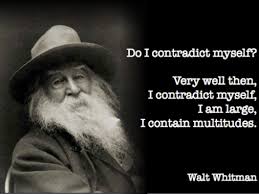
Image result for walt whitman sufficient just as i amThe poet Walt Whitman, singing himself and by natural extension (for one of generous spirit) all selves, celebrated the feeling of sufficiency just "as I am," and James says that "fluent" feeling is rationality's sine qua non. "Whatever modes of conceiving the cosmos facilitate this fluency, produce the sentiment of rationality." The very coupling of sentiment and rationality was already a clue, of course, that James's approach would defy rational convention. Not many epistemologists are interested in how rationality feels. That didn't deter James, who was given to mocking "our bald-headed young PhDs, boring one another at conferences" with their erkentnisstheories etc.

"Every one knows how when a painful thing has to be undergone in the near future, the vague feeling that it is impending penetrates all our thought with uneasiness and subtly vitiates our mood even when it does not control our attention; it keeps us from being at rest, at home in the given present. The same is true when a great happiness awaits us."

Anticipation is making me wait, is keeping me waiting, sang Carly Simon in a song made silly by association with ketchup. The waiting is the hardest part, sang Tom Petty. But anticipatory waiting can be (or can be reconstructed in memory as) delicious, when (so the speak) the ketchup flows at last. Fluency and sufficiency are hard to have and hold, but when you finally get there it's the greatest deliverance and homecoming. Indeed, "coming to feel at home" is the great prize in life for the human animal.

"It is of the utmost practical importance to an animal that he should have prevision of the qualities of the objects that surround him, and especially that he should not come to rest in presence of circumstances that might be fraught either with peril or advantage." Evolution wants us (so to speak) to feel at home in secure surroundings, and spurs our curiosity to interrogate our surroundings and insure their homeliness. 

Must we wait and hope for the fluent feeling of homey sufficiency to descend and grace us? No, we must muster our subjective energies and go after it. 
...in every fact into which there enters an element of personal contribution on my part, as soon as this personal contribution demands a certain degree of subjective energy which, in its turn, calls for a certain amount of faith in the result,--so that, after all, the future fact is conditioned by my present faith in it,--how trebly asinine would it be for me to deny myself the use of the subjective method, the method of belief based on desire!
Image result for climbing in the alpsIf you're climbing in the Alps and must face either certain death or a death-defying leap, you'd better believe in yourself. "The part of wisdom clearly is to believe what one desires; for the belief is one of the indispensable preliminary conditions of the realization of its object. There are then cases where faith creates its own verification." That's the view Bertrand Russell derided as the will to make-believe. But Russell was no climber, though like us all he was a chooser and a decider.

Are our choices and decisions freely willed? It so, we can't allow ourselves to be compelled to believe. "Our first act of freedom, if we are free, ought in all inward propriety to be to affirm that we are free." That was James's own decision, when he "just about touched bottom" and then fortuitously discovered Renouvier's definition of free will as the directed control of one's own attentive mind and decided to experiment with it. To attend to one thing and not another is to court a specific range of possibilities. James was forever battling the Rationalist/Idealist Hegelians and Positivist Necessitarians  of his day, whose doctrines seemed to deny possibility as a real feature of our world. 

"A world with a chance in it of being altogether good, even if the chance never come to pass, is better than a world with no such chance at all... the chance that in moral respects the future may be other and better than the past has been" is more rational if it frees us to entertain and experiment with more possibilities, and occasionally to summon our personal energy, to sustain a promising but insecure leap of belief and action towards something better. That's taking a chance, and not surrendering to fate.

As we've noted, some of us are more at home in a personal world of chance and risk. Those who are, studies seem to show, tend to be happier. James was probably one of those. "In utrumque paratits, then. Be ready for anything — that perhaps is wisdom."

The "Stone" essay "How to Live a Lie" proposes that James was a "free will fictionalist" who willfully accepted propositions that defy rational belief. I don't think much of the Times headline-writer's decision to label that a "Lie," fiction at its best is a vehicle of truth. Better to call it living an experiment, in the Millian sense: each of us, insofar as our lives become for us projects in pursuit of well-being, are experimentalists seeking the right personal fit between our beliefs, statements, actions, and experience. James was a life-long free will experimentalist, who found that believing in free will conduced to the best version of himself, made the most "rational" sense of his experience, made him a better philosopher and a better human being, made him happy in the fullest sense of the term. No lie.
==
Today is the birthday of French writer, historian, and philosopher François-Marie Arouet, better known by his nom de plume, Voltaire (books by this author), born in Paris (1694). Voltaire’s works regularly skewered politics and religion, and he was prolific in nearly every literary way, writing plays, essays, novels, and poetry. He’s best known for his satire Candide (1759), a breezy, trenchant treatise on humanity and philosophy, which blended fiction with real historical events like the Lisbon earthquake and the Seven Years War... His prolific output may have been the result of copious cups of caffeine: he’s said to have enjoyed nearly 40 cups of coffee every day, all while in bed, dictating his writing to secretaries. He decided to call himself “Voltaire” after a stint in the Bastille in 1718. It’s an anagram of AROVET LI, the Latinized spelling of his surname, and the first letters of the phrase le jeune, which means “the young”... Voltaire bought a large house in Geneva, where he set about cultivating a beautiful garden... This is where he also wrote Candide... On his deathbed, it is said that he murmured, “I die adoring God, loving my friends, not hating my enemies, and detesting superstition"... The agreement known as the Dayton Accords was reached on this date in 1995. The presidents of three rival Balkan states — Bosnia, Serbia, and Croatia — met at Wright-Patterson Air Force Base on the outskirts of Dayton, Ohio, to try to hammer out an agreement to end the war in Bosnia.  WA

On this day in 1620 the Mayflower Compact was signed by Pilgrims at Cape Cod... 1877 Thomas Edison announces his "talking machine" invention (phonograph), the 1st machine to play and record sound... It's Stan Musial's birthday (1920-2013)... 1963 US President John F. Kennedy flies to Texas (assassinated the next day)

Orig. draft 11.__.15. 5:30/6:15, 66/75

Tuesday, May 3, 2016

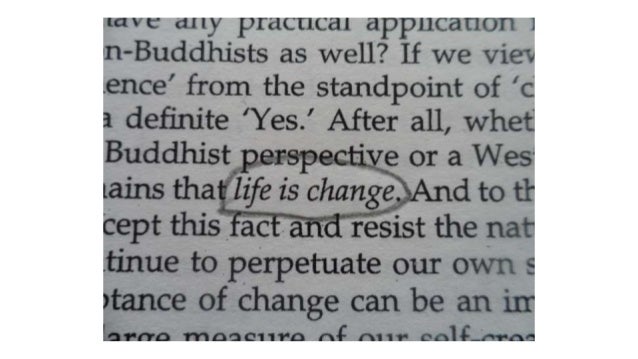
"Life is change"

Our first Lifelong Learning Happiness class yesterday was great fun, over in the Ingram Building across the street that used to be a Baptist church before the university bought it. The amusing irony is not lost on me, that I'm preaching happiness in a place I had to leave, to find our subject and my calling. Big change.

I had plenty of room to roam, with my mobile mic in the former sanctuary, as we introduced our topic and ourselves. It was quite a change from my usual classroom situation, to be in the presence of so many "mature" learners (not decades younger than I) who got all my dated references, laughed at my bad jokes, and weren't at all reticient to speak up and say what they'd learned over a lifetime.

One of the points they seemed to concur with: happy people aren't afraid to make a change. Gretchen Rubin, for instance, whose ongoing Happiness Project (not to be confused with Project Happiness, also dedicated to positive change) is happening because she found life in the legal fast lane insufficiently gratifying. She acknowledged the necessity of change.

Chris Phillips also comes to mind. He left a lucrative advertizing career to launch Socrates Cafe.

And then there's Matthieu Ricard, the molecular biologist who left France for Tibet, became the Dalai Lama's French translator and "the happiest man in the world." We'll talk about him next week. Can't wait.

6 am/5:53/7:34, 55/69/49

Tuesday, February 4, 2014

Research, and the good life for all

Did the Honors lecture yesterday. That was fun! Can't believe it's been nearly five years since the last time.

Today in Bioethics we'll talk "research." Things like clinical trials and research involving animals and their rights, and genetics, and epidemiology. We'll look at the funding gap between what we need to cure and where our research dollars are actually going, and at the moral imperative of genuine and informed consent. We'll look at disturbing instances of fraudulent and dishonest research. And we'll consider Peter Singer's claims about "speciesism."


The future of research is a daunting source of apprehension and speculation. Michael Sandel and Bill McKibben have aired serious concerns about genetic and other "enhancement" research as potentially catastrophic for our capacity to achieve or even recognize "meaningful" lives. Enhanced may not mean improved.

The Times has a cover story today we should notice: Ethicists are split over the use of genetic testing of embryos... to ensure [parents] that a bad gene would not be passed to their children.
In A&P, it's neuroscience and the good life with Owen Flanagan, as we continue to plow through The Really Hard Problem. (He made it into my honors lecture yesterday, btw, as a cherry-picking Blue Devil "modern-day pragmatist." Maybe we can take a peek at a couple of my slides today.

Many philosophers continue to look askance at Flanagan's empirical and hypothetical approach to eudaimonistic scientia, and to the suggestion that some facts about flourishing should inform our "value judgments." I'm still trying to understand why. Is it misplaced loyalty to a miscast reverence for Saint David of Edinburgh? Or for Aristotle? Or Buddha?

And speaking of the happiest, flow-iest man on earth, Mathieu Ricard...

We look as well today at Flanagan's discussion of Stoics, Skeptics, and Epicureans. "The good life for all," he says, is a more demanding ethic than Aristotle's. Nobody ever said democracy would be easy.

Buddhist psychology is all about alleviating suffering. I wonder if it's enough about optimizing joy, too. And this will inevitably bring us back to one of next time's topics, illusion. Might be worth revisiting a HAP 101 session, early last Fall, devoted to the theme.

Flanagan's main refrain, still, is that we give up our childish habits of thought and live up to our birthright as rational social animals who can handle the truth about our condition as finite material beings living in a material world. Can't argue with that, but I hope we'll draw a careful distinction between childish and child-like. That might be just the distinction a cherry-picking pragmatic pluralist needs, to preserve the integrity of the "thousand-eyed present."