
http://dlvr.it/T24P0Y
Emerson would have a thing or two to say to the young people who fret and worry about what others think of them, lack enthusiasm, doubt their own originality and prospects.
He said of the "meek young men" of his own day that they "grow up in libraries, believing it their duty to accept the views which Cicero, which Locke, which Bacon have given, forgetful that Cicero, Locke and Bacon were only young men in libraries when they wrote these books.” American Scholar
In Nature he said "The sun shines today also," so "Why should we not also enjoy an original relation to the universe? Why should we not have a poetry and philosophy of insight and not of tradition, and a religion by revelation to us, and not the history of theirs?"

I've circled around again to Circles, the tenth of his first series of essays (1841), for reaffirmation of my own original relation to the universe. He'd of course prod me to "tell me what you know" rather than recycle his words, and I will. I do. I also share the circumspection he and I both admire in Montaigne: “Que sais-je?” We're all experimenting with words and visions here.
But so many of the words in Circles bear repeating. Here are some that struck me yesterday on re-reading.
The life of man is a self-evolving circle, which, from a ring imperceptibly small, rushes on all sides outwards to new and larger circles, and that without end. The extent to which this generation of circles, wheel without wheel, will go, depends on the force or truth of the individual soul… if the soul is quick and strong it bursts over that boundary on all sides and expands another orbit on the great deep, which also runs up into a high wave, with attempt again to stop and to bind. But the heart refuses to be imprisoned…
There is no outside, no inclosing wall, no circumference to us…
Conversation is a game of circles. In conversation we pluck up the termini which bound the common of silence on every side.
We can never see Christianity from the catechism:—from the pastures, from a boat in the pond, from amidst the songs of wood-birds we possibly may.
The natural world may be conceived of as a system of concentric circles, and we now and then detect in nature slight dislocations which apprise us that this surface on which we now stand is not fixed, but sliding.
No facts are to me sacred; none are profane; I simply experiment, an endless seeker with no Past at my back.
Nature abhors the old, and old age seems the only disease; all others run into this one. We call it by many names,—fever, intemperance, insanity, stupidity and crime; they are all forms of old age; they are rest, conservatism, appropriation, inertia; not newness, not the way onward. We grizzle every day. I see no need of it.[RWE was 38.]
But the man and woman of seventy assume to know all, they have outlived their hope, they renounce aspiration, accept the actual for the necessary and talk down to the young… This old age ought not to creep on a human mind. In nature every moment is new; the past is always swallowed and forgotten; the coming only is sacred. Nothing is secure but life, transition, the energizing spirit. No love can be bound by oath or covenant to secure it against a higher love. No truth so sublime but it may be trivial to-morrow in the light of new thoughts. People wish to be settled; only as far as they are unsettled is there any hope for them.
Life is a series of surprises…
The one thing which we seek with insatiable desire is to forget ourselves, to be surprised out of our propriety, to lose our sempiternal memory and to do something without knowing how or why; in short to draw a new circle. Nothing great was ever achieved without enthusiasm. The way of life is wonderful; it is by abandonment.
Abandonent. Let go the past, just for now. Write your words, imagine your vision. Let it rip.
Then circle back for another pass, as the gyre expands to contain your expanding imagination.
And repeat the cycle.

As Eleanor Roosevelt said, "You wouldn't worry so much about what other people think of you, if you realized how them they do."
"...in order to feel social anxiety, you have to believe that other people’s negative opinions of you are worth getting upset about, that it’s really bad if they dislike you and really important to win their approval. Even people who suffer from severe social anxiety disorder (social phobia) tend to feel “normal” when speaking to children or to their close friends about trivial matters, with a few exceptions. Nevertheless, they feel highly anxious when talking to people they think are very important about subjects they think are very important. If your fundamental worldview, by contrast, assumes that your status in the eyes of others is of negligible importance, then it follows that you should be beyond the reach of social anxiety."
"How to Think Like a Roman Emperor: The Stoic Philosophy of Marcus Aurelius" by Donald J. Robertson: https://a.co/aEJLAkT
"some people seem to think it an expression of humility to call "the fertile earth a dunghill, and all the blessings of life by the thankless name of vanities." Instead, in Paine's opinion, it looks more like ingratitude."
…Paine's preferred principles were humanist ones: be grateful for life, do not make a cult of suffering, be tolerant toward others, and try to deal with problems as rationally as possible. He summed up his Enlightenment humanist credo: I believe in the equality of man, and I believe that religious duties consist in doing justice, loving mercy, and endeavouring to make our fellow-creatures happy. The Age of Reason, with its message of fellow feeling, equality, happiness, and the enlightened celebration of a magnificent cosmos, brought Paine some far-from-happy experiences. —Bakewell, Humanly PossibleAnton Chekhov said, "Any idiot can face a crisis; it is this day-to-day living that wears you out."
Sometime in the twenty-tens, it became common for students to speak of feeling unsafe when they heard things that offended them…
https://www.newyorker.com/news/the-weekend-essay/the-future-of-academic-freedom"I have an intense loyalty to people near to me, which shows itself in my readiness to go to great lengths to promote their good. This attitude defines my relation to friends, students, and family.
I also believe that although some things matter intensely, many of the things that upset people are of little significance. This conviction has enabled me to live without condemning much and without the desire to run other people's lives. The connected respect for autonomy has been the source of great happiness for me; I attribute my deeply satisfying relations to my children to mutual acceptance built on caring and on love. Love and respect have also served as the foundation of the extraordinary relationship my wife and I enjoy, sharing all the tasks and pleasures of life, and reflecting and writing together on the problems of education.
In graduate school, we are taught to write with footnotes, evoking authority for all questionable claims. Philosophers, like other human beings, find it consoling to run with the crowd and embrace few views that are out of favor. Knowing the fickleness of public opinion, I could never make myself believe that the number of people holding a position has anything to do with its truth. Accordingly, I have learned to write without footnotes, and, when it seemed appropriate, I have embraced wildly unpopular, though not intrinsically outrageous, ideas."
— Stoic Pragmatism by John Lachs
"…I am unable to think of anything more important for the future of academic philosophy in this country than for it to become less academic.Having had more than my share of bad instructors, I sought a job in education as a way to earn a living while I continued my philosophical reflections. I never suspected that I would develop a passion for teaching. Yet conveying to others the benefits I receive from philosophy has become a burning desire and a consuming activity in my life. I do it in a way that seems to some a form of witnessing, showing the immediate pertinence of philosophical ideas to my life.Immense satisfaction attends my good fortune in having had the opportunity to make a contribution to the lives of thousands of undergraduates. I view this multitude of people as extended family: I keep in touch with as many of them as I can and cheer them on in the pursuit of their purposes. I hope philosophy has made a significant difference in their lives. I have also been fortunate in having launched more than sixty young philosophers on their careers. My relation to them is one of lifelong concern and support; helping them with their problems and careers is of vital importance to me. I think of these activities not as the result of optional commitments on my part, but as the continuing expressions of my philosophical beliefs.People whose minds are energetic and who are interested in their fields find it easy to teach well. Bored instructors are boring and the self-absorbed fail to place themselves in the shoes of their students to see how what they say is received. Thinking before one's students' eyes—which means, among other things, teaching without notes—demonstrates what one expects them to do. Keeping in mind the interconnectedness of things and especially the relations of what one teaches to the ordinary concerns of students renders instruction vivid and, when things go well, even memorable.By no means least, good teaching requires deep respect for students. The activity is hallowed because it enables one human being to contribute to the creation of another. Its chance of success is enhanced by embedding it in wider human relations; truly good teachers tend to offer caring companionship as the context of instruction. Perhaps all learning is imitation; if so, there is added reason for teachers to offer themselves as living examples to their students. Knowledge that makes little difference to the instructor's life is, in any case, rightly suspicious and may deserve to be disregarded by students…"
— Stoic Pragmatism by John Lachs
"…The South is littered with memorial battlefields, state parks and memorials and the federal acreage — 4,600 acres at Chancellorsville, 9,500 acres at Chickamauga, 5,000 at Manassas, 2,500 at Vicksburg, rows of rusting cannon, and then the monstrosity that is Gettysburg, a 6,000-acre junkyard of obsolescent obelisks and meaningless mind-numbing monuments and sentimental statuary, a National Park of Bad Art, so cluttered it's hard to walk through and imagine the ferocious battle that took place. Very few people under the age of 60 care about the war it commemorates, and the junk should all be trucked away to a landfill and the land developed into nice neighborhoods with hiking trails and flower gardens and finally put Pickett's Charge and the Lost Cause behind us and go on to more interesting things. You want a memorial, put up a podium on the spot where Abe Lincoln gave his speech and let visitors press PLAY and listen to it..." GKThis reminded me of our brief discussion in CoPhi yesterday of the problem of Forrest Hall. I have a fix, which I've shared with GK's readers:
The ROTC building on my campus in middle Tennessee, and any number of residential streets hereabouts, still bear the name of Nathan Bedford Forrest. Old misplaced sentiment dies hard, administrative wheels grind glacially. But this could be a relatively easy fix: just drop an r, and commemorate the trees instead of the racist.


Yet another one (finally!- after a week lost to weather) [but see Margaret Renkl, below: that week was a gift, not a loss], and even after all these years I still give it an excited exclamation mark. The first day of class, like the first day in MLB, is a seasonal highlight.
If you want to make a good first impression on your professor, class, do not tell me you don't know what "MLB" means. Most of you don't, these days. So I'll also have to explain what a scorecard is, and what it means to get to first base. In CoPhi as in life, the goal is to get there so you can eventually come home... and maybe "know it for the first time," as the poet from St. Louis said ("the end of all our exploring/Will be to arrive where we started"). He didn't come home, he went to England and made a new home there. I came to Tennessee and made a new home here. The simple point is: when you make it home, you score.

"It’s been quite a year. Colleges became flash points for protests over affirmative action, abortion rights, free speech and hate speech, affordability, equity, policing, sexual harassment and assault, unionization, and the Israel-Hamas war, provoking, arguably, the most divisive and contentious campus conflicts since Vietnam..." Inside Higher Ed
But all of that is not our concern on Day 1. Our job is to begin to learn some of the pedagogic ropes, to introduce our subject matter in broad strokes, and to introduce ourselves to one another. Who are you? Why are you here?
Students usually give a variety of responses to that second question, some quite literal (because I was conceived and birthed) or prosaic (because I needed the credit hours) or conformist (or so it seems, after a string of short answers all say because this school is close to home) or pietistic (because god put me here). Many seem to interpret why to mean how, offering a biological explanation of their origins rather than an existential exploration of their aspirations and intentions. It's all good, on Day One. Nobody's in the cellar on Opening Day.
But I would propose, to those who say (or didn't say, but think) they don't want to know why they're here because that would create more anxiety to fulfill others' expectations,
Sounds like you think your purpose is something necessarily imposed externally, rather than something you yourself discover, fashion, and have a personal stake in. Not to have a purpose that you've made your own and internalized is to court nihilism. Or, it's to turn yourself into a robot like that forlorn little guy on Rick and Morty who learns his purpose is to pass the butter. Thing is, whether we're originally "programmed" (by nature, genetics, experience, god) with a set purpose or not, being conscious, reflective, and free means we get to regulate and possibly even re-write the program. I hope you'll come to see philosophy as an invitation to do just that, to find and follow the purpose-driven life. Otherwise, your answer to why you're here is: don't know, don't want to know, don't care. Doesn't matter.
I say it matters. You're not a butter bot. Find your purpose.

And to those who matriculated here because they didn't want to stray too far from home:
Home is sweet, but again I encourage you all to push yourselves to expand your horizons and your conception of home. Growing up means making yourself at home in the wider world. Carl Sagan said it best: to be a true cosmopolitan is to be a citizen of the cosmos, no matter where you hang your hat.
What you want to do is what Jennifer Michael Hecht says the old "graceful life philosophers" like the Epicureans did:
The experience of doubt in a heterogeneous, cosmopolitan world is a bit like being lost in a forest, unendingly beckoned by a thousand possible routes. At every juncture, with every step, one is confronted with alternative paths, so that the second-guessing becomes more infuriating even than the fact of being lost. After a direction is chosen, one is constantly met with another tree in one's path. What do you do if you come from a culture that had a powerful sense of home and local value, and now you are lost in something vast and sprawling, meaningless and strange? The stronger your belief in that half-remembered home, the more likely you are to panic, to grow claustrophobic among the trees and beneath their skyless canopy. Hellenistic men and women felt a desperate desire to get out of the seemingly endless, friendless woods. The graceful-life philosophies of this period were able to achieve an amazing rescue mission for the human being lost in the woods and bone-tired of searching for home. They did this by noticing that we could stop being lost if we were to just stop trying to get out of the forest. Instead, we could pick some blueberries, sit beneath a tree, and start describing how the sun-dappled forest floor shimmers in the breeze. The initial horror of being lost utterly disappears when you come to believe fully that there is no town out there, beyond the forest, to which you are headed. If there is no release, no going home, then this must be home, this shimmering instant replete with blueberries. Hang a sign that says HOME on a tree and you're done; just try to have a good time. — Doubt: A History: The Great Doubters and Their Legacy of Innovation from Socrates and Jesus to Thomas Jefferson and Emily Dickinson by Jennifer Michael HechtThe great task of a reasonable life is to stop searching maniacally for a way out of the “forest” (the natural universe). "Hang a sign on a tree that says Home" and be done with it.

So to begin: Who am I, why am I here?
Well, I'm the designated instructor, a veteran MTSU prof and also (like the poet) a native of the St. Louis region who ran away, I not so far though as old Tom. (I had a professor at Mizzou who told me I wrote like Eliot. I chose to take that as a compliment, but many of my peers think less of poetic prose than I do. Their problem.) There's more about me in the sidebar bio, if anyone cares.
Why I'm here (in Honors 218): to introduce my field of study and promote the relevance and value of philosophy for life. Why I'm here on the planet: to ameliorate what I can, and keep moving forward-- to light a candle rather than curse the darkness.
And that, for present purposes, is who I am: a meliorist and a peripatetic, a guy who says most problems are made soluble-- or tolerable at least-- by putting one foot in front of the other and repeating. A guy who never took Latin but loves to say things like Solvitur ambulando and Sapere aude, and who likes to award bases to students who can translate such expressions and explain them. A guy who agrees with Carl Sagan that knowing we live on a pale blue dot ought to make us kinder, more humane, more enlightened, and more in love with life.
Time at last to make first contact. See you in class!

…In "The Book of (More) Delights," the poet and essayist Ross Gay writes about the gift of time that opens up whenever he unexpectedly arrives at an appointment early, or when the person he plans to meet is running late. Such unplanned changes in agenda can feel, he writes, "like the universe just dropped a bouquet of time, and often a luminous bouquet of time, in your lap."
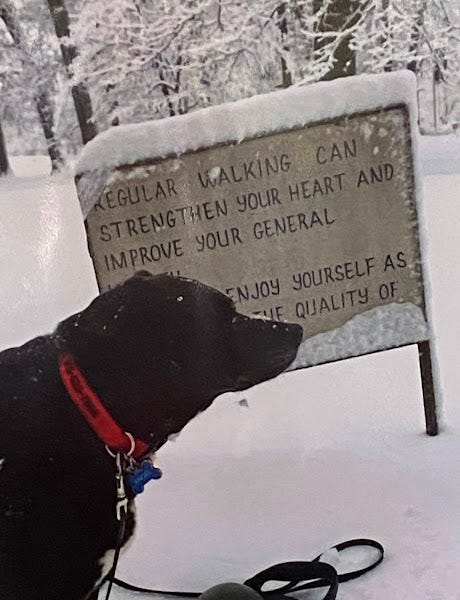
That's what a snow day feels like here. A snow day in the American South on an overheating planet is exactly like an extravagant bouquet of luminous time that comes out of nowhere and lasts as long as it cares to, on a schedule we cannot entirely predict, much less control. Last week the sky offered an unexpected gift of time. Thank God I had no choice but to take it. —Margaret Renkl

An Atheist Chaplain and a Death Row Inmate’s Final Hours
Devin Moss spent a year ministering to convicted killer Phillip Hancock. Together, they wrestled with one question: How to face death without God.
--
“It’s well known that people that really believe, that really have faith, die better,” he said. “How can we help people die better that don’t have supernatural faith?” nyt
As noted recently, Andrew Copson, and before him Corliss Lamont, have some ideas on this front.
So has Professor Dennett.