Delight Springs

Monday, August 31, 2015

I believe in walking and talking

And pedaling. My wife and I went for a bikeride yesterday on the old converted rails-to-trails greenspace that runs along the Cumberland River near Ashland City, enjoying the mild breezy weather and even the light rain that accompanied the last leg of our trip. Good conversation and good times just seem to flow better when you're moving but in no hurry to get somewhere.

In CoPhi today we revisit "This I Believe," in book form the freshman summer read (again) and in format the model I'm suggesting students follow for their final reports this semester. They can post their short essays of core conviction on our site and on TIB's, along with accompanying podcast recordings if they choose.

Some philosophy teachers encourage their Intro students to focus more on what others have believed, but I believe a philosophy course is all about finding words and voice for the inarticulate philosophy William James says we all have whether we know it or not.

So I've asked students to find TIB essays they like, share them, talk about them, listen to their classsmates' views, and begin thinking about how to frame their own TIB essays. Some of their early nominations: Warren Christopher on trust, Jackie Robinson on free minds & hearts, M. Gandhi on peace, moving beyond stereotypes, being cool to the pizza dude, the power of hello...

And because we're still getting accustomed to the walk-and-talk approach to philosophy and learning, today we're looking at what peripatetics believe too.
Time is not money; time is a an opportunity to live before you die. So a man who walks, and lives and sees and thinks as he walks, has lengthened his life. Donald Culross Peattie, Joy of Walking
Walking means seeing the unseen, understanding, friendship, privacy, emotional perspective, physical capacity... an image of life itself. John Man, Walk!
This book could not have been written by sitting still. The relationship between paths, walking and the imagination is its subject, and much of its thinking was therefore done -- was only possible -- while on foot... walking [is] a reconnoitre inwards, and the subtle ways in which we are shaped by the landscapes through which we move. Robert MacFarlane, The Old Ways
I believe they're right.

And I believe Calvin shouldn't worry so much about what other people think.


podcast
5:50/6:19, 66/86

Friday, August 28, 2015

A happy start

This has been just about as perfect a first week of class as I've ever enjoyed, with enthusiastic students, mild weather, and a convivial revival of the post-Happiness Happy Hour tradition at the Boulevard last night. We were all peripatetic, no one was pathetic, all is copacetic. Everyone in Happy Class seems already to get the crucial point of presence, of being fully awake and alive to the moment at hand. We all seem happy to be here this week, and happy to keep on walking. Happy but not sappy, with nuanced views of the backdrop of cruelty and suffering that honest happiness cannot ignore or explain away. When I asked students to react to old Schopenhauer's repudiation of our subject, the responses were thoughtful, balanced, and wise.

Athletes speak of "staying within themselves," which I interpret to mean something like presence in motion and a disciplined commitment to training.  For a peripatetic philosopher that translates into a series of measured steps, establishing a reliable rhythm of corporeal movement that the mind naturally falls in with, making thought and forthright conversation flow. Endorphins too. Maybe that's how you "dissolve" (as Maria Popova says Willa Cather said) into happiness. And health. And a sense of meaning and purpose, if that's what you're looking for too.

Walk on!

5:30/6:17, 64/87

Thursday, August 27, 2015

Peripatetics in Tennessee

The great peripatetic experiment seems to be working. Took both of my afternoon CoPhi classes out and across campus yesterday, 30+ students in each, ambling at a leisurely pace in discussion groups of 3, chewing on the questions What's philosophy, what's yours, & who's your favorite philosopher? We all met up at the Naked Eye Observatory, the Uranidrome, to compare notes, in the mid-to-late afternoon shade of Pluto and the Trans-Neptunian Objects, and after a bit resumed our trek. Complaints about bugs and heat and weary feet were few, appreciation of the open sky (which of course the brain is wider than, as Emily Dickinson the philosopher said) and fresh air was evident on many faces.

Image result for naked eye observatory mtsu

Next stop, the steps of the oldest and most classical-looking structure on our campus, the Old Main (KOM). Many interesting things were reported and later posted on our site. Some named usual suspects as their faves - Aristotle, Hume, Thoreau - while others surprised us - D.H Lawrence (or T.E., they weren't certain), T.S. Eliot, the author of  Kite Runner. 

Image result for kom mtsu

And then, the fire engine and campus police suddenly swarmed our location with sirens blaring. We decided it might be best to move along. But we'll be back.

And back as well, at least in one small corner of middle Tennessee, is the proud, unduly-neglected, and now no-longer-dormant old Lyceum tradition of walking-and-talking philosophy.

5:30/6:16, 60/84

Wednesday, August 26, 2015

Small stuff

Had two more Opening Day classes yesterday, beginning with my first-ever 8 am class and concluding with the Philosophy of Happiness. Both went well, dwarfing the trivial annoyances, interruptions, and worries - a malfunctioning machine, a pair of looming deadlines, a nonconforming online form - that crowded in to fill the day's midsection. The early class gave me just the timely distraction I needed, from a rude school crossing-guard's gratuitous shout and whistle. (There must be magic in those whistles, the way they seem to empower some of their blowers with a sense of arrogant authority.) The later class compensated for the computer "help" that was no help at all.

The great thing about my job, and I suppose any job that regularly offers the possibility of absorption and constructive interaction with interested/interesting humans, is that when it goes well it makes all that other stuff and nonsense feel as small as it really is. A time-out from turbulence and trouble, a reminder of the shopworn wisdom in the old cliche about not sweating the small stuff.

In Happiness class I solicited a class Grump, someone who would admit to being unimpressed by our culture's manic pursuit of happiness and disinterested in its attainment. One or two confessed to a streak of pessimism but most seemed amenable to my Jamesian starting-point:
If we were to ask the question: “What is human life's chief concern?” one of the answers we should receive would be: “It is happiness.” How to gain, how to keep, how to recover happiness, is in fact for most men at all times the secret motive of all they do, and of all they are willing to endure. William James
So, we'll let Schopenhauer's ghost be our class Grump this time:
What disturbs and depresses young people is the hunt for happiness on the firm assumption that it must be met with in life. From this arises constantly deluded hope and so also dissatisfaction. Deceptive images of a vague happiness hover before us in our dreams, and we search in vain for their original. Much would have been gained if, through timely advice and instruction, young people could have had eradicated from their minds the erroneous notion that the world has a great deal to offer them.”
Well, I said, he's wrong. Oh, the world offers us plenty of small-potatoes unhappiness every day (see paragraph 1 above), the small stuff we all tend to sweat. But as yesterday reminded me, it offers other stuff too. Good stuff.

And I'm going to push my line on Schopenhauer: his ghost will never admit it, but his profession of pessimism made him happy.

5:30/6:16, 59/81

Tuesday, August 25, 2015

Ignatius

New Orleans was founded on this date in 1718. Some of my new students are from there (met two of my new classes yesterday, two more today), as is one of my favorite old ones. The scene in the courtyard yesterday just outside my classroom on Opening Day was perfectly mild and evocative of summer's transition to school days. The soundtrack would have to be something sweet and jazzy.


Quick free association: first thing you think of, when you think of the crescent city? Louis Armstrong, Mardi Gras, letting the good times roll? Katrina? For me it's one Ignatius J. Reilly, philosopher-slob, critic of modernity, Boethius and Batman enthusiast who said “leaving New Orleans also frightened me considerably. Outside of the city limits the heart of darkness, the true wasteland begins.” I love it that New Orleans has a statue of him, not that many fictional antiheroes earn such a distinction.


"You must begin a reading program immediately so that you may understand the crises of our age," Ignatius said solemnly. "Begin with the late Romans, including Boethius, of course. Then you should dip rather extensively into early Medieval. You may skip the Renaissance and the Enlightenment. That is mostly dangerous propaganda. Now that I think of it, you had better skip the Romantics and the Victorians, too. For the contemporary period, you should study some selected comic books... I recommend Batman especially, for he tends to transcend the abysmal society in which he's found himself. His morality is rather rigid, also. I rather respect Batman.” ― John Kennedy Toole, A Confederacy of Dunces 

5:30/6:15, 58/80

Friday, August 21, 2015

Staying awake

It's Fall Faculty Meeting day already, that annual kickoff event just  before classes begin when we all are supposed to crowd into the stuffy dramatic arts auditorium for a pep talk - last year more a scolding - from the top, a roll-call of new colleagues, and a sentimental farewell from one of our retiring number. We don't all go, there are boycotters among us, but I wouldn't miss it. Or the free lunch to follow. It's good to begin the year with a sense of the campus zeitgeist and the policy imperatives our administrative controllers intend to execute. As William Stafford's poem says, "it is important that awake people be awake... the darkness around us is deep." WA

It's the birthday of late novelist Robert Stone (1937), who said "Writing is lonely... most of the time you are in a room by yourself. Writers spend more time in rooms, staying awake in quiet rooms, than they do hunting lions in Africa." Staying awake is today's theme, it seems. Not everybody manages that well, at the fall faculty meeting.

I've given myself one last summer read, or re-read, just finishing again the masterful Wallace Stegner's All the Little Live Things. What a depth of insight into the crotchety and complicated relations between the generations, and into the contradictory ways nature and life are both beautiful and cruel. From beginning (“How do I know what I think till I see what I say?”)  to end (“I shall be richer all my life for this sorrow”) Stegner kept me both awake and dreaming in the surrounding darkness, the way only really great literature can. What a magnificent writer. He's one I'll mention the next time a student tells me she doesn't read fiction because it's not "true." Wake up, kids, and dream.

And now my summer's dream ends. It's back onto the highway for the long commute to school. I have an event-appropriate audiobook cued up for the ride: William Deresewiecz's Excellent Sheep. His recent postscript in Harper's is worth every educator's time, and it'll be much on my mind in Tucker Auditorium this morning. "How college sold its soul," indeed. Thank goodness for the honest refuge of fiction.

podcast
5:25 am/6:12, 61/83

Thursday, August 20, 2015

Music of the spheres

Voyager 2 was launched 38 years ago today, towing a golden (actually copper) record featuring the sites, sounds, voices, and music of earth.
The contents of the record were selected for NASA by a committee chaired by Carl Sagan of Cornell University, et. al. Dr. Sagan and his associates assembled 115 images and a variety of natural sounds, such as those made by surf, wind and thunder, birds, whales, and other animals. To this they added musical selections from different cultures and eras...
Would an alien intelligence listen to music, or even have ears? Mathematics is supposed to be the universal language, but this is way more fun to imagine. ET be goode!

"The spacecraft will be encountered and the record played only if there are advanced spacefaring civilizations in interstellar space. But the launching of this bottle into the cosmic ocean says something very hopeful about life on this planet."
And about musical sophistication in the cosmos.

Gene Roddenberry imagined our first warp drive ride into space accompanied by Steppenwolf's "Magic Carpet Ride." Wouldn't it be nice!

6 am/6:11, 67/82

Wednesday, August 19, 2015

We built that

Gene Roddenberry, the "Great Bird of the Galaxy," would have celebrated his 94th birthday today. His optimism spoke to a basic need I too seem to have had already at age 9 (and still have), when he introduced the Enterprise, Vulcan philosophy, the Prime Directive, and intergalactic and inter-species (never mind interracial) comity. His version of the human trek insisted that "there is a tomorrow — it's not all going to be over in a big flash and a bomb, the human race is improving, we have things to be proud of as humans. No, ancient astronauts did not build the pyramids — human beings built them because they're clever and they work hard." WA

I saw Roddenberry speak at my school when I was an undergrad in the 70s, at a time of American "malaise" when we all seemed to need a  re-infusion of that kind of humanistic, pluralistic, naturalistic, melioristic thinking. We could use a booster. Who else is going to build the better future?

In an episode from Trek's next generation, a young space cadet informs his captain that "William James won't be on my Starfleet exams" and is instructed, in a line Roddenberry didn't write but did inspire, "Nothing really important will be. Open yourself to the past, history, art, philosophy, and all of this might mean something."
gr
5:45/6:10, 74/82

Tuesday, August 18, 2015

‘The Philosopher’

I think I've found this academic season's poetic anthem and keynote, just in time for the first day of the Fall term in what I'm dubbing the Year of the Peripatetic. We'll be leaving our "chamber drear" at every opportunity, especially while the summer's sun is still with us. 
Enough of Thought, Philosopher;
Too long hast thou been dreaming
Unlightened, in this chamber drear –
While summer’s sun is beaming –
Space-sweeping soul, what sad refrain
Concludes thy musings once again?
– Emily Brontë (1818-1848), ‘The Philosopher
Emily Brontë - Philosopher
6 am/6:09, 73/81

Monday, August 17, 2015

We forget

Late in his lovely memoir of growing up in Memphis, Screening RoomAlan Lightman steps briefly away from the intimate family narrative to recall one of the ineluctable realities revealed by his subsequent scientific vocation.
Caught up in the inches and minutes of our lives, we forget that we are specks on the surface of a sphere 12,000 miles across, which hurls us through six hundred million miles of empty space every year--as it orbits about a bigger sphere of gas and fire. And that larger sphere, our sun, makes its own circuit about the center of the galaxy every two hundred and fifty million years.
I try not to forget all that. Every time I gaze at the sky, day or night, I prod myself to keep things on the ground in perspective. I think about the cosmic scale of time and space, wonder what's out there, and regret the absence of perspective so widely suffered by those who never look up from the gritty details of daily living.

Lightman surprises me when he continues,
If we thought about such enormities, we would be unable to speak. We would be unable to write our few feeble words, build our flimsy cities. We would just wait for our minute of life and awareness to pass.
I suppose that's true of some of us. But I hope it's rather the case that if most humans ever really learn to keep it all in perspective, we'll become better people: more reflective and wonder-struck, less belligerent and cruel and stupid. More sustainably committed to living well together during our brief opportunity to circle the sun, and to passing along a solid legacy as the spotlight of time shifts ahead.

And I'd like to think we'd be better writers. Like Lightman.

I wonder if he ever read today's WA poem, Louise Gluck's "Telescope"? It shares his sense of incommensurability between the human and cosmic scales, and insinuates a delusional human tendency to see things as closer and more manageable than they really are. Moving away from the telescope's image of distant bodies, she says, "You see again how far away each thing is from every other thing."

Maybe. But I think it's also possible to see that we're connected with even the most remote realities, and that bearing them in mind prevents a kind of obtuse forgetfulness that we simply must overcome if we're ever to shrink the distances between ourselves and the stars. Or between one another.

5:30/6:08, 72/77
podcast

Friday, August 14, 2015

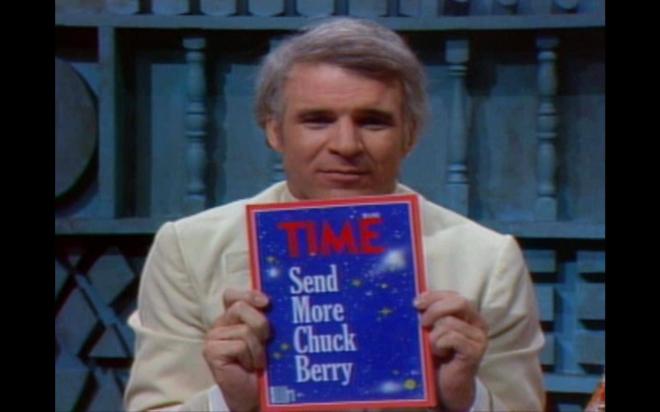
Steve Martin

Steve Martin is 70?! The wild and crazy philosophy major turned stand-up comedian turned actor turned bluegrass musician doesn't act his age in public. But he's studiously pondered  the philosophy of humor, and was deeply influenced by an early reading of Somerset Maugham's The Razor's Edge (whose protagonist was in turn deeply influenced by William James). His re-enactment of the death of Socrates rivals Woody Allen's version, if not Plato's.
[College] "changed what I believe and what I think about everything. I majored in philosophy. Something about non sequiturs appealed to me... If you’re studying geology, which is all facts, as soon as you get out of school you forget it all, but philosophy you remember just enough to screw you up for the rest of your life."
But in a good way.

5:30/6:06, 65/90

Thursday, August 13, 2015

Healthy and wise

Dawn-rising doesn't work for everyone, and can in fact (says Charles Bukowski's WA poem this morning) be an impediment to awareness and wisdom. But even when I throw away the alarm clock in summer, my body clock hauls me up and out. If that doesn't make me healthy, wealthy, or wise, at least it makes me routinely reliable and (by summer standards) productive. Days when I've overslept 'til 7 tend to go off the rails - like Bukowski's life, as he cultivated the style and sensibility of "the defeated, the demented and the damned." That's one way to win a cult following, I suppose. Takes all kinds. The dissipated life's not for me.

It's Alfred Hitchcock's birthday. Note to Older Daughter:  he said “a good film is when the price of the dinner, the theatre admission, and the babysitter were worth it." He also said happiness is "a clear horizon — nothing to worry about on your plate, only things that are creative and not destructive..." That's healthy and wise, at any hour. And if you're healthy and wise, you're wealthy in the most valuable currency there is.

6 am/6:05, 62/86

Wednesday, August 12, 2015

Nothing important to communicate

 "Echo 1, NASA’s first communications satellite, was launched on this date in 1960." WA 

What a different world we live in now, constantly chattering and listening to chatter that's been beamed into space and back. But Thoreau's point about the telegraph still applies, doesn't it?
As with our colleges, so with a hundred "modern improvements"; there is an illusion about them; there is not always a positive advance.. Our inventions are wont to be pretty toys, which distract our attention from serious things. They are but improved means to an unimproved end, an end which it was already but too easy to arrive at; as railroads lead to Boston or New York. We are in great haste to construct a magnetic telegraph from Maine to Texas; but Maine and Texas, it may be, have nothing important to communicate. Either is in such a predicament as the man who was earnest to be introduced to a distinguished deaf woman, but when he was presented, and one end of her ear trumpet was put into his hand, had nothing to say. As if the main object were to talk fast and not to talk sensibly. We are eager to tunnel under the Atlantic and bring the Old World some weeks nearer to the New; but perchance the first news that will leak through into the broad, flapping American ear will be that the Princess Adelaide has the whooping cough.
 Much of what leaks into our broad, flapping ears lately seems to be gossipy infotainment (including most political discourse and other "reality" programming). I don't want to ditch the satellites - Commander Kelly's satellite transmissions have been transcendent - but down here on the ground there's definitely room for real "improvements."
==
6 am/6:04, 71/87
podcast (including previous posts)

Tuesday, August 11, 2015

Moving in

Back from moving Older Daughter to school, this time ahead of the throng since she's signed on as a Resident Assistant this year and had to report early for training. It's a different vicarious experience, moving your kid into an utterly empty college dorm. Same feeling of clean-slate anticipation and excitement, curiosity and mild concern, eagerness and trepidation, worry and hope.

But walking those empty corridors, peering into those identically scrubbed and denuded rooms, I was also struck by a feeling of the contingent, constructed nature of the collegiate experience we've inherited. Our traditional ways of educating and transitioning our young, preparing them for independence, happiness, and success, might be otherwise.

The appalling expense of higher education in this country (and non-public secondary education), the emphasis on preparing students for careers and and competitive participation in a "global economy," the false assumption (as Frank Bruni put it) that where you go wholly determines who you can be... these "givens" are mythic, and largely unquestioned. We just do it this way because we've done it this way. We could change.

5:35/6:04, 76/90

Saturday, August 8, 2015

Truth and youth

Birthday of poet Sara Teasdale (1884), who understood life's bargain opportunity: “When I can look life in the eyes, / grown calm and very coldly wise, / life will have given me the truth, / and taken in exchange — my youth.” WA

Beware young people who think they already know it all, and old people who don't accept the bargain.

On this day in my youth, in 1974, Richard Nixon resigned the presidency. TD I was sure that would change our politics in a big way, for the better, and usher in generations of wise, honest leadership in America. I wasn't quite looking life in the eyes then. Now, I no longer expect politics to deliver transformational change.

That's one of the unfortunate truths the poet may have had in mind. It's not "the truth," the only truth - that would not be wise. She was trying to rhyme.

Jon Stewart was telling a truth when he signed off the other night: "bullshit is everywhere." (Remember when he hosted Harry Frankfurt?) Paul Krugman was too, in yesterday's Times: "the Republicans can't be serious." Still, after all these years.

 
Tom Tomorrow cartoon

7 am/6:01, 67/90

Friday, August 7, 2015

At sea

Beautiful night at the ballpark last night, a rare doubleheader and a sweep for the home team against Memphis. Amused myself between innings monitoring tweeted updates from the so-called GOP debate. What a ludicrous spectacle. What a letdown for all who still entertain the fantasy of responsible dialogue between serious and worthy applicants for the nation's most important position of leadership. As the Donald said, it was not "nice." Don't go, Jon Stewart, we need you!

Meanwhile, in our local election, none of the at-large candidates for five spots on our bloated city council could manage to garner even 10% of the vote. Rather than a run-off, since the amendment to shrink the council failed, how about a lop-off? The voters have spoken.

But there's good news: the right mayoral contender came up just a little short.

Today's the birthday of anthropologist Louis Leakey (1903), who showed that our earliest ancestors were "out of Africa," and the anniversary of ethnologist Thor Heyerdal's Kon-Tiki expedition (1947) showing that some of our later ancestors were a lot more resourceful and nautically intrepid than previously thought. WA

How would the current crop of political pretenders fare on Heyerdal's raft? They're already adrift and at sea. How far can they go? I'd like to find out. Shove off, guys.

5:50/6:00, 72/86

Thursday, August 6, 2015

Vote

Fiftieth anniversary of the Voting Rights Act (1965). We're still overcoming.

Appropriately it's voting day here in Nashville, near ground zero for events that precipitated that historic legislation. Our mayoral race does not excite me, though I do want to see the defeat of the candidate who was stupidly quick to declare the Charleston atrocity non-racially motivated.

I am eager to vote for the elimination of several city council seats. That body is ridiculously overstaffed and underwhelming. Like the Tennessee state House and U.S. Congress.

How many of us would have voted to drop "Little Boy" on Hiroshima seventy years ago this morning? And how many would have voter's remorse?

Would we have voted for penicillin in 1881? Or would there have been an anti-antibacterial movement?

We the people aren't as informed or as reflective as we ought to be, as participants in popular democracy, nor are our public educational institutions adequately supported and funded to that end. Was it H.L. Mencken who said the public is an ass? It is, often enough. But the plutocracy's a bigger one. Anyway, he was speaking publicly too.

Anti-intellectualism has always been a problem here, as Douglas Hofstadter documented. It's his birthday too. And as Isaac Asimov said,
Anti-intellectualism has been a constant thread winding its way through our political and cultural life, nurtured by the false notion that democracy means that 'my ignorance is just as good as your knowledge.'”
Vox populi clearly does not always reflect the public interest, as old Rousseau rightly said, but it's always in the public interest to solicit the voices of the people and start a conversation. To the polls.

Postscript, 8:15 am. Getting antsy, waiting for the heavy rainfall to subside so I can get on with my habitual 8 am walk. Thoreau said he always went, "in any weather," but I'll bet there were mornings when he waited it out in his pondside shack too. Good time to invoke Stoic patience, consult the radar, admit will's natural limitations, and ponder this:
“All voting is a sort of gaming, like checkers or back gammon, with a slight moral tinge to it, a playing with right and wrong, with moral questions; and betting naturally accompanies it. The character of the voters is not staked. I cast my vote, perchance, as I think right; but I am not vitally concerned that that right should prevail. I am willing to leave it to the majority. Its obli­gation, therefore, never exceeds that of expediency. Even voting for the right is doing nothing for it. It is only expressing to men feebly your desire that it should prevail. A wise man will not leave the right to the mercy of chance, nor wish it to prevail through the power of the majority.
There is but little virtue in the action of masses of men. When the majority shall at length vote for the abolition of slavery, it will be because they are indifferent to slavery, or because there is but little slavery left to be abolished by their vote. They will then be the only slaves. Only his vote can hasten the abolition of slavery who asserts his own freedom by his vote."  On the Duty of Civil Disobedience
Polls don't close 'til nightfall, there is more day to dawn.

6:30/5:59, 72/82
Podcast

Wednesday, August 5, 2015

Wendell Berry

Birthday of poet/novelist/farmer/environmentalist Wendell Berry (1934), whose poem about a man who diligently archives his vacation but still misses it could be an allegory of life in our socially mediated, digitally translated time. WA
...preserving his vacation even as he was having it
so that after he had had it he would still
have it. It would be there. With a flick
of a switch, there it would be. But he
would not be in it. He would never be in it.
Aren't we rarely "in it" these days, many of us, though constantly online, in touch, in REC mode? Framing, documenting, liking, sharing, but not fully experiencing the moments of our lives?

Or is that just Chicken Little the Luddite squeaking?

Either way, Wendell Berry is an admirable defender of authentic existence and living at first hand, in touch with the earth that sustains us. Like his friend Gary Snyder he reminds us that nature isn't just something external to our lives but is life itself. We need to be there for it. In it.

I went to Berry years ago for help assembling my thoughts on the place of hope in our affairs, in Springs of Delight.
Writer and poet Wendell Berry tautly summarizes the call to hope I find so prominent in James and Dewey: "A part of our obligation to our own being and to our descendants is to study life and our conditions, searching always for the authentic underpinnings of hope." But, he elaborates significantly, the search must center on ourselves, in our own time:
"We can do nothing for the human future that we will not do for the human present. For the amelioration of the future condition of our kind we must look, not to the wealth or the genius of the coming generations, but to the quality of the disciplines and attitudes that we are preparing now for their use . . . [T]he man who works and behaves well today need take no thought for the morrow; he has discharged today's only obligation to the morrow."

Berry goes on to illustrate but also to strain this correct emphasis on the present as preparing (and possibly sabotaging) but not simply waiting on the future. He says that disciplined attention to present needs aligns us "with natural processes, [with] no explicit or deliberate concern for the future. We do not eat, for instance, because we want to live until tomorrow, but because we are hungry today and it satisfies us to eat." In fact, both kinds of reasons—present satisfaction and continued existence—are coordinate in human action.
Maybe the best thing the eminently-quotable Berry ever said: "Be joyful because it is humanly possible." At least be present.

5:50/5:59, 75/90
Podcast

Tuesday, August 4, 2015

Happy existentialists

Birthday of Louis Armstrong (1901), who really did think it's a wonderful world; and Percy Bysshe Shelley (1792), kicked out of Oxford for writing risque poetry and disbelieving in God, who said "Do it now — write nothing but what your conviction of its truth inspires you to write.” He died before he was 30. WA

Yesterday's Godot post left me thinking about Existentialism and its popular but false reputation for bleakness. The proto-existentialist pioneers Kierkegaard and Nietzsche weren't philosophers of bleakness, though both depicted a stark world of lonely choice, personal isolation, and irreversible responsibility. When I think of them, though, the starkness recedes and a joyful, affirming, peripatetic mood steps up. Nietzsche's "formula" for happiness was "a yes, a no, a straight line, a goal." He said
“all truly great thoughts are conceived by walking.” Rising at dawn, Nietzsche would stalk through the countryside till 11 a.m. Then, after a short break, he would set out on a two-hour hike through the forest to Lake Sils. After lunch he was off again, parasol in hand, returning home at four or five o’clock, to commence the day’s writing. Gymnasiums of the Mind
 Kierkegaard, the Melancholy Dane, cheerfully advised:
“Above all, do not lose your desire to walk. Everyday, I walk myself into a state of well-being & walk away from every illness. I have walked myself into my best thoughts, and I know of no thought so burdensome that one cannot walk away from it. But by sitting still, & the more one sits still, the closer one comes to feeling ill. Thus if one just keeps on walking, everything will be all right.” K's Journals and Papers
In contrast to Samuel Beckett's waiters, no peripatetic existentialist ever despaired to take the next step.

 6:50/5:58, 72/97
Podcast

Monday, August 3, 2015

Tired of waiting

It's been sixty years since Samuel Beckett affronted English theater convention with Godot. WA
VLADIMIR: There's man all over for you, blaming on his boots the faults of his feet... We can still part, if you think it would be better. ESTRAGON: It's not worthwhile now.Silence.VLADIMIR: No, it's not worthwhile now.Silence. ESTRAGON: Well, shall we go? VLADIMIR: Yes, let's go.They do not move.
And the first curtain fell. Would you have stayed for the second act? Or would you have moved?

Peripatetics, or this one anyway, find that play's inertial heaviness unnerving. Those guys, like most angsty existentialists, just needed to go.

As do I, on this lovely autumnal August morning. Just a few lines of dialogue more, for the road, but then I'm not waiting another moment.
VLADIMIR: Try and walk. (Estragon walks.) Well? ESTRAGON: It fits. VLADIMIR: (taking string from his pocket). We'll try and lace it. ESTRAGON: (vehemently). No no, no laces, no laces! VLADIMIR: You'll be sorry. Let's try the other. (As before.) Well? ESTRAGON:(grudgingly). It fits too. VLADIMIR: They don't hurt you? ESTRAGON: Not yet. VLADIMIR: Then you can keep them. ESTRAGON: They're too big. VLADIMIR: Perhaps you'll have socks some day. ESTRAGON: True.VLADIMIR: Then you'll keep them?ESTRAGON: That's enough about these boots...VLADIMIR: Yes, but—ESTRAGON:(violently). Enough! (Silence.) I suppose I might as well sit down.He looks for a place to sit down, then goes and sits down on the mound.VLADIMIR: That's where you were sitting yesterday evening.  I could only sleep. VLADIMIR: Yesterday you slept. ESTRAGON: I'll try.He resumes his foetal posture, his head between his knees.VLADIMIR: Wait. (He goes over and sits down beside Estragon and begins to sing in a loud voice.) Bye bye bye bye
Bye bye– ESTRAGON: (looking up angrily). Not so loud! VLADIMIR: (softly).
Bye bye bye bye
Bye bye bye bye
Bye bye bye bye
Bye bye . . .
And there they go again, blaming the boot for the foot's ambivalence. What Beckett said of uncomprehending critics, I say of his characters and all who identify with them: "Why people have to complicate a thing so simple, I can’t make out.” Just pick a direction and go, guys!

Set some goals, make a plan, do something... like my young friend who, following the example of his hero Penn Jillette, has reclaimed health and happiness and set himself on the path of the philosopher."The most basic things we owe each other as humans are love, respect, and telling the truth as we see it."

In fairness to the real substance beneath his innovative and surprising style, I'm sure Beckett would agree

6 am/5:57, 66/97
Podcast

Friday, July 31, 2015

Raising hell

Two great justice-seekers, Mary Harris "Mother" Jones (1837) and Primo Levi (1919), were born on this date. Labor crusader Jones has become a progressive icon, Auschwitz survivor Levi a reminder that our greatest foe is our own tendency "to believe and act without asking questions." WA

“The first thing is to raise hell,” said Jones, "that’s always the first thing to do when you’re faced with an injustice and you feel powerless."

Levi spoke for the powerless, and depicted a startling vision of aurora so different from mine. “Dawn came on us like a betrayer; it seemed as though the new sun rose as an ally of our enemies to assist in our destruction.” Those of us fortunate enough to face each new day in freedom, graced with the gift of hope in the rays of a morning star, should be raising more hell.

I recently finished Anthony Doerr's All the Light We Cannot See, a novel in the spirit of Primo Levi. It makes a subtler point: before raising hell, you have to see the injustice in front of you. "Open your eyes and see what you can with them before they close forever," is a repeated refrain.

Also recently finished Doris Kearns Goodwin's Bully Pulpit. TR was often a hell-raiser and usually a justice-seeker, if also a swaggering imperialist and "bully"; but as I read it the great heroes of this story were the "muckraking," eye-opening journalists who shined light into dark corners. Ida Tarbell was a Mother Jones for her time. We need more like her now.

7:30/5:54, 68/91
Podcast

Thursday, July 30, 2015

Impatience

Birthday of Casey Stengel (1890), who said "there comes a time in every man's life and I've had plenty of 'em," and C. Northcote Parkinson (1909), whose eponymous law decrees the expansion of work "to fill the time available for its completion."

Don't I know it. I'd like to repeal that one, or amend it with a provision that the quality of work expands indefinitely to match extended time. That would not be necessary, if real deadlines were imposed. But those only work if they're accurately anticipated and scrupulously enforced. Douglas Adams (1952-2001) said it best, before his own final deadline arrived (as they do) unannounced : "I love deadlines. I like the whooshing sound they make as they fly by." He must have said that before he died, Casey might have observed. Or Yogi.

Image result for deadline cartoon new yorker
newyorker.com

I was extolling the virtue of patience yesterday, of taking small steady steps towards the largest destinations and goals in our lives. But reflecting on deadlines, especially the big one at the end, challenges that mindset. Christopher Hitchens (1949-2011), when asked about his least favorite virtue, named (of course) "Faith. Closely followed, in view of the overall shortage of time, by patience.”

Seneca said "Nobody works out the value of time: men use it lavishly as if it cost nothing… We have to be more careful in preserving what will cease at an unknown point." We'd better make time for that.

6:15/5:54, 77/91. Seneca... Deadlines
Podcast

Wednesday, July 29, 2015

Patience

Another nice evening at the ballyard, with Older Daughter this time. Rooting for the home team is rough these days, but we're patient fans. At least we got tee-shirts and a souvenir cup featuring former Cy Young winner Barry Zito, patiently working his way back to the bigs. And we got to see an old Dodger, Jim "Junior" Gilliam, warmly remembered by an older one, Vin Scully, and honored by his hometown. (Scully, who's been doing Dodgers games an incredible sixty-six years starting back when they were still in Brooklyn, was the younger man then. The veteran ballplayer from Nashville, he recalls, patiently welcomed the rookie broadcaster with kindness.)

It's the birthday of Democracy in America author Alexis de Tocqueville, the early 19th century French aristocrat who found America's middle class possessed of sufficient "practical intelligence" to offset their vulgarity and ignorance and allow them to govern the new nation. WA

We tend to identify the middle class in terms of relative wealth and income, but if vulgarity and ignorance are the key markers there's never been a larger middle class competing for political office in America than is represented by the current crop of presidential candidates. The vulgar and ignorant billionaire who makes the other "jackasses" (Lindsey Graham's word) look good is, by this criterion, the most middle of them all. What would de Tocqueville say now? I imagine he'd be impatient with this bunch.

It's also the birthday of the patient centenarian poet laureate who said "it is out of the dailiness of life that one is driven into the deepest recesses of the self," Stanley Kunitz. There's a statement for our Hume group to ponder, given the skeptic's dual commitment to dailiness and to metaphysical selflessness.

Dailiness, the everyday repetition of routine, the return to work, the renewal of purpose: my daily walk is a model and metaphor of that. Deep recesses? I might not choose those words to describe the experience derived from dailiness, and the word "self" might even be negotiable; but I know that without the scaffolding provided by repetition and routine, there would be no structural support for reflections on selfhood or anything else. That's why I try to plug patiently away, day after day.

7 am/5:53, 75/93
Live the questions now... the limits of satire... how not to take a nature walk
Podcast

Tuesday, July 28, 2015

Hume the pragmatist

Looking forward to the David Hume course my cophilosophers and I are about to embark on. We're so eager to get going, in fact, that we've already sort of begun. One of us has ventured the view that Hume was not a pragmatist.

He was a skeptical but not a radical empiricist in the sense intended by William James, one who notices not only the objects of phenomenal experience but also their conjunctive relations, as mirrored in the grammar of speech ("and," "with," etc.) but only partially articulated thereby. James thought Hume's version left our experience chopped into bits, when in reality it flows in and through the interstices of nominative thought.

If Hume were right, James suggests, it's as if that bird I've been watching flit about, here near my thinking porch, were visible only in the moments of arrested movement and I had to be skeptical about how he arrived at each successive stop. In fact, his flits and flights and hops and skips are continuous with his perchings. It's part and parcel of his experience. The attentive birdwatcher sees this, where the intellectualist is tricked into missing it.

But not being a radical empiricist is one thing, not being a pragmatist another. Depends as always on how we define our terms, of course; but that famous Humean call to common life - "Be a philosopher, but be still a man" - is to me the epitome of a pragmatic sensibility. Acknowledging the impracticality, imprudence, and un-sociability of using reflective reason to cover one's un-salubrious retreat from what the world calls "real life," Hume knew when to remove his philosopher's cap, drop the skeptical routine, and join his peers in a game over a pint.

His was the extrovert's version of Thoreau's definition of philosophy, as the ability to solve some of the problems of life not just theoretically but practically. I'll be surprised if we students of Hume don't end up agreeing that the most pressing practical problem, from both Hume's and James's points of view,  is how to live happily and well. They're both that kind of pragmatist.

6:45/5:52, 77/91. Hume-Thoreau connection.
Podcast

Monday, July 27, 2015

Full of life

Great time at the ballpark last night with my young friend from New Orleans who, attending only his second professional baseball game ever, was delighted to find that my home team was playing his. The Zephyrs from NOLA beat Nashville 9-7, and he tolerated my complaints about our relatively mild humidity. Down on the bayou the air's thick as water, he says. We have no idea. Like William Carlos Williams' crowd at the ballgame, the spectatorial spirit of uselessness delighted us too. David Hume ("be a philosopher but... be still a man") would have approved.

And to our Humean friend who could or would not join us, whose blanket hostility to spectator sports I find so confounding, a note from the late Renaissance scholar and baseball commissioner:
“The gods have fled, I know. My sense is the gods have always been essentially absent. I do not believe human beings have played games or sports from the beginning merely to summon or to please or to appease the gods. If anthropologists and historians believe that, it is because they believe whatever they have been able to recover about what humankind told the gods humankind was doing. I believe we have played games, and watched games, to imitate the gods, to become godlike in our worship of each other and, through those moments of transmutation, to know for an instant what the gods know.”
A. Bartlett Giamatti, Take Time for Paradise: Americans and Their Games
In other words, joining the crowd at the ballgame doesn't make you a sellout or a bad atheist. It just means you're doing your part to naturalize paradise, to bring heaven out of the clouds and down to earth, to the delightfully distracted space that Giamatti elsewhere called the "green fields of the mind"-where it always belonged in the first place.

It's the birthday of a woman to whom I feel a real debt of gratitude, Elizabeth Hardwick (1916). She co-founded the New York Review of Books, dedicated to spotlighting "the unusual, the difficult, the lengthy, the intransigent, and, above all, the interesting." I like the NYRB, but what I most thank Ms. Hardwick for is her earlier (1961) edition of The Selected Letters of William James. I first came across it as an undergraduate, rediscovered it in grad school, was charmed by the irrepressible humanity of its subject, and began a lifelong fascination with the philosopher who was capable even as a very young man of writing letters like this one to a despondent friend:
To Thomas W. Ward.
BERLIN, Jan. —, 1868.

...It made me feel quite sad to hear you talk about the inward deadness and listlessness into which you had again fallen in New York. Bate not a jot of heart nor hope, but steer right onward. Take for granted that you've got a temperament from which you must make up your mind to expect twenty times as much anguish as other people need to get along with. Regard it as something as external to you as possible, like the curl of your hair. Remember when old December's darkness is everywhere about you, that the world is really in every minutest point as full of life as in the most joyous morning you ever lived through; that the sun is whanging down, and the waves dancing, and the gulls skimming down at the mouth of the Amazon, for instance, as freshly as in the first morning of creation; and the hour is just as fit as any hour that ever was for a new gospel of cheer to be preached. I am sure that one can, by merely thinking of these matters of fact, limit the power of one's evil moods over one's way of looking at the Kosmos.
That was the tip of an iceberg I'm so happy I ran into. Thank you, Elizabeth Hardwick.

[The real me, idolatry of the Whole, my tedious book...]
6:50/5:51, 75/97
Podcast

Saturday, July 25, 2015

The autodidact

“When people are free to do as they please, they usually imitate each other.” That was the great autodidact philosopher longshoreman Eric Hoffer, born on this date in 1902. He also wrote:
In times of change, learners inherit the earth, while the learned find themselves beautifully equipped to deal with a world that no longer exists.”
He was no fan of our youth-besotted culture:
If a society is to preserve stability and a degree of continuity, it must learn how to keep its adolescents from imposing their tastes, values, and fantasies on everyday life.”
He knew the value of kindness:
“Kindness can become its own motive. We are made kind by being kind.”
And of work:
“The greatest weariness comes from work not done."
To work.

6:15/5:49, 70/93
Podcast

Friday, July 24, 2015

The sound of human nature

The Almanac features a Gary Snyder poem this morning, describing the peaceful dawn sounds of animal nature returning to life-
distant dogs bark, a pair of
cawing crows; the twang
of a pygmy nuthatch high in a pine—
from behind the cypress windrow
the mare moves up, grazing.
 And then, the less peaceful drone of human nature returning to the office-
a soft continuous roar
comes out of the far valley
of the six-lane highway—thousands
and thousands of cars
driving men to work.
I can relate. From my dawn porch I too hear the occasional bark, caw, twang, and chirp. And, I hear that continuous roar of internal combustion, on I-40 a couple of miles away. "Soft"? Not the word I'd choose. Some days the sound is less invasive, that may have something to do with topography and the state of the atmosphere but probably more with the hearer's state of mind and the poet's prompt. Usually I tune out the roar. This morning I can't. Thanks, Gary. Thanks, Henry Ford.

But it's all nature, it's all right here with us whether we're attending or not. We'd better attend. It may be tolerable or ignorable, but it's not sustainable.

6:15/5:49, 70/87
Podcast

Thursday, July 23, 2015

The speed of thought

Ford sold its first Model A on this date in 1903, a topless red two-seater that soared to the dizzying speed of 28 mph. (WA) It's been life in the fast lane for humanity ever since, but as Rebecca Solnit says, faster's not always better. "The indeterminacy of a ramble, on which much may be discovered, is being replaced by the determinate shortest distance to be traversed with all possible speed, as well as by the electronic transmissions that make real travel less necessary." Less necessary, maybe, but no less rewarding.

Moving from Point A to Point B with rapidity is one thing, internal movement another. What is the optimal speed across a landscape, if you want to go far within? All motion is relative to its frame of reference, of course. Just remember that we're standing on a planet that's revolving at 900 mph, give or take. That should be dizzying, but we never notice.

Likewise, internal motion's optimal locomotive frame is the one that falls away from notice. There was a time when the passenger train, indeed, was a great engine for thought - occasional catastrophic train-wrecks excepted. Running on smooth and sturdy rails, creating its own interior space, I would gladly trade my Corolla for a daily commute on a commercial steam locomotive.

That's not a present option, nor (at forty miles out) is the bicycle. But since re-committing to a daily fitness ride earlier this summer, I've found two wheels increasingly conducive to the flow of ideas. When I want to file one for future reference I pull from my pocket the voice recorder that doubles as a phone (etc.) and spit it out. One hand on the rudder's not optimal, though, so it keeps those memos short.

Walking to work would be best, if only the workplace were always within range. That's why summer's such a good season for me, when I walk to work every single day like Henry. And bike. If he'd come along just a little later, I'll bet he would've too. Bear on a bicycle, why not?

One reason, perhaps. Solnit again: "I like walking because it is slow, and I suspect that the mind, like the feet, works at about three miles an hour. If this is so, then modern life is moving faster than the speed of thought, or thoughtfulness."

6:15/5:48, 74/84.
Podcast

Wednesday, July 22, 2015

Whole-hearted empiricism

Birthday of Edward Hopper (1882), who said "all I ever wanted to do was to paint sunlight..." (WA)

In these early hours of day, that's a worthy ambition. I'd do it myself, if I had any aptitude for painting. Words don't capture the light, but once in a while they reflect it in unexpected ways. So I carry on.

Perseverance, putting down one word and then another and then another, and then circling back with pencil and eraser and delete key - that's a simple mirror of the steady routine involved in perambulating and in pedaling, one foot in front of the other, legs up and down, wheels round and round. Take breaks and breathers as required but don't quit. Do it again tomorrow. Keep a'goin.'

William James criticized David Hume for a "half-hearted" empiricism...

(Is this relevant? I never know, unless and until my subconscious informs me later, so I'd better just go ahead and put it down. Words work that way, like tracks or traces in the mist to pick up later. Or not.)

James thought Hume didn't get at the roots of our experience, didn't persist to notice the everyday "powers" that produce our confident common-sense expectation of the dawn and all that follows, billiard balls knocking predictably into pockets, people generally behaving with kind sentiment and fellow-feeling, moments transitioning to moments like a flowing stream, particles of experience coalescing into practical knowledge and life wisdom. He noticed these phenomena but did not fully credit their value, and so became a skeptic and not a radical empiricist. He didn't, James thought, go the distance.

A whole-hearted empiricist is all in, noticing connections others miss (like "and" and "or" and "but" as particles not just of speech but of experienceable reality, said James) and boldly risking error in pursuit of happiness and truth. "Our [intellectual] errors are not such serious things." The verdict on that isn't all in. But with a whole heart you persevere.

 Hume's friend Franklin said our sun is rising, not yet setting. Thoreau said it's but a morning star. If Hume was too skeptical and old-worldly, maybe the American "radicals" weren't skeptical enough. But the great thing about sunrise is its implicit promise: if you persevere, light will be cast.

6:45/5:48, 73/87
Podcast

Tuesday, July 21, 2015

An old-fashioned view

Hemingway, noteworthy here if only for the splendid title of his first novel, was born on this date in 1899. The Sun Also Rises would be a decent name for a blog. But I wouldn't want to emulate his bullfighting sexist lifestyle, or the manner in which he ended it. I'm not crazy about his writing style either.

It's also the birthday of a later and (to my taste) more admirable American writer, John Gardner (1933). Sunlight Dialogues could name this blog too. I recall reading his novel Mickelsson's Ghosts early in grad school because it was rumored (probably falsely) to be modeled on one of my new teachers, an eccentric distinguished philosopher. Most philosophers don't believe in ghosts, but this one (the fictional character and his alleged template) did. And does, so far as I know. I believe in human spirits too; but mine are alive in the natural world.

Gardner's Art of Fiction made me want to write a novel myself. Still do. He wrote, possibly with Hemingway in mind:
To write with taste, in the highest sense, is to write [...] so that no one commits suicide, no one despairs; to write [...] so that people understand, sympathize, see the universality of pain, and feel strengthened, if not directly encouraged to live on.
And,
Fiction does not spring into the world fully grown, like Athena. It is the process of writing and rewriting that makes a fiction original, if not profound.
Gardner's On Moral Fiction took a hard line against art for art's sake:
In a world where nearly everything that passes for art is tinny and commercial and often, in addition, hollow and academic, I argue--by reason and by banging the table--for an old-fashioned view of what art is and does...
 It confronts despair and emboldens the reader to get up and face the sun another day. In fairness, lots of ultimately-suicidal writers (like Papa Hemingway) did that too, before despair got the better of them. We all have to take life one day at a time.

Gardner was not a fan of Faulkner, as he made clear in an interview with Paris Review, but his stance towards the moral function of art reminds me of Faulkner's nobel speech:
I decline to accept the end of man. It is easy enough to say that man is immortal simply because he will endure: that when the last ding-dong of doom has clanged and faded from the last worthless rock hanging tideless in the last red and dying evening, that even then there will still be one more sound: that of his puny inexhaustible voice, still talking. I refuse to accept this. I believe that man will not merely endure: he will prevail. He is immortal, not because he alone among creatures has an inexhaustible voice, but because he has a soul, a spirit capable of compassion and sacrifice and endurance. The poet’s, the writer’s, duty is to write about these things. It is his privilege to help man endure by lifting his heart, by reminding him of the courage and honor and hope and pride and compassion and pity and sacrifice which have been the glory of his past. The poet’s voice need not merely be the record of man, it can be one of the props, the pillars to help him endure and prevail.
In other words, humankind: don't quit.

6:50/5:47, 79/90
Podcast

Monday, July 20, 2015

The pace is quickening

The Eagle landed on this date 46 years ago. Apollo 11, 1969. Neil Armstrong's giant leap. It seemed unreal to a 12-year old midwestern American boy watching those fuzzy, surreal images on the old living room console.

That's "unreal" in the "outasight" sense, hyper-real in fact, full of promise for the wondrous world of tomorrow we were sure was soon to follow. "We came in peace for all mankind," but mostly we came for fear of a Soviet lunar eclipse.

A generation later, that boy would encounter college students who doubted the reality of the achievement. "Nah, that didn't happen." But it did, kids. Uncle Walter was no faker.

They probably can't understand why some of us, of that earlier generation, get so excited now by a drone flyby of Pluto. We'd surprise our own younger selves,  having then thought we'd go more boldly into the final frontier than this, by now. It's taken the better part of that boy's lifetime to reach those new horizons. Just getting there is hugely gratifying, and (as the Times details) could easily have not happened.

The span of a human lifetime is, we must remind ourselves, barely a blip on the cosmic ocean. Carl Sagan left lots of good reminders, like this one from Pale Blue Dot:
"Two billion years ago, our ancestors were microbes; a half-billion years ago, fish, a hundred million years ago, something like mice; ten million years ago, arboreal apes; and a million years ago, proto-humans puzzling out the taming of fire. Our evolutionary lineage is marked by mastery of change. In our time, the pace is quickening."
Taking a wider view, the disappointed man who was that impatient boy can better appreciate just how far we've come and how much further we still can go, "in our time." For real.

6:30 am/5:47, 81/95
Podcast

Friday, July 17, 2015

The delusion of crowds

Disneyland opened its gates for the first time sixty years ago today, and it's the birthday of Georges Lemaitre (1894), the Belgian astronomer credited with proposing the Big Bang (but Fred Hoyle came up with the name, by which he intended derision for the universe-from-nothing theory). Also, today's Google doodle reminds, it's the birthday of crusading journalist Ida B. Wells, who said "the way to right wrongs is to turn the light of truth upon them."

So, let's talk about reality and delusion. Thoreau said he went to Walden because he wanted to live deep, get to the bottom of things ("rocks in place"), understand real life. Metaphysical philosophers are always asking "What's real?" Most sensible people recognize that appearances can mislead. Seems like reality would be high on most people's lists.

Well, it's not. Who's the leader of the club that's made for you and me? Not Georges Lemaitre. Our collective mind is not so expansive. It's a small world, after all. We prefer fantasy, most of us, to reality, delusion to hard truth. A young earth, a magical creation, a magical kingdom, the House of Mouse, Main Street USA. I've known more chronological adults smitten with Mickey and all he represents than I can count.

And, I confess, I've known what it's like to be eight years old and excited beyond reason to be "going to Disneyland!" I don't recall a lot of specifics from that first trip to Anaheim with my parents back in the real Mad Men era, but I do recall the anticipation and the unbearable thrill of actually approaching the theme park for the first time. I don't remember how much it mattered to me then, that the whole production was a big phony. I do remember thinking that the hall of presidents was more creepy than real, and that I had been happier thinking about being in Disneyland than I was actually being there. That first visit did not measure up, for me, to the hype and expectation.

But when our kids began pestering to visit Orlando, we did our parental duty and took them. Shelled out big bucks for an overpriced meal with Snow White and Goofy, stood in looong sweaty pushy lines waiting for un-magical rides and performances, felt claustrophobic in a sea of humanity that seemed enchanted with itself and contented with a barely-virtual experience of branded mass consumerism and faux nostalgia for Neverland. But those were my impressions, the kids seemed to have a good enough time. They didn't overthink it. Their generation is possibly inured to hype, beyond unreasonable expectation.

A World of Tomorrow that makes a brighter smarter future feel real, that celebrates the magic of reality, that really expands our universe of imagination: that's a theme that hasn't really been done yet. If they build it, I will come.

6 am/5:45, 74/94
Podcast

Postscript, 7.20.2015 - It's important for Dads to try and see the Disney world through the kids' eyes too:

The Disney view of happiness-a perfect street, animals, a castle, rides-foolish but attuned to our time

Thursday, July 16, 2015

Work and play

Podcast. It's the anniverary of the day in 1945 when the first atom bomb was successfully detonated. Enrico Fermi took bets on whether it would blow up the entire planet, or just New Mexico. Guess he lost.

On a brighter note, I love the Almanac's poem today by Edward Hirsch. He's remembering being 16, learning to work and play and enjoy life... "each night was a Walt Whitman of holidays, the clarity of a whistle at 5 P.M., the freedom of walking out into the open air." Almost makes a drudge summer job like hoisting garbage (or peddling overpriced baked goods to rude pushy people, Older Daughter?) appealing, for the contrast.

If work is whatever you have to do, and play is what you do because you enjoy doing it, it's shocking how many of us end up in work we don't enjoy and never expected to. Seems like that first summer job would wake everyone to the urgency of finding meaningful work. Why don't we teach courses in that?

I do, sorta. Take your time here if you can afford to, I tell students, it's so important to find work you want to do. Your happiness really depends on it, unless you're Sisyphus and can content yourself with whatever rock you're assigned.

These days, by the time freshmen enter my classroom they've already been advised to hurry up and leave, already. Get out "in four," get a job, get our graduation rate up, get us off the hook. Good luck.

I'm so glad I took an extra year, as an undergrad, to find my vocation. Tuition back then was so much lower, like everything else, but how do you put a price on "the freedom of walking out into the open air"? As Henry said, the cost of things is best measured in the exchange rate of "what I call life."

It's only mid-July and here I am, already thinking about how much fun it will be subverting the advising system at work in the Fall (well, in August). Mustn't rush the summer.

6:15/5:44, 70/92

Wednesday, July 15, 2015

More day to dawn

Podcast. It's the birthday of Iris Murdoch, the most successful philosopher/novelist ever. "She was interested in the way that a writer could use fiction to express bigger ideas." I wish more philosophers used philosophy to express bigger ideas.

Also the birthday of Jacques Derrida, who said "there is nothing outside the text" and said deconstruction is "the experience of the impossible." A text, as deconstructive postmodernists deploy the term, can be any form of symbolic (mis)representation or partial communication, any bearer of conventional understandings that sustain social life. So if there's nothing outside that, then all talk of reality as an experiential check on verbal excess is just talk.

Today is the anniversary of Emerson's divinity school commencement address in 1838. He knew there's plenty outside the text, and that both philosophy and literature are about something large, real, and exterior to themselves. WA

"More day to dawn" was Emerson's friend Thoreau's way of wrapping up Walden on a note of hope for our capacity to engage the large extra-textual world on a daily basis. Our sun is a morning star, we're still a young species, there's still time for us to wake up and live. We are as little children, freshly arrived on this planet, ready for adventure and discovery and new horizons every day.

How about that mission to Pluto!

"More day to dawn" is also, btw, my new name for the podcast formerly known as "Up@dawn".

5:50/5:43, 72/89.

Monday, July 13, 2015

Sauntering with children

5:50/5:41, 75/97. Podcast
It was Thoreau's birthday yesterday, and the Almanac spotlights Wordsworth today. The two great trans-Atlantic nature-loving Walking Poets. One found "intimations of immortality in [his] recollections of early childhood," the other inspired a great series of children's books by D.B. Johnson that I fondly recall from our girls' early childhood.

The Times yesterday featured a trio of children's books that celebrate what Henry called the art of sauntering and "the simple pleasures of a stroll." It's an art not far removed from the carefree spirit of childhood, that in later life evokes in sentimentalists and poets a sense of eternal youth.

But did Thoreau or Wordsworth ever walk with children? (Children other than themselves, I mean. Someone calculated that Wordsworth has to have averaged about seven miles a day from the age of five.) That's an art unto itself. A chapter of Philosophy Walks will indulge my own recollections of walking with children, and talking with them, and rediscovering the world through fresh eyes. It's an experience I recommend, and am forever trying to recapture. It's hard to get back. Is that what Henry meant when he said he "long ago lost a hound, a bay horse, and a turtle dove, and am still on their trail"?
==
Brainpickings: Thoreau on the art of walking & the spiritual rewards of sauntering http://buff.ly/1L9rScT... on defining your own success http://buff.ly/1fAHMBN

Saturday, July 11, 2015

E.B. White

6:20/5:40, 74/93. Podcast (Soundcloud/Opinion)
Birthday of ever-quotable Elwyn Brooks (E.B., "Andy") White, who said:

I rise in the morning torn between a desire to improve the world and a desire to enjoy it. This makes it hard to plan the day.

All that I hope to say in books, all that I ever hope to say, is that I love the world.

Always be on the lookout for the presence of wonder.

I would feel more optimistic about a bright future for man if he spent less time proving he can outwit Nature and more time tasting her sweetness and respecting her seniority.

A writer who waits for ideal conditions under which to work will die without putting a word to paper.

Never hurry, never worry.

Be obscure clearly.

Semicolons only prove that the author has been to college.

A writer's style reveals something of his spirit, his capacities, his bias. It is the Self escaping into the open.

I admire anybody who has the guts to write anything at all.

And he told George Plimpton, in Paris Review,
I think some writers have lost their sense of proportion, their sense of humor, and their sense of appreciation. I am often mad, but I would hate to be nothing but mad: and I think I would lose what little value I may have as a writer if I were to refuse, as a matter of principle, to accept the warming rays of the sun, and to report them, whenever, and if ever, they happen to strike me.
Advice, and rays, accepted.
==
Here is New York

Friday, July 10, 2015

Whitman and Proust

6:30/5:39, 72/95. Podcast
Birthday of Calvin and Proust. Two more disparate human types would be hard to yoke. One championing our Total Depravity, claiming infants enter the world already damned; the other luxuriating in the sensual subjective experience of memory and longing. I have no use at all for the TULIP-planter. But Proust, despite our popular image of him tucked away writing in his cork-lined chamber, was actually a peripatetic. There are passages in Memory of Things Past that illustrate the accuracy of a quote the brainpicker featured yesterday:
Walking at our own pace creates an unadulterated feedback loop between the rhythm of our bodies and our mental state that we cannot experience as easily when we’re jogging at the gym, steering a car, biking, or during any other kind of locomotion. When we stroll, the pace of our feet naturally vacillates with our moods and the cadence of our inner speech; at the same time, we can actively change the pace of our thoughts by deliberately walking more briskly or by slowing down.
Because we don’t have to devote much conscious effort to the act of walking, our attention is free to wander—to overlay the world before us with a parade of images from the mind’s theatre. This is precisely the kind of mental state that studies have linked to innovative ideas and strokes of insight...
Perhaps the most profound relationship between walking, thinking, and writing reveals itself at the end of a stroll, back at the desk. There, it becomes apparent that writing and walking are extremely similar feats, equal parts physical and mental. When we choose a path through a city or forest, our brain must survey the surrounding environment, construct a mental map of the world, settle on a way forward, and translate that plan into a series of footsteps. Likewise, writing forces the brain to review its own landscape, plot a course through that mental terrain, and transcribe the resulting trail of thoughts by guiding the hands. Walking organizes the world around us; writing organizes our thoughts. How walking helps us think.
That was in the New Yorker last September, as was an insightful Adam Gopnik essay/review [correction: earlier & in the podcast I confused Gopnik with Remnick... can't tell your New Yorker players without a scorecard] of the more recent and self-appointed French philosopher of walking I've been ridiculing, Frederic Gros. It didn't change my mind about Professor Gros being an unfortunate and misleading spokesman for my favorite non-spectatorial pastime. Gopnik draws the correct contrast between walking as an escape into solitude, away from a robust sense of self, versus walking as connection, walking as much toward an identity as away. Walt Whitman is the paradigmatic exemplar of the latter. I'm wondering if Gros's sensibility, in this regard, is more Proustian. Or is Proust's more Whitmanesque? And how do they all relate to the first French philosopher of walking, Michel de Montaigne, who said "my thoughts sleep if I sit still"?

Thursday, July 9, 2015

Oliver Sacks

7:15/5:39, 78/93. Podcast
Overslept. Sun's trying to steal the march on me today. I was mocking the French "philosopher of walking" yesterday for not walking daily, suggesting that he'd do better with a dog; but when I sleep in, this time of year, walking the dog becomes borderline-abusive. Inhumane. Unethical. So I'd better get on with it, soon as I note the birthday of storyteller/neurologist/Awakener Oliver Sacks in London, 1933.

He has his detractors but I'm a fan. First noticed him, I think, in 1993 when he participated in a strange symposium with Daniel Dennett, Stephen Jay Gould, Stephen Toulmin, Rupert Sheldrake, and Freeman Dyson called A Glorious Accident. So elegant, diffident, measured, but above all humane. And maybe just a little self-aggrandizing. He's been depicted by Robin Williams in Awakenings, and fictionalized by Richard Powers in The Echo Maker. The way he's addressed his probably-terminal prognosis is admirable. After quoting David Hume's anticipated "speedy dissolution" in "My Own Life" last February, he writes:
Over the last few days, I have been able to see my life as from a great altitude, as a sort of landscape, and with a deepening sense of the connection of all its parts. This does not mean I am finished with life.
On the contrary, I feel intensely alive, and I want and hope in the time that remains to deepen my friendships, to say farewell to those I love, to write more, to travel if I have the strength, to achieve new levels of understanding and insight.
This will involve audacity, clarity and plain speaking; trying to straighten my accounts with the world. But there will be time, too, for some fun (and even some silliness, as well).
I feel a sudden clear focus and perspective. There is no time for anything inessential. I must focus on myself, my work and my friends. I shall no longer look at “NewsHour” every night. I shall no longer pay any attention to politics or arguments about global warming.
This is not indifference but detachment — I still care deeply about the Middle East, about global warming, about growing inequality, but these are no longer my business; they belong to the future. I rejoice when I meet gifted young people — even the one who biopsied and diagnosed my metastases. I feel the future is in good hands.
I have been increasingly conscious, for the last 10 years or so, of deaths among my contemporaries. My generation is on the way out, and each death I have felt as an abruption, a tearing away of part of myself. There will be no one like us when we are gone, but then there is no one like anyone else, ever. When people die, they cannot be replaced. They leave holes that cannot be filled, for it is the fate — the genetic and neural fate — of every human being to be a unique individual, to find his own path, to live his own life, to die his own death.
I cannot pretend I am without fear. But my predominant feeling is one of gratitude. I have loved and been loved; I have been given much and I have given something in return; I have read and traveled and thought and written. I have had an intercourse with the world, the special intercourse of writers and readers.
Above all, I have been a sentient being, a thinking animal, on this beautiful planet, and that in itself has been an enormous privilege and adventure.
Spoken like a Humean.
==
A Leg to Stand On